
Anthropic, the company behind the Claude AI assistant, launched Claude Meetings in beta on November 12, 2026. The feature adds Claude to Google Meet video calls as a participant everyone can see. It takes notes, answers questions and drafts documents while the team talks.
The beta is still rolling out and is limited to the Team and Enterprise plans, Claude’s subscriptions for organizations. On November 10, when Anthropic introduced its Claude Sheets spreadsheet, it said only that Meetings was “coming soon.”
On November 12, Anthropic published the rules in a blog post and on an updated page of the Claude Help Center, its support site. Both pages cover who turns the feature on, what data Claude keeps and what is free.
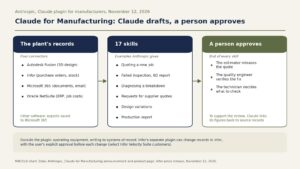
The same day, Anthropic also launched Claude for Manufacturing, a plugin for factories that drafts quotes and quality reports, on the Team and Enterprise plans.
The two pages disagree on one point: whether, by default, Claude joins calls that include people from outside the organization.
How Claude joins a meeting and what it produces
To bring Claude in, a team member opens the Meetings area in Claude, connects their Google Calendar and picks a meeting. Each person can also have Claude join all of their meetings automatically, or all of them except one-on-ones. The owner, who manages the organization’s Claude account, cannot turn that setting on for someone else.
During the call, people say “Claude” and ask their question, or type it in the Google Meet chat. By default, Claude answers in writing in that chat, which everyone on the call can see. It can also create a document, a digital whiteboard or slides on the spot, which invited teammates can edit as the conversation continues. Claude can stay in a call for up to eight hours.
Claude can use each participant’s connected tools, meaning the work apps that person has linked to their Claude account. As an example, the Help Center cites sending a message in Slack, the workplace messaging app. Claude asks for the person’s permission the first time, and that approval carries over to later requests. For now, when someone makes a request out loud, Claude asks every time to confirm who is speaking.
After the meeting, a page on claude.ai, Claude’s website, holds the notes, a summary, the action items, the transcript and the documents created during the call. Invited members of the organization get a recap email with a link to that page. They can later ask Claude about those meetings in a regular chat.
On by default for Team, opt-in for Enterprise
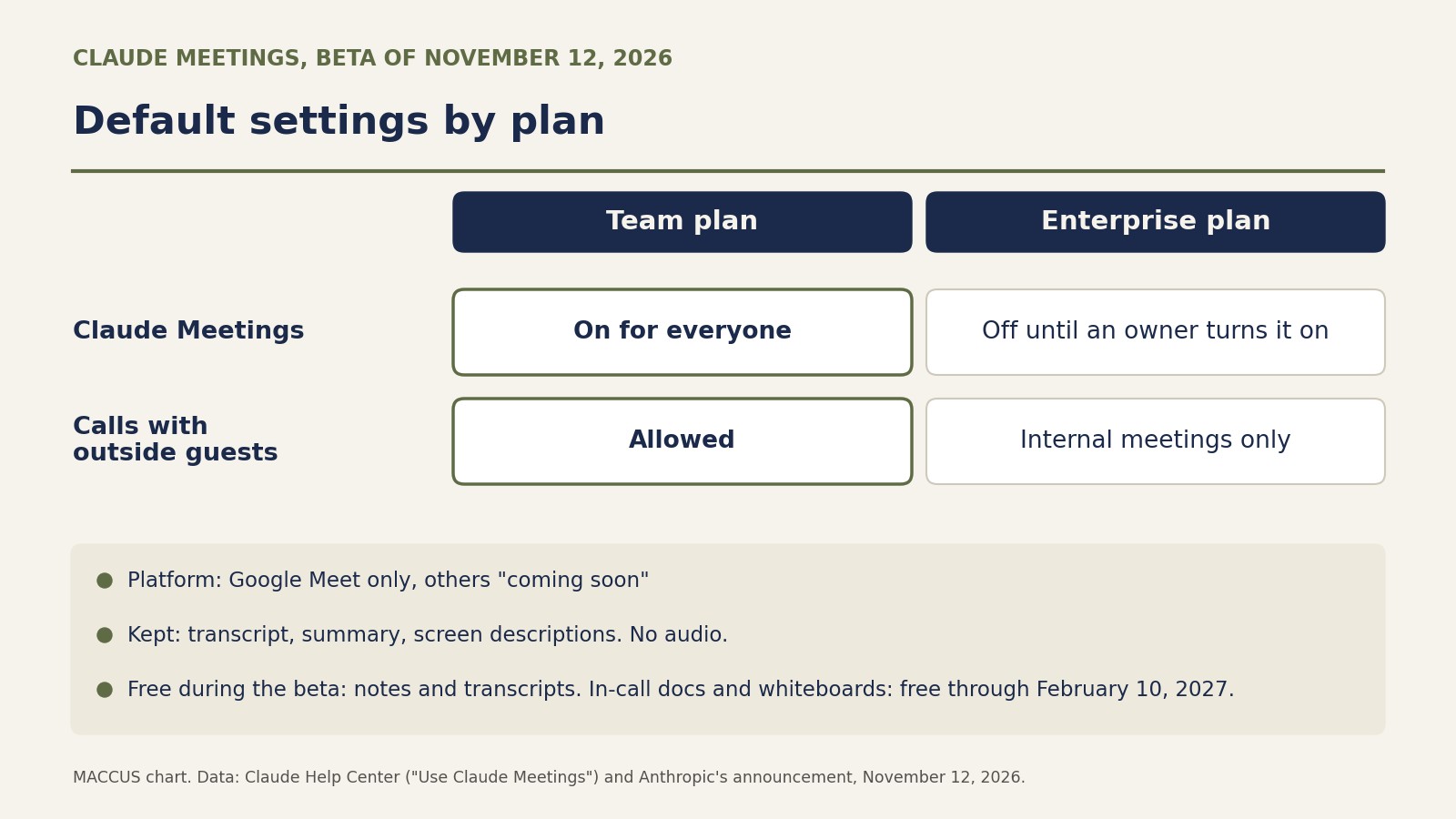
On the Team plan, Claude Meetings is on for everyone by default, and the organization’s owner can turn it off. On Enterprise, it is off until the owner turns it on, for the whole organization or for specific roles. On both plans, the owner must first allow Claude to connect to Google Calendar.
Some organizations cannot use the feature during the beta. The Help Center’s list includes organizations with a zero data retention agreement, under which Anthropic does not keep their data. Organizations that use a configuration built for HIPAA, the U.S. health data privacy law, are also excluded. So are those that manage their own encryption keys, the codes that lock their data.
Outside guests: two versions of the default
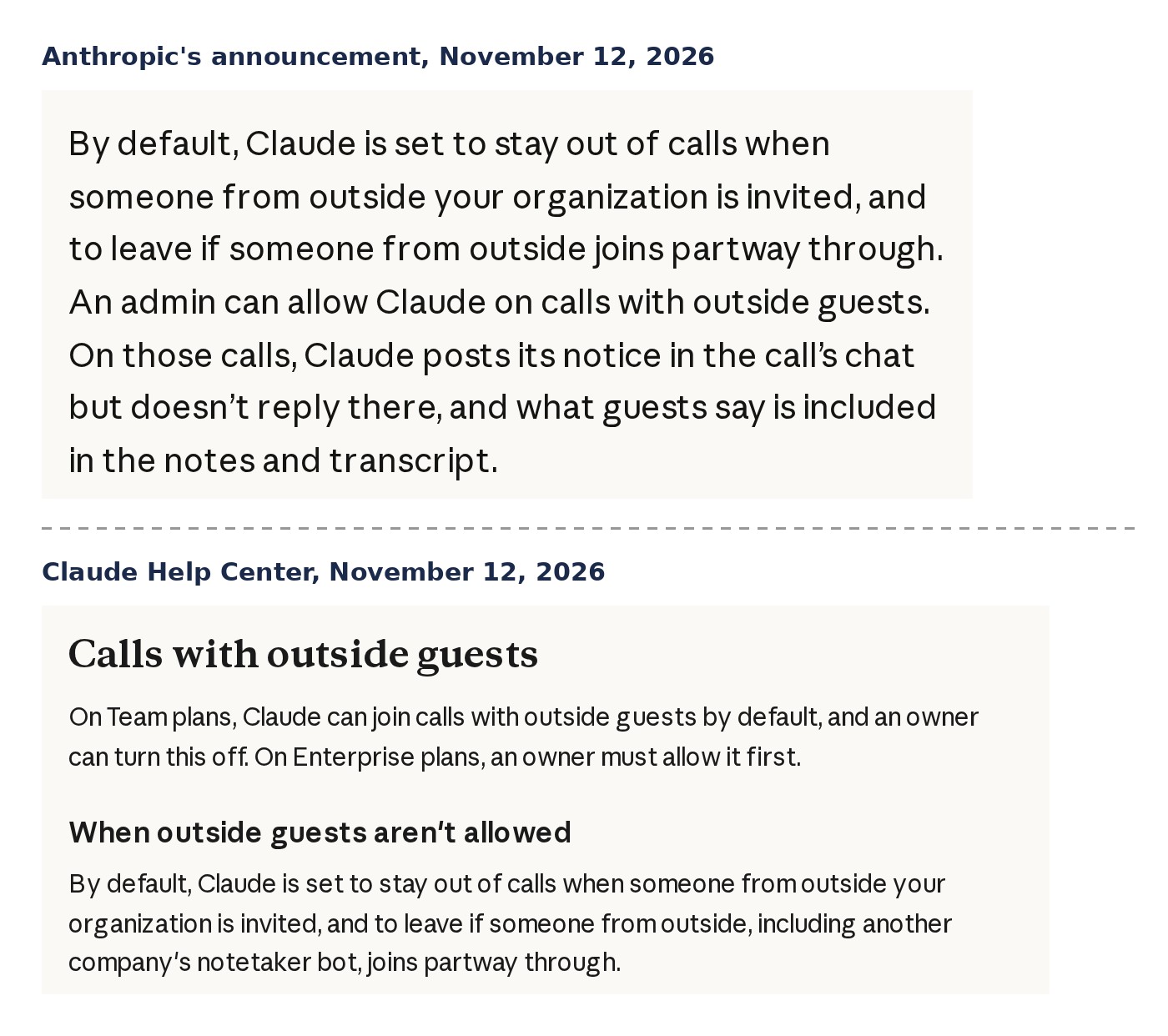
Anthropic’s blog post says that “by default,” Claude stays out of a call whenever someone from outside the organization is invited. It also leaves if such a person joins partway through. According to the post, an admin can lift that rule.
The Help Center answers differently for each plan. On Team, Claude can join calls with outside guests by default, and the owner can block that. On Enterprise, the owner has to allow it first. The page’s list of owner settings confirms those defaults: “Internal meetings only” on Enterprise and outside guests “allowed” on Team.
Just below, though, the same page repeats the post’s “by default” sentence almost word for word, under the subheading “When outside guests aren’t allowed.” Two U.S. tech sites had already reported that rule: TechCrunch on November 10 and Computerworld on November 11.
When outside guests are allowed, Claude listens and takes notes. It posts a notice in the call chat but does not reply there. What guests say goes into the notes and the transcript, but the guests do not get the meeting page or the recap email. Each member also has a personal setting for meetings with outside guests.
When outside guests are not allowed, Claude stays out of the call, or leaves if an outsider joins partway through. The Help Center adds that this rule also applies to another company’s note-taking bot.
The data Claude keeps and the consent question
According to Anthropic, Claude keeps a transcript, a summary and descriptions of what is shown on screen, but not an audio recording. Neither the post nor the Help Center says how long that data is kept.
Anthropic adds that Claude shows up as a participant and posts a notice in the chat when it joins. The company asks users to make sure everyone on the call is fine with being transcribed before they add Claude or turn on automatic joining.
Craig Durr, chief analyst at the research firm The Collab Collective, told Computerworld that “recording and consent rules vary by jurisdiction and by company policy.” He said IT, legal and HR teams should agree on when Claude is allowed into a meeting before the company rolls it out.
Free during the beta, except for connected tools
According to Anthropic’s blog post, Claude’s notes, transcripts and answers are free during the beta on Team and Enterprise. The Help Center’s pricing section simply calls them “included” on those two plans and does not mention the beta.
The Help Center notes one exception. Answers that go through a participant’s connected tool count toward that person’s usage and can lead to charges for the organization.
Documents and whiteboards created during a meeting stay free through February 10, 2027. Anthropic has not announced what they will cost after that date.
Google Meet for now, Microsoft Teams later
Both the post and the Help Center name only Google Meet. The post says other platforms are “coming soon,” without naming them. According to Computerworld, an Anthropic spokesperson said the feature would be available on Google Meet and on Microsoft Teams, Microsoft’s workplace chat and video app. Clubic, a French tech site, points out that Google Meet already includes Gemini, Google’s own AI assistant, which can take notes in French.
Anthropic also says it is working with five makers of note-taking and call-analysis tools: Gong, Attention, Granola, Fireflies.ai and Otter. The goal is to let users send a meeting’s transcript to those apps soon.
Anthropic’s own use and what analysts say
Clubic quotes Nicholas Lin, Anthropic’s product lead for knowledge work. He says Claude has sat in on nearly all of the company’s internal meetings for about two months. Computerworld also cites an article by the U.S. news site Axios in which Lin says the tool could become “more proactive” over time.
For now, Claude acts only when someone asks it to. Durr, the Collab Collective analyst, said he would watch that closely. In his view, a meeting participant that acts on its own would be a different product, one that raises different governance questions.
In Computerworld, analysts at the research firm Gartner call Claude Meetings “a beta entrant in a mature market.” They advise waiting until the tool has proven it works with the meeting platform, storage, privacy rules and support a company has already approved. They also want Anthropic to offer finer-grained controls, including over data retention.
Irwin Lazar, principal analyst at the research firm Metrigy, groups Claude Meetings with other assistants that have similar features. He names Microsoft’s Copilot assistant in Teams, Zoom My Notes, Cisco’s Webex meeting agent and standalone apps such as Otter and Granola. He said it makes sense for Claude to read meeting notes directly, with no copying and pasting.
On Reddit, one user asked whether Anthropic looks at the most popular third-party tools people use with Claude and then builds its own version.
What it means
With Claude Meetings, Anthropic’s assistant becomes a meeting participant that listens and produces documents during the call. In Computerworld, Durr describes Claude moving from a place people go to ask a question to a place where teams do their work. For Team-plan organizations that use Google Meet, the feature is on by default. Once the owner allows the Google Calendar connection, any member can invite Claude.
The main gap between the post and the Help Center is about outside guests. The post says keeping them out is the default, and the Help Center repeats that sentence under a subheading. Yet for the Team plan, the Help Center’s main text and its settings list both allow outside guests. The gap matters because those calls often include clients or suppliers, who are not covered by the organization’s internal rules.
Data retention is the least documented area: Anthropic does not say how long it keeps transcripts. How AI vendors store conversations became an issue this month at Notion, a team workspace app, with Notion AI conversations exposed through a breach at a subcontractor.
The promised benefit is getting work done during the call itself. For now, that promise rests on the internal use Lin described. No one has measured it independently.
Four questions remain: whether Anthropic brings the two pages into line, when Microsoft Teams support arrives, what in-meeting documents and whiteboards will cost after February 10, 2027, and whether Claude gets the more proactive mode Lin mentioned.
Sources
- Introducing Claude Meetings, Anthropic, November 12, 2026
- Use Claude Meetings, Claude Help Center, updated November 12, 2026
- More ways to work with Claude: Sheets, Whiteboards, and Interactive Connectors, Anthropic, November 10, 2026
- Anthropic targets workplace collaboration with Claude Meetings, Computerworld, November 11, 2026
- Anthropic lance Claude Meetings, l’IA qui transforme les réunions en plans d’action et tâches, Clubic, November 11, 2026
- Anthropic launches Claude Meetings to turn workplace discussions into plans and tasks, TechCrunch, November 10, 2026
Header image: MACCUS chart, data from the Claude Help Center and Anthropic’s Claude Meetings announcement, November 12, 2026