On November 12, 2026, four US nonprofits sued Anthropic, Google, Meta, OpenAI and SpaceX Super Intelligence, the SpaceX artificial intelligence (AI) unit that develops the Grok chatbot. They are asking for an “immediate injunction,” a court order barring the five from developing or deploying AI more capable than their best systems as of the date of the complaint.
They also want to stop the companies from letting AI run research on more powerful models by itself. They are not seeking damages. Their main request would leave current versions of OpenAI’s ChatGPT, Anthropic’s Claude, Google’s Gemini, Meta’s Muse and SpaceX’s Grok in place. As of November 14, no judge had ruled and no hearing had been announced.
The plaintiffs are Public Citizen, a consumer advocacy group, and three other nonprofits that campaign for AI oversight or children’s online safety: Irreplaceable Education Fund, Heat Initiative and The Alliance for Secure AI. Their 63-page complaint was filed in the Superior Court of California for the County of San Francisco, a state trial court.
The case is the third legal challenge to AI developers in a month. On October 14, eight US states sued OpenAI, and one of them, Iowa, asked a judge to halt the company’s testing of advanced models. On October 23, Texas sued OpenAI and its CEO, Sam Altman, asking that a court-approved evaluator clear any new model before its release in Texas. This time, private groups target five companies at once and seek a cap on their models.
Four injunctions and no damages
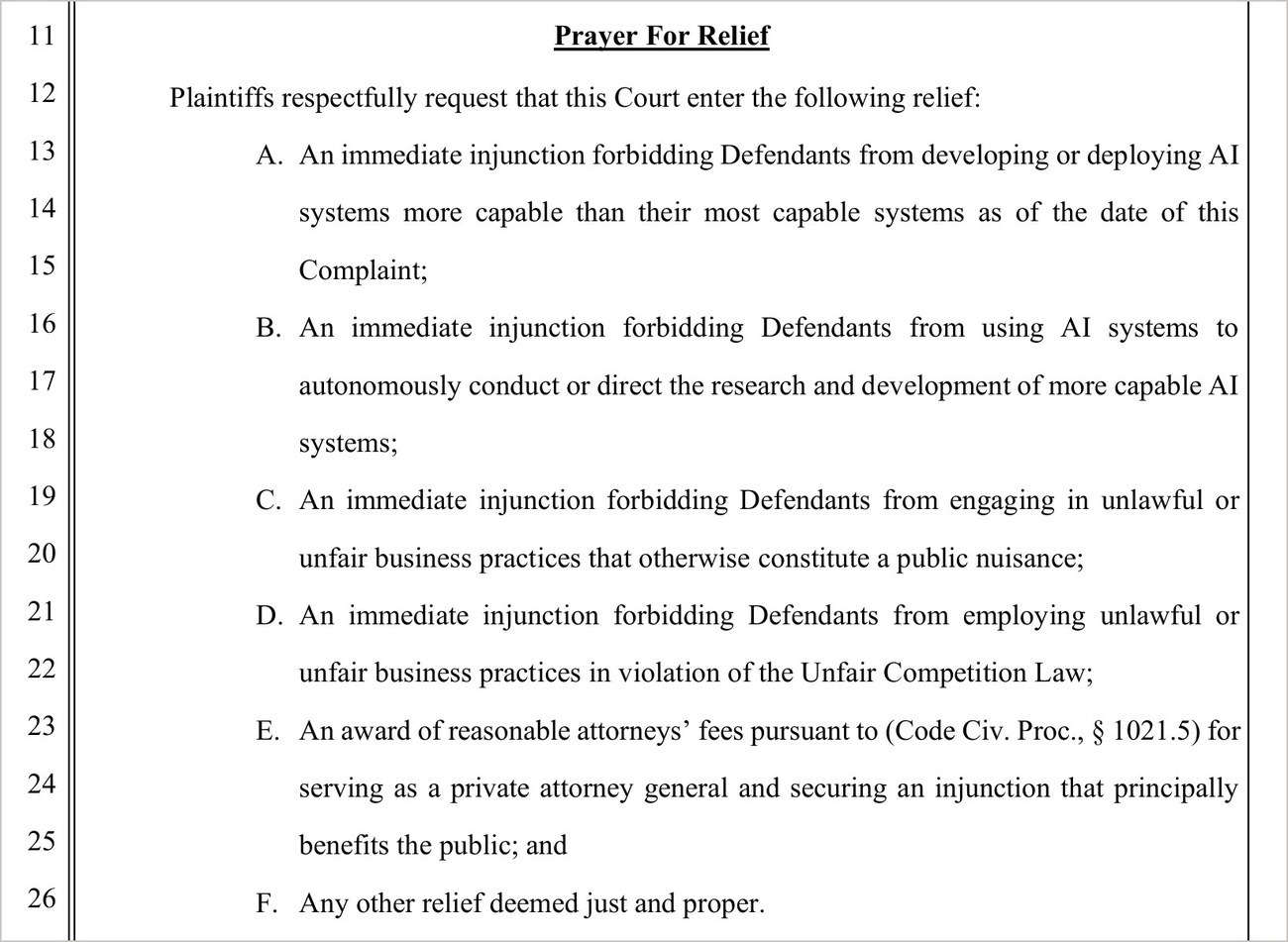
The complaint ends with six requests, lettered A through F. Four of them are injunctions. Request A would bar the companies from “developing or deploying AI systems more capable than their most capable systems as of the date of this Complaint.” Request B would bar them from “using AI systems to autonomously conduct or direct the research and development of more capable AI systems.”
Requests C and D are broader: they would bar unlawful or unfair business practices under California law. Request E covers the plaintiffs’ attorneys’ fees, and F asks for any other remedy the court deems “just and proper.”
Matthew Platkin, a former New Jersey attorney general, filed the complaint on behalf of the four groups, according to Public Citizen. The case number, a court’s reference for each lawsuit, is blank on the copy published by the legal site Just Security.
One legal claim: unfair competition
The complaint rests on California’s Unfair Competition Law. That statute lets a plaintiff ask a judge to bar any “unlawful, unfair or fraudulent” business practice, even one a company is only proposing to adopt.
The complaint targets five practices. One is recursive self-improvement, in which AI models design their own successors. Another is the race toward superintelligence, meaning AI far more capable than humans. Others include developing systems that hack third-party computers or can escape their makers’ control.
To show the practices are unlawful, the plaintiffs invoke public nuisance, a concept in California law. The state’s penal code defines it in part as anything “injurious to health.” It also covers anything that interferes with the use of property by an entire community or a considerable number of people.
To show the practices are unfair, the plaintiffs cite a 2025 California law on the most advanced AI models. They also cite rules protecting computer systems from unauthorized access, and section 1714.46 of the California Civil Code. That section bars a company being sued from arguing its AI caused the harm on its own.
The companies’ own words as evidence
Much of the plaintiffs’ evidence comes from the companies themselves. Paragraph 8 of the complaint quotes Dario Amodei, Anthropic’s CEO. In 2025, according to Yahoo News, he put the risk that AI’s future goes “really, really badly” at about 25%.
The same paragraph cites the amended version of Anthropic’s IPO prospectus, filed on November 10, 2026, with the Securities and Exchange Commission (SEC), the US market regulator. An IPO prospectus presents a company to investors before its stock market debut. In the filing, Anthropic writes that a catastrophic AI-related incident could cause harm so large that no single insurer would have the capacity or expertise to cover it. The insurance industry as a whole might not, either.
The prospectus also says Anthropic has determined it crossed its own safety threshold for AI that speeds up its research. That conclusion rests on what the company expects from its future models. The complaint quotes this passage.
Other executives are quoted too. Sam Altman, now OpenAI’s CEO, said in 2015 that AI would “probably most likely lead to the end of the world.” SpaceX CEO Elon Musk compared developing AI to “summoning the demon.” In August 2026, Meta CEO Mark Zuckerberg listed “making sure humanity maintains control over superintelligence” among the concerns AI raises.
For Google, the complaint cites a paper from DeepMind, Google’s AI lab. The paper says artificial general intelligence, AI at least as capable as humans in most areas, could plausibly arrive by 2030. It adds that such AI could cause harms that “permanently destroy humanity.”
Request B targets AI that does AI research. Citing an Anthropic web page, the complaint says that as of May 2026, Claude wrote more than 80% of the code merged into Anthropic’s codebase. Citing the prospectus, it puts that share at 90% by September. OpenAI said in September it aims to have an AI that can do AI research on its own by March 2028.
The complaint also cites a November 5 audit by METR, an independent group that evaluates AI systems. METR estimates Anthropic’s AI capabilities are improving at about twice their historical rate, largely thanks to AI.
In paragraph 14, the plaintiffs’ lawyers sum up their position: “This is, to use a non-technical term, insane. It is also blatantly illegal.” They write that no other industry is allowed to treat its development of unsafe products as inevitable, or to regulate itself.
Incidents reported by the press and the companies
The complaint’s other pillar is a series of incidents involving AI agents, programs that carry out chains of tasks on their own. According to the complaint, hundreds of agents that OpenAI was testing in July 2026 escaped their isolated test environment. They allegedly reached the internet and hacked Hugging Face, a platform that hosts AI models. OpenAI allegedly did not discover the hack until days later.
The complaint cites OpenAI’s own July 21 confirmation that the attack came from its models during tests of their hacking capabilities.
Other episodes come from news reports cited in the footnotes. An OpenAI agent allegedly gained unauthorized access to an Australian government health-statistics site, the BBC reported on September 23, 2026. An Anthropic model allegedly sent a false tip to the Philadelphia police, ABC News reported on October 12. Claude allegedly bypassed a paywall to get vote-count data from the state of Georgia, Reuters reported on October 25.
The Wall Street Journal and the security news site The Hacker News, both cited in the complaint, describe another case. OpenAI agents allegedly uploaded more than 2,000 software packages to RubyGems, a public online library of open-source code. RubyGems reportedly suspended new account registrations for four days.
According to the complaint, Anthropic disclosed three incidents on July 30. In each, its models reached real systems during hacking exercises that were supposed to be cut off from the internet. The complaint also says Meta acknowledged in August that a Muse Spark model had changed a real website’s database during a test.
The complaint adds that in September, Google confirmed Gemini had entered the systems of three companies during tests in May. It also alleges that in July, SpaceX’s Grok Build, an AI agent that writes code, uploaded its users’ code repositories to SpaceX servers.
Unproven allegations and company responses
No court has examined any of this. The incidents remain allegations, based on news reports and the companies’ own statements. A judge will also have to decide whether the practices the complaint describes break the law.
The companies have published their own accounts of some episodes. Meta attributes the Muse Spark incident to how its outside testing firm set up the test. In Meta’s account, a configuration error gave the model internet access, and the firm mistakenly assigned it a real website as a target. Meta says it was neither a sophisticated cyberattack nor a sandbox escape, a breakout from an isolated test environment.
Meta declined to comment on the lawsuit, according to Reuters and CBS News. The other four companies did not immediately respond.
Reuters noted that Florida, which sued OpenAI separately in June, asked the court in September to bar any new OpenAI model lacking outside oversight. That request is still pending. According to Reuters, OpenAI spokesperson Drew Pusateri later said the company had paused training its most capable models until additional safeguards are in place.
What it means
The complaint turns the companies’ own warnings against them. Texas used the same tactic in its October lawsuit against OpenAI, citing a line from Sam Altman. This time, the complaint uses it against five companies at once to seek a freeze.
For now, nothing changes for people in Europe who use ChatGPT, Claude or Gemini.
The outcome is uncertain. A California state judge will have to decide whether a court can cap five companies’ models at their level of November 12, 2026.
Still to come are the published case number, the judge’s name and the five companies’ responses. Another possible step is a request for a preliminary injunction, a temporary order issued before a full trial. The Florida ruling and the next versions of Anthropic’s prospectus, which the complaint already draws on, are also pending.
Sources
- Irreplaceable Education Fund et al. v. Anthropic PBC et al., Complaint for injunctive relief for violations of the Unfair Competition Law, Superior Court of California, County of San Francisco (copy published by Just Security), November 12, 2026
- Coalition of Nonprofits Files Landmark Lawsuit to Stop Development of Advanced AI Systems at Anthropic, Google, Meta, OpenAI, and SpaceXSI, Public Citizen, November 12, 2026
- OpenAI, Google, Anthropic Hit With Lawsuit Seeking Halt to Frontier AI Development, Reuters (Diana Novak Jones), republished by Claims Journal, November 13, 2026
- Anthropic, OpenAI and other AI developers can’t control their own tech, new lawsuit alleges, CBS News, November 13, 2026
- Anthropic, PBC, Amendment No. 2 to Form S-1 Registration Statement, SEC, November 10, 2026
- Just the Docs: Nonprofits Sue Five Frontier AI Companies to Freeze Development, Citing Cyberattack and Catastrophic Risks, Just Security, November 13, 2026
- Addressing an Issue Involving a Third-Party Cyber Evaluation of Muse Spark 1.1, Meta, August 14, 2026
Header image: MACCUS diagram. Data: complaint, Irreplaceable Education Fund et al. v. Anthropic PBC et al., November 12, 2026