Fifty days after switching it on around Washington, D.C., the Federal Aviation Administration (FAA) is using an AI tool to suggest flight routes and departure times nationwide. The FAA, which runs US air traffic control, says the tool, SMART, works in the airspace of all 22 of its en route centers. Those centers guide planes at high altitude between airports.
For passengers, the FAA’s case so far comes down to about 10 minutes. That is the agency’s average saving per flight on the 180 flights SMART has helped reroute since September 21. Some lawmakers had expected a 90-day evaluation first.
The FAA’s short statement announcing the expansion on November 10 called the Washington rollout a success. It also put the average fuel saving at almost 80 gallons per flight.
On Friday, November 13, a telecommunications outage hit multiple FAA en route centers, and the agency halted departures nationwide. Air Space Intelligence (ASI), the company that builds SMART, said its software played no part. No official has linked the two.
From three Washington airports to 22 centers
The FAA picked ASI, a Boston company, in June. The 12-year contract, worth $875 million according to Reuters, covers two systems. The first, FMDS, will replace the FAA’s current software for managing traffic flow. The second, SMART, is a feature inside it that spots congestion before aircraft take off.
SMART went live on Monday, September 21, in the airspace around Reagan National, Dulles and Baltimore/Washington International airports. “SMART will slash those frustrating delays, reduce stress on air traffic controllers, and lower travel prices,” Transportation Secretary Sean Duffy said that day. The tool is part of a $12.5 billion push to modernize US air traffic control.
In October, the FAA began validating SMART with its centers in Miami, Jacksonville and Atlanta, Fox News reported.
SMART advises; controllers keep planes apart
SMART advises FAA traffic managers, who plan the flow of flights. The FAA’s one-page fact sheet says it uses AI to analyze airline schedules, weather, airport capacity and airspace conditions. It then predicts traffic flows and spots conflicts before they happen.
The agency says SMART draws on 200 data streams, including controller staffing. The fact sheet gives its goal as “zero delays at the start of the day.”
FAA specialists at a SMART center in Washington check its output. They send scheduling recommendations to the agency’s Command Center in Warrenton, Virginia, which passes them to local air traffic facilities “for local leadership to consider.” Controllers, who talk to pilots, “remain responsible for keeping aircraft safely separated,” the fact sheet says.
“This is not about automating air traffic control,” ASI chief executive Phillip Buckendorf told NPR in October. “The AI does the math, the AI does the computation,” he said. The traffic manager makes the decision, he added.
180 flights, by the FAA’s count
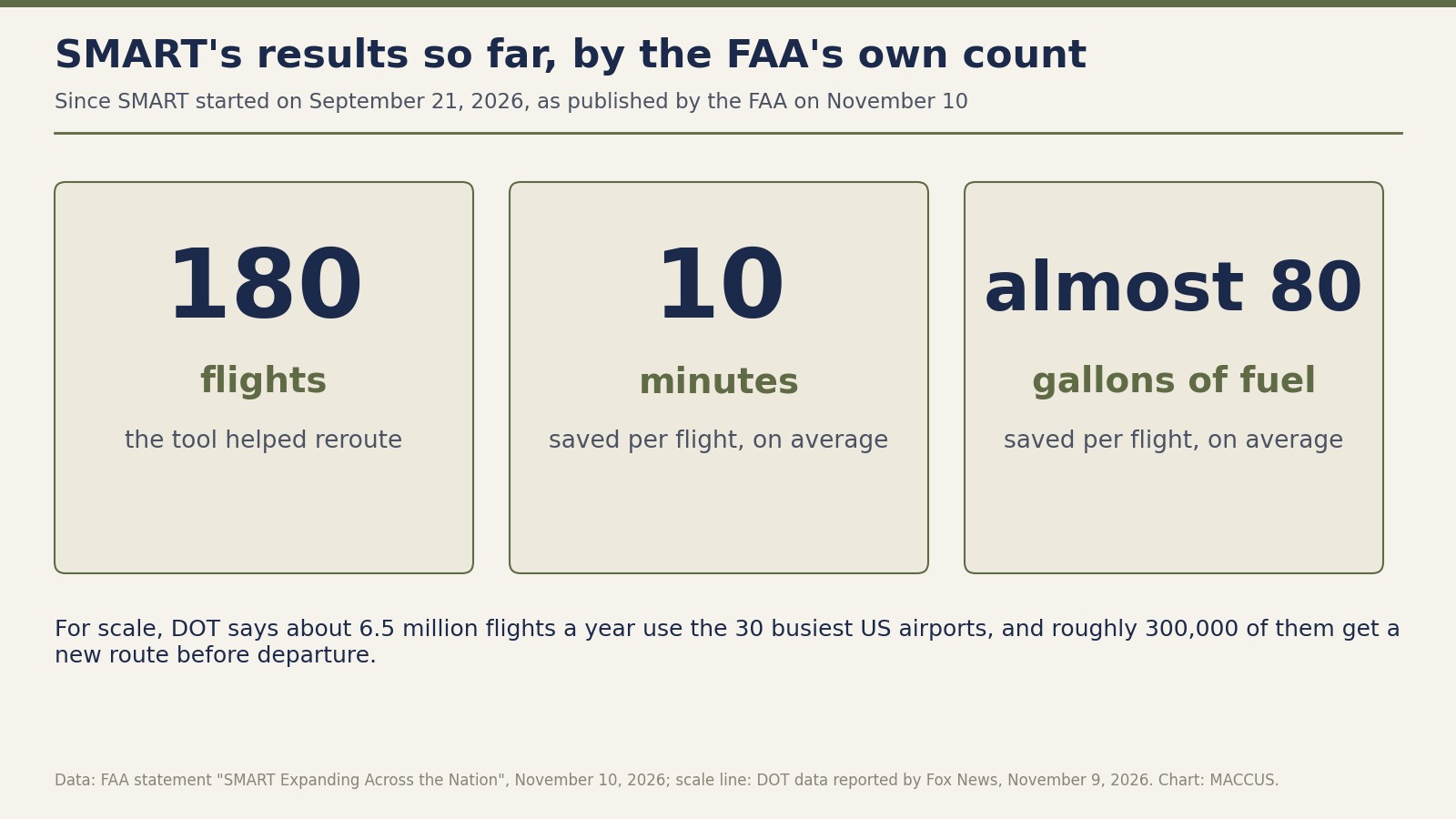
The Department of Transportation (DOT), which oversees the FAA, gave Fox News another figure: about 24,000 passengers on those 180 flights.
One October flight from Reagan National to Orlando, with 147 passengers, was expected to hit congestion on its planned route. SMART suggested a route farther west, and controllers accepted it. The trip ended up 11 nautical miles shorter and six minutes faster, according to DOT.
At $4.31 a gallon of jet fuel, the FAA’s figure of almost 80 gallons comes to just under $345 per flight, Gizmodo calculated.
DOT’s figures also show the scale of the task. About 6.5 million flights a year use the 30 busiest US airports. Roughly 300,000 of them get a new route before departure. In the air, 3.6 million are rerouted, given new headings by controllers (vectored) or made to circle in holding patterns.
DOT also expects SMART to help in storms. Today the FAA blocks off large rectangles of airspace around bad weather, even when safe corridors may remain, says a DOT fact sheet cited by Fox. SMART is meant to find routes around storms and show when closed airspace can safely reopen.
Lawmakers expected a 90-day evaluation
In October, members of Congress asked the FAA to pause SMART. Among them were Senator Chris Van Hollen and Representatives April McClain Delaney and Don Beyer, all three Democrats. Their letter says they understood the September launch as “part one of a phased rollout that begins with a 90-day evaluation period before broader, nationwide deployment.”
The letter asked about safety testing and staff training, what results would count as success, and who would be responsible if a SMART recommendation contributed to a safety incident: the controller, the FAA or the developer. The FAA’s November 10 announcement did not address the lawmakers’ questions about testing and training, the aviation site AVweb noted.
Airlines heard a similar timeline. According to Gizmodo, Politico reported in mid-September that Duffy and FAA officials had assured airlines a 90-day trial would come before the full rollout. The nationwide expansion came on day 50.
The controllers’ union kept its distance. “NATCA has not been involved in the design, testing, or implementation of SMART and therefore cannot speak to its effect on the air traffic control workforce at this time,” the National Air Traffic Controllers Association said in September.
Beyer, whose district includes Reagan National, was blunt: “The FAA should not use my constituents as guinea pigs for an unproven AI air traffic control system.” Airlines for America, the major US airlines’ trade group, praised the FAA’s push to modernize the nation’s flight management tools as “one of the most exciting and bold initiatives taken on by the FAA in decades.”
The nationwide ground stop of November 13
CNBC reported that around 4 p.m. Eastern on Friday, November 13, the FAA halted departures nationwide, an order called a ground stop. The agency cited a “temporary telecommunications outage” affecting multiple en route centers. By 6 p.m. Eastern, the flight-tracking site FlightAware counted more than 10,000 delayed flights and 2,500 cancellations in the US that day, according to NPR. Homeland Security Secretary Markwayne Mullin said there was no indication of a threat.
Multiple sources told CBS News that an update to the private communications network connecting the air traffic control system caused the system to reboot, leading to a crash. CBS said the system is operated by L3Harris, which did not immediately respond to its request for comment. The FAA had not published a root cause as of Friday evening, Eastern time. Telecommunications infrastructure is among the equipment the FAA’s modernization effort aims to replace by the end of 2028.
ASI quickly dismissed speculation about its software, NPR reported. “The current ground stop is not based on or a result of the SMART system, any product of ASI or our integration with FAA and ATC,” the company said on social media. No official has linked the outage to SMART.
What the FAA has not shown
The FAA’s published evidence for SMART so far is three figures in a short statement, plus one example DOT gave Fox News. Fox noted the early results cover a relatively small share of US flights.
The statement does not say how the agency decides SMART helped reroute a flight, what the 10 minutes are measured against or how often local facilities turned recommendations down. The statement also leaves the lawmakers’ questions unanswered, such as how SMART performs during severe weather or outages.
Waymo, by comparison, publishes its robotaxi crash record over 271 million driverless miles, measured against human drivers.
Dave Riley, a retired air traffic controller, called SMART “a step in the right direction” in October but doubts it will do much about the system’s biggest problem. The FAA is still thousands of certified controllers short of full staffing, NPR reported. “It won’t replace humans. It’ll be another tool in the toolbox,” Riley told NPR in September.
What it means
AI advice on departure times and routes reached all 22 centers in 50 days, faster than lawmakers expected. Other public bodies using AI have published early numbers. Japan’s government estimates that weekly users of its staff AI tool save about 110 minutes a week on the tasks they give it. Judges in Shenzhen each closed about 50% more cases in 2025 than in 2024 with an AI system drafting judgments for them to check.
For passengers, the gain on offer is concrete: minutes and fuel saved per flight, and help finding routes around storms and deciding when closed airspace can reopen. The cost so far is in evidence and accountability: the results are the FAA’s own, the union says it was not involved, and who answers for a bad recommendation is unclear.
Three things will show whether the speed pays off: data from the 22 centers through the winter storm season, the FAA’s answers to the lawmakers’ questions, and a count of how often local facilities accept or turn down SMART’s recommendations.
Sources
- SMART Expanding Across the Nation (FAA General Statements), Federal Aviation Administration, November 10, 2026
- Strategic Management of Airspace, Routes, and Trajectories (SMART), fact sheet, Federal Aviation Administration
- Aviation regulators turn to AI to help manage the nation’s airspace, NPR, September 21, 2026
- EXCLUSIVE: Trump’s FAA touts new AI-powered tool helping thousands of passengers avoid flight delays, Fox News, November 9, 2026
- Van Hollen Joins McClain Delaney, Colleagues in Call to Pause FAA’s AI Tool at Washington-Area Airports, Office of Senator Chris Van Hollen, October 2026
- FAA Picks ASI For Air Traffic Management Software, AVweb, June 23, 2026
- FAA grounds departing flights nationwide, citing air traffic communication system outage, CNBC, November 13, 2026
- FAA issues nationwide ground stop for all U.S. airports, NPR, November 13, 2026
Header image: MACCUS timeline chart drawn from the FAA statement of November 10, 2026, NPR, Fox News (DOT data), AVweb and the lawmakers’ letter