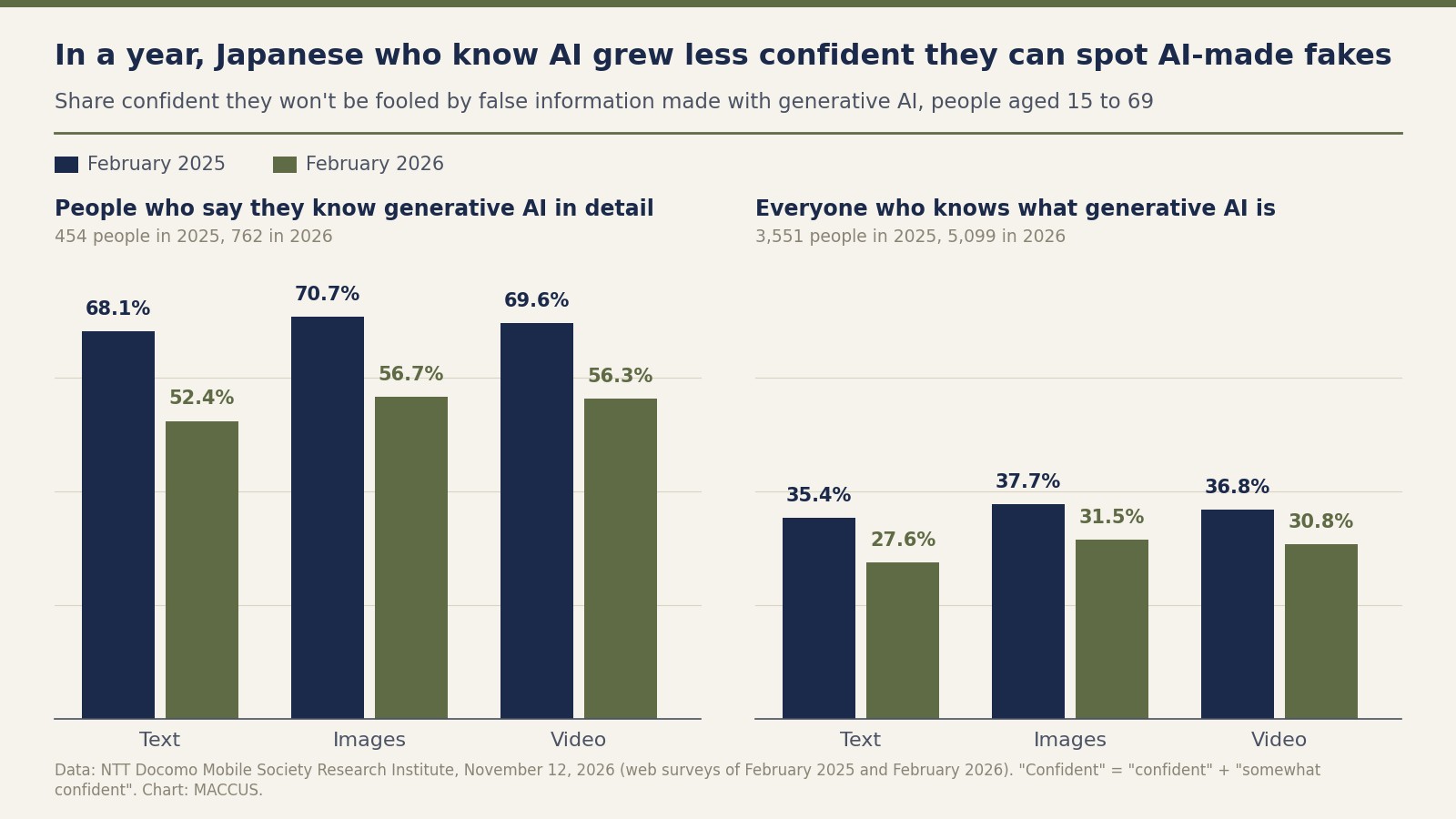

In February 2025, about two in three AI-savvy Japanese felt confident that false text made with AI would not fool them. A year later, about half did: the share fell from 68.1% to 52.4%. The AI-savvy are people who say they know generative AI in detail. Generative AI writes text or makes images and video on request.
The Mobile Society Research Institute of NTT Docomo, a Japanese mobile carrier, published the figures on November 12. The institute says it works independently of the telecom industry’s direct interests. It asked the same question in online surveys of 7,527 people aged 15 to 69 in February 2025 and 7,223 in February 2026. “Confident” here combines two answers, “confident” and “somewhat confident.”
Confidence fell for all three formats the institute asked about. Among everyone who knows what generative AI is, the confident share for text fell from 35.4% to 27.6%. For images, it fell from 37.7% to 31.5%, and for video from 36.8% to 30.8%. That is about three people in ten, down from more than a third, in a year when generative AI use in Japan nearly doubled.
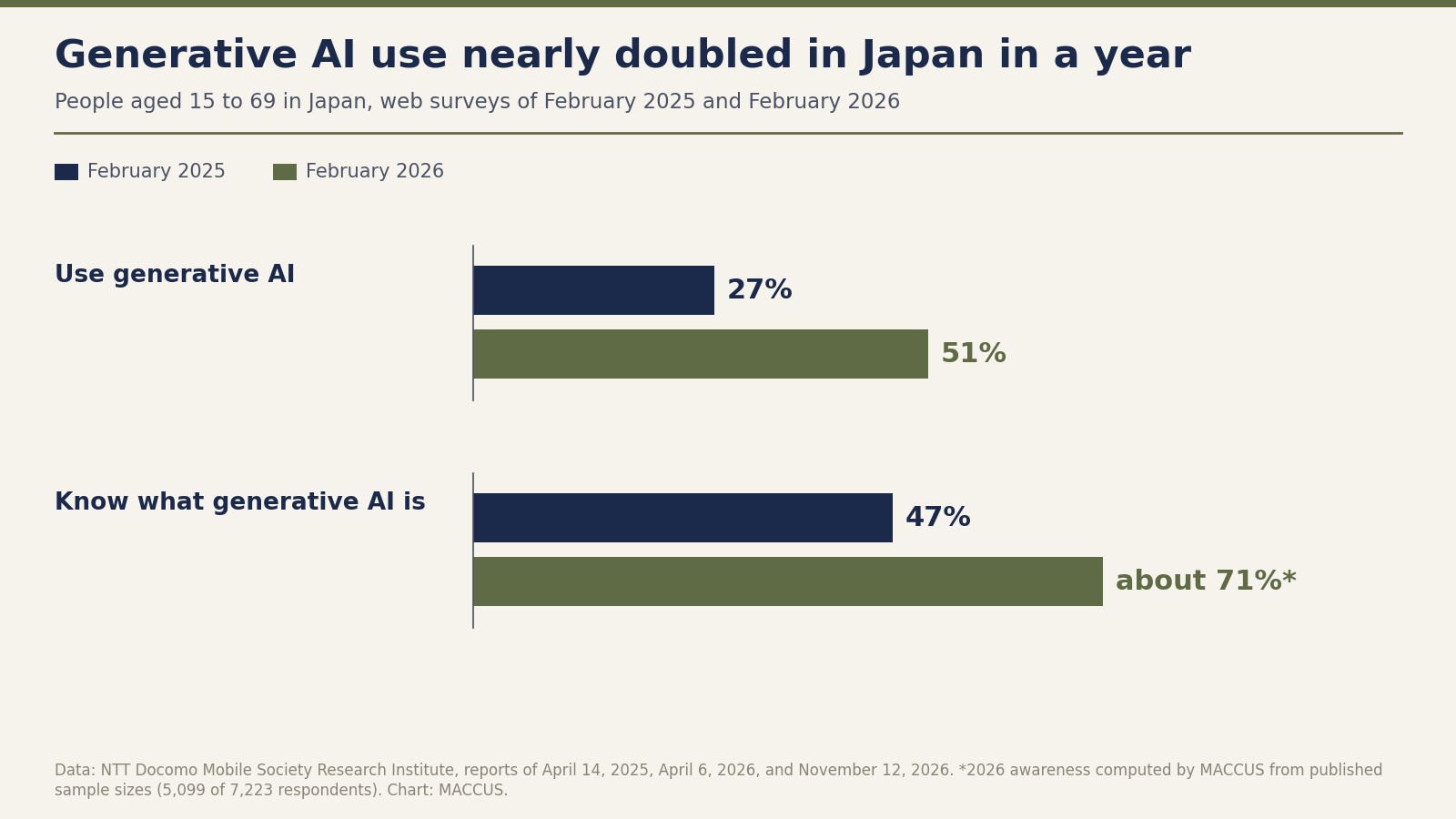
Generative AI use went from 27% to 51% in one year
In February 2026, 51% of Japanese aged 15 to 69 used generative AI, up from 27% a year earlier, according to the institute’s April 6 report. Use rose in every age group. The 2026 figure counts anyone using at least one kind of tool: chat and advice, search and text generation, or video, image and music generation. That February, 22% of Japanese aged 15 to 69 chatted with an AI or asked it for advice at least once a week in their private lives.
Awareness rose as well. In February 2025, 47% of Japanese aged 15 to 69 knew what generative AI is, and another 45% had heard the name without knowing what it was. By February 2026, 5,099 of the 7,223 respondents said they knew it. That is about 71%, a share we calculated from those two numbers.
Japan’s government is also adopting AI. In a pilot this fiscal year, about 180,000 civil servants can use an official AI tool. By the government’s own estimate, those who use it weekly save about 110 minutes a week on average.
Young men and the AI-savvy lost the most confidence
The groups that started out most confident fell furthest, in percentage points. Among the AI-savvy, confidence about text dropped 15.7 percentage points, the gap between 68.1% and 52.4%. For images, the drop was 14.0 points, from 70.7% to 56.7%, and for video 13.3 points, from 69.6% to 56.3%.
Of the sex and age groups, men aged 15 to 29 were the most confident in both years. Their confidence about text fell 16.4 points, from 58.2% to 41.8%, the largest drop of any sex and age group. For images, it fell from 63.9% to 51.5%, and for video from 62.7% to 49.9%.
Confidence fell in every sex and age group, for all three formats. Women aged 15 to 29 went from 41.2% to 33.4% for text. Women aged 50 to 69 were the least confident group: 14.7% for text in 2026, down from 19.5%. Men aged 50 to 69 moved the least, down 3.7 points for text.
Early adopters and people burned by AI felt surer
Two groups stood out in the 2026 survey. People who first learned about generative AI in 2023 or earlier were the most confident: 32.7% for text, 36.9% for images and 36.3% for video. Those who learned about it in 2025 or 2026 came in at 22.7%, 25.2% and 25.0%.
The second is people burned by AI: 275 generative AI users who said they had once trusted AI too much, skipped checking its output and made a mistake. They were more confident than the 3,394 users who did not pick that answer. The gap was widest for images: 47.3% against 34.7%, or 12.6 points. It was 6.5 points for text and 5.7 for video.
The institute does not claim to know why, and writes that this survey alone cannot clearly explain the early-adopter gap. It suggests early adopters may simply be more interested in AI and know more about it. It also suggests they may have gained confidence by using AI when its output was less accurate. For the burned users, it suggests that heavy users get more chances to fail and may grow more confident through that experience.
More AI users complained about wrong answers
A September 24 report from the same surveys shows users growing more wary of errors. Among generative AI users, the share who complained that answers contained false information rose from 34.8% in 2025 to 40.4% in 2026. The share who found it hard to tell fact from false information rose from 31.1% to 35.4%. In 2026, 61.7% of users who say they always fact-check AI output flagged false information, more than any other group sorted by how often they check.
Other complaints eased. Complaints about not knowing which AI service to use fell from 16.6% to 13.2%, and those about cost from 12.8% to 9.5%.
What the survey does not measure
The survey records how sure people feel. It does not test whether they can tell real from fake: nobody was shown a fake and asked to judge it.
The group answering the question also changed: it took in people who learned about generative AI recently. The institute itself says this may partly explain the fall. The drop also shows up among the AI-savvy. But that group is self-described, and it grew too, from 454 people in 2025 to 762 in 2026.
Self-reported knowledge is not always reliable. In a report released in October, Harvard researchers found that 53% of American men said they knew who Craig Dalton was, a name the researchers had made up.
The respondents come from an online panel: people who signed up to take web surveys. Quotas set how many came from each sex, five-year age band and prefecture, to match Japan’s population. It is not a random sample, in which everyone has an equal chance of being chosen.
In detection tests, people mostly scored near chance
Two other studies tested the skill directly, on different people and with AI content made by older tools. The first was published in September 2025 by Communications of the ACM, a computer science journal. It was preregistered: the authors filed their plan before collecting data.
In the study, 1,276 participants sorted real and AI-generated images, audio and video, laid out like an online news feed. They were right 51.2% of the time on average, close to a coin toss. On images, they scored 49.4%.
Familiarity with AI-made content did not help in that study. People who said they knew it well scored 51.9%, against 51.1% for those who said they were unfamiliar with it. The authors expect people’s detection skills to plateau as the generators improve.
A University of Florida team compared people with detection algorithms, programs built to spot fakes. In a study published January 7, 2026, 2,203 undergraduates judged whether face photos were real or deepfakes, fake faces made with AI. The students were right 49% of the time, and a detection algorithm 97%. On video, 1,901 students did better, at 63%, and the best algorithm scored 49%.
What it means
By February 2026, about seven in ten Japanese aged 15 to 69 knew what generative AI was, and half used it. In the year before that, the people who say they know it best grew less sure of their own judgment. Our reading is that they were recalibrating. The ACM study suggests that kind of confidence had little basis: its participants scored near chance, and those who said they knew AI-made media well did no better.
That shifts more of the checking from people to tools, though in the Florida tests, software beat students on still faces and lost to them on video. Along with media literacy, the ACM authors call for watermarks on AI-made files, plus cryptographic signatures and content provenance records that show where a file came from. The generators keep improving and spreading: since the February 2026 survey, Google’s AI model Gemini Omni 1.2 Flash has started making 15-second video clips with sound. The winner of the Prix Goncourt, France’s best-known literary prize, says he hid one ChatGPT sentence in his novel and has told only the jury which one.
The next data point is February 2027, if the institute asks the same question again. Its own findings suggest two things to watch: whether confidence keeps falling once nearly everyone has used these tools, and whether early adopters and burned users stay more confident. Neither answer would show whether those people catch more fakes. That would take a real-or-fake test like the ACM and Florida studies, run on Japanese respondents.
Sources
- 生成AIの偽情報に「だまされない自信」1年で低下し約3割に, NTT Docomo Mobile Society Research Institute, November 12, 2026
- 生成AI利用率、過半数に。1年で急増, NTT Docomo Mobile Society Research Institute, April 6, 2026
- 生成AIが「どのようなものか知らない」人は約半数, NTT Docomo Mobile Society Research Institute, April 14, 2025
- 生成AIの不満「誤情報」40%に増加、確かめながら使う姿勢の広がりも, NTT Docomo Mobile Society Research Institute, September 24, 2026
- As Good as a Coin Toss: Human Detection of AI-Generated Content, Communications of the ACM (Di Cooke, Abigail Edwards, Sophia Barkoff, Kathryn Kelly), September 22, 2025
- Is this real? Susceptibility to deepfakes in machines and humans, Cognitive Research: Principles and Implications (Pehlivanoglu et al., University of Florida), January 7, 2026
Header image: MACCUS chart drawn from the NTT Docomo Mobile Society Research Institute report of November 12, 2026