Japanese government employees who use their official AI tool at least once a week save about 110 minutes a week on average on the tasks they give it, according to an estimate the government built from their own answers. Japan’s Digital Agency published the figure on October 30 in the first usage survey of Gennai, the generative AI system that about 180,000 government staff can use in a large pilot this fiscal year.
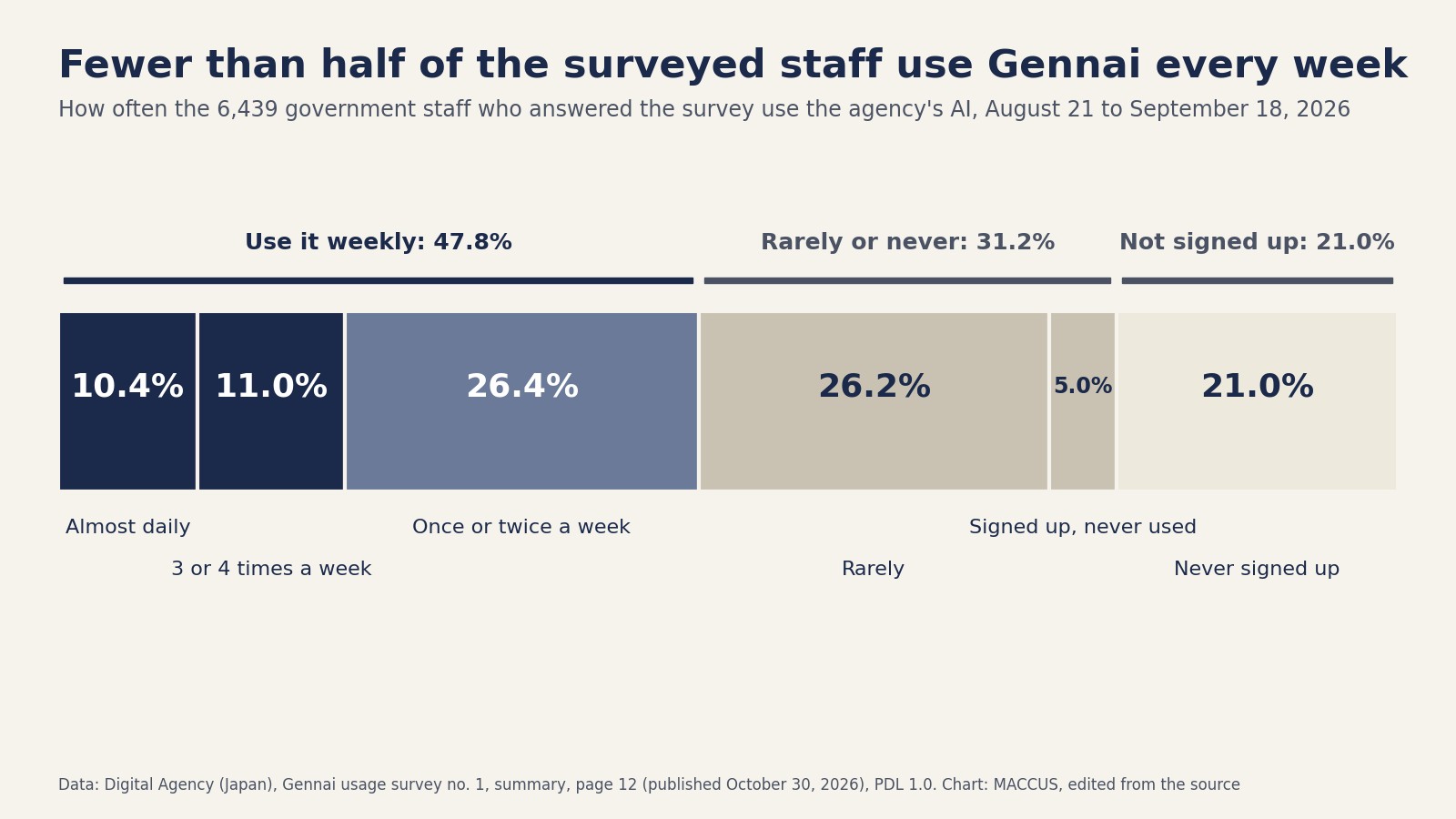
Use is uneven. Of the 6,439 employees who answered, 47.8% use Gennai weekly, 31.2% rarely or never, and 21.0% had not signed up. The agency warns that a gap in output and productivity may open between staff who use AI and those who do not. One employee whose hours went up wrote that the work of colleagues who “cannot or will not use AI” gets passed to the people who can.
Who answered, and what they reported
The survey ran as a web questionnaire from August 21 to September 18 across ministries and agencies. According to the agency’s summary report, 2,467 respondents work at ministry headquarters and 3,972 in regional branch offices, and 77.7% hold ranks between junior clerk and assistant division director.
Only the 3,078 weekly users were asked about satisfaction and working time, and 71.7% said they were satisfied. A majority, 54.4%, said Gennai had cut their weekly hours on the tasks where they use it by an hour or more: 35.1% by one to three hours, 10.9% by three to five, 5.2% by five to ten and 3.2% by ten or more. Another 34.6% saw little change, 0.7% said their hours rose by an hour or more, and 10.2% did not know.
To reach 110 minutes (about 1.83 hours), the agency took the midpoint of each range, counted “ten hours or more” as ten and any increase as a negative saving, and scored “about the same” and “don’t know” as zero. CNET Japan noted on November 1 that the figure is an estimate, with no working time measured.
Savings rise with frequency. Among almost-daily users, 70% reported saving an hour or more a week, against 62% of those who use it three or four times a week and 45% of once-or-twice-a-week users.
Drafts, transcripts and a parent’s schedule
Asked what Gennai improved, with several answers allowed, 1,498 of the 3,078 weekly users picked faster first drafts that skip the blank page. In the same question, 1,088 said they get up to speed on specialist subjects faster, and 1,059 that they can now pull what they need from documents too long to read in full.
In anonymous comments the agency published, one employee wrote that a transcription job that used to take several days now takes three hours and 45 minutes. Another wrote that their office, which used to hire a contractor and spend six months to a year on a guideline, produced one in house in about three months, although their own workload went up. A parent wrote that the time saved lets them do the job without sacrificing family life.
Japanese companies are looking at the same tasks. In a Nikkei survey of major firms, more than one in five said they may hire fewer university graduates from fiscal 2029, and office work topped the list of jobs they think AI could take over.
Agents and parliament next
On October 20, the agency began rolling out “Agent Chat” to ministries in stages, and aims to add a more advanced agent workshop, “Gennai Kobo,” by around December. The agency says its own research shows the plan is a world first: an environment equivalent to advanced AI coding agents, which write and fix code, handle files and run commands from plain-language instructions, offered to rank-and-file staff as well as specialists on a shared government platform for about 180,000 people. Both tools, whose rules of use were drawn up with Japan’s AI Safety Institute, are due to be released as open source, “Gennai OSS Ver. 2.0,” around February 2027.
The parliament app went live as a prototype on October 30. It searches past answers and source documents, drafts a reply, suggests likely follow-up questions and checks for contradictions with earlier answers. Developed under contract by NTT Docomo Business since April, it was tested by 102 experienced staff recruited from 16 ministries and agencies, and about 80% of testers who answered a survey said they wanted to use it. Staff are trying it during the extraordinary Diet session now sitting, and full use is planned from the ordinary session in January 2027.
The agency names the risk of hallucination and sets as a rule that staff do not adopt an AI draft as it stands: they check facts against source documents, and the minister who delivers the answer remains responsible for it. “It is important to use it while always keeping a critical eye on whether the AI’s answer is right,” Digital Minister Toshiharu Furukawa told reporters the same day, Nikkei xTech reported.
How other governments compare
In Britain, the Government Digital Service gave Microsoft 365 Copilot to 20,000 civil servants in 12 organizations from September 30 to December 31, 2024, and adoption held at about 80% after the first month. Its findings report, published June 2, 2025, says participants saved an average of 26 minutes a day, a figure also calculated from the midpoints of self-reported ranges. That is about 130 minutes over a five-day week, by our arithmetic. The two numbers measure different things: the British figure covers the working day, Japan’s covers only the tasks where Gennai is used, and the tools, countries and years differ.
Two European governments acted differently on October 26. Sweden’s Government Offices, which employ about 5,100 people, cut direct access to ChatGPT and Claude on staff computers to steer employees toward approved services such as Microsoft Copilot, while some staff keep both assistants through a platform built in house. The same day, the Dutch government sent parliament a plan for about 25,000 fewer civil service jobs by 2035 that names AI as one way to do the work with fewer people.
The limits of the survey
Every time figure is self-reported in a web form, and neither the release nor the summary gives a response rate or says how well the 6,439 respondents represent everyone with access. Time saved on a task does not always come off the working week. Several published comments describe moving the time to other work, and the agency says quality improved even where total hours barely changed. Asked for the percentage change in their time on those tasks, 59.1% of weekly users put it under about 10% either way, and 29.4% reported cuts of 20% or more.
Weekly users also list problems: 949 of the 3,078 said answers were sometimes inaccurate or unreliable, and 627 that output could not be used as it stood and took work to fix. One wrote that verifying every answer ends up taking time, and that anything they could verify themselves they could often have handled without the AI. Among the 3,361 staff who use Gennai rarely or never, or have not signed up, 1,166 said they do not know how to use it, 925 see no need, and 994 already use another AI service all the time.
The survey also predates the agent tools. The agency plans training for staff who have not signed up or rarely use the tool, a cross-ministry “Gennai Library” of shared skills and data before the fiscal year ends, and what it calls “a way of working not pushed around by AI”: the output of AI, it writes, far exceeds human capacity in volume and speed, and staff chasing it with a heavier load would defeat the purpose.
What it means
The survey gives Japan a first measure of how its civil servants use a government-wide AI tool, drawn from 6,439 of them. For the staff who use it weekly, the agency’s estimate is about 110 minutes a week on the tasks they hand over, built from their own answers, in the same range as the 26 minutes a day British civil servants reported in their 2024 Copilot trial, although the two surveys measure different things.
The adoption numbers point the other way. Fewer than half of the respondents use Gennai weekly, and among the 3,361 who rarely or never use it, many say they do not know how to use it or already rely on another AI service. The agency warns that a productivity gap may open between users and non-users.
The next reading comes around January 2027, when the agency runs a second survey after the agents reach ministries. The ordinary Diet session that opens that month will show whether the answer-drafting app moves from trial to daily use, and the open-source release planned for February would let local governments and companies run the same agent tools.
Sources
- ガバメントAI 源内 利用状況アンケート調査(第1回)の結果を公表しました, Digital Agency (Japan), October 30, 2026
- ガバメントAI 源内 利用状況アンケート調査結果 概要, Digital Agency (Japan), survey summary (PDF), October 30, 2026
- ガバメントAI 源内においてAI エージェント利用環境の提供を開始するとともに、「源内基準」を公表します, Digital Agency (Japan), October 20, 2026
- ガバメントAI 源内で「国会答弁作成支援AIアプリ」のプロトタイプ版を提供開始します, Digital Agency (Japan), October 30, 2026
- ガバメントAI 源内における「国会答弁作成支援AIアプリ」のプロトタイプ版の提供開始について, Digital Agency (Japan), briefing document (PDF), October 30, 2026
- ガバメントAI基盤「源内」、18万人に国会答弁作成支援アプリを試験提供, Nikkei xTech, October 30, 2026
- 「AIを使える職員に仕事が集中」–政府の生成AI調査に負担増の声も, CNET Japan, November 1, 2026
- Microsoft 365 Copilot Experiment: Cross-Government Findings Report, Government Digital Service, GOV.UK, June 2, 2025
Header image: chart by MACCUS, data from the Digital Agency (Japan) Gennai usage survey no. 1, summary (published October 30, 2026), Public Data License 1.0, edited by MACCUS