“Only 20% of European digital services run on European infrastructure,” Arthur Mensch, chief executive of the French AI company Mistral AI, said in Dublin on Friday, November 13, 2026. He made the remark after briefing the leaders of the European Union’s 27 countries at their first-ever meeting on artificial intelligence, Politico Europe reported. The summit was informal, with no political statement to adopt, and the leaders announced no new money.
The same day, a Microsoft outage cut off Outlook email and parts of Teams for users in 74 countries, including many of the officials gathered in Dublin. Microsoft’s own incident notice puts the outage at about 30 hours, from Thursday morning to Friday afternoon, Paris time, as our report on the Microsoft 365 outage details. In the UK, some doctors’ offices told patients to call with urgent questions, Euronews reported.
Politico’s report gives no method for Mensch’s figure, and his company sells a European alternative. Published estimates point the same way as his claim. Cigref is an association of France’s largest companies and public bodies that buy digital services. A 2025 study for Cigref estimated that 83% of EU business spending on software and cloud services (computing and storage rented online) goes to American companies.
A first AI summit, crowded out by Ukraine
European Council President António Costa, who chairs EU leaders’ summits, put AI on their agenda for the first time, Euronews reported that morning. Mensch opened the session on Europe’s competitiveness and sovereignty. The AI researcher and Nobel laureate Geoffrey Hinton opened the one on AI’s effects on society.
A dispute over who should speak for the EU in Ukraine peace talks took up much of the day. “We are not going to pretend that we are experts [on AI],” a senior EU official said, according to Politico. Costa said the leaders would return to AI in three months.
Mensch’s figures and Mistral’s commercial interest
Mensch said the money Europe spends on foreign technology, American or Chinese, “could be reinvested here, on infrastructure we control and [to] finance European research and development.” He did not specifically address the outage, Politico noted.
At the summit, Mensch repeated a figure from his mid-October op-ed in Le Monde, according to the French tech news site FrenchWeb. By his estimate, European companies pay more than €260 billion a year to American cloud and software providers. FrenchWeb noted that Mistral, which sells AI models and services, has a direct commercial interest in seeing that money move. On October 29, Mistral released the weights of its largest model, Large 4; the files are public.
The 20% figure has no published source. Reports do not say whether “European digital services” means services sold by European companies or services used in Europe. Nor do they say what it counts: revenue, users or number of services.
Europe’s software and cloud bill
Mensch’s €260 billion figure matches the study that Asterès, a Paris economics firm, published for Cigref in April 2025. It estimates that EU organizations spent about €400 billion on business software and cloud services in 2024, and that 83%, or €330 billion, went to American companies. Asterès estimates that 80% of the value of those purchases, about €264 billion, is created in the United States. It compares this “digital bill” with the EU’s €360 billion of energy imports in 2024.
Official trade statistics could not isolate these flows, the study says, partly because Ireland, where much of this activity is booked for tax reasons, skews them. So Asterès interviewed six chief information officers at large French companies and scaled their answers to the whole EU in proportion to GDP.
A second Asterès study for Cigref, dated May 2026, looks at prices. It surveyed about 50 Cigref members and partners in France, Belgium and the Netherlands. They reported cloud and software costs rising 8.7% a year over the past three years and expect 12% a year over the next five. On that basis, Europe would pay an average of €140 billion a year more from 2026 to 2030 for the same volume of services, on top of normal software inflation.
The second study puts the cost to the European economy at about €107 billion a year in value added, or 0.6% of GDP, and 1.4 million jobs by 2030. It adds that 17 cents of every euro spent on cloud and software go directly to European providers, and non-European providers reinvest another 17 cents in Europe.
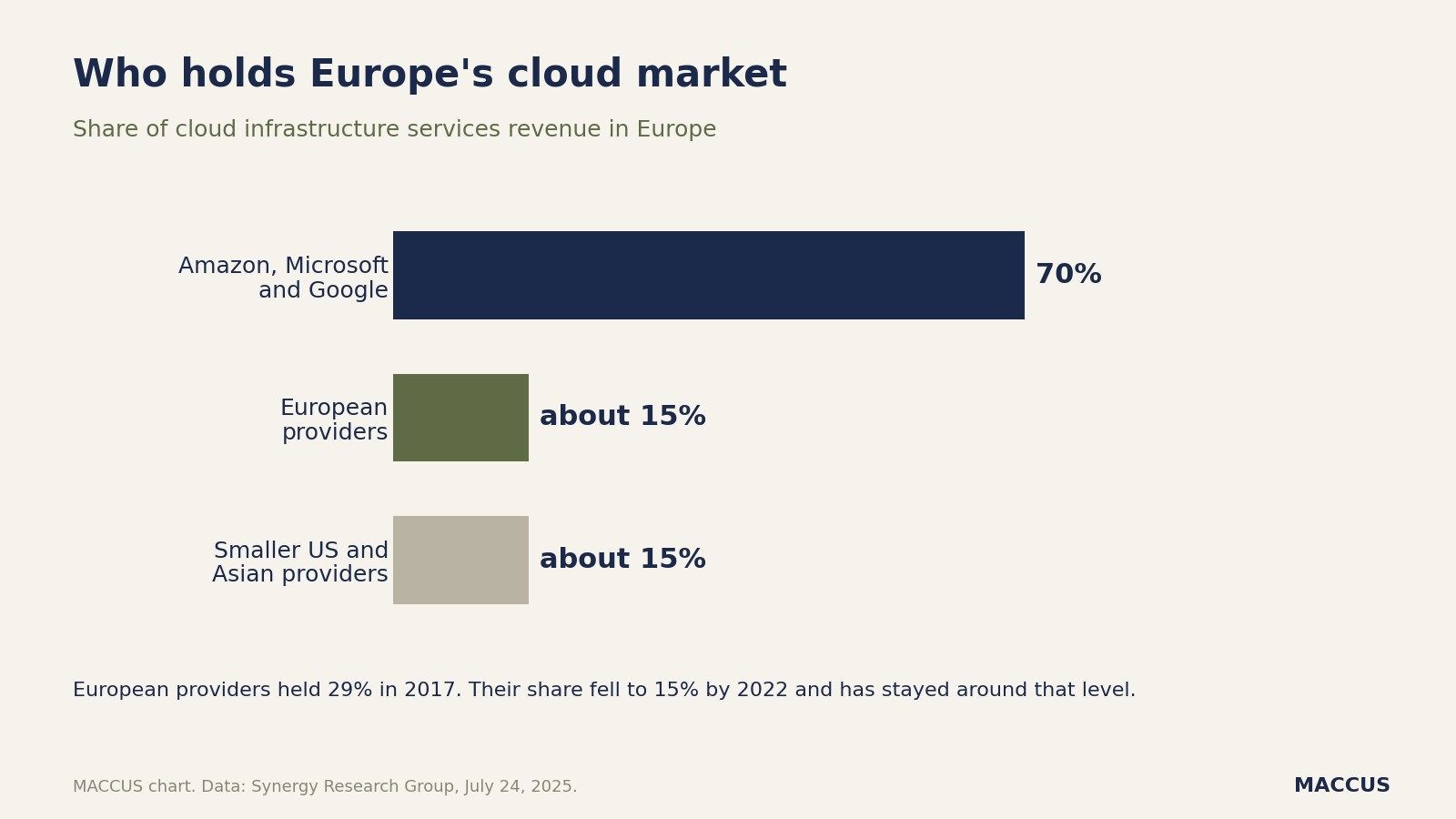
Amazon, Microsoft and Google hold 70% of Europe’s cloud infrastructure market, Synergy Research Group said in July 2025. European providers more than tripled their cloud revenue between 2017 and 2024, but the market grew sixfold. Their share fell from 29% in 2017 to about 15% in 2022 and has stayed around that level.
A Finnish MEP: “a political and strategic mistake”
As the outage went on, Aura Salla, a Finnish member of the European Parliament (MEP), sent out a press release in Finnish at 10:52 a.m. Helsinki time on November 13. Salla sits with the center-right EPP group. The release’s title was “EU:n ja Suomen lopetettava Microsoftin käyttö,” or “The EU and Finland must stop using Microsoft.”
“Olemme ulkoistaneet liian suuren osan digitaalisesta infrastruktuuristamme EU:n ulkopuolisille toimijoille. Tämä on poliittinen ja strateginen virhe, joka on korjattava,” she wrote. In English: “We have outsourced too much of our digital infrastructure to actors outside the EU. This is a political and strategic mistake that must be corrected.”
Salla cited the Microsoft disruption and earlier Starlink disruptions in Ukraine. She said the goal was not to replace American companies with a single European one, and that replacing Microsoft would not happen overnight. She named Linux, the Finnish cloud providers UpCloud and Enfo, and the security company WithSecure as alternatives, and said public procurement “must support European technology.” Her release is one lawmaker’s demand, and neither Finland nor the EU has made a decision.
Others made the same point, Politico reported. Sebastian Toffaletti is secretary general of the Digital SME Alliance, a trade group for smaller tech firms. He called the outage a “reminder of the systemic risk created by concentrating digital infrastructure with a few global tech giants.” German Social Democrat lawmaker Johannes Schätzl said: “Digital sovereignty must be measured by whether we can remain operational even during outages like this.”
The next dates
French President Emmanuel Macron closed the day with a post on X: “Our independence cannot be outsourced. It must be built here at home, in Europe.” He added: “If we want our companies to grow here, let’s also give them their first big contracts here.” He announced that he and the Dutch prime minister will host tech executives, whom he called “Tech Creators,” in Paris on December 2.
European Commission President Ursula von der Leyen said she would bring an “ambitious” proposal to the leaders’ next summit, at the end of November, France 24 reported, citing AFP. The proposal would boost funding for Europe’s “technological sovereignty.” She said the effort would need at least €500 billion of investment.
Costa pointed to the planned European Competitiveness Fund, FrenchWeb reported. Its size is being negotiated in the EU budget for 2028 to 2034.
The EuroHPC Joint Undertaking is choosing consortia to build “AI gigafactories,” very large data centers for training AI models. EuroHPC is the EU and member-state body that funds Europe’s public supercomputers.
According to its call page, bids for one of the call’s two parts close on December 3. The other part was pushed to February 4, 2027, to give member states time to commit funding. FrenchWeb reports that the December 3 deadline covers the largest sites.
What it means for Europe
AI reached the EU leaders’ agenda for the first time, with dependence on foreign technology among the main themes. That day, an outage made this dependence concrete for the people in the room. The decisions lie elsewhere: von der Leyen’s funding proposal, the EU budget for 2028 to 2034, and the rules on what governments buy.
The 20% can be read two ways, both backed by numbers. European cloud providers tripled their revenue in seven years, and EUROPA, an open model backed by the Commission, is in test runs on a public supercomputer. Their market share, though, has been stuck near 15% since 2022, while US providers invest about €10 billion every quarter in Europe, John Dinsdale, a chief analyst at Synergy, said in July 2025. Both headline numbers remain claims: Mensch’s 20% has no published method, and the €264 billion estimate rests mainly on six interviews.
On December 1, European Parliament committees discuss the draft report on the Cloud and AI Development Act, a law the Commission has proposed, Euronews reports. The draft calls for public authorities to buy more cloud services from European providers. The figure to watch is the share of public contracts that go to European providers.
Sources
- Microsoft outage renews European calls to detox from US tech, Politico Europe, November 13, 2026
- Ukraine envoy row hijacks EU leaders’ first AI summit, Euronews, November 13, 2026
- The EU has always found a way through. On AI, it’s struggling to see it., Politico Europe, November 15, 2026
- MEP Aura Salla: EU:n ja Suomen lopetettava Microsoftin käyttö, Aura Salla via STT Info, November 13, 2026
- Post by Emmanuel Macron on X, Emmanuel Macron, November 13, 2026
- La dépendance technologique aux softwares & cloud services américains : une estimation des conséquences économiques en Europe, Cigref and Asterès, April 25, 2025
- De la dépendance technologique à la captation économique : ce que les hausses tarifaires du cloud-logiciel coûtent à l’Europe, Asterès for Cigref, May 2026
- European Cloud Providers’ Local Market Share Now Holds Steady at 15%, Synergy Research Group, July 24, 2025
Header image: MACCUS chart, data from Asterès for Cigref (April 2025).