The number of software security flaws published in 2026 passed 100,000 on Friday, November 13, more than twice the 2025 total. VulnCheck, a firm that tracks vulnerabilities, counted 100,222 that afternoon, The Register reported. These are CVEs: flaws that have been publicly disclosed and given a standard identifier.
VulnCheck’s Josh Bressers, who runs its coordinated vulnerability disclosure work, named the main cause: “There’s no denying the fact that vulnerability hunting with AI is driving a majority of what we’re seeing.”
The same day, Project Zero, Google’s in-house team of bug hunters, replaced the rules it had used since 2021 for making flaws public. “We are finding several vulnerabilities a week in targets where we once found a few vulnerabilities a year,” the team wrote. The AI company Anthropic, the developers of the PostgreSQL database and Project Zero itself describe the same strain: flaws are now found faster than they get fixed.
Twice last year’s count in ten and a half months
The National Vulnerability Database (NVD), the US government’s public CVE catalog, run by the standards agency NIST, shows the same jump. Our November 16 query of its public API counted 97,820 CVEs published from January 1 to November 15, 2026. That leaves out rejected records, IDs that were later voided; counting them, the total is 100,592. Without rejected records, all of 2025 had 48,150.
In NVD’s data, every month since March has topped the busiest month of 2025. October brought 17,051 CVEs, nearly four times as many as October 2025.
Microsoft alone added 1,094 flaws to the count on Tuesday, November 10, its monthly patch day for security fixes, after 1,474 the month before, according to The Register.
The share that attackers actually use has held roughly steady, The Register reports. About 1.4% of this year’s CVEs, 1,363 of them, are in VulnCheck’s catalog of flaws known to be exploited. A steady share of a growing total still means more exploited flaws, Bressers said.
Attackers are also moving faster. VulnCheck found that the median time from a CVE’s publication to its exploitation fell from 120 days in 2025 to 80 days in the first half of 2026. The security firm CrowdStrike tracked exploitation based on public proof-of-concept code, samples showing that a flaw can be used. It found that from January to June, 88% came within 48 hours of the code’s release.
Project Zero drops soak time and plans shorter deadlines
Since 2021, Project Zero had given a vendor, the maker of the affected software, up to 90 days to fix a flaw it reported. It then waited 30 more days of “soak time” for users to install the patch before publishing the details. In the team’s November 13 post, Natalie Silvanovich wrote that AI-assisted discovery and exploitation have made that timeline “clearly insufficient.”
The new rule, called “Full X,” publishes a flaw’s details X days after the vendor learns of it, whether or not it is fixed. X is 90 days from November 13; it will drop to 60 on February 2, 2027, and to 30 on January 3, 2028. Grace periods, or extensions, are gone, and so is the special rule for variants, close relatives of a known bug.
Part of the reasoning is about patches. Large language models (LLMs), the AI systems behind chatbots, now help attackers read a fix and work back to the flaw it closes. The post says that “zero patch-to-exploitation time is a reasonable, though imperfect, model of attacker behavior.” Under that model, where an attack can follow a patch at once, soak time “is no longer meaningful.”
Volume is the second reason. Agreeing with each vendor on whether a bug is fixed, or whether a grace period applies, is “quickly becoming unmanageable,” the post says. Project Zero consulted the vendors it reports to most, and their concerns explain why the deadline shrinks in steps.
Fixing has become the bottleneck
Anthropic, maker of the Claude AI models, said on October 8 that it had found more than 29,000 candidate vulnerabilities in widely used software over six months. It had reviewed only about 6,000 by hand. It remained, in its words, “bottlenecked on our human capacity to validate these findings.” Its new opt-in scanner sends reports straight to the maintainers who run open-source projects, without human review.
VulnCheck’s Patrick Garrity, who has questioned Anthropic’s claims since April, tallied the results on November 9. He used the public ledger, or running list, of Project Glasswing, Anthropic’s open-source security effort launched April 7. As of November 2, it showed 37,966 findings and 217 marked fixed. Between September 8 and November 2, findings grew by 11,813 and fixes by 15.
PostgreSQL, a widely used open-source database, shows the strain from the maintainers’ side. Robert Haas, one of the developers with the right to add code to it, wrote on October 30 that version 19 would ship late. For a decade, new major versions had come out between mid-September and mid-October. On November 12, version 19 was still at its second release candidate, a near-final test version.
By Haas’s count, from April to September, changes copied back to the latest released version numbered 433 for version 18 in 2026, against 248 for version 17 in 2025, up more than 74%. The reason, Haas wrote, is that many people now report bugs “that they found using LLMs.” In his words: “it’s become vastly easier to find those bugs. Fixing them has also gotten easier, but not to the same degree.”
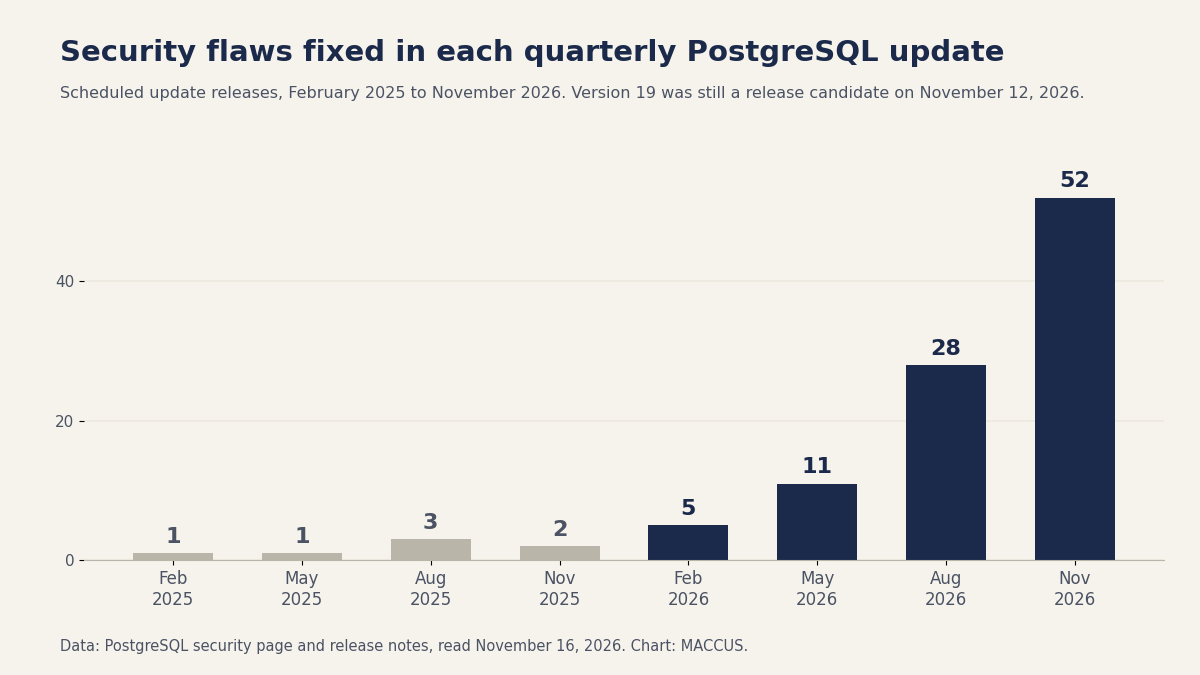
On November 12, PostgreSQL’s quarterly update fixed 52 security vulnerabilities, against 2 in the same update a year earlier. The project’s security page lists 96 flaws fixed in this year’s four quarterly updates, compared with 7 in 2025’s.
AI on the repair side
On November 4, OpenAI, the maker of ChatGPT, said an unreleased model had found 948 Linux kernel flaws and drafted a candidate patch for each. The kernel is the core of the Linux operating system.
On November 10, Google DeepMind said its AI agents had proved key security properties of the actual compiled code behind the Signal protocol. That protocol is the encryption used in the Signal and Google Messages apps. Researchers wrote the specifications, the properties to prove, with help from AI models, and human experts reviewed every one.
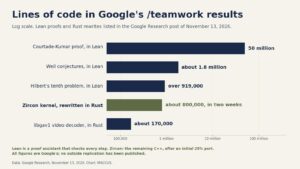
Agents running on Google’s Gemini Carbon AI model then wrote over six million lines of Lean, a language whose checker verifies every step of a proof. They flagged about 1% of the codebase for human review. DeepMind says the work took “just four weeks” for a task that “historically takes expert teams years.”
As a test, the team put two real, previously fixed bugs back into an isolated copy of Signal’s code. Both times, the system produced a machine-checked proof that the buggy version was insecure.
Anthropic reported similar proof work in October, when Claude wrote machine-checked no-crash proofs across 123 open-source libraries, collections of reusable code. On November 13, Google also said its agents had finished porting its Zircon operating system kernel to Rust, a programming language designed to rule out common memory errors.
Limits of the counts and the claims
Nobody has measured how much of the rise comes from AI. Bressers’ “majority” is his firm’s reading of the trend, and Project Zero describes only its own targets. CVE totals also differ by source and by date. VulnCheck counted 100,222 on November 13, while NVD’s count to November 15 was 97,820 without rejected records and 100,592 with them.
More published flaws do not mean equally more attacks. Of the 442 CVEs that VulnCheck attributes to Anthropic, it found 2 exploited in the wild, meaning used in real attacks. The curl project, maker of a widely used data transfer tool, had published 34 reports from Anthropic’s scanner as of November 9, according to VulnCheck. Of those, 19 were marked as not vulnerabilities, 6 confirmed as low severity and 9 still awaiting assessment.
Haas does not find the version 19 delay “particularly concerning.”
DeepMind’s proofs cover the core cryptographic code of the Signal protocol, checked against specifications that human experts reviewed one by one. DeepMind does not claim to have verified the whole Signal app.
What it means
Finding flaws was long the slow, expensive part of software security. In 2026 the count of published flaws doubled, and Project Zero now finds several flaws a week in targets where it once found a few a year. Anthropic, the PostgreSQL developers and Project Zero all place the strain in what comes next: checking reports, writing and reviewing fixes, and getting them installed.
Project Zero’s schedule assumes vendors can speed up that stage. From January 3, 2028, a flaw’s details will go public 30 days after the vendor learns of it, fixed or not. The team’s view is that attackers can now turn a published patch into an attack almost at once.
AI tools are also starting to work on the repair side, though none of these efforts is routine yet. The things to watch are PostgreSQL 19’s release date, the fix count on Anthropic’s Glasswing ledger, how vendors handle Project Zero’s 60-day deadline from February 2, 2027, and whether DeepMind applies its method to other widely used code.
Sources
- Policy and Disclosure: 2026 Edition, Natalie Silvanovich, Google Project Zero, November 13, 2026
- This year’s bug count just passed 100K, Jessica Lyons, The Register, November 13, 2026
- Vulnerability APIs (CVE API 2.0), NIST National Vulnerability Database, queried November 16, 2026
- After 7-months, Glasswing Overwelms Maintainers with Underwhelming Findings, Patrick Garrity, VulnCheck, November 9, 2026
- Launching an opt-in vulnerability-finding service for open-source software, Anthropic, October 8, 2026
- Postgres 19 is late, and it’s AI’s fault, Robert Haas, October 30, 2026
- PostgreSQL 18.7, 17.12, 16.16, 15.20, 14.25, and 19 RC 2 Released!, PostgreSQL Global Development Group, November 12, 2026
- Introducing AlphaProof Code: a breakthrough in verifying complex software at depth, Pushmeet Kohli and Swarat Chaudhuri, Google DeepMind, November 10, 2026
Header image: chart by MACCUS, data from the NIST National Vulnerability Database, queried November 16, 2026