Alibaba launched Qwen4-Max, the new flagship artificial intelligence model from its Qwen team, on November 16, 2026. The Chinese company priced it 25% below Qwen3.8-Max, the model it replaces at the top of its lineup. Yet the chart Alibaba published with the launch shows a rival, Anthropic’s Claude Opus 5.5, ahead of it on 10 of 16 tests.
Qwen4-Max is a closed model. Alibaba does not publish its weights, the numerical values that make up the model. It runs only remotely, in Alibaba’s apps (Qwen Studio, QwenWork and Qoder) or through QwenCloud, Alibaba’s online service. There, companies reach it through an API, the interface that lets their own software call the model.
The online bank Revolut has gone the other way for its coding work. It says it pays a tenth as much since replacing Claude Code, Anthropic’s coding tool, with GLM, a Chinese model it runs on its own servers.
Qwen4-Max costs $1.50 per million tokens sent to it and $4.50 per million tokens it produces, down from $2 and $6 for Qwen3.8-Max. A token is a fragment of a word, the unit AI models use to count and bill text. The Qwen team’s launch post puts more weight on a different saving: Qwen4-Max uses up to roughly half as many tokens as Qwen3.8-Max.
New architecture, same 2.4 trillion parameters
Qwen4-Max has 2.4 trillion parameters in its main structure, according to the Qwen team’s post. Parameters, also called weights, are values set during training, and their count gives a rough sense of a model’s size. Qwen4-Max uses only 71 billion of them for each token it processes. This design, called a mixture of experts (MoE), cuts the computing needed for each response.
That total has not changed: QwenCloud’s page for Qwen3.8-Max already lists 2.4 trillion parameters. According to Dow Jones Newswires, the figure might disappoint the market, since some had suggested Qwen4 could exceed 3 trillion. That is the size Moonshot AI, a Chinese AI company, claims for its Kimi K3.1 Pro model.
The model also has 328 billion parameters of a different kind: tables that catalog short sequences of tokens. Alibaba says these tables add to the model’s capacity at little computing cost.
Qwen4-Max can also read images and video. Its context window, the amount of text it can handle at once, is one million tokens, the same as Qwen3.8-Max.
The post does not say which chips Alibaba used to train the model. One researcher found traces of Nvidia chips barred from export in the weights of Chinese models. His method works only on published weights, so it cannot be used on Qwen4-Max.
Lower prices than Qwen3.8-Max and Opus 5.5
The table shows prices per million tokens sent to the model (input) and produced by it (output), as QwenCloud and Anthropic listed them on November 16.
| Model | Input | Cached input | Output |
|---|---|---|---|
| Qwen4-Max (Alibaba) | $1.50 | $0.075 | $4.50 |
| Qwen3.8-Max (Alibaba) | $2 | $0.25 | $6 |
| Claude Opus 5.5 (Anthropic) | $4 | $0.20 | $20 |
The cached input rate applies when a request reuses the opening of an earlier one, such as long instructions repeated with every call. Qwen4-Max charges 70% less for cached input than Qwen3.8-Max. Our guide to Claude models covers Opus 5.5 pricing.
A single Qwen4-Max response can run to 393,000 tokens, three times the 131,000 allowed by Qwen3.8-Max. But Qwen4-Max’s QwenCloud page lists batch processing, where grouped requests are handled later, as unavailable. Qwen3.8-Max offers it at half price.
Up to half as many tokens on Alibaba’s own tests
Work360 is a test Alibaba designed that covers 26 broad professional fields. On it, Qwen4-Max uses about 24% fewer tokens than Qwen3.8-Max at “Xhigh,” the highest effort setting tested. The effort setting controls how long the model reasons before it answers. At the lower “High” setting, the saving reaches 35%.
Terminal-Bench 4.0 tests a model working in a terminal, the text window where programmers type commands. There, the saving reaches about 48% at Xhigh and 49% at High. Qwen’s account on X sums it up as “up to ~50% fewer tokens.”
On Work360, lower prices and fewer tokens cut the average cost per task by 62%, from $4.43 with Qwen3.8-Max to $1.67 with Qwen4-Max. The Work360 score also rises, from 47.74 to 52.69.
Sixteen tests against models from Anthropic, OpenAI and Moonshot AI
The post compares Qwen4-Max with four rivals: Anthropic’s Claude Opus 5.5, OpenAI’s GPT-6.1 Sol and GPT-6 Astra, and Moonshot AI’s Kimi K3.1. The chart leaves out Google’s Gemini models and Anthropic’s Claude Fable 5.2, which tops the ranking of the independent evaluation firm Artificial Analysis.
Against Qwen3.8-Max, the new model improves on all 15 tests where the older one has a score. According to the post’s footnotes, scores on seven of the 16 tests come from public leaderboards run by others, including Artificial Analysis, Arena and Mercor.
Qwen4-Max posts the top score on 4 of the 16 tests. One is DeepSWE, where an agent, meaning an AI that works on its own step by step, handles coding work. Qwen4-Max scores 75.7 there to Opus 5.5’s 74.2.
It also tops three other tests, shown against Opus 5.5. On Agents’ Last Exam, which covers long tasks, it scores 46.7 to 43.4. On HLAB-Vals, a legal-work test, the score is 21.3 to 9.2. On BioMysteryBench, a bioinformatics test, it is 85.0 to 81.9.
Opus 5.5 beats Qwen4-Max on 10 of the 16 tests, and two of the three widest gaps are in coding. On ProgramBench, which asks a model to rebuild software without seeing its code, Opus 5.5 scores 65.0 to 31.5. On Terminal-Bench 4.0, it leads 59.6 to 48.5, though Kimi K3.1 has the top score there, at 67.2. Opus 5.5 also wins on Humanity’s Last Exam, a set of expert-level questions, by 59.8 to 51.7.
Alibaba’s claims go further than its chart. According to Dow Jones Newswires, Alibaba said in a statement that Qwen4-Max achieved top rankings, particularly in coding, AI agent tasks and visual reasoning. Its own chart shows Qwen4-Max leading only one of four coding tests, DeepSWE. The other three are CodeArena, Terminal-Bench 4.0 and ProgramBench.
On both visual understanding tests, Qwen4-Max trails all three Anthropic and OpenAI models. On Chartography, a chart-reading test, it scores 54.2 to Opus 5.5’s 66.3. The other test, Video-Index, covers video.
38th of 81 models in an independent ranking
Artificial Analysis combines nine evaluations into a single score, its Intelligence Index. In its ranking published on launch day, Qwen4-Max scores 43 and places 38th of 81 models. That is just above 41, the median score of comparable models.
On Artificial Analysis’s Qwen4-Max page, which compares ten leading models, it comes ninth. It trails Claude Fable 5.2 (65), Claude Opus 5.5 (59), GPT-6.1 Sol (55) and Kimi K3.1 Pro (46), among others. Only Grok 4.7, from xAI, scores lower, at 35. The Austrian news site Trending Topics ran the headline “Alibaba’s Giant Qwen4-Max Model Trails Claude, GPT and Moonshot AI.”
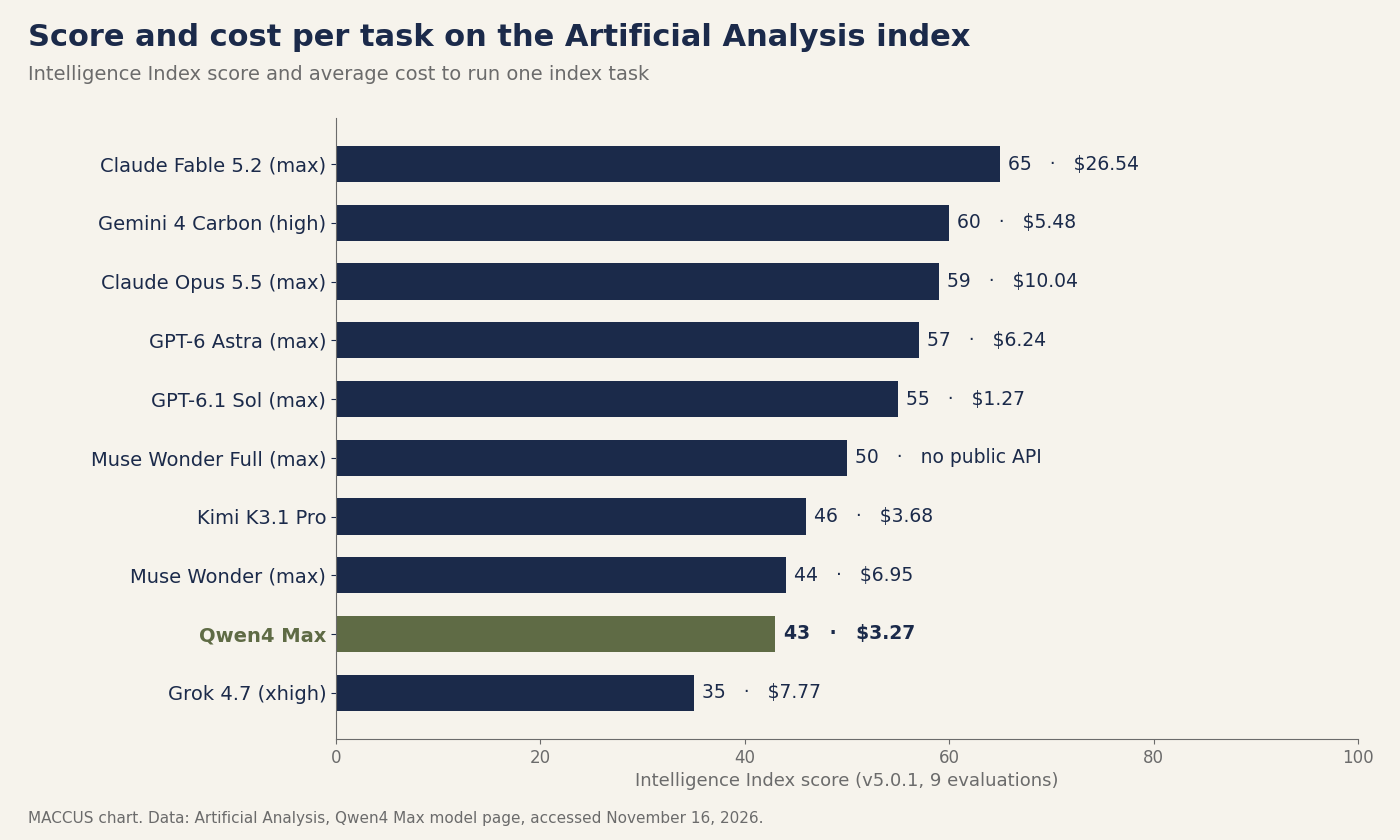
Artificial Analysis also measures the average cost of running one task from its index. Qwen4-Max averages $3.27 per task, against $10.04 for Claude Opus 5.5. OpenAI’s GPT-6.1 Sol costs $1.27 per task and still scores 12 points higher.
Qwen4-Max is also wordy. It produced 127 million tokens to complete the index, against a median of 78.6 million, and Artificial Analysis rates it “very verbose.” Every extra token is billed, so wordiness eats into the savings from a low per-token price.
Cost per task has become a launch pitch. On November 9, Meta used it for its Muse Ember model, which it says matches Anthropic’s Claude Haiku 5.5 at about a third of the cost per task.
Unchecked claims and open questions
The use cases in the launch post are Alibaba’s own accounts, with no independent verification. One comes from production sites of two automotive companies, SANF and Pacific Union. There, Alibaba says, the manual work to program the machining of a part fell from about 475 minutes to 24.
The safety results also come from Alibaba. Last Secure Code Bench checks whether the code a model writes is both correct and secure. On it, the share of functions (blocks of code) that pass both checks rises from 22.0% for Qwen3.8-Max to 31.8% for Qwen4-Max. Alibaba’s own security experts say “no capabilities posing large-scale cybersecurity risks have been observed.”
Open weights, which anyone can download, are promised, but for later and for other models. Qwen’s account on X says the weights of smaller Qwen4 models “will be released,” with no date, size or license. Trending Topics notes that Alibaba has kept its Max models on its own online service since Qwen2.5-Max.
On hosting, the QwenCloud page for Qwen4-Max shows its Singapore region, and neither that page nor the launch post mentions servers in Europe.
What it means
Alibaba is competing on price first. A Qwen4-Max token costs a quarter less than a Qwen3.8-Max token and far less than an Opus 5.5 token. Its efficiency gains are measured only against Qwen3.8-Max, on tests Alibaba chose.
Against rivals, Alibaba’s own data is less flattering. Qwen4-Max finishes first on only 4 of 16 tests and trails Opus 5.5 on most of the coding and vision tests. The independent Artificial Analysis index puts it in the middle of the pack.
Price per token and cost per task tell different stories. On the Artificial Analysis index, Qwen4-Max costs about a third as much per task as Opus 5.5 and scores 16 points lower. It also costs more than twice as much per task as GPT-6.1 Sol, which ranks higher.
The launch mainly concerns companies that pay for AI by usage, through an API. They must also be able to do without servers in Europe, which Alibaba has not announced. For companies that want to run a model on their own servers, as Revolut does, Qwen4-Max is not an option. Only the smaller Qwen4 models promised as open weights could be.
Still to watch: independent coding results; the date, size and license of the open Qwen4 models; and whether Qwen4-Max gets a European server region.
Sources
- Qwen4-Max: Your New Teammate Has Arrived, Qwen team (Alibaba), November 16, 2026
- Qwen4-Max announcement, Qwen (@Alibaba_Qwen) on X, November 16, 2026
- Qwen4-Max, model page and pricing, QwenCloud, accessed November 16, 2026
- Qwen3.8-Max, model page and pricing, QwenCloud, accessed November 16, 2026
- Qwen4 Max: Intelligence, Performance & Price Analysis, Artificial Analysis, accessed November 16, 2026
- Pricing, Anthropic, accessed November 16, 2026
- Alibaba Unveils AI Model With Stronger Performance at Lower Cost, Dow Jones Newswires (Tracy Qu), November 16, 2026
- Alibaba’s Giant Qwen4-Max Model Trails Claude, GPT and Moonshot AI, Trending Topics, November 16, 2026
Header image: MACCUS chart. Data: Alibaba (Qwen team), blog post of November 16, 2026