At a rural boarding school in China, 4,000 pupils learn their core subjects from lessons made by AI, the headmaster told Reuters for an investigation published on November 16. Most are children of migrant workers who left for jobs in the cities. The school faces a problem China’s wealthy cities rarely have: a shortage of qualified teachers.
The school, Funan County Qinqing High School, is in Anhui, an inland province west of Shanghai. The Reuters investigation looks at China’s drive to bring AI into its classrooms. China has almost 200 million primary and secondary students, and the government wants all of them literate in AI by 2030, Reuters reported.
Research on what AI does to learning points both ways. A study of 26,811 secondary students in one county in central China found that adopting AI raised homework scores by 18%. Within six months, though, scores on monthly exams fell 20%. Most of the drop came from students whose fast, high-scoring homework suggests the AI did it for them.
Qinqing’s tablets, AI tutors and young teachers
Qinqing’s students follow personalized classes on tablets. When they get stuck, AI tutors ask them questions instead of handing over the answer, headmaster Yang Tianliang told Reuters. The school makes its texts, images, interactive lessons and videos with Chinese AI models: Alibaba’s Qwen, plus models from TikTok owner ByteDance and Beijing-based Z.AI.
“An AI agent doesn’t suffer from fatigue, and it never makes a student feel stupid for asking a basic question,” Yang said.
He credits the approach with helping lift the school’s university admission rate from below 60% to 90% in recent years. Reuters could not verify those figures. He estimates that at least 200 other Chinese schools are experimenting with similar systems.
Qinqing’s use of tablets and AI software predates ChatGPT, which OpenAI released in November 2022. A 2023 promotional article on the Chinese website China.com described Qinqing as a private boarding school. Its stated goal, the article said, is the best education for “left-behind children,” whose parents work in distant cities. The school brought in an AI learning system in February 2022, according to that article.
A 2025 profile of Yang in Jiaoyu Liaowang, a Chinese education magazine, says the school gave tablets to its first-year classes in September 2017. The profile describes a division of labor: in science subjects, AI presents the course material and teachers answer questions, while humanities classes stay teacher-led. It puts the teachers’ average age at 26.
Binding plans in nearly half the provinces and municipalities
Nearly half of China’s provinces and municipalities (big cities with the rank of a province, such as Beijing and Shanghai) have rolled out binding “AI+ education” plans, Reuters found. Shanghai requires at least 30 hours of teaching on AI skills per grade each year. The Beijing city government plans 100 AI pilot schools and wants AI used to monitor student health. Ningxia and Gansu plan to put AI literacy into high-stakes school entrance exams by 2027.
China’s government sees AI as key to its economic future and its tech rivalry with the United States, Reuters notes. The push also reaches industry: China’s industry ministry says the country produced more than 40,000 humanoid robots in six months. For schools, the United States relies on decentralized, nonbinding guidance with no dedicated funding, according to Stanford University’s 2026 AI Index, cited by Reuters.
Nationally, the Ministry of Education presented an AI + Education Action Plan in April, issued by five central government departments. It calls for AI education in local curricula nationwide and AI courses for rural and remote schools through national platforms. For teachers, it calls for a national AI literacy standard and AI knowledge in qualification exams.
Reuters reviewed more than 100 government purchasing documents and found at least $31 million committed over the past year to AI classroom equipment, training and teaching platforms. Reuters says the real total is likely far higher, spread across thousands of local budgets.
The plans go beyond teaching. In the provincial documents Reuters reviewed, Guizhou is adding AI facial recognition and behavioral analysis to classrooms. Shanghai is deploying systems that monitor students’ mental and physical health. In Yunnan, lessons in 14,000 classrooms are slated to be recorded and analyzed by AI.
Reuters calls the effort “sweeping but uneven.” “Implementation is all over the place,” said Ted Mo Chen, chief of staff at ClassIn, a Chinese education technology startup. At the elite end, the $39,000-a-year Beijing New Talent Academy runs its own AI, robotics and programming curriculum. One 13-year-old student there has built more than 200 apps with AI.
Better homework, worse exams
The homework and exam figures come from a study by David Strömberg, Victor Lei and Yanhui Wu. It came out in June as a discussion paper of the Centre for Economic Policy Research (CEPR), a European network of economists. It covers 26,811 students in grades 7 to 12, roughly middle and high school, in one county in central China. Drawing on 30 months of school records in nine subjects, it compares students who had started using AI with those who had not yet.
By June 2025, about 80% of the students in the study said they used generative AI, up from almost none in September 2022. The authors reported this in a column on their findings on the economics website VoxChina. The most common tools were Doubao and DeepSeek, Chinese general-purpose chatbots with no special teaching features.
Once students adopted AI, a homework assignment took them about 45 minutes instead of 64, and their homework scores rose 18% above their pre-AI average. Within six months, their monthly closed-book exam scores fell 20% below their pre-AI level. Entrance exams took a slower hit. Scores fell 24% on the high-school entrance exam and 18% on the college entrance exam, with the full effect showing after about two years.
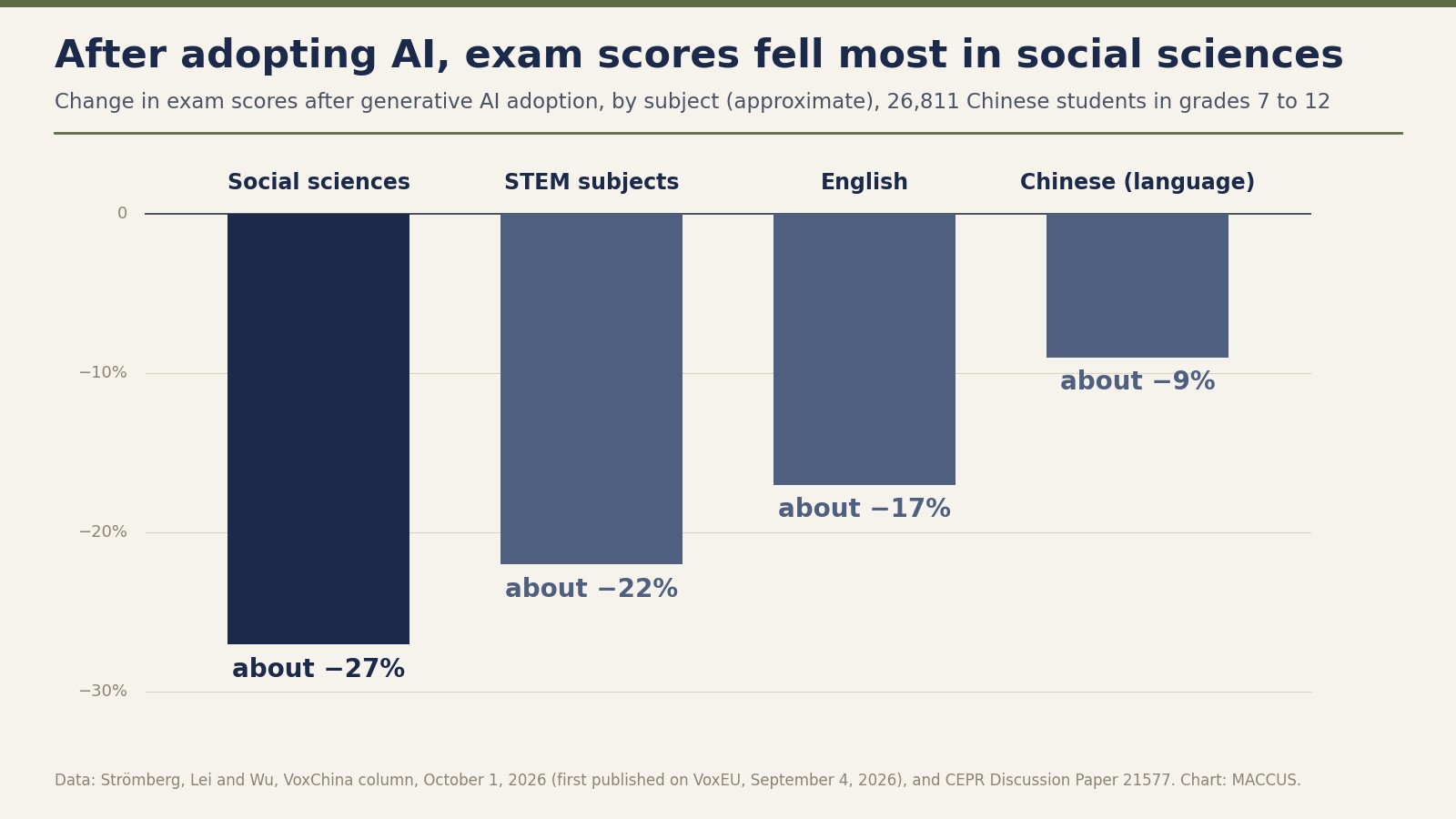
By subject, exam losses were largest in social sciences, at about 27%, against about 22% in STEM subjects, 17% in English and 9% in Chinese language. Middle-school students, high achievers and boys lost the most.
The results split by how students used the tool. After six months, about four in five AI users finished their homework in under 50 minutes, faster than the fastest students without AI. Their homework scores were very high and their exam scores markedly worse, a pattern the authors read as outsourcing the work to the AI. The other fifth kept spending about as much time on homework as non-users, with similar exam scores.
Reuters also reported a separate national survey of more than 320,000 Chinese students this year. Those who used AI at least three times a week showed weaker memory, comprehension, analytical and creative skills than less frequent users. Reuters notes that the findings do not establish causation.
Exams are a concern elsewhere too. In the UK, where 94% of undergraduates use AI on graded work, England’s higher education regulator wants far more AI-free assessment. In South Korea, the top scorer of this year’s tax accountant licensing exam said on November 15 that AI gave him his answers.
What the evidence does not show
Qinqing’s figures all come from its headmaster: the 4,000 pupils, the admissions rise and the 200 other schools. Reuters could not verify the admission figures and cites no independent evaluation of the school’s results.
The CEPR study is a discussion paper that has not been peer reviewed. It covers one county, and the authors write that the size of its effects cannot be applied directly to other places.
Students also chose how to use AI. The authors note that those who kept spending time on homework may differ in motivation, information or AI skills. Requiring more homework time would not necessarily restore learning, they write.
Many of the provincial measures are still plans. China has no standard way yet to measure AI literacy, Reuters found. “Mature, widely adopted assessment rubrics for compulsory school-level AI competency are still being built,” said Selena Guo, portfolio lead at the research firm China Policy. China’s education ministry did not respond to Reuters’ request for comment.
What it means
China is moving AI in schools from pilot projects to binding plans in nearly half its provinces and municipalities, a degree of coordination Reuters found nowhere else. Qinqing shows the appeal for schools short of teachers: Yang says AI now handles core subjects for its 4,000 pupils.
The CEPR study suggests that how students use AI decides much of the outcome. “In China and many other countries, well-designed tutoring tools already exist, often at nearly zero cost. Most students just do not use them,” the authors wrote. Qinqing says its AI tutors ask questions rather than give answers, but Reuters cites no outside measure of whether its students learn more.
The next tests are the 2027 entrance exams in Gansu and Ningxia, a journal’s review of the CEPR paper and the AI assessment standard Guo says is still being built.
Sources
- Inside China’s drive to build an AI-native generation, Reuters (via Euronext), November 16, 2026
- China aims to build an AI literacy system, Chinese government portal (english.www.gov.cn), April 15, 2026
- The Generative AI Learning Penalty: Evidence from Chinese Secondary Education, CEPR Discussion Paper 21577 (RePEc listing), June 2026
- The Generative AI Learning Penalty in Secondary School, VoxChina (David Strömberg, Victor Lei, Yanhui Wu), October 1, 2026
- 安徽阜南亲情高中携手“河马爱学”,让个性化教育在乡村成为可能, China.com (from Jinbao Online), August 31, 2023
- 以数智革新重构教育生态, Jiaoyu Liaowang magazine, July 28, 2025
Header image: MACCUS chart drawn from Strömberg, Lei and Wu, CEPR Discussion Paper 21577 (June 2026) and their VoxChina column (October 1, 2026)