In the UK, 94% of undergraduates now use AI to help with work that counts toward their grades. That figure comes from the latest yearly survey by the Higher Education Policy Institute (HEPI), a UK think tank. Most often, that means asking a chatbot to explain a concept, summarize a reading or help structure an essay. A smaller group goes further: 12% say they have pasted AI-generated text straight into an assignment, up from 3% in the 2024 survey.
On November 11, 2026, England’s higher education regulator, the Office for Students (OfS), said many universities still grade students on work that AI can do for them. For graded assignments done without supervision, such as essays written at home, “it is frequently possible to complete them to a high standard using AI tools,” its report says. The report adds that the evidence suggests AI detection tools “do not consistently and reliably identify AI use.”
The regulator now wants “far greater use of AI-free assessment,” such as in-person exams, and it can sanction universities that fall short. Its rules still allow AI where an assessment tests what the course teaches.
From half of students to nearly all in two years
HEPI has surveyed UK undergraduates yearly since 2024, with sponsorship from Kortext, a company that sells AI-powered study tools to universities.
In the first edition, published in February 2024, 53% of students said they had used generative AI tools, such as chatbots, to help with graded work. A year later, the figure was 88%. The 2026 edition, published on March 12, 2026, put it at 94%. That poll covered 1,054 students in December 2025.
The regulator’s report opens with the same figures, dated by when students were polled: the share “has risen from 53 per cent in late 2023 to 94 per cent in late 2025.”
A related shift shows up in France, where the Wikipedia pages teenagers open for homework lost much of their back-to-school surge in the school year ChatGPT arrived.
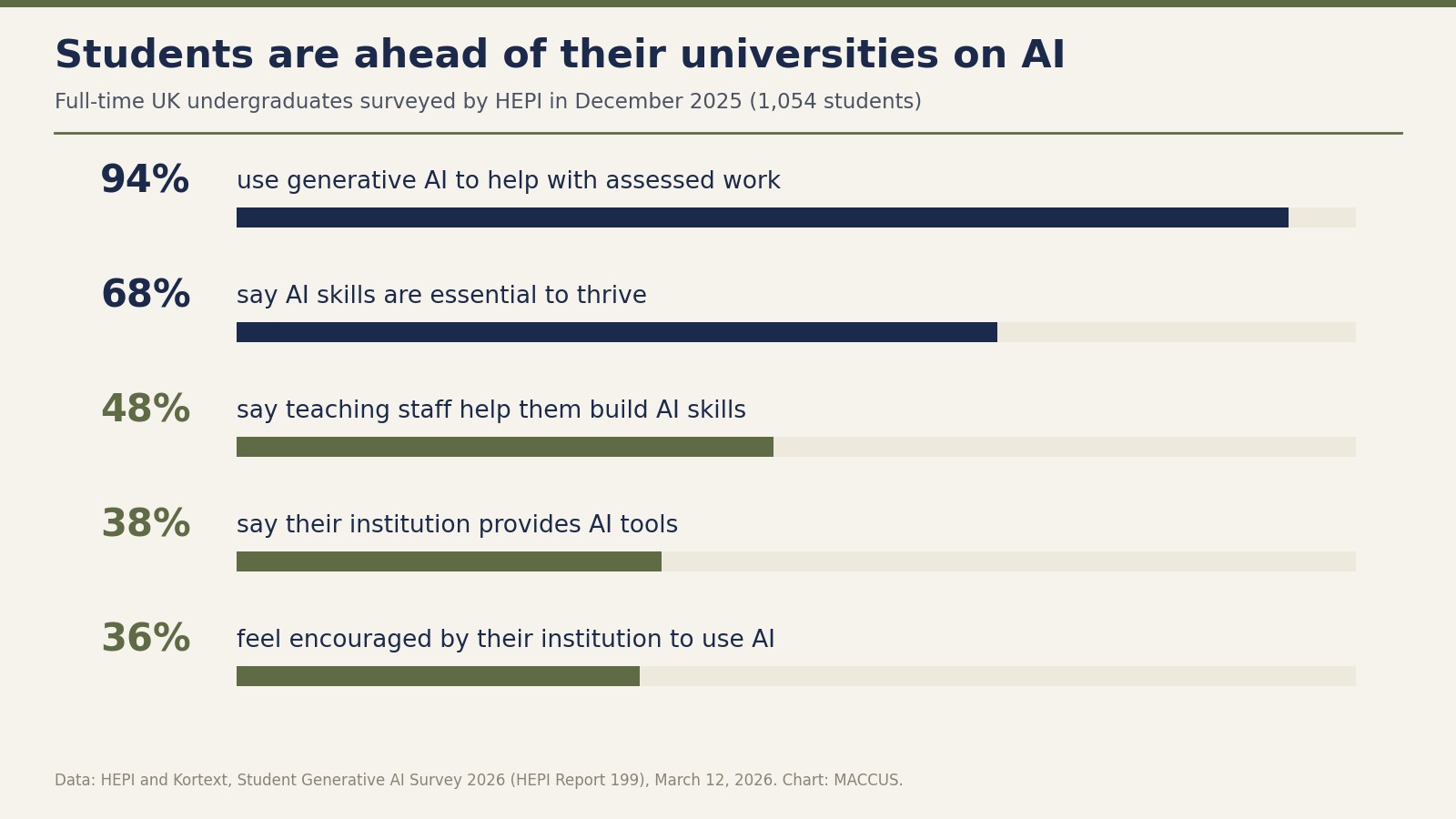
Universities have moved more slowly than their students. In the 2026 survey, only 36% of students said they feel encouraged by their institution to use AI, and 38% said it provides them with AI tools. More than two-thirds (68%) called AI skills essential, but only 48% said their teaching staff help them build those skills.
In the same survey, 65% said AI has already changed significantly how they are assessed.
The job market they are heading for is changing too. At Anthropic, the company behind the Claude chatbot, juniors have fallen from 27% to 9% of technical hires since early 2025. In the US, early counts show about 12% fewer undergraduates are studying computer science this fall than a year ago.
What students and staff told the regulator
The OfS wrote its report with Advance HE, a membership organization for universities. The report draws on events and interviews held from June to September 2026. In total, 244 staff members and 91 students and student representatives took part, from at least 127 institutions, most of them in England.
The report’s central finding concerns unsupervised work, such as essays written at home and submitted online. Many of these assessments “can be completed to a high standard using AI tools with limited engagement from students,” it says. Participants described degree programs graded through essays submitted remotely as particularly vulnerable.
Students told the regulator about classmates who had completed assessments with AI, “sometimes in just a few minutes.” Those classmates got grades similar to those of students who did the work themselves, they said. “Some students described their peers being unable to recall basic details about the assessment they had just submitted,” the report says.
“Coursework is now overwhelmingly written in part, or exclusively, with the help of AI. Presentation slides fare no better,” one staff member wrote. Another said that “pervasive use of AI may render our assessment of students close to impossible in some areas.” That phrase, from one staff member, became the Guardian’s headline on November 11.
Proving misuse after the fact is hard, the report adds. “It is usually not possible to conclusively establish whether a student has adhered to their institution’s AI policy.”
Participants also raised a fairness problem. A student who pays for the most advanced AI model may get a higher grade than a classmate with the same knowledge who uses a cheaper model or none.
On unsupervised assessments, the regulator concludes, grades are “likely to reflect students’ access to AI tools and their proficiency in using them,” rather than the knowledge and skills the assessments are meant to measure.
The rules England now applies
To stay registered with the OfS, universities in England must meet a set of rules called conditions of registration. One of them, known as B4, requires every assessment to be “valid” and “reliable,” so that degrees reflect what students actually know and can do.
In a press release on November 11, the OfS said it will require universities to meet that standard. It added that “in many cases, this will require the use of secure (AI-free) assessments.” The same release says institutions “must also ensure courses are up-to-date and require students to develop relevant skills.” Its title asks universities to help students develop AI skills.
The regulator’s compliance guidance, published the same day, defines secure assessments as those designed to prevent AI use. Examples include in-person exams, presentations, vivas (oral exams), performances and practical tasks. Where universities allow AI, assessments must still show that students met the course’s learning outcomes (what it sets out to teach), “which may include the effective use of AI.”
When a university falls short, the OfS says it can impose conditions specific to that university, fine it, or suspend its access to student support funding and OfS grants.
“AI is rapidly reshaping higher education,” said Josh Fleming, the OfS director of strategy and delivery. He called it both “a huge opportunity” and “a generational risk to the system as it stands.” He added: “We need to see far greater efforts to tackle these risks, including far greater use of AI-free assessment.”
The UK government’s Department for Education said it expects the OfS to make its regulatory framework “explicit, strong and durable on the use of AI,” the Guardian reported. Universities UK, the umbrella group for 147 institutions, told the paper that many universities had already changed how they assess students. It cited “more in-person exams, presentations, vivas, process-based assessment and assessments that integrate AI in a controlled way.”
The limits of the evidence
The OfS report is not a survey. Its participants volunteered, and the regulator warns that they “may not be fully representative” of students and staff. The report has no percentages of its own. The ones it cites come from outside surveys, which put the share of students using AI for academic work between 74% and 94%. The “close to impossible” line is one staff member’s view, quoted in the report.
HEPI’s 94% counts any AI help on graded work, from explaining a concept to editing a draft. Each year’s figure comes from a different group of about 1,000 to 1,250 students, with a margin of error of about 3 percentage points in the last two editions. The 2024 poll was run by UCAS, the UK university admissions service, rather than by the polling firm used since.
The OfS report also lists the costs of secure assessments. In-person exams and vivas are particularly resource-intensive, participants said. Some also said closed-book exams “bear little resemblance to the activities students will complete in professional environments.” That format may disadvantage some students, such as disabled students.
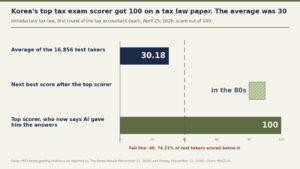
Wearable devices may also make cheating easier in exams and other secure assessments, the report notes. In South Korea, the top scorer of this year’s tax accountant licensing exam said in November that a miniature camera and an AI tool gave him his answers, and his proctors noticed nothing.
What it means
By HEPI’s count, AI help on graded work went from about half of UK undergraduates to nearly all of them in two years. Universities moved more slowly. England’s regulator has now put in writing what staff had been telling it: on unsupervised work, a grade may reflect a student’s access to AI tools more than what the student knows.
The regulator’s answer still leaves room for AI. It wants far more secure assessment because, by its own findings, an essay written at home no longer reliably shows what a student knows. It also accepts assessments that allow AI, provided they still test what the course is meant to teach. Each university now decides, course by course, how much to bring back in-person exams and how much to grade students on how well they work with AI.
The first thing to watch is the OfS: whether it opens investigations or sets conditions on universities over how they assess students. Universities will also have to pay for more exams and vivas, which participants in the OfS report called resource-intensive. HEPI’s next survey will show whether the share of students who paste AI text straight into their work, 12% in the latest edition, keeps rising.
Sources
- Making AI work for students: reflections on institutional practice, Office for Students and Advance HE, November 11, 2026
- Universities should help students develop AI skills while protecting confidence in degrees, Office for Students, November 11, 2026
- Effective institutional practice in AI, Office for Students, November 11, 2026
- Student Generative AI Survey 2026 (HEPI Report 199), HEPI and Kortext, March 12, 2026
- Student Generative AI Survey 2025, HEPI and Kortext, February 26, 2025
- Provide or punish? Students’ views on generative AI in higher education, HEPI and Kortext, February 1, 2024
- AI has made it ‘close to impossible’ to assess university coursework, regulator says, The Guardian (Richard Adams), November 11, 2026
Header image: chart by MACCUS from the HEPI and Kortext Student Generative AI Surveys 2024 to 2026 and the Office for Students, November 11, 2026