Between October 6 and November 10, 2026, four physicists posted papers on a particle physics problem only partly solved since 1998. The question is how to define the Standard Model, and theories like it, on a lattice, a grid of points standing in for space and time. Each paper says an AI model did part of the work.
The first, by Nathaniel Craig of UC Santa Barbara, calls its central proof “Astra-led”. Astra is OpenAI’s GPT-6 Astra model. The third, by Edward Witten of the Institute for Advanced Study in Princeton, credits Anthropic’s Claude Opus 5.5 with suggesting a variant of one step.
On November 15, Craig explained the work on OpenAI’s new science blog. He calls the result “a candidate nonperturbative lattice definition for the Standard Model”. Nonperturbative means it does not treat the forces as small corrections. He adds that a key piece of it “remained open for more than 25 years.”
The four papers came out within 35 days, from four academic institutions, and used AI models from two rival labs. None has been peer reviewed yet.
A grid that adds particles nobody asked for
The Standard Model describes the known elementary particles and three of the four fundamental forces. Physicists usually compute with it by treating interactions as small corrections, a method called perturbation theory. Some questions, such as where most of the proton’s mass comes from, need methods that keep the interactions at full strength. For the strong force, which binds quarks inside protons, the standard tool is a lattice, a finite grid that a computer can handle.
The obstacle is the weak force, which drives some radioactive decays. It acts differently on left-handed and right-handed particles, mirror images of each other. That makes the Standard Model a “chiral” theory.
Fermions are the matter particles, such as electrons and quarks. Put a left-handed fermion on a grid in the most natural way, and a right-handed partner appears that nobody asked for. Physicists call this fermion doubling. A 1981 “no-go” theorem by the physicists Nielsen and Ninomiya pins down why it is so hard to avoid.
Later work removed the extra particles with a construction called overlap fermions. One piece was still missing: a consistent phase for the fermions, a kind of bookkeeping that depends on what the force fields do at every grid point. The physicist Martin Lüscher settled it for a simpler case, a chiral version of electromagnetism, in a paper submitted on November 25, 1998.
Craig’s construction and the Astra-led proof
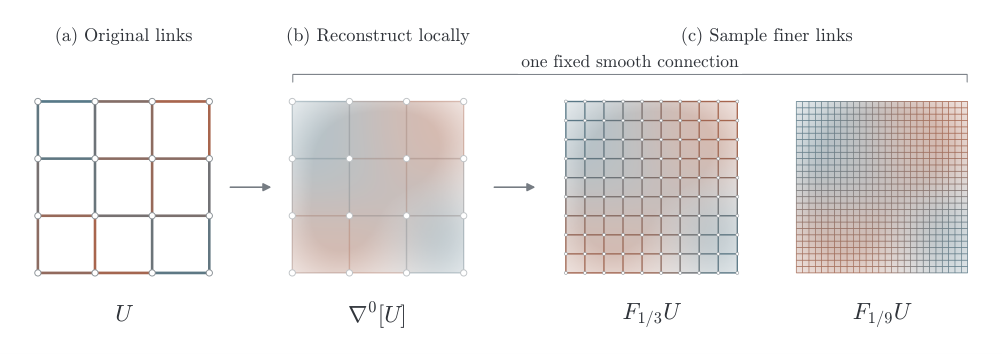
Craig’s idea was to redraw the force fields on finer and finer grids and add up the small phase differences from each grid to the next. A figure in his October 6 paper shows the fields carried onto grids with one-third and one-ninth of the original spacing.
Craig writes that he proposed the strategy, which went through “several rounds of iteration with Astra and outside experts before arriving at the current Astra-led proof.” The manuscript “combines author-written sections with extensive rewrites of the Astra-composed proof.” Its acknowledgments say GPT-6 Astra “was essential to this result.” The paper gives Craig’s affiliations as UC Santa Barbara and OpenAI.
Astra also ran the checks that Craig and his colleagues proposed. They included a translation of the paper’s mathematical statements into Lean, a language whose software checks every step of a proof. According to the paper, all sixteen Lean modules passed that check without errors and used no unproved placeholders.
In his blog post, Craig says Astra “suggested the right way to carry a given set of force fields onto finer grids” and “took the lead in developing the detailed proof.” He names three lattice specialists, Maarten Golterman, Andreas Kronfeld and Yigal Shamir, who “spent time looking over Astra’s proof and asking probing questions.”
Three more papers in five weeks
On October 21, Stephen Hsu of Michigan State University posted a paper that takes a different route. It puts the force fields and the Higgs field, which gives particles mass, on a lattice. Quarks and leptons, such as the electron, stay in continuous space.
Hsu’s acknowledgments say: “The technical details in the Appendix are entirely AI-led results (mostly GPT Astra with verification by Claude and other models).” A revised version on November 6 adds a result about Craig’s construction: for weak fields, it agrees with the continuous-space treatment apart from local correction terms.
On November 3, Witten posted a 33-page note. He is a string theorist who won the Fields Medal, a top prize in mathematics, in 1990. In the note, he writes that “Craig overcame the difficulties and, with the aid of several new ideas, finally constructed a lattice regularization of chiral gauge theories in enough generality to encompass the Standard Model.” Witten then describes a variant of Craig’s construction that, he notes, Hsu had also proposed.
In the main text, Witten writes that “Anthropic’s Claude Opus 5.5 suggested a likely variant” of one step, the one that turns grid data into a smooth continuous field. He also notes that Opus 5.5 described a second variant. His acknowledgments add: “Assistance on many details was provided by Claude Opus 5.5.” Hsu and Witten each thank a colleague for pointing them to Craig’s paper.
On November 10, Dorota Grabowska of the University of Washington’s InQubator for Quantum Simulation posted her own lattice construction in Hamiltonian form. That form describes how the system evolves in time, and the paper calls it a starting point for building quantum circuits, the programs that run on quantum computers. Her construction takes a separate route, placing the theory on the boundary of an extra dimension. The paper cites Craig, Hsu and Witten as other candidate definitions.
Grabowska’s disclosure says Claude “generated much of the code,” “produced the figures to the author’s design” and helped draft the text. It also says: “The ideas are the author’s.”
The four papers credit AI for different jobs. Craig describes an AI-led proof, Hsu an AI-led appendix, Witten a suggested variant and help with details, and Grabowska code, figures and drafting.
Open questions and unchecked claims
All four are preprints on arXiv, the open server where physicists post papers before review. Craig calls his construction “much more a beginning than an end” and “far more an answer in principle than an answer in practice.”
Craig’s paper and blog post list open questions. One is reflection positivity, a condition that helps connect the grid calculation to a quantum theory in which probabilities are conserved. The paper adds that “a definition of the interacting continuum theory remains open.” That is the full theory, forces included, without the grid.
Hsu proves reflection positivity only in a special case, with the Yukawa couplings and a parameter called theta switched off. The Yukawa couplings give quarks and leptons their mass. His proof is for a modified version of the construction, and Hsu writes that its equivalence with Craig’s original “is not proved.”
Witten’s abstract says the lattice approach can run on a computer “in principle, but not in practice by Monte Carlo methods,” the random-sampling technique behind most lattice simulations.
Craig’s paper also warns that Lean verification is not “the final word in physics,” since much more can go wrong in physics than a gap in the logic. None of the three specialists Craig thanks has posted an assessment on arXiv. Craig’s account ran on the blog of OpenAI, which his paper lists as one of his affiliations.
Craig’s post adds that OpenAI has proved the existence of the simplest unified theory containing the Standard Model’s force fields and fermions in continuous spacetime. We could not find a public version of that proof. On November 10, a panel chaired by the Nobel laureate David Gross backed part of OpenAI’s Yang-Mills existence proof. The panel lists a second OpenAI submission, dated November 4, as “work in progress” without saying what it covers.
What it means
The result is a candidate definition, and lattice specialists will judge it. For more than 25 years, the full question drew only partial results; in five weeks, it drew four papers. The later ones cite and test the earlier ones: Hsu’s revision tests Craig’s construction, and Witten compares his route with both earlier papers.
The papers also mix the two labs’ models. Hsu checked GPT Astra’s appendix with Claude, and Witten used Anthropic’s model on a variant of a construction built with OpenAI’s.
Both labs have other recent physics results. In September, a plasma physicist credited GPT-6 Astra Pro with counterexamples to a 1967 fusion conjecture. In October, Anthropic reported that Claude had designed quantum circuits cheaper than the best published ones.
The Gross panel’s repository now asks authors of proposals on “chiral SU(5),” the symmetry group Craig’s construction starts from, to file them under that category. Next to watch: a public verdict from the specialists Craig consulted, a proof of reflection positivity for his original construction, and a method that turns the definition into simulations people can run.
Sources
- A step toward defining the Standard Model on a lattice, Nathaniel Craig, OpenAI, November 15, 2026
- A gauge-invariant measure for lattice chiral fermions, Nathaniel Craig, arXiv, October 6, 2026
- The Standard Model on a finite bosonic lattice with continuum Weyl fermions, Stephen D. H. Hsu, arXiv, October 21, 2026, revised November 6, 2026
- A Note On Lattice Definition of Gauge Theories With Chiral Fermions, Edward Witten, arXiv, November 3, 2026
- Lattice Hamiltonians for Chiral Gauge Theories, Dorota M. Grabowska, arXiv, November 10, 2026
- Abelian chiral gauge theories on the lattice with exact gauge invariance, Martin Lüscher, arXiv, November 25, 1998
- yang-mills-group/YM, results repository, Yang-Mills group, GitHub, updated November 15, 2026
Header image: chart by MACCUS, data from the four arXiv preprints, Martin Lüscher’s 1998 paper and OpenAI’s November 15, 2026 post