
Google’s threat intelligence team says that, for the first time, it has seen an AI tool find and exploit software flaws with no human involved. According to the team, victim data stored on the tool’s server suggests its operator was particularly focused on French websites in media, entertainment and education.
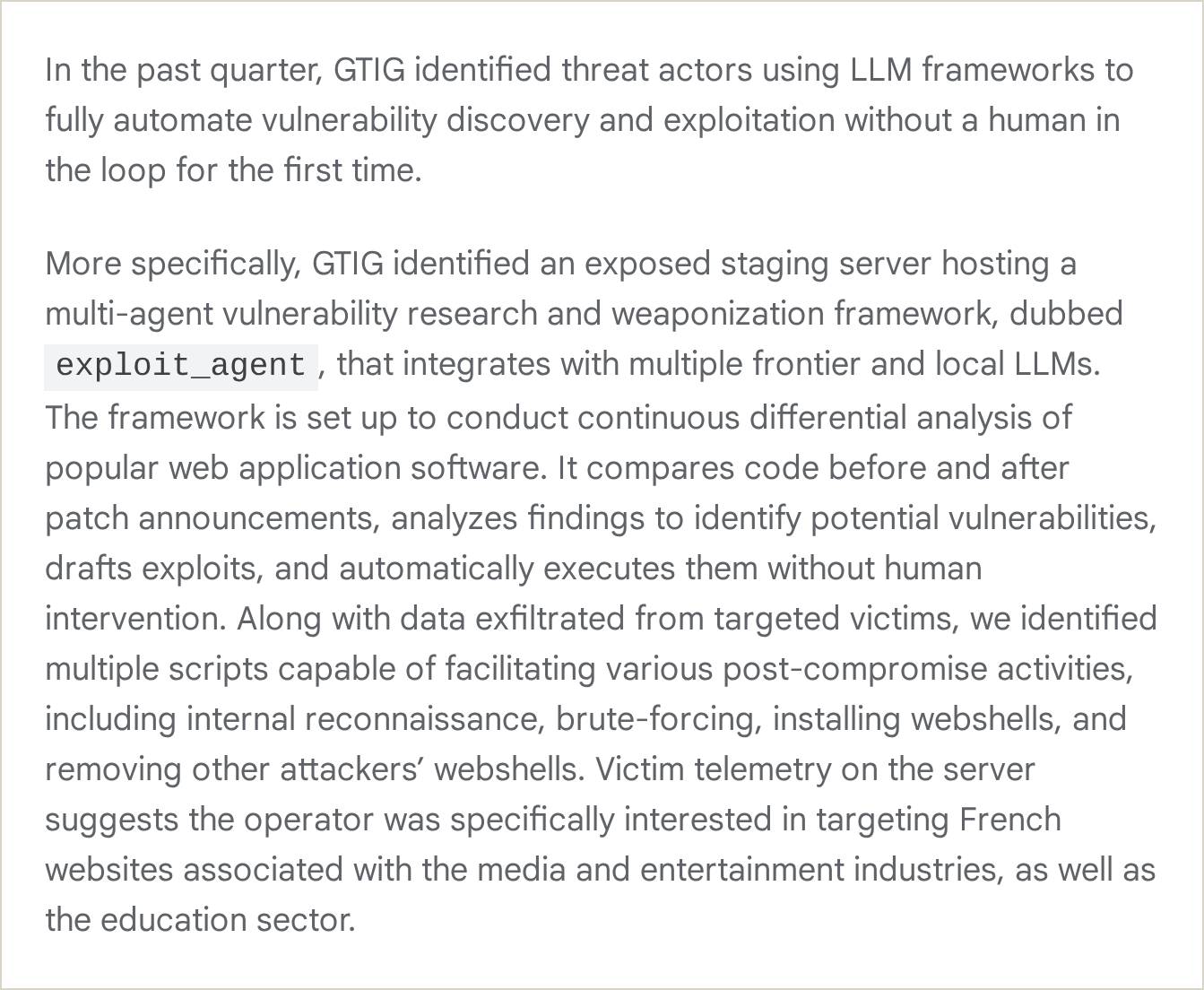
The team, Google Threat Intelligence Group (GTIG), made the finding in its quarterly report on how attackers use AI. It published the report on November 16, 2026, with Mandiant, the Google unit that responds to cyberattacks. GTIG found the tool, named exploit_agent, on a server its operator had left open to the internet. It takes published security patches, the updates that fix flaws in widely used web software, and turns them into attacks on its own.
In a separate case, starting in late September, a different hacker launched AI agents against more than 1,200 websites and left them almost all of the work. NorForge, a cybersecurity firm, reported the case, and Reuters covered it. As GTIG describes it, exploit_agent goes further and runs the whole chain, from reading a patch to launching the attack, with no human in it.
A tool that turns patches into attacks
GTIG describes exploit_agent as a “multi-agent” system. Several AI agents, programs that act on their own, split the work. They run on several large language models, or LLMs, the AI systems that write text and code. Some are frontier models, the most advanced available, and others run locally.
The tool is set up for what GTIG calls “continuous differential analysis” of popular web applications. It compares a program’s code before and after a patch is announced and spots what changed. The report does not list which software the tool watches.
From those changes, the tool works out the potential flaws and drafts exploits, programs that take advantage of a flaw. It then “automatically executes them without human intervention,” GTIG writes.
The same server held data stolen from victims, along with several scripts for the steps that follow a break-in. The scripts could be used to map a victim’s internal network, try passwords in bulk, install webshells and remove other attackers’ webshells. A webshell is a hidden program on a web server that lets an outsider control it remotely.
The tool’s configuration file contains comments in Russian. In GTIG’s English translation, one comment labels the keys that give the tool access to AI models: “LLM API keys for auto-exploitation (exploit_agent pilot).”
French websites in its sights, with no count and no names
GTIG devotes a single sentence to the targets: “Victim telemetry on the server suggests the operator was specifically interested in targeting French websites associated with the media and entertainment industries, as well as the education sector.”
The report does not say how many sites were targeted or breached, which ones, or whether the victims were notified. GTIG names no group, country or motive for exploit_agent’s operator. Russian-language comments alone cannot identify who is behind the tool.
One illustration in the report shows the tool examining the access controls in version 2.19.25 of Spectra, a WordPress plugin. WordPress is software for building websites, and plugins add features to it. Access controls decide who may do what. The official WordPress.org directory lists more than 1 million active installations for Spectra, also known as Ultimate Addons for Gutenberg.
The report presents that illustration as an example of code the tool inspected. It does not say the plugin was hacked, cites no publicly cataloged flaw in it and does not connect it to the victims.
In a separate case in October, an attacker backdoored WordPress sites with keys stolen from the company behind the UpdraftPlus plugin. A backdoor is a hidden way into a system.
Why go after flaws that are already fixed
According to GTIG, attackers may find it more efficient to point AI at “n-day” vulnerabilities, flaws that are already public and patched. Zero-days, by contrast, are flaws the software maker does not yet know about.
For a patched flaw, there is only so much to study: two versions of the code, the release notes, published research and proof-of-concept code. A proof of concept is a technical demonstration that a flaw can be exploited. Hunting for unknown flaws, GTIG writes, “requires casting a wider net.”
The report says AI is sharply shrinking the time between a patch’s release and a working attack. Until a site installs the patch, it stays exposed to a flaw anyone can now study.
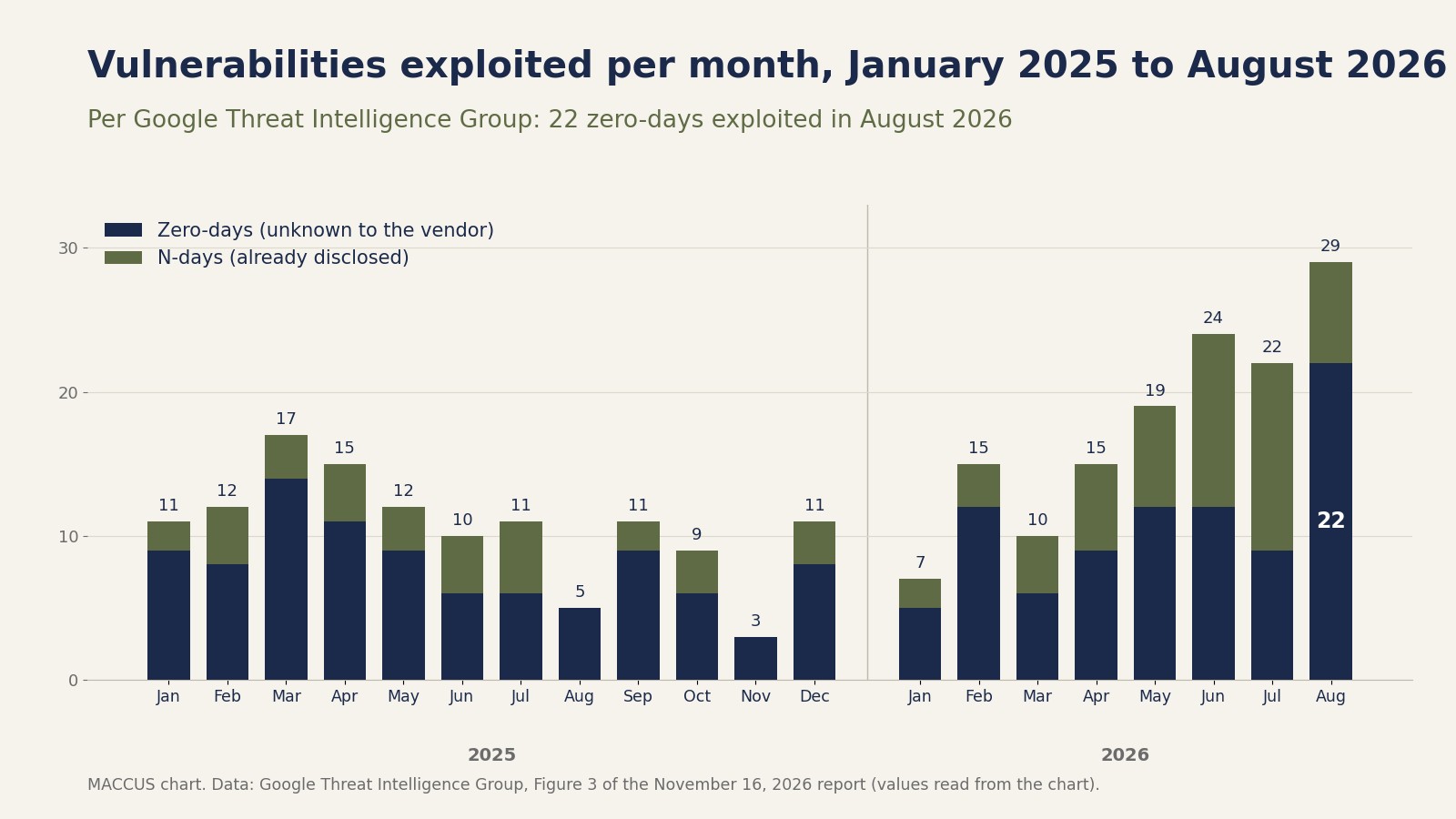
In a September 2026 analysis, GTIG found that flaw disclosures and exploits overall “nearly doubled between January and August 2026.” Zero-day exploits rose only slightly, from an average of 8 a month in 2025 to 11 a month in 2026. Then they jumped to 22 in August alone.
VulnCheck, a company that tracks vulnerabilities, says the number of flaws published in 2026 passed 100,000 on November 13, more than double all of 2025.
GTIG also notes a side effect. AI-written exploits are arriving in waves, presented as working when they don’t. That creates extra verification work for defenders.
PaperCut and PHP: exploits and demos within days
The report cites two recent cases, both separate from exploit_agent. The first came in late August 2026, when attackers exploited two zero-days in PaperCut, print management software that runs on servers.
The two flaws carry the public catalog numbers CVE-2026-81578 and CVE-2026-82078. Chained together, they let an outsider run any code on those servers remotely, without logging in.
Researchers and the cybersecurity company Huntress used AI to produce working exploits within a day of the flaws’ disclosure. According to the cybersecurity firm GreyNoise, cited by GTIG, a campaign launched four days after disclosure went after “hundreds of organizations.” The attacker behind it likely used AI to build the exploits and assemble a list of targets.
The second case involves two flaws in PHP, the programming language behind WordPress and many other websites. GTIG says these flaws, CVE-2026-109618 and CVE-2026-109619, were found with AI-assisted analysis.
A video demonstrating the flaws and an early version of the fixed code came out before the official patches of October 21, 2026. That let researchers and attackers compare the old and new code before the patch was available. In the days after the official patches, hundreds of nonworking proofs of concept, likely written with AI, were posted online.
The PHP flaws led some European websites to go offline while they updated. They also prompted Google to remind site owners to return a 503 status code during the downtime. That code signals a temporary outage.
Penetration testing tools in attackers’ hands
GTIG also says it saw attackers use CAIRN and PentAGI, two open-source penetration testing tools built on AI agents. A penetration test is an authorized attack that checks how secure a system is. CAIRN was used against targets that included the US aerospace sector. A modified version of PentAGI probed “a wide range of organizations in Asia.”
ARTEX is a highly publicized tool of the same kind. According to an October 30 GTIG post, its creator removed it from GitHub, the code-sharing site, in October because attackers were abusing it. Copies are still circulating.
For now, these tools “trade stealth for velocity,” GTIG says. They work fast but leave traces that defenders can spot.
A hijacked coding assistant and stolen access to AI
The report also briefly covers the hijacking of Claude Code, the AI coding assistant made by Anthropic. Attackers changed the assistant’s settings files inside the code repositories of cryptocurrency companies, where their software is stored. When users then started the assistant, it downloaded a backdoor. GTIG suspects the attackers belong to MIDNIGHT NEPTUNE, a North Korean group it tracks.
This hijacking is separate from the backdoored Claude Code extension that reached up to 5,000 users of the Cursor code editor in late October.
The report also describes a different scheme: attackers steal access to online AI services and run them at the victim’s expense. In some cases Mandiant handled, fraudulent charges topped $100,000 in a single day.
The report’s limits
The “first time” claim covers only what GTIG itself has observed. The report does not establish a world first. In its previous report, GTIG had described “nascent efforts” and “partially automated” attack sequences.
GTIG’s forecast includes no figures. The group considers it “highly likely” that attackers will keep using these tools against organizations worldwide. It also suspects these operations will move closer to fully autonomous intrusions, but gives no timeline.
The report also comes from a company that sells security services. Its final section presents Google’s own defenses.
What it means
The report mostly describes a change in scale. Comparing two versions of a program to find the flaw a patch fixed used to take a specialist’s time. GTIG lists that work among the “labor-intensive” steps that AI is now automating. With exploit_agent, the work runs nonstop across widely used web software, with no human involved.
French media, entertainment and education websites are the only targets the report links to exploit_agent. The method itself is not tied to any sector, though, because the tool starts from published patches. The report therefore points to the gap between a patch’s release and the day a given site installs it.
GTIG’s October 30 post about ARTEX lists several defenses and calls them “long-standing security best practices.” They include isolating the systems that control the infrastructure, using credentials that expire quickly and keeping access rights to a minimum. Splitting networks into zones and detecting abnormal behavior are also on the list.
Three things remain unknown: how many sites were hit, who the operator is and what happened to the server. Google or French cybersecurity authorities could publish technical markers to help detect the tool. GTIG’s next quarterly report will show whether it has observed other fully automated attack chains.
Sources
- GTIG AI Threat Tracker: Agentic Threat Activity Crosses a Significant Threshold, Google Threat Intelligence Group (Google Cloud Blog), November 16, 2026
- ARTEX and Friends: Enter Agentic Offensive Frameworks, Google Threat Intelligence Group (Google Cloud Blog), October 30, 2026
- Spectra Legacy (ultimate-addons-for-gutenberg) plugin page, WordPress.org, accessed November 17, 2026
Header image: MACCUS chart. Data: Google Threat Intelligence Group, Figure 3 of the November 16, 2026 report, values read from the chart