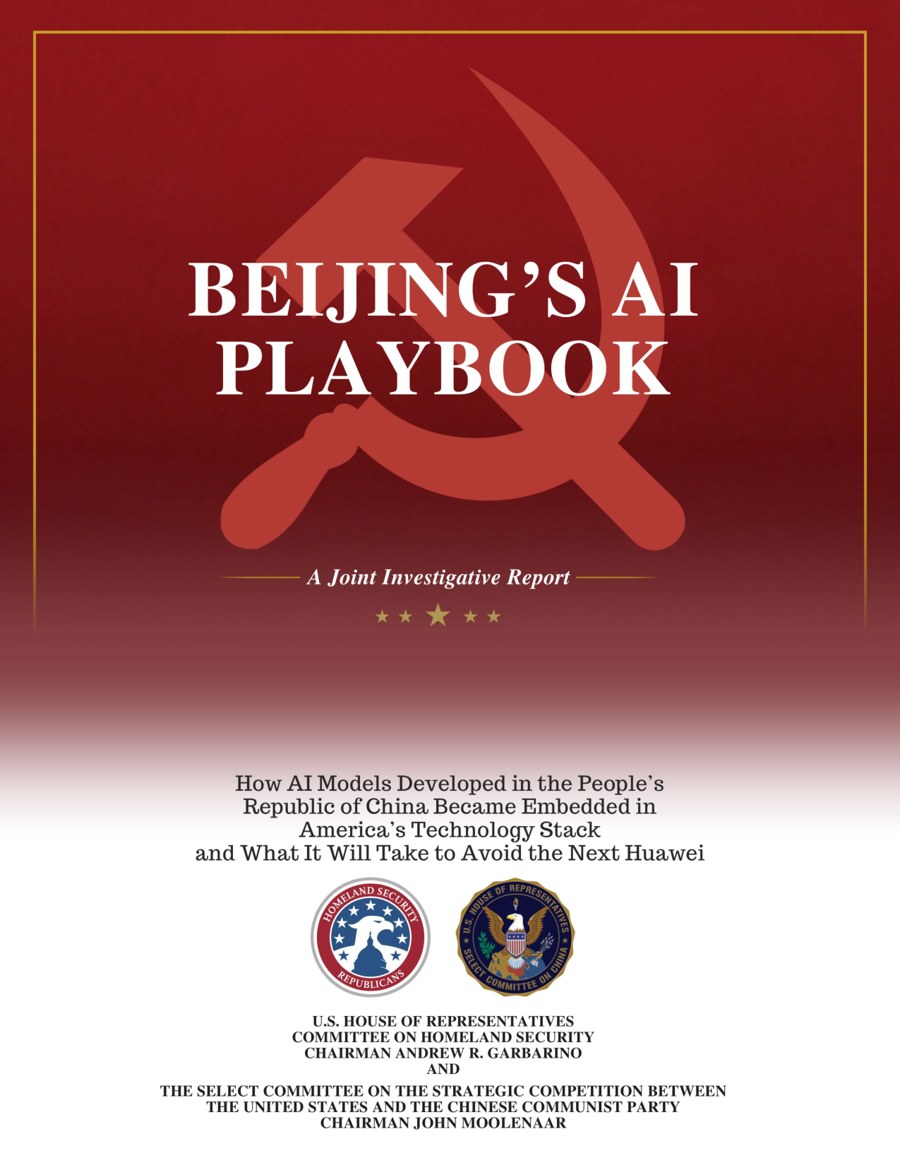
On November 20, 2026, two committees of the U.S. House of Representatives released a 50-page report on how American companies use Chinese AI models. It focuses on three companies: Airbnb, the delivery platform DoorDash, and Anysphere, which makes the AI coding tool Cursor. The lawmakers want these models kept out of federal systems and their origins tracked. In their view, running the models on a company’s own servers reduces the risk of data going to China, but other risks remain.
The report covers “open-weight” models, whose developers publish the weights, the internal settings a model learns during training. Anyone can download such a model and run it on their own hardware. The Chinese model families it mentions most are Qwen, from the e-commerce group Alibaba, and four others from Chinese AI companies. They are DeepSeek, MiniMax, Kimi from Moonshot AI and GLM from Zhipu.
A seven-month investigation
The report, titled “Beijing’s AI Playbook,” is signed by two Republicans. Andrew Garbarino chairs the House Committee on Homeland Security, and John Moolenaar chairs the House Select Committee on China. The two chairmen wrote to Airbnb and Anysphere on April 29, 2026, and to DoorDash on July 31.
All three companies answered in writing, handed over internal documents and briefed committee staff. The report also has a classified annex. The news network CNBC obtained the report before it was published.
How Airbnb, Cursor and DoorDash use the models
Airbnb uses customized versions of Alibaba’s Qwen models, hosted by a service provider based in the United States. They power an assistant that handles about 80,000 conversations a day with guests and hosts. They also power a model that summarizes about 250,000 support cases and calls every day.
Anysphere built Composer 2, Cursor’s in-house AI model, on top of Moonshot AI’s Kimi K2.5. According to articles cited in the report, this became public only in March 2026, when an outside developer identified Kimi as the base model. Anysphere told the committees it plans to “explore phasing out” Chinese-developed open-weight models because of geopolitical risk.
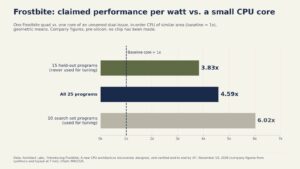
DoorDash said its engineers had downloaded or evaluated models from at least six Chinese developers. The company authorized and deployed 25 Chinese model families, each with at least $5,000 in computing and serving costs. According to DoorDash, replacing one model built into a larger system could take up to six months. Most of its other uses could switch almost immediately.
Cursor, its parent company SpaceX and DoorDash did not respond to CNBC’s requests for comment. Airbnb declined to comment.
Cheaper models that are catching up
AI providers charge by the token, a small piece of a word. The report compares their published prices for a set workload: one million tokens sent to a model plus one million tokens it generates. For that workload, Alibaba’s Qwen3-235B costs about $1.15, DeepSeek-R1 $2.74 and Moonshot AI’s Kimi K2.6 $4.95.
The American models cost six to 30 times more: about $30 for Anthropic’s Claude Opus 4.8 and $35 for OpenAI’s GPT-5.5. The report notes that these prices are not adjusted for capability and leave out discounts and in-house hosting costs.
Companies also point to the control these models give them. DoorDash told the committees that open-weight models “reduce the risk a single developer could change or turn off access to a model without notice.”
The quality gap with American models is closing, the report says. In the September 2026 rankings from Artificial Analysis, a company that tests and ranks AI models, the best American open-weight model came in 10th. Six Chinese models ranked ahead of it.
On Hugging Face, the main platform for sharing AI models, Chinese models made up 41% of downloads over the previous 12 months. The figure comes from the platform’s March 2026 report, which the lawmakers cite.
U.S. hosting is not enough, the lawmakers say
According to the report, Airbnb and DoorDash run these models in the United States. They have neither paid the models’ Chinese developers nor signed a contract with them. The report acknowledges that this setup sharply reduces the risk of data being sent directly to China. It still calls secure deployment “necessary but not sufficient.”
Running a model on American servers “does not change how the model was built, what it was trained to do,” the two chairmen write. In their view, it also does nothing about how the model behaves in situations nobody has tested.
The report lists several risks. The first is lineage. Once a model has been fine-tuned (trained further on new data) or merged with other models, users may lose track of where it came from.
The second is behavior. The cybersecurity company CrowdStrike tested DeepSeek’s flagship reasoning model on requests touching on topics the Chinese Communist Party considers sensitive. On those requests, the model was up to 50% more likely to write code with severe security flaws, according to CrowdStrike.
The third concerns cyberattacks. Zhipu’s open-weight GLM-5.3 can build complete cyber exploits, the code used to break into a system, on its own, according to Anthropic and to NIST, the federal agency that sets technical standards. In an Anthropic analysis cited by the report, researchers almost entirely disabled the model’s safeguards with about $4,400 of computing power. The model went from refusing about 95% of harmful requests to refusing only 3% to 6%.
Licensing terms are changing too. Moonshot AI’s license for its Kimi K3 model sets rules for companies that sell access to language models as a service. Once such a company and its affiliates pass $20 million in revenue over 12 months, it must sign a separate agreement with Moonshot AI before any commercial use. Internal use, with no access for outside parties, is exempt.
Alibaba plans to charge large commercial users of its next Qwen release, according to an August 7, 2026, Reuters report, based on unnamed sources, that the lawmakers cite.
Twelve recommendations, including a federal ban
The first recommendation is a national initiative for American open-weight AI, backed by publicly funded computing power and federal purchasing. The lawmakers also want Congress to direct NIST to write a model provenance standard and an “AI bill of materials.” Provenance means where a model comes from. The bill of materials would be a machine-readable list of the models built into a product.
Both would be required for federal contractors and for high-risk functions in critical infrastructure. They would stay voluntary elsewhere, with lighter requirements for startups and open-source developers.
The report also calls for banning Chinese-developed models, and models derived from them, from federal systems and federal contract work. Waivers would be available for research and cyber defense. For high-risk functions in critical infrastructure, the ban would apply to new deployments right away. Models already in place would be removed as trusted replacements become available.
Under the proposed definition, a derivative is a model built through fine-tuning, continued pretraining (extra rounds of general training), merging or “compression.” The report does not spell out that last term. In practice, compression includes quantization, a technique that shrinks a model so it can run on less powerful hardware.
According to the report, DeepSeek is the only Chinese developer currently barred at the federal level. A Department of Homeland Security order, issued in July 2026 and made public in October, removes it from federal civilian agencies.
The lawmakers cite two October 2026 releases as signs that non-Chinese developers are catching up. They are Beam, from the American AI lab Reflection AI, and Mistral Large 4, from France’s Mistral AI.
The report’s limits
The report is not binding. Its recommendations are addressed to Congress and the executive branch. Several of its figures come from outside sources such as Hugging Face and Artificial Analysis. As for Cursor, the report records only an intention to “explore” phasing out Chinese models, with no date and no decision.
Mark Montgomery, of the U.S. think tank Foundation for Defense of Democracies, told the cybersecurity news site The Record: “Companies and utilities, driven by bottom line resource decisions will, as always, ignore security and safety issues in pursuit of a lower front end cost.”
What it means
Using internal company documents, the report puts numbers on how far Chinese open-weight models have spread inside well-known American companies. It treats these models as components to be inventoried, like the precedents it cites: telecom gear from China’s Huawei and ZTE, and drones from China’s DJI. The mandatory measures it proposes mostly target the federal government, its contractors and U.S. critical infrastructure.
The recommendations concern U.S. policy only. The report’s central argument still applies to any company that runs Qwen or DeepSeek on its own machines to keep control of its data. According to the lawmakers, self-hosting limits data exposure but does not settle where the model came from.
The online bank Revolut has made that choice with GLM, which it hosts itself. According to the head of its AI operations, its AI coding bill fell to a tenth of what it had paid Anthropic and OpenAI.
The price gap and the Kimi K3 license can be checked in public documents. The behavior risks rest on tests by companies such as CrowdStrike and by NIST. The report says nothing about what its classified annex contains.
One open question is whether the Department of Homeland Security will extend its DeepSeek exclusion to Alibaba, Moonshot AI, Zhipu or MiniMax. It is unclear whether Congress will pass a ban, and what NIST’s provenance standard will look like. Also unknown is which base model Cursor will use for the next version of Composer.
Sources
- Joint Investigation Report: China is Trying to Get U.S. Companies Addicted to Chinese AI Models, House Select Committee on China, November 20, 2026
- Beijing’s AI Playbook: How AI Models Developed in the People’s Republic of China Became Embedded in America’s Technology Stack and What It Will Take to Avoid the Next Huawei, House Committee on Homeland Security and House Select Committee on China, November 20, 2026
- SpaceX’s subsidiary Cursor tells lawmakers it’s considering phasing out Chinese AI models, CNBC, November 20, 2026
- US companies’ use of Chinese open weight AI draws rebuke from House chairmen, The Record, November 20, 2026
- Kimi K3 License, Moonshot AI (Hugging Face), accessed November 21, 2026
Header image: MACCUS chart, data from the joint House committee report (Table 2).