About 1.4 million public school students in New York City, Los Angeles and Chicago may soon stop using Google Search for schoolwork. Their three school districts are weighing other search engines, The New York Times reported on November 18, 2026. The reason is a new Google rule. Schools can switch off Google’s AI tools for students, but they cannot keep Google Search without the AI built into it.
None of the three districts has made a decision, and Google’s new default does not start before early 2027. Even so, in under three weeks the dispute has drawn in parents, a US senator and Google’s own employees.
The rule Google announced on November 3
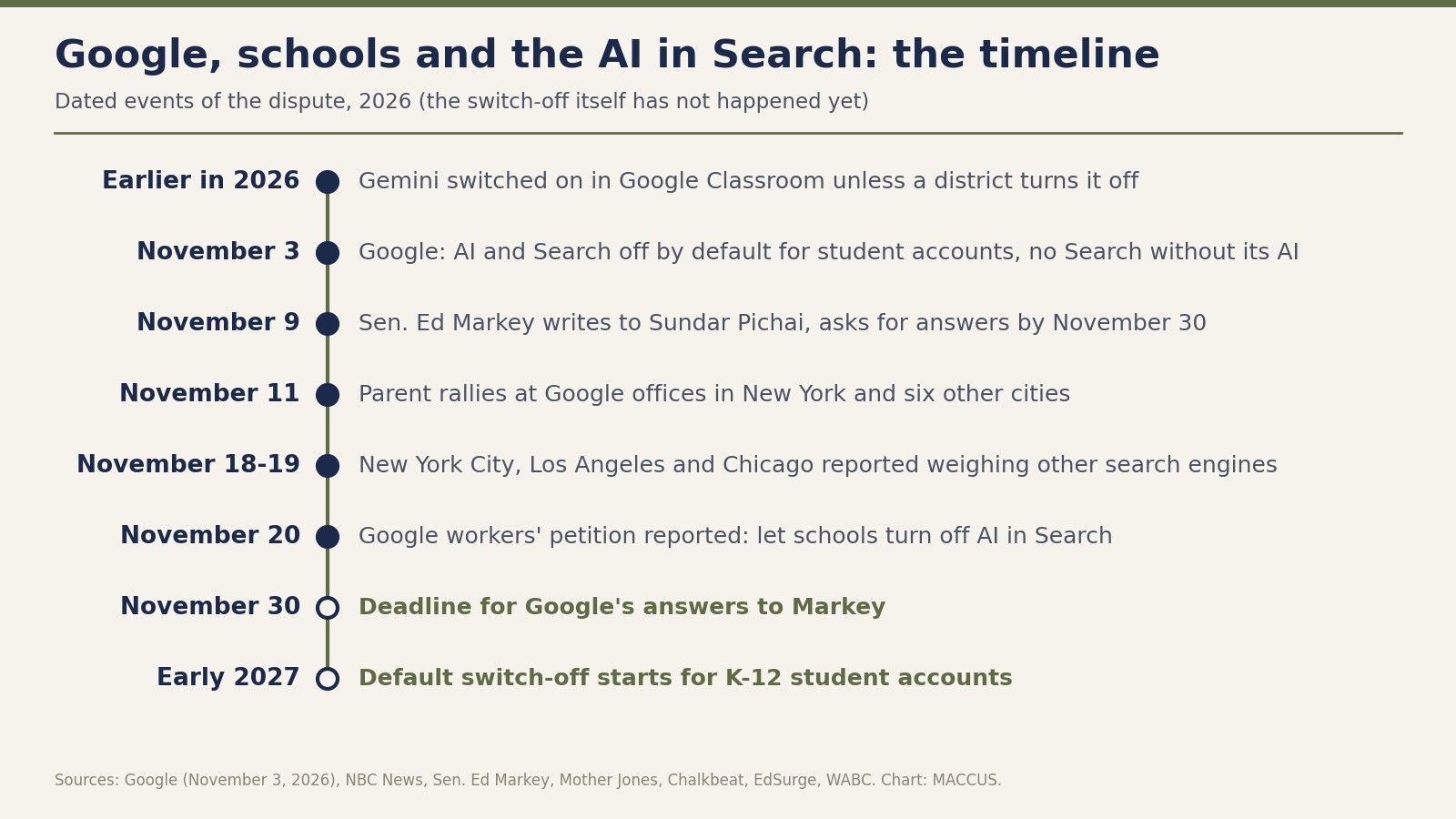
On November 3, Chris Phillips, Google’s vice president and general manager for education, announced new school controls on Google’s blog. They cover Google Search and Gemini, Google’s AI chatbot, along with Gemini Notebook and Gemini in Classroom. Access to all four “will be entirely off for K-12 student accounts until school administrators explicitly turn them on,” he wrote. K-12 means kindergarten through 12th grade.
The change takes effect in early 2027, according to EdSurge, an education news site. On paper, it gives schools more control. Until November 3, Google’s Gemini products were switched on automatically for schools using Google Classroom, Google’s app for class assignments, NBC News reported.
The catch is in Search. Later on November 3, after an initial backlash, Google said schools could turn on Search alone, without the Gemini products. But Search would still come with its AI features. So a school that wants no AI at all loses Google Search.
Those AI features include AI Overviews, the AI-written summaries shown above the links, and AI Mode, a chatbot-style version of search. A recent US experiment measured what AI Overviews do to clicks on websites. WABC, the ABC station in New York, reported Google’s reason: the company says AI features are now deeply integrated into Search and it cannot offer a chatbot-free version.
In a statement quoted by NBC News, Google said its announcements “give schools more choice, not less.” It said AI Mode and AI Overviews would guide students step by step “so that students don’t get quick answers to schoolwork.”
Three big districts weigh other search engines
A Chicago Public Schools spokesperson said the district was “actively exploring all options to independently suppress” the AI Overviews at the top of Google results. If it cannot give students Google Search without that feature, the district will “look to other search solutions,” the spokesperson added. Chalkbeat Chicago, a local education news site, reported the statement on November 11.
On November 19, New York City schools chancellor Kamar Samuels said in a WABC report: “Google is trying to give us an ultimatum here. They’re saying either you use student generative AI in our search engine or nothing at all … and we are not buying into that binary choice.”
Microsoft’s Bing and DuckDuckGo are among the alternatives being considered, WABC reported; both offer options to turn off AI-generated answers. Samuels said no decision had been made and the city was still in talks with Google. New York City’s schools are also several months into a one-year moratorium on generative AI tools that students use directly, according to EdSurge.
Los Angeles is weighing other engines too, The New York Times reported on November 18. Los Angeles Unified, the city’s school district, told EdSurge that it had already disabled Google’s AI Overviews. It said it would “continue to evaluate whether these and any digital tools support student learning.”
By their own figures, the three districts count about 1.4 million K-12 students. New York City counted about 766,900 students as of October 31, a preliminary figure reported by Chalkbeat. Chicago reports 287,957 for 2026-27, plus 16,730 preschoolers, across 626 schools that include charter schools, which are publicly funded but run independently (district figures).
Los Angeles Unified projects about 361,000 students for 2026-27 (Fingertip Facts). That count leaves out pre-K, transitional kindergarten (a year before kindergarten) and independent charter schools.
Parents, a senator and Google’s own staff push back
On November 9, Sen. Ed Markey, a Massachusetts Democrat, wrote to Sundar Pichai, the CEO of Google and its parent company Alphabet. He said the policy “places schools in an impossible position: either give students access to potentially harmful technology or lose a critical educational research tool.” He asked for answers by November 30. One question is whether it is technically feasible to give student accounts Search results without AI Overviews and other generative AI features.
On November 11, parents and their children rallied outside Google offices in New York and six other cities, the magazine Mother Jones reported.
On November 20, Mother Jones reported that hundreds of Google employees were pressing company leaders to withdraw the policy. Their petition comes from the Alphabet Workers Union, a union of workers at Google’s parent company. It is addressed to Pichai, Phillips and Elizabeth Reid, the head of Search.
“Cutting off access to Search for schools that don’t wish to use AI will not help persuade our users, and will more likely result in them shutting out Google products altogether,” the petition says. It asks Google to let schools turn off AI features in Search without losing Search. Company leaders have acknowledged the petition but have not answered its demands, Mother Jones reported.
Some schools already hide the AI themselves
Some districts did not wait for Google. Fairfax County Public Schools in Virginia, the ninth-largest school district in the US, built a browser plug-in that hides AI-generated answers in students’ search results, according to EdSurge.
Niles Community Schools in Michigan published a free Chrome browser add-on on GitHub, a code-sharing site. It removes AI Overviews and AI Mode but keeps the regular results. Its instructions warn that Google changes its search page often. On November 4, Securly, a company that sells web filters to schools, said its filter now blocks AI Overviews and AI Mode.
Google’s case and a former employee’s theory
“Our goal is simple: provide school leaders the control and confidence to use AI products in classrooms as they see fit,” Phillips wrote. Google says its Guided Learning mode, which coaches students with questions instead of giving answers, “leads to measurable learning gains.” A Google spokesperson told EdSurge: “We hear parents and teachers’ concerns about students using AI to shortcut learning, and we share the same goal: help students learn.”
Erin Mote, CEO of the education nonprofit InnovateEDU, has called for student AI tools to be off by default. She told EdSurge that Google’s move is a positive step.
On NPR on November 13, Tracy Pizzo offered another explanation for why schools cannot get Google Search without AI. Pizzo, who worked at Google for more than a decade, pointed to two antitrust suits, cases under competition law, brought by publishers. In September, they were dismissed in Washington, D.C., after a judge decided that Search and AI are an integrated product, she said.
“Now if Google were to provide an off switch for schools only … that’s evidence that they can be separated,” Pizzo told NPR. The antitrust experts NPR asked “weren’t entirely convinced, but also didn’t dismiss it altogether.” Google did not answer NPR’s questions about the connection.
The open questions
Google says its approach is not final, and it will share details with schools in the coming months.
Google’s claim of learning gains rests on its own research. NBC News cited the SCALE Initiative at Stanford’s Graduate School of Education. The initiative says there are no high-quality studies of student use of AI that establish cause and effect. Mother Jones did not give a count of the employees who signed, and none appears on the published petition.
What it means
Google now treats AI as part of Search itself. Some of the largest US public school systems want the search engine without it. The dispute is over who decides what a student sees on a search page. Elsewhere, schools and regulators are drawing their own lines. England’s university regulator wants more AI-free exams, while a rural Chinese school says its pupils learn core subjects from AI.
Leaving would cost the districts something too. A district that leaves gives up the search engine most teachers and students already know. A district that stays accepts AI summaries in Search, even if it bans chatbots everywhere else. Plug-ins and filters can hide the AI, but they can break whenever Google changes its search page.
The next dates are November 30, when Google’s answers to Markey are due, and early 2027, when the default switch-off starts. If New York City moves its students to Bing or DuckDuckGo, hundreds of thousands of children will learn to search on another engine. If Google builds an off switch for schools, other public bodies could ask for the same.
Sources
- Designing responsible AI for learning, Google, The Keyword, November 3, 2026
- Google to shut off search for schools that opt out of AI, NBC News, November 3, 2026
- After Google warns schools about disabling AI feature, Chicago protesters say ‘we don’t want your Gemini’, Chalkbeat Chicago, November 11, 2026
- Why is Google cutting off Search from AI-free schools? Here are some theories, NPR, November 13, 2026
- NYC public school enrollment drops by 23,000 students, raising tough questions over budgets and closures, Chalkbeat New York, November 16, 2026
- Google Says Schools Can’t Have Search Without AI. Some Are Finding a Way., EdSurge, November 19, 2026
- New York City schools weigh alternatives to Google search, ABC7 New York (WABC), via Yahoo News, November 19, 2026
- Google Workers Tell Their Employer Not to Punish Schools That Don’t Want AI, Mother Jones, November 20, 2026
Header image: MACCUS chart. Data: NYC Education Department via Chalkbeat (November 16, 2026), LAUSD Fingertip Facts 2026-27 (projections), Chicago Public Schools (September 2026); K-12 counts computed by MACCUS