A mathematician at Anthropic, the company that makes the AI model Claude, says he has found a proof of the Riemann hypothesis with Claude’s help. First stated in 1859, the hypothesis is the most famous open problem in mathematics. Levent Alpöge posted a four-page note on his website on the morning of Friday, November 20, 2026, US time. “I believe I have, working with Claude, discovered a proof of the Riemann Hypothesis,” he wrote.
He published the proof only as computer code, written in Lean, a programming language in which software checks every step of a proof. The code runs to about 17 million lines, according to Quanta Magazine, and no version for human readers comes with it. Several researchers ran it on their own machines the same day without errors. According to Quanta, nobody yet understands the proof itself.
The case echoes a recent one in physics, on Yang-Mills theory, which describes forces between particles. On November 10, a panel chaired by Nobel laureate David Gross backed a Lean proof produced by OpenAI’s AI. The panel wrote that it did not yet fully understand the proof.
Alpöge’s note and its code-only proof
Alpöge’s note goes beyond the Riemann hypothesis. He says the method “easily extends much further” to the generalized Riemann hypothesis, a broader version of the same statement. “Claude and I have also formalized the arguments without assumptions,” he adds, using the term for writing a proof out in Lean. The note points to the proof itself, a code archive in 14 parts hosted on his site.
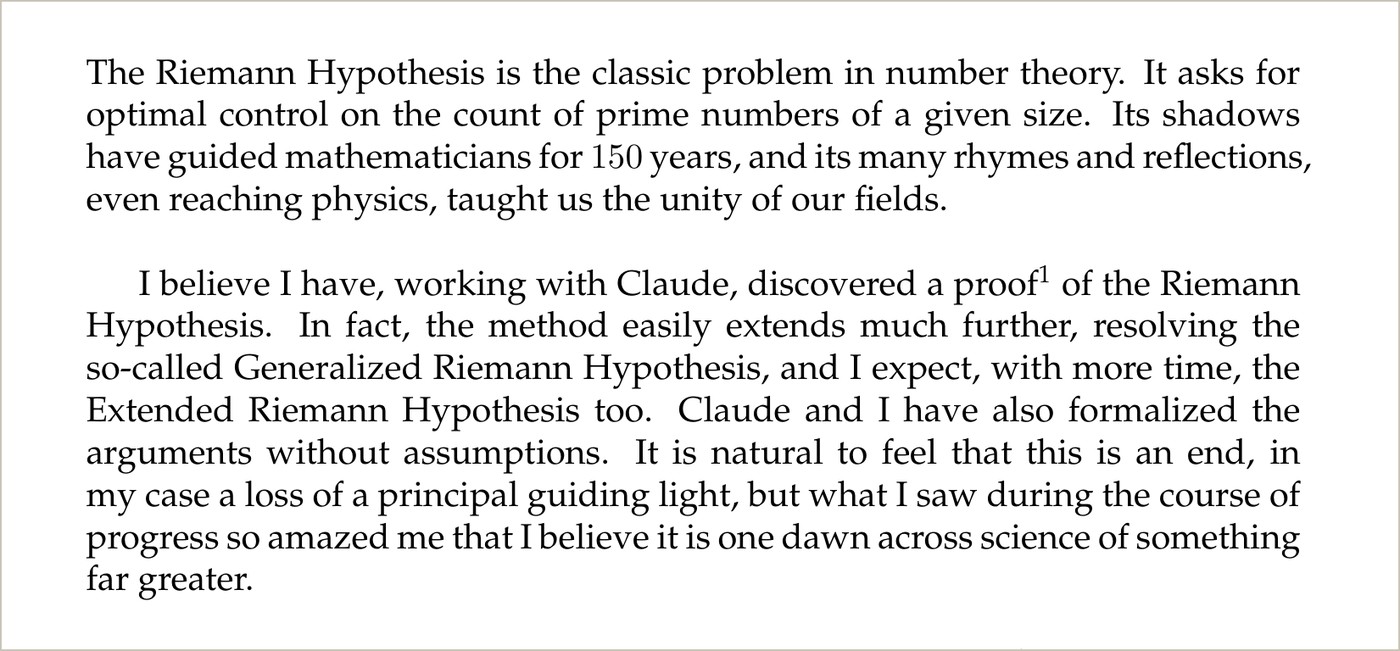
Alpöge explains why there is no readable text. Claude’s written version of the proof ran past 250,000 pages, Alpöge writes, and posting that “massive unreadable travesty” would have been “obviously inappropriate.” So “I decided to only present Lean.” He says he intends to do his best to understand the argument and its simplifications, to talk about it and to “write it properly.”
He is explicit about the AI’s role. He writes that he steered the work, and then “Claude flew, and danced, and sparkled near that finish line.” He admits he has “little mastery” of some tools the proof uses: automorphic forms on higher rank groups, a specialized area of number theory. He also warns that some descriptions in the note paraphrase a summary by Claude that “might make zero sense.”
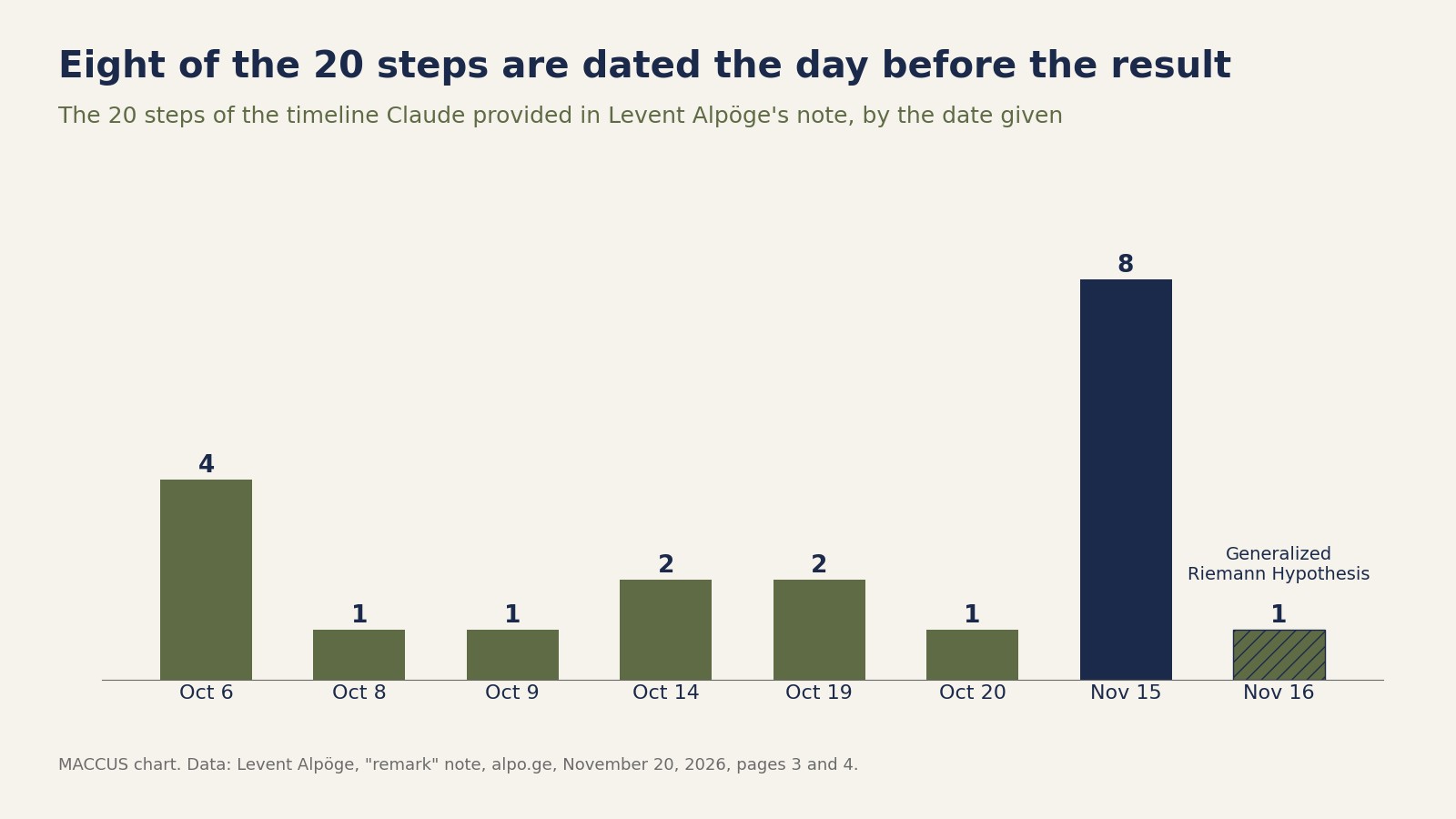
The note ends with a 20-step timeline “Claude provided,” running from October 6 to November 16, 2026. Eight of the 20 steps are dated November 15, more than any other day. The last line, dated November 16, reads “GRH,” short for generalized Riemann hypothesis.
What the code claims to prove
The Riemann hypothesis concerns the zeta function, a function tied to how prime numbers are spread out. It states that all of the function’s “nontrivial” zeros, the points where it equals zero, have the same real part, 1/2. If it holds, the primes are distributed as regularly as they possibly can be. The Clay Mathematics Institute, a US foundation, offers $1 million for a solution.
The generalized version asks the same question of a wider family of functions, called L-functions. Alpöge’s code covers only part of that family. The Lean community opened a verification repository on GitHub, a code-sharing site, and its authors read the code’s statements by hand.
According to that repository, the code claims a proof of the Riemann hypothesis as stated in Mathlib, Lean’s main math library. For the generalized hypothesis, the claim covers only Dirichlet L-functions, one subfamily.
Other researchers compile the code
Lean code “compiles” when the software accepts every step without error. According to Quanta, Andrew Sutherland of MIT was the first to compile Alpöge’s code, shortly before noon on November 20. Simon DeDeo of Carnegie Mellon University followed a few hours later. Sutherland then ran it again with a variant of Lean.
“The Lean proof has been compiled and independently rechecked by the Lean kernel with only the three standard axioms,” Sutherland told Scientific American. The kernel is the small part of the software that checks each step. Axioms are the starting rules accepted without proof. Sutherland called it “an historic moment.”
Deeper checks are pending
Compiling is only a start. Kevin Buzzard of Imperial College London, quoted by Scientific American, names the first question to ask: does the code’s statement match the actual theorem? Another check, the “comparator,” makes sure the code has not quietly redefined the terms of that statement. It is slow: according to the Lean community repository, the full procedure takes hours on a large machine and about 100 GB of disk space.
As of the morning of November 21, the repository said verification was still in progress, with no result posted. Its notes report that a text search of the code’s 175,187 files found no added axiom and no step left blank.
The same notes say that compiling successfully with Lean 4.33.1, the version Alpöge used, “counts as limited evidence.” That version lacks some later fixes that bear on the reliability of its kernel. So the repository leaves the verdict to Lean 4.36.0 and independent checkers.
Nobody understands the proof yet
Two other recent large Lean projects started from proofs already written on paper. In September, Anthropic said it had translated the proof of Fermat’s Last Theorem into Lean, some 13 million lines according to Quanta. In late October, a startup named Axiom translated the classification of finite simple groups, a human proof of about 15,000 pages by Axiom’s count, into Lean. Alpöge’s proof has been published only as code.
On his blog, mathematician Terence Tao calls it an “(enormous) Lean-only proof” and expects its “digestion” to take some time.
On a very early reading, Tao writes, the proof appears to use “the full power of modern developments on the Langlands program and arithmetic geometry.” The Langlands program is a vast web of conjectures connecting number theory to other fields.
Criticism came fast. Maksym Radziwiłł of New York University, whom Alpöge thanks in the note, told Quanta the four-page write-up contains “nonsensical statements.” In his view, a Lean proof checks that the symbols follow the rules without saying why the result is true. “The object of mathematics as the rest of science is really the question ‘why?’ and this doesn’t answer it at all,” he said.
The $1 million Clay prize cannot be awarded yet. Its rules require publication in a qualifying outlet, then a wait of at least two years, then general acceptance by the mathematical community.
A day after Anthropic went public
Alpöge’s note came one day after Anthropic’s Nasdaq debut on November 19. Alpöge raises the timing himself, without naming the stock listing: “The precise timing is horrible.” He says he sent Dario Amodei, Anthropic’s chief executive, a hypothetical question late on Sunday night, November 15, then asked whether he could announce. There was, he writes, “a constraint to respect.”
“There is an obvious cynical view, to do with the timing, but it is false,” he adds. According to Quanta, he obtained the result on Monday, November 16, and waited several days before making it public. As of November 20, the magazine reported, Anthropic had made no official announcement.
A separate, all-human claim
Also on November 20, Stanford professor Ravi Vakil, president of the American Mathematical Society, posted a 940-page manuscript by Alessandro Masullo. According to Quanta, Masullo is a postdoctoral scholar at Stanford. In it, Masullo puts forward his own proof of the generalized Riemann hypothesis, which Vakil calls “a proposed proof of GRH.”
Vakil wrote that mathematician Brian Conrad had been looking closely at it for months and that it was “so far looking good to him.” “It is all human, with no AI,” he added.
About eight hours later, Vakil posted an update. Several people had reported problems in Masullo’s proof to him, problems “identified with the assistance of different AI models.” He wrote that he makes “no claim as to the correctness of the proof strategy.” According to Quanta, an earlier Masullo attempt at the Riemann hypothesis did not hold up, and many number theorists are withholding judgment.
What it means
A claimed proof of the most famous problem in mathematics has arrived only as machine-checkable code. An Anthropic employee obtained it with Claude, then published it the day after the company went public. It remains a claim: the code compiles and passes the Lean 4.33.1 kernel, evidence the Lean community calls limited. Nobody says yet that they understand the argument.
Here, authority rests with the proof checker, software that mechanically checks what Alpöge and Claude produced. The principle is the same as in the no-crash proofs Claude wrote for 123 open-source libraries: software checks every step the model wrote. It has the same limit, too: a checker tests the steps only against the statement it is given. That is why the human reading of the statement, and the comparator, matter.
The day also showed roles starting to reverse. In Alpöge’s case, humans are trying to understand a proof built with an AI, and its author is one of them. In Masullo’s case, AI models helped find the problems reported to Vakil in an all-human manuscript.
Next to watch: the comparator result on the Lean community repository, the written version Alpöge intends to produce, any statement from Anthropic and the review of Masullo’s manuscript. The big unknown is how long it will take to understand Alpöge’s proof. Tao expects it to take some time, even with a human author on hand to answer questions.
Sources
- remark, Levent Alpöge, alpo.ge, November 20, 2026
- Transformation (live updates), Quanta Magazine, November 20, 2026
- Anthropic mathematician claims to prove Riemann hypothesis, most famous problem in all of math, Scientific American, November 20, 2026
- The AI Riemann hypothesis proof is almost certainly true, independent mathematicians attest, Scientific American, November 20, 2026
- riemann-hypothesis (verification repository), Lean community, GitHub, accessed November 21, 2026
- Unforced Euler singularity, unforced Navier-Stokes singularity, and the Generalized Riemann Hypothesis, Terence Tao, What’s new, November 20, 2026
- Hurried Announcement: Alessandro Masullo GRH, Ravi Vakil, Math 216, November 20, 2026
- Rules for the Millennium Prize Problems, Clay Mathematics Institute, accessed November 21, 2026
Header image: MACCUS chart. Data: Lean community verification repository (GitHub), notes of November 21, 2026