
An AI gun detector was 90% sure a teenager outside his Maryland high school was holding a firearm, according to a lawsuit filed November 17, 2026. He was holding a bag of Cool Ranch Doritos; he and three teammates were eating chips after football practice. School and police staff looked at the image, saw chips and canceled the alert within two minutes. About 15 minutes later, police were sent anyway, and officers with guns drawn handcuffed all four.
The four plaintiffs, current and former students of Kenwood High School in Baltimore County, are Black and were all minors on the night of October 20, 2025. The Lawyers’ Committee for Civil Rights Under Law filed their suit in the Circuit Court for Baltimore County.
The suit names Omnilert, which makes the detector, and the county school board. It also names Baltimore County, on behalf of its police department, the principal and several officers, among others. The claims include unreasonable search and seizure, false arrest and negligence. The account of that night below comes from the complaint: it is the students’ version, and no court has ruled on it.
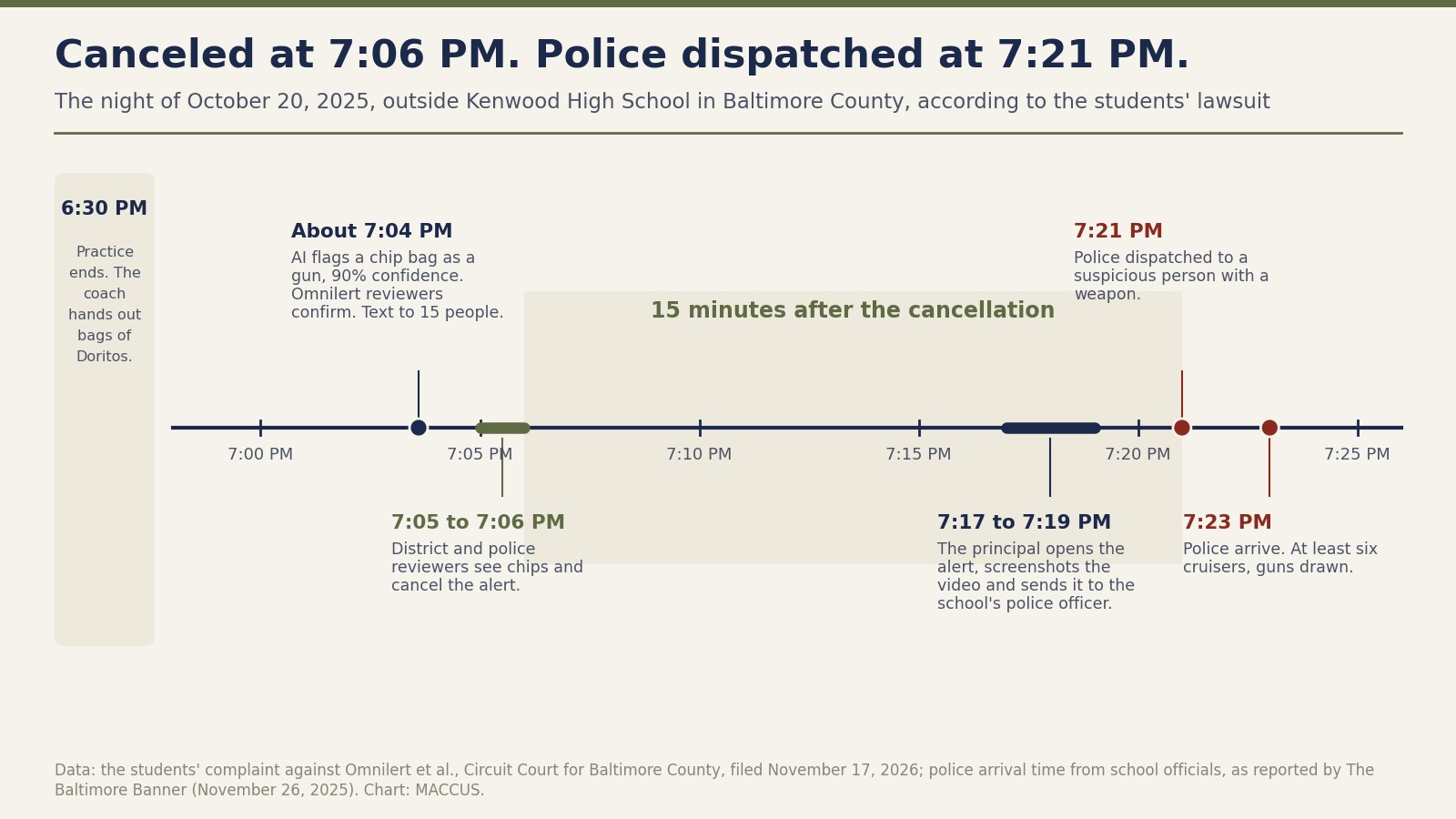
Canceled at 7:06 PM, dispatched at 7:21 PM
Football practice ended around 6:30 PM, and the coach handed out bags of Doritos, the complaint says. Shortly before 7:04 PM, the system flagged the bag in one student’s hand as a firearm, with 90% confidence. Omnilert’s human reviewers checked the image and confirmed the threat, according to the complaint. The alert then went out by text to at least 15 people: five district employees and ten county police employees.
Between 7:05 and 7:06 PM, the district’s executive director of school safety, a safety manager and a police sergeant reviewed the alert. They saw a bag of chips and canceled it, and a second text sent the cancellation to every recipient.
The principal opened the first text between 7:17 and 7:19 PM. Its link led to a page showing the alert had been canceled, the complaint says. She enlarged the video instead and took a screenshot of the student holding the bag. She sent it to the personal phone of the school resource officer, or SRO, the police officer assigned to the school.
At 7:19 PM, according to the complaint, she texted two district officials: “Omni alert is working. Kid standing on my patio right now. Looks like one of mine and looks like he’s armed. My SRO is calling it into the precinct now.”
The resource officer forwarded the screenshot to the precinct and texted the principal that the object “looks like a blue gun.” She replied: “Right, but maybe not.” At 7:21 PM, officers were dispatched to a “report of a suspicious person with a weapon.” By then, the complaint says, at least ten police employees had received both the alert and its cancellation.
On their knees, then “it’s the Omnilert”
At least six police cruisers pulled up with lights flashing, the complaint says. Several officers drew their guns, and the teenagers raised their hands. Officers ordered them to their knees on the concrete, handcuffed them, and searched them and their backpacks. They stayed in handcuffs for at least six minutes.
The officers found nothing, the complaint says. When the supervising corporal asked where the call had come from, another officer answered: “it’s the Omnilert.” “AI’s not the best,” the corporal told the students. He also told them: “Hey, thanks for not running away, that would have been a real problem.” The officer who had named Omnilert muttered “stupid AI cameras” as he left.
Omnilert’s response and the inspector general’s findings
In 2025, Omnilert and the district said the system had worked as intended. Omnilert spokesperson Blake Mitchell said then that the image “closely resembled a gun being held.” On November 18, 2026, he told The Baltimore Banner that the company was reviewing the lawsuit and was “truly sorry for the fear they and their families experienced.” The district declined an interview request, and the county police declined to comment.
Maryland’s Office of the Inspector General for Education, a state watchdog, sent its report to the district on November 25, 2025. It found no bias: the software does not weigh race or gender and “focuses solely on the moving object.”
The bag alone did not set off the alert, the report found: “The Omnilert system did not detect a single blue potato chip bag as a threat.” The trigger was “the student’s hand movement, including its position and angle.” The report also cites an object sticking out slightly past his fingers near hip level, and the object’s reflective surface.
Thousands of detections, about 12 alerts a day
In the district’s schools, the report says, the AI produces thousands of detections a day across more than 9,500 cameras. Roughly 200 of them go to Omnilert’s monitoring staff for a visual check. The district then receives about 12 alerts a day for its safety staff and selected police to review.
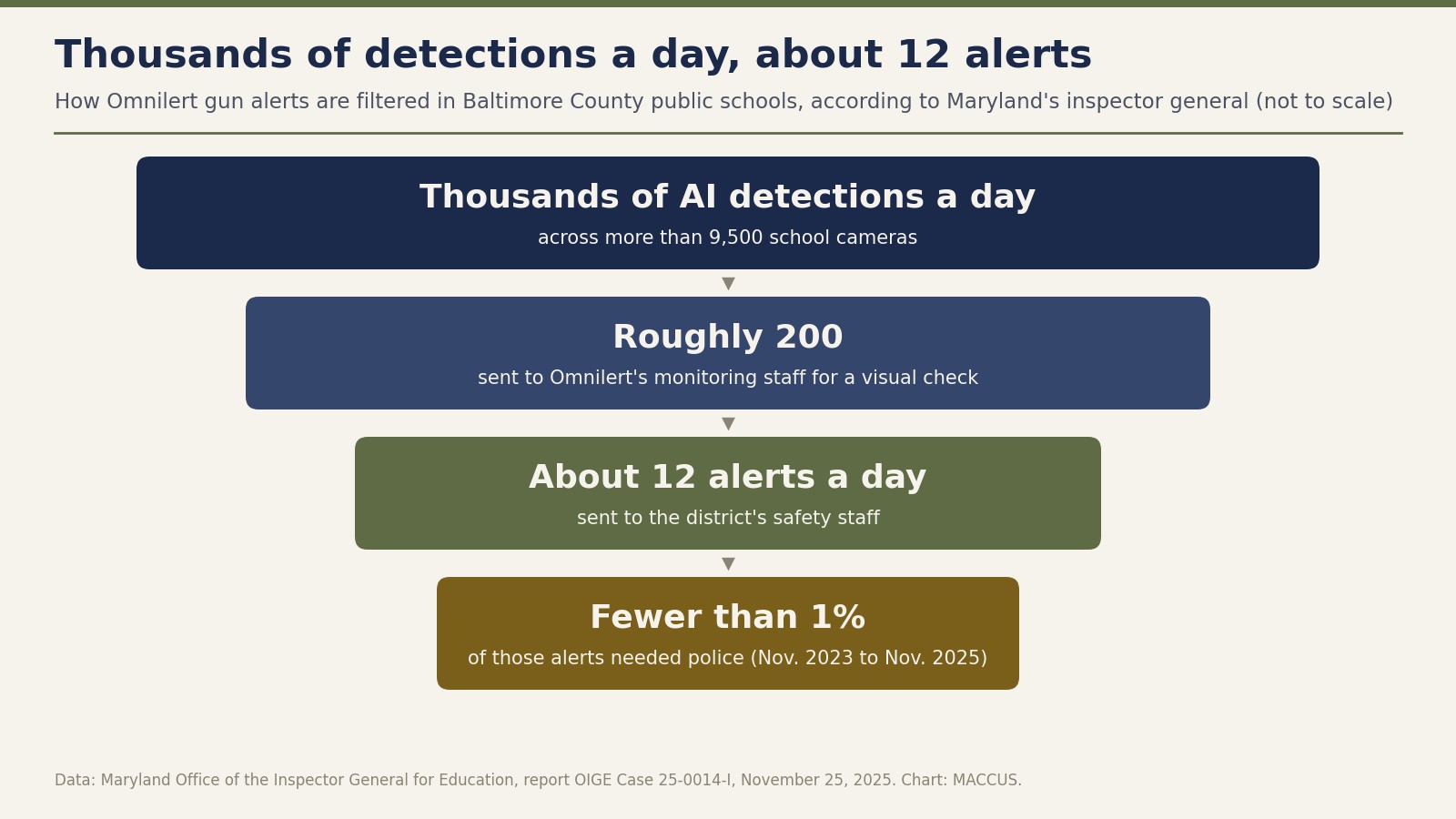
From November 2023 to November 2025, fewer than 1% of the alerts sent to the district required notifying the police, the report found. The complaint calls that “a false positive rate of more than 99%.” Some screened-out objects were real look-alikes, the report notes, such as replica weapons used in drills by Junior ROTC, a high school military cadet program.
Before that night, county police had answered alerts set off by children’s toys, a stapler and a glue gun, the complaint says. Omnilert’s marketing promises “Near-Zero False Positives.”
Outside schools, London’s police say live facial recognition has led to more than 3,000 arrests in two years, and Britain plans a law on it.
A gap in the protocol and the state’s fix
The complaint, the inspector general and school officials agree that the alert was canceled before anyone called the police. They differ on blame. The complaint says Omnilert’s reviewers should have caught a bag of chips. The inspector general found that detection and monitoring “operated within the designed parameters.”
Several of the 15 recipients could cancel an alert, the report found. But the district’s protocol had a gap: other recipients “could bypass or circumvent it by simply making a phone call or sending a text message” to police.
The principal told investigators she enlarged the video to look for a weapon and did not see the cancellation notice. She said she contacted the resource officer to check whether he knew of the alert. Zooming in on the image on a phone “could cause the user to overlook the cancellation text message,” the report found.
The report cites a second case, at Parkville High School on November 7, 2025. There, recipients outside the school system kept a threat alert going after the district canceled it, out of what the report calls “an abundance of caution.”
The report made three recommendations: alert police only after a threat is confirmed, use Omnilert’s app instead of text messages, and train school executives and county police twice a year. The district said it would adopt them and had retrained administrators and police partners in November 2025, the Banner reported. The complaint says the system still runs at Kenwood and that the failures behind the incident “remain in place.”
The students seek damages. They also ask for a court order barring the district and the county from using the system, “or any comparable AI gun-detection system.” The ban would last until verification protocols, cancellation and communication procedures and training are in place. “This should have never been escalated to the police,” said Leah Frazier, who leads the Lawyers’ Committee’s Digital Justice Initiative.
What it means
Omnilert says systems like its own are “intentionally designed with a clear priority: not missing a real firearm,” according to the complaint. False alarms come with that design, and a person is meant to catch them. At Kenwood, Omnilert’s reviewers looked first and passed the alert on, the complaint says, and the district and police staff who looked next canceled it. The failure that put guns on the teenagers came after, in a text-message chain that reached 15 people, ten of them police employees, any of whom could still call the precinct.
The inspector general and the students agree on the fix: police act only on a confirmed alert, and a cancellation reaches everyone who received the alert. The same sequence, an automated flag checked by human reviewers before police step in, preceded a Florida woman’s arrest over messages typed into the AI chatbot Claude. Schools are adopting AI fast, from security cameras to a rural Chinese school where 4,000 students learn core subjects from AI, its headmaster says.
Under a 2025 state law, the Maryland Center for School Safety must deliver a study of the most effective ways to detect weapons in public middle and high schools by December 1, 2026. In court, the ruling on the order the students seek will decide whether a confirmed alert before an armed response becomes a legal requirement in Baltimore County.
Sources
- Complaint and Demand for Jury Trial, four students v. Omnilert, LLC, et al., Circuit Court for Baltimore County, Maryland, filed by the Lawyers’ Committee for Civil Rights Under Law, November 17, 2026
- Lawyers’ Committee Files Lawsuit on Behalf of Black Students Detained and Searched Due to AI Alert Falsely Identifying a Bag of Chips as a Firearm, Lawyers’ Committee for Civil Rights Under Law, November 17, 2026
- Investigative Synopsis, OIGE Case 25-0014-I, Maryland Office of the Inspector General for Education, November 25, 2025
- Students sue Baltimore County schools after AI weapons detection system mistook chips for gun, The Baltimore Banner, November 18, 2026
- State investigators: AI tool wasn’t biased when it flagged student’s chips as gun, The Baltimore Banner, November 26, 2025
Header image: MACCUS chart. Data: the students’ complaint against Omnilert et al. (filed November 17, 2026); police arrival time from school officials, as reported by The Baltimore Banner