

People on Medicare who take insulin and pay their own share at the pharmacy spent an average of $265 on insulin in 2024, down from $572 in 2020. KFF, a health policy research group, published the figures on November 20, 2026, in an analysis of Medicare prescription claims. The analysis covers about 1.9 million people in 2024 who had a Medicare drug plan and got no low-income help with their copays. Per prescription, their average bill fell from $54 to $25, a 54% drop, while the average patient filled the same number of prescriptions each year.
Two $35 caps brought their bill down, according to KFF. The first was a voluntary Medicare test started in 2021 under the first Trump administration: drug plans that joined it charged no more than $35 for a month’s supply of many insulins. The second is the Inflation Reduction Act, a law signed by President Biden in 2022. Since January 1, 2023, it has limited what Medicare patients pay to $35 a month for each insulin their drug plan covers, with no deductible to meet first. That cap is still in force.
The law stops at Medicare. People with private insurance have no federal cap, and their protection depends on the state they live in and the kind of plan they have.
A drug that people rationed
Insulin has been in use for a century. About a fifth of the estimated 40 million Americans with diabetes depend on it, according to KFF Health News, KFF’s newsroom. For years, steep price increases pushed what patients paid to hundreds and even thousands of dollars. Many patients rationed their insulin, sometimes with deadly consequences, the newsroom reports.
Diabetes is common among people on Medicare, the federal health insurance for Americans 65 and older and for some younger people with disabilities. One in three Medicare beneficiaries has diabetes, according to the Centers for Medicare & Medicaid Services (CMS), the agency that runs the program. More than 3.3 million of them use insulin.
What patients paid, year by year
KFF worked from the claims of a 20% sample of beneficiaries in Part D, the part of Medicare that covers prescription drugs, using data held by CMS. It counted only enrollees without Medicare’s low-income subsidies, the help that lowers drug costs for people with limited income. People who get that help already pay small, fixed copays.
Together, these patients paid $971 million for insulin in 2020. The total fell 23% to $745 million in 2021, the first year of the voluntary test, then to $677 million in 2022. In 2023, the first year of the legal cap, it fell another 23%, to $514 million, and it was $506 million in 2024. With low-income enrollees included, the total went from slightly over $1.0 billion in 2020 to $535 million in 2024.
The average amount patients paid per prescription, a 30-day supply, followed the same steps: $54 in 2020, $40 in 2021, $36 in 2022, $26 in 2023 and $25 in 2024.
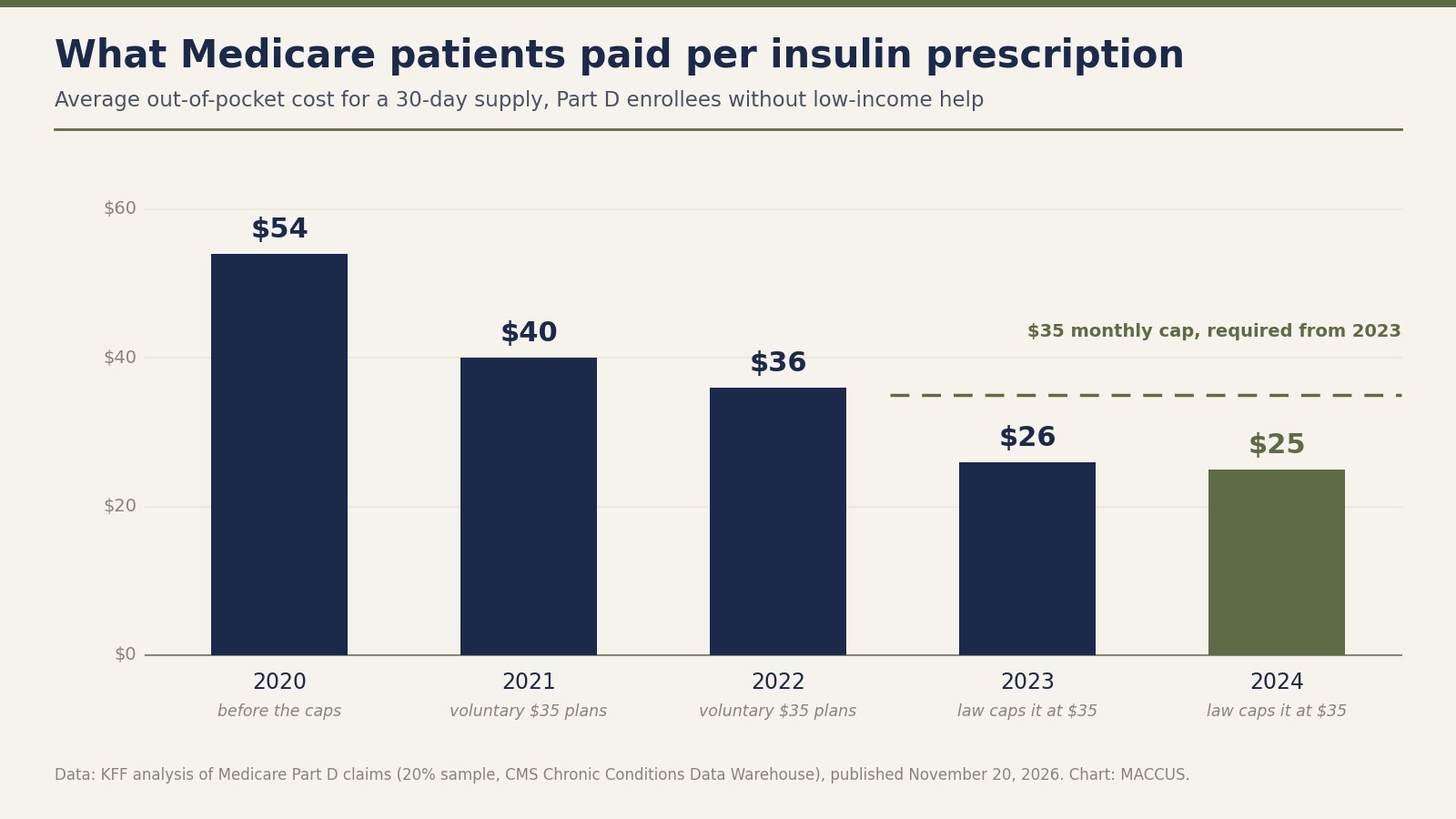
The drop did not come from patients filling fewer prescriptions: they filled an average of 11 a year, every year from 2020 to 2024. Over the same years, the number of insulin users without low-income help rose from 1.7 million to 1.9 million. KFF links that rise to growing enrollment in Medicare drug plans.
The ten insulins these patients used most show the change product by product. In 2020, a month’s supply of each cost them more than $35, from $70 for Tresiba Flextouch U-200 down to $43 for Insulin Lispro Kwikpen U-100. In 2024, each cost them less than $35, from $29 for Basaglar Kwikpen U-100 down to $23 for Lantus Solostar.
How the $35 cap got into law
The 2021 test was called the Part D Senior Savings Model. Drug plans chose whether to join, and insulin makers paid discounts on the insulins in the test. In 2022, 2,159 drug plans took part, and CMS estimated that more than 800,000 people who use insulin were enrolled in one of them. The model ran until December 31, 2023.
The Inflation Reduction Act made the cap a rule for all Medicare drug plans. Since January 1, 2023, a month’s supply of each covered insulin has cost a Medicare patient no more than $35. The yearly deductible, the amount patients pay on their own before their plan starts sharing costs, does not apply to insulin. Insulin for traditional insulin pumps, which Medicare covers as medical equipment, got the same cap on July 1, 2023. CMS estimated that the law’s insulin cap would benefit at least 1.4 million people with Medicare.
The two measures came from administrations of different parties, and KFF credits both. Its figures show the largest yearly drops in the first year of each measure.
The patients the cap does not cover
The $35 cap applies only to Medicare. Bills to extend it to people with private insurance have been introduced in Congress but not passed, KFF notes. Congress is now considering a national cap, according to KFF Health News. The bill’s co-sponsors come from both parties and include Senator Kevin Cramer, a North Dakota Republican.
States have moved faster: 29 of them cap what patients pay for insulin in the health plans they regulate. Colorado was first, in 2019, with a limit of $100 for a 30-day supply. North Dakota’s legislature passed a $25 monthly cap in 2025 with overwhelming support from both parties. Many workers fall outside state caps, because health insurance from large employers is typically regulated by the federal government.
In North Dakota, insurers argued that a cap would raise premiums for everyone else. Supporters pointed to a similar cap for state employees that had little effect on premiums.
Outside Medicare, what patients pay has also fallen without any federal cap. Privately insured patients paid an average of $470 a year for insulin in 2018 and $220 in 2025, according to federal data cited by KFF Health News. The newsroom says prices eased as drug companies faced a public backlash.
KFF’s analysis measures what patients paid at the pharmacy. It does not measure what Medicare spends on insulin, what drugmakers earn or what drug plan premiums cost. Its figures stop at 2024.
What it means
The claims data show what the two caps did for Medicare patients on insulin. Their average yearly bill fell by half between 2020 and 2024, while they filled the same number of prescriptions. It fell in two steps, in 2021 and 2023, the first years of the two measures.
The $35 limit covers insulin only. Newer treatments are still in trials, from Ozempic-type drugs tested well beyond diabetes to a pancreatic cancer pill now tried as a first treatment and a melanoma vaccine made for each patient.
The federal cap does not reach people with private insurance, among them many younger patients covered through an employer. In a KFF survey earlier this year, 68% of Republicans and 77% of Democrats said there is not enough government regulation to limit the price of prescription drugs. For privately insured patients, the next changes depend on whether Congress passes a national cap and on how many more states follow North Dakota in the plans states regulate, and on what drugmakers charge.
Sources
- Out-of-Pocket Costs for Insulin Among People with Medicare Decreased by Half Between 2020 and 2024, KFF, November 20, 2026
- Fed Up With the Healthcare Industry, This Red State Capped Insulin Prices for Patients, KFF Health News, November 13, 2026
- The Inflation Reduction Act Lowers Health Care Costs for Millions of Americans, Centers for Medicare & Medicaid Services, October 5, 2022
- Part D Senior Savings Model, Centers for Medicare & Medicaid Services, retrieved November 23, 2026