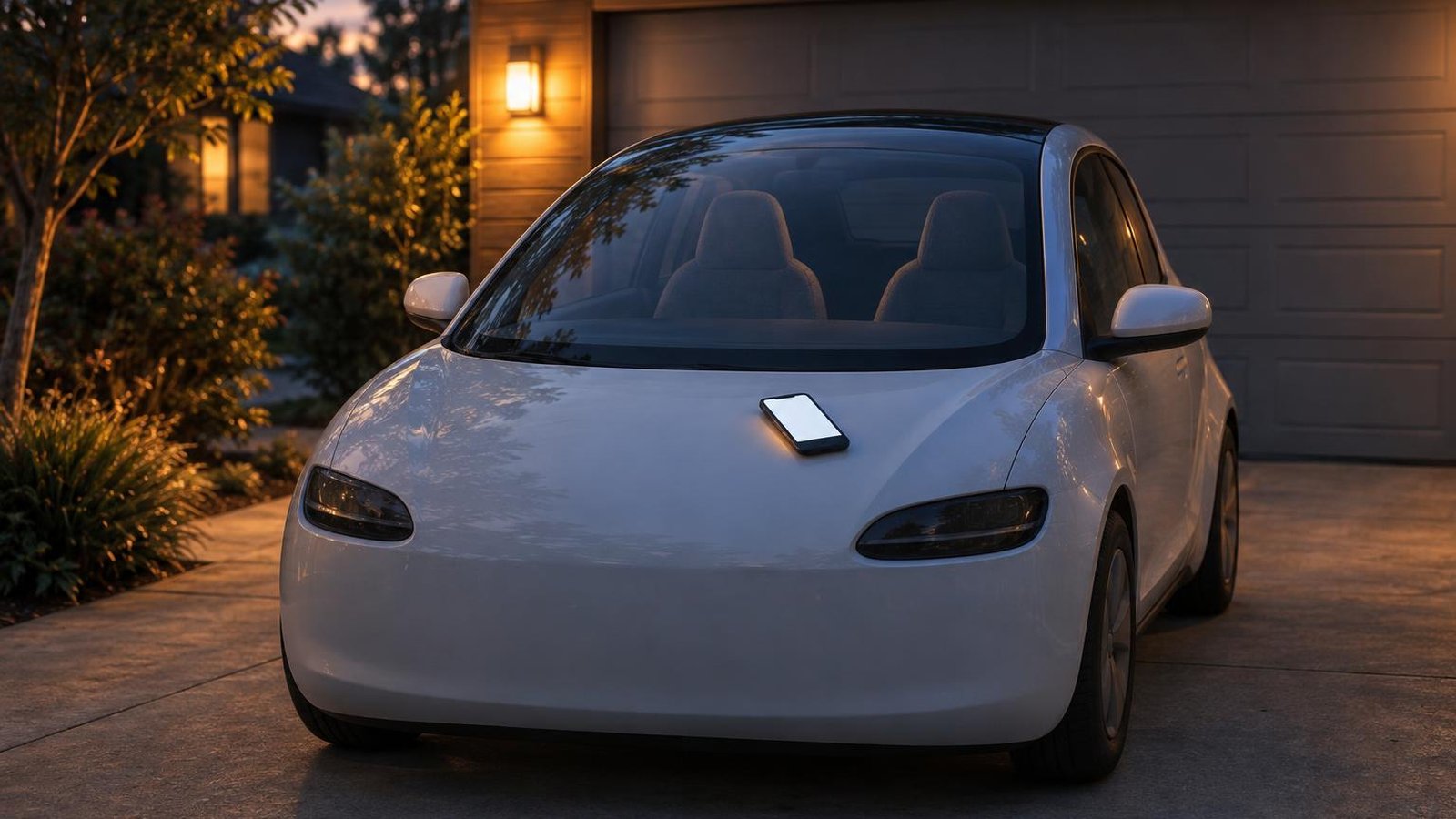

Tesla’s Cybercab, a $29,990 two-seat car with no steering wheel or pedals, will not move unless its owner keeps paying a monthly fee. Tesla began taking orders from invited buyers on November 13, 2026, and posted the terms on its online order page. “Your Cybercab will not operate without an active Autonomy Subscription,” the terms say, as quoted by the electric-vehicle news site Electrek.
Tesla’s order screen lists that subscription at $299 a month, with the first month included. The same terms limit where the car can go and require Tesla’s written consent to resell it.
Tesla’s Robotaxi account on X said on November 13 that “select customers” were being invited to buy the car “for personal use,” according to the news site Latin Times. Buyers put down a $1,000 deposit that is not refundable. Tesla estimates the first deliveries for December in Austin, Texas, and Latin Times adds that they depend on regulatory approval.
The agreement, clause by clause
The order agreement and the subscription agreement run to 11 pages together, according to the gadget review site The Gadgeteer, which read both. Tesla’s terms page returned an access-denied error when we tried to open it on November 23. The clauses below are therefore as quoted by Electrek, The Gadgeteer and the Tesla news site Drive Tesla, whose accounts match wherever they overlap.
The agreement itself names no price, and it lets Tesla change the fee with one month’s notice.
The car works only inside “Tesla-enabled Robotaxi geofences,” as The Gadgeteer quotes: virtual boundaries around the areas Tesla has mapped for its driverless taxis. Tesla “may expand, reduce, relocate, or otherwise modify the operating area at any time,” as Electrek quotes. Another line quoted by The Gadgeteer reads: “Operation outside the operating area is prohibited and may be technologically prevented.”
Use must be personal and non-commercial. Without Tesla’s written authorization, the owner cannot put the car on Tesla’s own taxi network, a ride-hailing app, a delivery app or a rental platform. Only the registered owner may use it, and only while riding in it for the whole trip.
The terms also provide for “strikeouts,” penalty marks for improper or unsafe use. Three or more suspend the self-driving for a week. The car may not operate that week, and its fee is not refunded.
Owners may not sell, transfer or borrow against the car without Tesla’s prior written consent. The order agreement treats a sale without that consent as void, The Gadgeteer reports. Tesla can also buy the car back at any time, at a fair market value that Tesla determines, with the owner paying to deliver it.
After an unapproved sale, or even an attempted one, Tesla can disable the car remotely and refuse the owner future vehicles. It can also claim $50,000 or the full value of the transaction, whichever is greater.
Tesla has used a resale clause before. Buyers of the first Cybertruck pickups, the Foundation Series, could not sell them within a year of delivery without risking a penalty of $50,000 or more. Tesla removed the clause from the Cybertruck sales agreement in August 2024, Teslarati reported at the time.
What the $299 fee covers
The fee covers more than the driving. According to The Gadgeteer, it pays for autonomous driving, connectivity, remote support and roadside assistance, with towing of up to about 50 miles. It also covers tire rotations and replacements, flat repairs, windshield and wiper replacement, cabin air filters, washer fluid and camera cleaning. Insurance, registration, charging, parking and general cleaning stay with the owner.
The car cannot be driven by hand on a public road. Its touchscreen can move it a short distance at up to 2 mph, for positioning, The Gadgeteer reports. Only a holder of a valid US driver’s license may use that control. Each car also arrives with about 250 miles on the odometer from Tesla’s road testing.
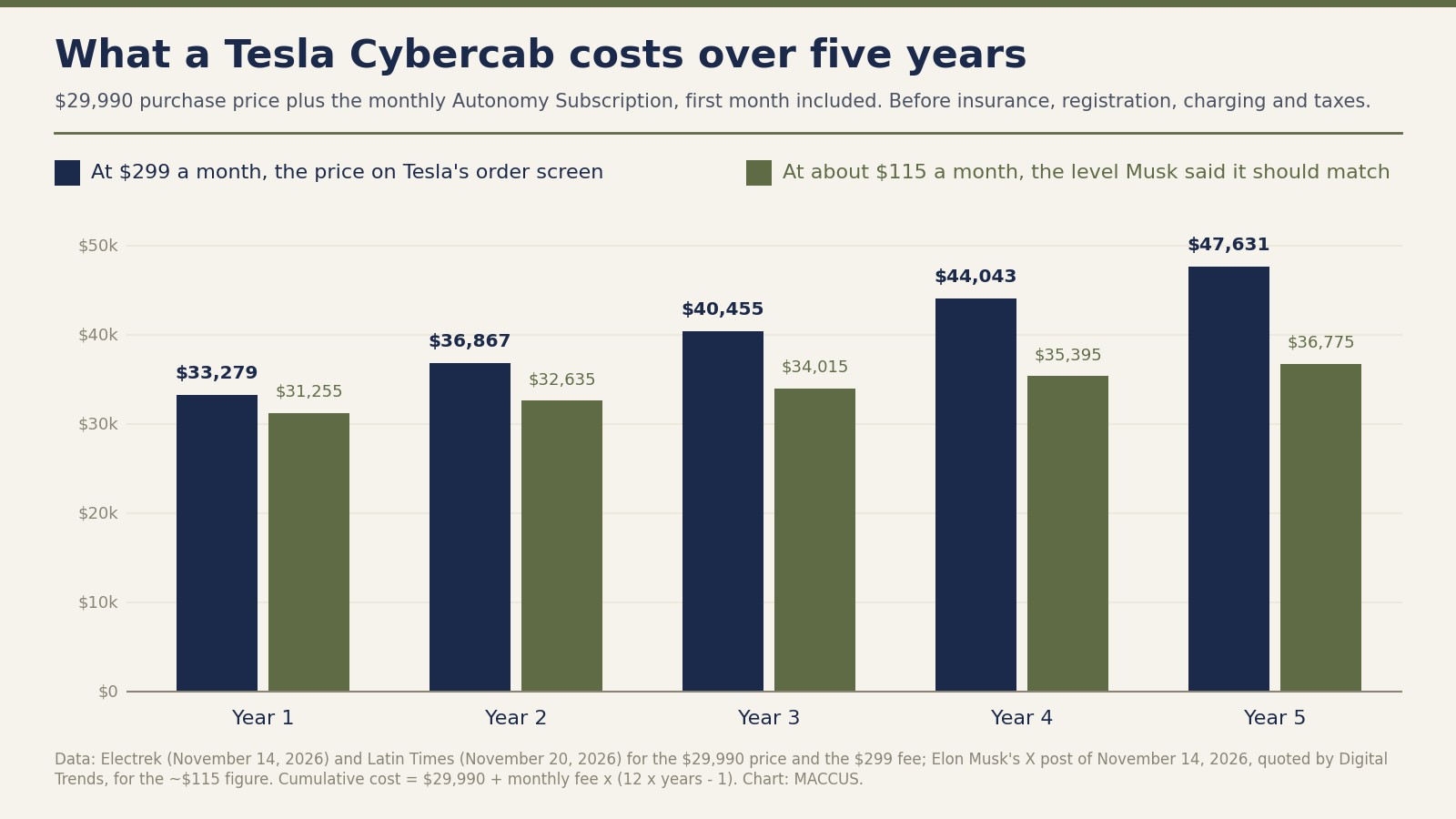
At $299 a month, five years of fees add up to more than half the car’s price. Because the first month is included, two years means 23 paid months, and five years means 59. Latin Times calculated the two-year total, car included, at $36,867 before taxes, insurance and charging. Electrek put the five-year total at $47,631 before insurance, registration, charging and taxes.
Where Tesla’s documents point
Tesla’s guide for police and firefighters no longer says that every Robotaxi belongs to Tesla. It used to read: “All Robotaxi vehicles are owned and operated by Tesla at this time.” The version dated November 20, 2026, deletes that line, the Tesla news site Not a Tesla App reported the next day. The same update says the Cybercab is “designed to operate on public roadways with posted speed limits up to 85 MPH,” which includes highways.
On November 18, Elon Musk, Tesla’s chief executive, spoke at the DealBook Summit, a New York Times business conference. He said Tesla plans “an autonomous version of the Model Y that won’t have steering wheels or pedals.” This version of the Tesla SUV would be for “groups of six or seven people,” the car news site CarExpert and Electrek report. Musk gave no date and no price, and CarExpert notes it is unclear whether that version would be sold to the public.
Musk has said personal cars could get early access to Tesla’s taxi network in December, Not a Tesla App reports. The current Cybercab agreement allows commercial use only with Tesla’s written authorization.
Until now, driverless cars have belonged to company fleets such as Waymo’s, the market leader according to the auto industry services company Cox Automotive. Waymo says it gives about 2 million rides a month in the US, and that its cars had 95% fewer serious crashes than human drivers in its own data. The Cybercab also arrives as sales shift quickly toward electric vehicles. EU electric car sales passed gas and diesel combined in September, and 57% of the heavy trucks sold in China in October were electric.
The open questions
The price may move. On November 14, Musk posted on X that “the monthly fee is too high,” as quoted by the tech news site Digital Trends. He wrote that the fee should match what Tesla charges on its other models for its self-driving package and connectivity, “more like ~$115/month.” Latin Times reported on November 20 that no change had been announced, and SlashGear still put the fee at $299 on November 22.
Deliveries have not started. Latin Times says they depend on regulatory approval, and CarExpert reports that NHTSA, the federal vehicle safety regulator, has opened an inquiry into how Tesla self-certified a car with no steering wheel, pedals or mirrors. Self-certification means the carmaker itself declares that a car meets federal safety standards. Tesla has reportedly asked that its response stay confidential.
The resale terms have not been tested. No Cybercab has reached a private buyer yet, so no court has had to decide whether a sale made without Tesla’s consent is really void. No court has ruled either on whether a $50,000 claim would hold up under a state’s law.
What it means
One reading is that the terms make ownership conditional: the buyer pays $29,990 up front and owns the hardware. Tesla keeps control of the monthly price, the map of where the car may go and a veto over who buys it next. On that reading, Electrek’s $47,631 five-year bill is the price of a long service contract with a large down payment. That reading has to concede that the fee buys real upkeep, from tires to towing, and that a wheel-less car has no other way to drive on public roads.
The other reading is that $299 a month pays for a driver plus routine upkeep, and Musk himself says the fee should be closer to $115. AAA, the motorists’ association, put the average yearly cost of owning and running a new car at $12,863 in a study published September 15, 2026. That is $1,071.92 a month, and it counts fuel, maintenance, repairs, tires, registration, taxes, depreciation and finance charges. This reading has to concede that the owner still pays insurance, charging and registration on top, and that the car only works where Tesla’s map allows.
Over the next five to twenty years, the test is whether people want to own a car they cannot drive. In Cox Automotive’s 2026 survey of US consumers, published September 28, 10% picked a fully driverless car, with no option for a human to drive, as the most appealing for a car they own. That was down from 17% in 2016, and Cox noted that no such car was yet on retail sale. The next things to watch are the fee Tesla sets in its first price notice to owners, whether the wheel-less Model Y is ever offered to buyers, and whether the resale clause survives longer than the Cybertruck’s, which Tesla removed in August 2024.
Sources
- Tesla Cybercab’s autonomy agreement is insane: $299/mo or it doesn’t move, Electrek, November 14, 2026
- You can buy a Cybercab now, and Tesla still holds the keys, The Gadgeteer, November 14, 2026
- Tesla’s Cybercab Can Be Privately Owned but Not Manually Driven, Resold Freely, or Used Without the Monthly Subscription, Latin Times, November 20, 2026
- Tesla wants you to pay $30,000 for a car that stops working if you cancel its subscription, Digital Trends, November 20, 2026
- Tesla’s Updated Cybercab Manual Hints at Owner Robotaxis, Highway Access & More, Not a Tesla App, November 21, 2026
- Tesla plans Model Y without a steering wheel or pedals, CarExpert, November 22, 2026
- New Vehicle Ownership Costs Hit $12,863 Annually, AAA, September 15, 2026
- Autonomous Vehicles Gain Ground as Consumer Familiarity and Robotaxi Use Grow, Cox Automotive, September 28, 2026