Two years into a clinical trial, 82 of every 100 patients treated after melanoma surgery with a vaccine made from their own tumor, on top of the standard drug Keytruda, were alive with no sign of the cancer returning. Among those who got Keytruda alone, 70 of every 100 were. Over the whole follow-up, adding the vaccine cut the risk of recurrence or death by 42%.
Merck and Moderna released detailed results of the phase 3 trial, called INTerpath-001, on October 22, 2026, and presented them two days later at the European Society for Medical Oncology (ESMO) congress in Madrid. The trial enrolled 1,137 patients whose stage IIB to IV melanoma had been completely removed by surgery. They were randomly assigned, two to one, to the vaccine plus Keytruda or to a placebo plus Keytruda, and neither patients nor their doctors knew who got which.
The vaccine, intismeran autogene, is still investigational. No regulator has approved it, and this trial only included patients whose tumors had already been removed. According to Merck’s release, the companies are “engaging with regulatory authorities,” and the results have been accepted for publication in The New England Journal of Medicine.
One vaccine per patient
Each treatment starts with a sample of the patient’s tumor. Its DNA is compared with the patient’s normal DNA to find mutations that only the cancer carries. Up to 34 of the resulting abnormal proteins, called neoantigens, are then encoded in a strand of messenger RNA (mRNA), the technology popularized by COVID-19 vaccines. Once injected, the mRNA is read by the body’s own cells, and the immune system learns to attack cells that carry those proteins.
Patients received 1 milligram of the vaccine every three weeks, for up to nine doses. They also got Keytruda every six weeks for about a year. Keytruda, an immunotherapy that helps the immune system find and attack tumor cells, is a standard treatment after melanoma surgery. Making each patient’s vaccine takes roughly six weeks, Dr. George Ansstas of Washington University in St. Louis told CNBC, and patients start Keytruda while they wait.
The numbers from Madrid
The trial’s main measure was recurrence-free survival: the time until the cancer came back anywhere in the body or the patient died. After a median follow-up of 24.6 months, the combination lowered the risk of recurrence or death by 42% compared with Keytruda alone, a hazard ratio of 0.58. The risk of the cancer spreading to distant organs, or of death, fell by 38%. At two years, 88.5% of patients on the combination were alive with no distant spread, versus 80.2% on Keytruda alone.
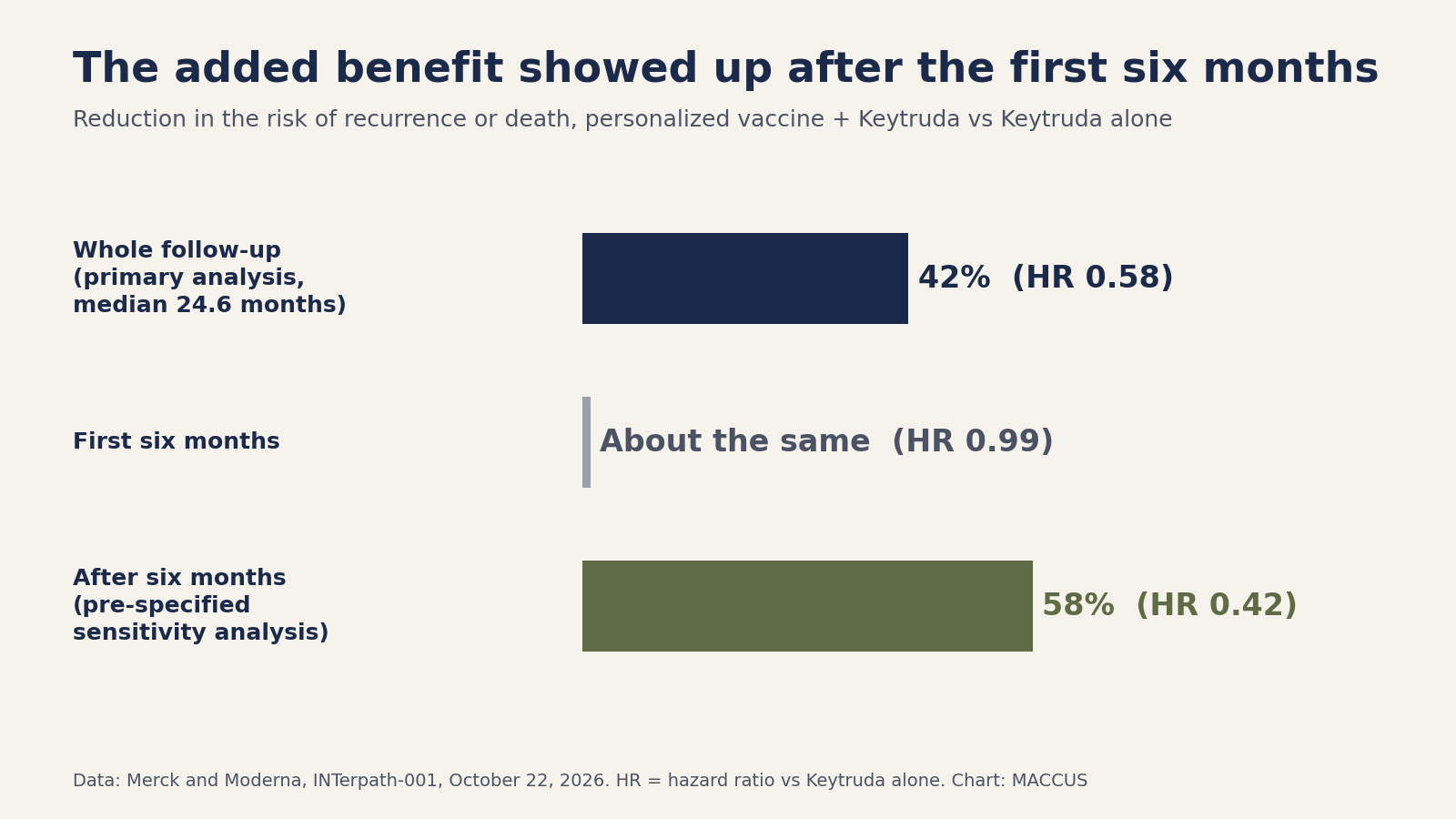
During the first six months, the two groups did about the same (hazard ratio 0.99). After six months, following the vaccination course, the combination cut the risk of recurrence or death by 58%, in a sensitivity analysis the companies had planned in advance. Ansstas told CNBC that the six-week wait for each vaccine and the time the immune system needs to respond may explain the delay. CNBC noted that this explanation remains a hypothesis.
A second planned analysis, which left out patients who never received a dose of vaccine or placebo as intended, put the reduction at 49%.
Side effects were slightly more common with the vaccine, but severe ones were about as frequent in both groups: treatment-related side effects of grade 3 to 5 affected 14.2% of patients on the combination and 13.4% on Keytruda alone. Fever (52.2%), pain at the injection site (51.0%) and fatigue (38.5%) were the most common in the vaccine group. About 7% of patients on the combination stopped treatment because of a side effect, compared with 5% on Keytruda alone, BioPharma Dive reported.
Doctors cheered, the stock fell
Screenshots of the results leaked on social media on Thursday, October 22, and ESMO released the data early. Moderna shares, up nearly 600% this year on hopes for the vaccine, fell as much as 25% that day before recovering some ground, CNBC reported. Investors had expected a 40% to 50% reduction in risk, according to BioPharma Dive, and Moderna had said that 35% would count as clinically significant. “While approval seems likely, commercial success is far less certain,” Trung Huynh, an analyst at RBC Capital Markets, wrote in a note quoted by BioPharma Dive.
In a smaller phase 2b trial, the same combination had cut the risk of recurrence or death by 49% after five years of follow-up, The ASCO Post reported. Ansstas, who worked on the phase 2b trial, told CNBC that the larger trial also enrolled some patients at lower risk of recurrence, which may have slightly tempered the result.
Six melanoma specialists told CNBC that the results mark a clinically meaningful advance and that the combination could eventually become a standard of care for patients who have surgery first, without immunotherapy beforehand. “I have led clinical trials. None of them has improved over PD-1,” Hussein Tawbi of MD Anderson Cancer Center, an investigator in the trial, told BioPharma Dive, referring to the drug class that includes Keytruda. “And now we see we can do better.”
What the trial has not shown yet
Overall survival data are not yet mature, and fewer recurrences do not by themselves prove that patients live longer. The companies report “a favorable trend” in survival, and the trial goes on: ClinicalTrials.gov lists its estimated completion date as September 2030.
The trial tested the vaccine after surgery. It did not compare it with immunotherapy given before surgery, an approach now used more often for patients whose tumors can be removed, CNBC noted. Dr. Adil Daud, a melanoma oncologist at the University of California, San Francisco, told CNBC he expects many patients whose tumors are still in place to keep getting Keytruda before surgery, because “that approach is simpler and doesn’t put the patient through the delay” of making a vaccine.
The price is unknown. Merck declined to estimate it when NPR asked, and the companies have not disclosed what each vaccine costs to make. “It’s probably going to cost like a lot of money,” Daud said.
The result covers melanoma only. BioNTech, another vaccine developer, recently reported that its own personalized vaccine failed a mid-stage trial in colorectal cancer, according to BioPharma Dive. “Knocking one tree does not give you a cabin or a village,” Merck Research Laboratories president Dean Li told CNBC before the results came out.
What it means
STAT sums up the history of cancer vaccines as about 100 years of failure. In a lecture, Vinod Balachandran of Memorial Sloan Kettering Cancer Center called that history “long and sordid.” Merck and Moderna call INTerpath-001 the first positive phase 3 result for a treatment built from each patient’s tumor and for an mRNA-based cancer therapy. Like Waymo, which measures its robotaxi crash record against human drivers, the trial used the current standard treatment, Keytruda, as its yardstick.
The next five years will show whether the vaccine stays an add-on for one skin cancer or works across tumor types. The companies are running nine phase 2 and phase 3 trials, including three phase 3 trials in non-small cell lung cancer and trials in bladder and kidney cancer. Interim results from a mid-stage kidney cancer trial could come later this year or in the first half of 2027, Huynh wrote. “In principle, this type of approach may be applicable to other types of tumors,” James Larkin of London’s Royal Marsden Hospital, scientific co-chair of the ESMO meeting, told reporters.
Over the next 10 to 20 years, manufacturing is a main bottleneck. Melanoma alone accounted for more than 338,000 new cases worldwide in 2024, according to Merck, and each course is a one-off, made from one person’s tumor in about six weeks. “You can’t just stockpile a million vaccines,” Daud told CNBC. Moderna chief executive Stéphane Bancel told CNBC the company is finishing a filing with regulators and aims for full approval next year, and NPR reported that Merck will apply to the FDA.
Sources
- Merck and Moderna Will Present Results From Landmark Phase 3 INTerpath-001 Trial for Intismeran Autogene Plus KEYTRUDA (pembrolizumab) at ESMO 2026 Presidential Symposium, Merck, October 22, 2026
- A Clinical Study of Intismeran Autogene (V940) Plus Pembrolizumab in People With High-Risk Melanoma (V940-001), NCT05933577, ClinicalTrials.gov, record updated September 24, 2025
- INTerpath-001 Trial of mRNA-Based Individualized Neoantigen Therapy Meets Primary and Key Secondary Endpoints in Patients With High-Risk Resected Melanoma, The ASCO Post, August 21, 2026
- Moderna, Merck shares fall on eagerly anticipated cancer vaccine results, BioPharma Dive, October 22, 2026
- Doctors call Moderna, Merck cancer vaccine data a major advancement, despite Wall Street reaction, CNBC, October 23, 2026
- After a cancer vaccine’s first success, the race is on to expand the impact, STAT, October 25, 2026
- Merck’s melanoma vaccine trial shows reduced recurrence or death from skin cancer, NPR, October 26, 2026
Header image: chart by MACCUS, data from Merck and Moderna, INTerpath-001 results, October 22, 2026