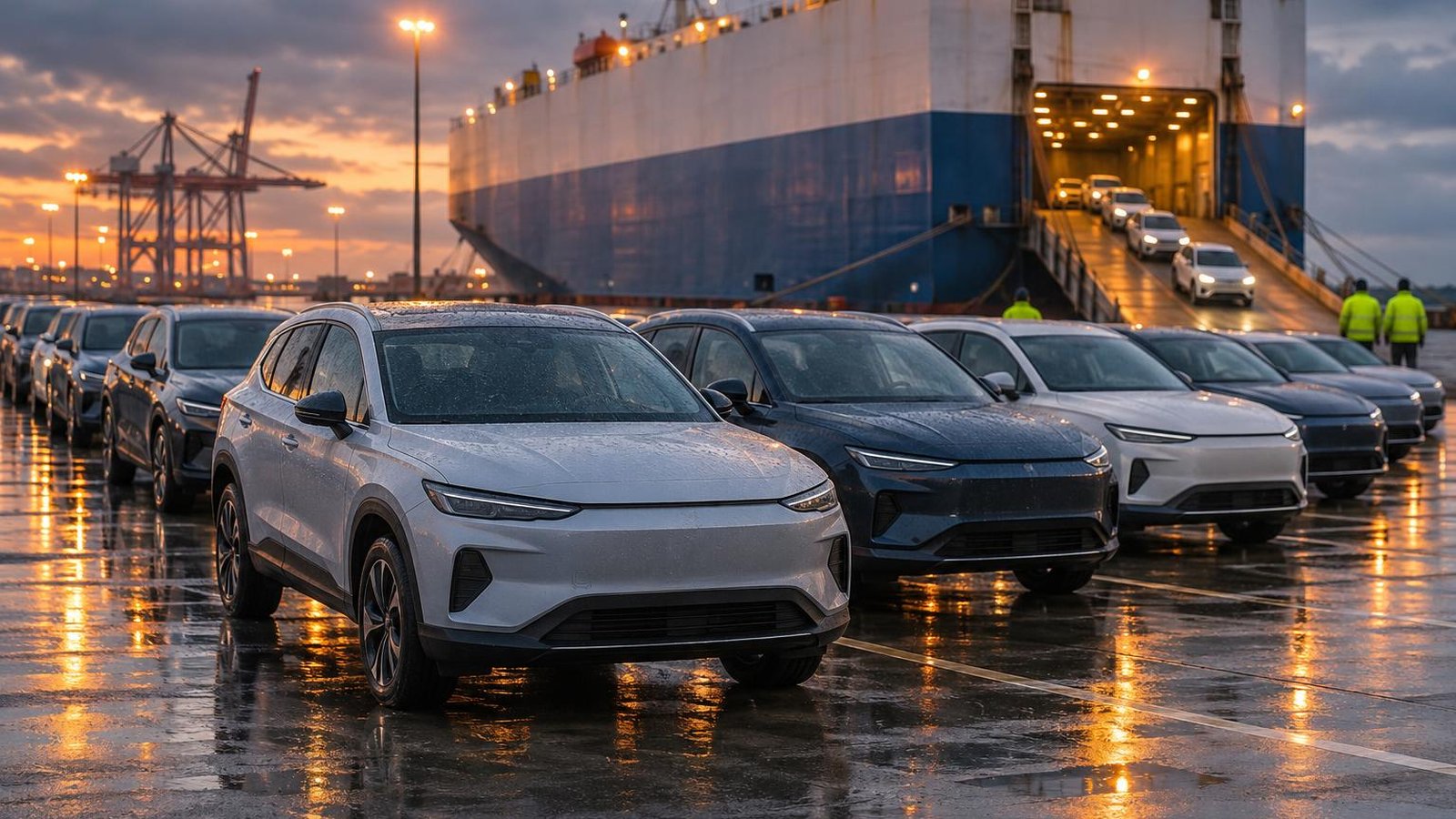

The European Union will let in at most 191,780 new hybrid cars made in China from December 1, 2026, to June 18, 2027. The European Commission set this provisional import quota in a regulation published on November 24, 2026, citing a sharp rise in hybrid imports led by China. Once the quota is used up, further imports “shall not be allowed to enter the Union,” the text says. Chinese-made cars inside the quota pay the usual 10% import duty.
Shipments from China grew more than tenfold, from 46,001 cars in 2023 to 486,582 in the 12 months to June 2026. Whether the quota is a cut or a rise depends on the comparison. By our calculation from the regulation’s own figures, the 200-day quota is about 16% above what China would ship in that time at its 2025 pace. On the same calculation, it is about 28% below its pace of the latest 12 months.
A cap for each big supplier, aimed at China
The text, Commission Implementing Regulation (EU) 2026/2614, was adopted on November 23 and takes effect on December 1. It is a “provisional safeguard measure,” a temporary limit the EU can impose when a sudden rise in imports threatens its own producers. It covers new full, mild and plug-in hybrids built to carry up to nine people. A mild hybrid has a battery that assists the combustion engine, while a plug-in hybrid’s battery is also charged from the grid.
The Commission’s press release says the quotas carry out “the understanding reached at the second meeting of the EU-China Trade and Investment Consultations on 9 October 2026, to moderate China’s exports of hybrids to the EU.” It adds that they “will apply to all hybrid imports regardless of their origin.”
Every country that supplied more than 2% of the EU’s hybrid imports in 2025 gets its own quota, except South Africa. Each quota equals that country’s 2025 imports “increased by a value slightly above 15 %,” scaled to the 200 days. The Commission ties the 15% to the EU hybrid market, which grew by an average of 15% over the previous three years. All other countries share a single quota of 1,500 cars a year.
Over the 200 days, Japan gets the next-largest quota, 170,889 cars, followed by Turkey with 126,320, the United Kingdom with 105,402 and South Korea with 67,924. Mexico, Morocco, Serbia and the United States get between 18,482 and 34,755 each. South Africa is exempt under the rule for developing countries. Norway, Iceland, Liechtenstein, Ukraine and Kenya are outside the measure.
The quotas run in three periods: December 1 to February 28, March 1 to May 31, and June 1 to 18. Unused volumes carry over to the next period. China’s quota for the first period is 86,301 cars. In the three months to June 2026 alone, China shipped 170,748 hybrids to the EU, almost twice that number.
Each car counts against the quota of the country where it was made, whatever the brand on its hood. The EU’s rules of origin decide which country that is. Cars that use China’s quota also need an export certificate “signed and stamped” by the CCCME. That is the China Chamber of Commerce for Import and Export of Machinery and Electronic Products, a Chinese trade body.
From electric cars to hybrids
The regulation links part of the surge to the EU’s previous fight with China over cars. In 2024 the EU put countervailing duties on battery electric cars from China. These extra tariffs, meant to offset state subsidies, ranged from 17% for BYD to 35.3% for SAIC. Imports of those cars then stopped growing: 438,396 in 2024 and 430,721 in 2025.
Hybrid imports took off instead. The duties “created an incentive for Chinese manufacturers to expand exports of hybrid vehicles that were not subject to additional duties,” the Commission writes. It adds that many manufacturers’ production lines can build different types of powertrain.
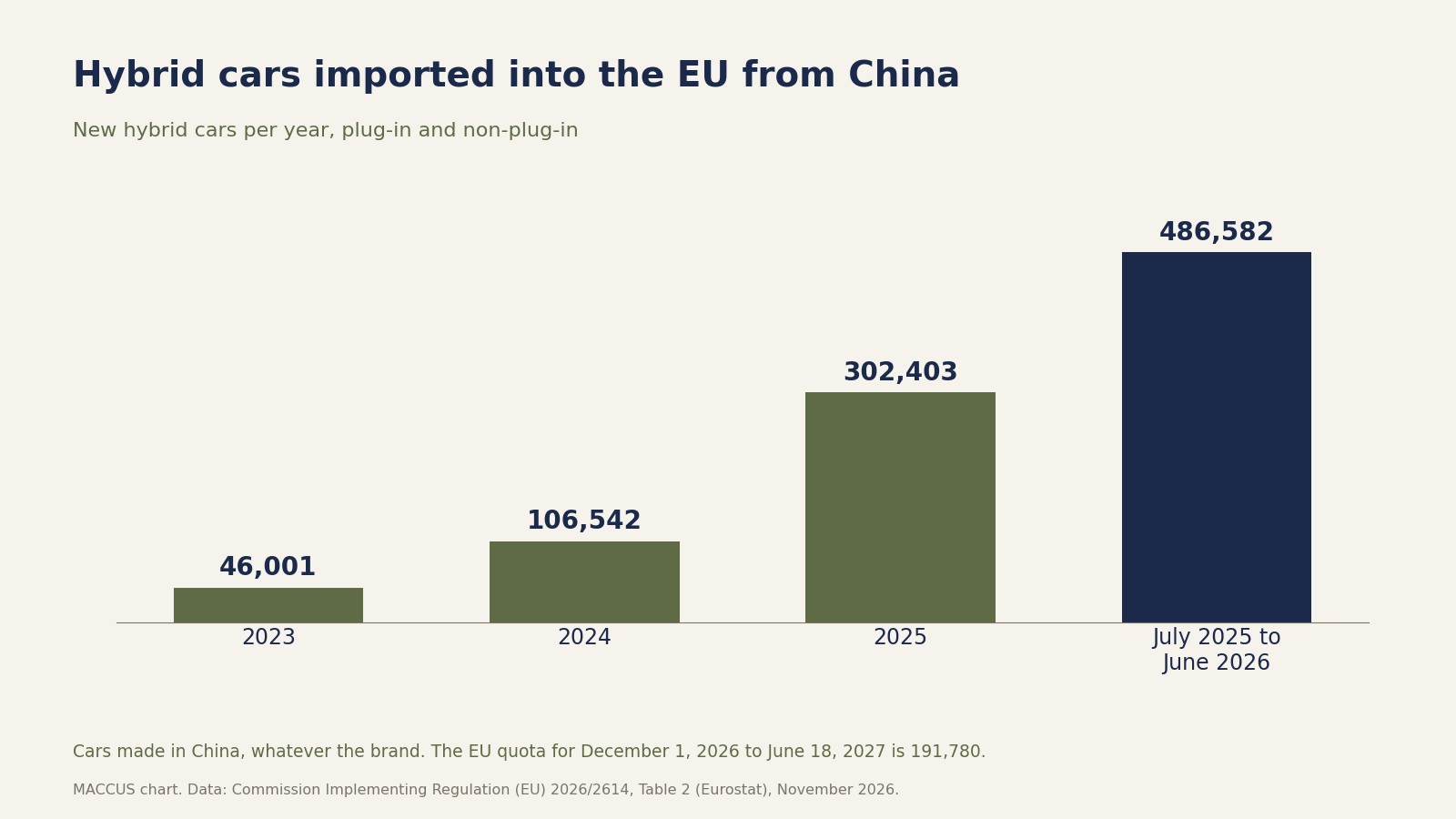
Hybrids made up 46% of new car registrations in the EU in the 12 months to June 2026, up from 33% in 2023. Over the same span, EU demand for new hybrids rose from 3.53 million cars a year to 5.11 million. By our calculation, which compares imports with registrations, about 1 in 77 hybrids sold in the EU in 2023 was made in China. The same calculation gives about 1 in 10 for the latest 12 months.
Sales of fully electric cars are growing too. In September, EU electric car sales rose 73% and outsold gasoline and diesel cars combined. In China, sales of gasoline-only cars fell 49% in September, and 57% of the heavy trucks sold in October were electric.
Cheaper imports and falling EU profits
Imported hybrids from all origins, China included, were priced “around 18 % lower” than EU-made ones in the first half of 2026, the Commission found. It compared list prices of basic versions of 25 imported and 29 EU-made models, in four size classes from small cars to large SUVs. The comparison covered more than 200,000 imported cars.
EU carmakers’ share of their home hybrid market fell from 74% in 2025 to 72% in the 12 months to June 2026. Demand grew by 364,442 cars between those two periods, and imports took 54% of that growth. The EU industry’s profitability on hybrids fell 57% between 2023 and the 12 months to June 2026, the Commission says. In those 12 months the industry “only reached two-thirds of the minimum profit” needed to stay viable in the long run.
Beijing’s answer
China’s Ministry of Commerce replied the same day, November 24. Its spokesperson said the EU had decided on provisional measures less than a month after opening its investigation on October 30. Before the investigation began, the two sides had agreed on what the ministry called a lawful, pragmatic and balanced arrangement on hybrid trade.
The ministry asked the EU to keep to that understanding, follow World Trade Organization rules and fully apply non-discrimination, the principle of treating all trading partners alike. It said China reserves all rights under the WTO framework, including filing a dispute and seeking trade compensation. “保护主义没有出路,开放合作才是正道,” the statement said: protectionism leads nowhere, and openness and cooperation are the right path.
On October 9 in Beijing, EU trade commissioner Maroš Šefčovič had presented the understanding as an outcome of his visit. “This opens the prospect of cutting China’s exports by more than a half,” he said. He did not say from what level.
A provisional measure based on a threat
The quotas are provisional and last at most 200 days. The Commission says it worked “on the basis of the information available at this stage,” ahead of questionnaire replies from EU producers, importers and dealers. It may impose definitive measures within nine months of opening the investigation on October 30, a deadline it can extend by up to two months.
So far, the Commission has found no serious injury, the trade-law term for significant overall harm to an industry. The situation of EU producers “does currently not yet point to the existence of serious injury,” it writes. It acted instead on a “threat of serious injury” and on what it calls critical circumstances, which justify a provisional measure before the investigation ends.
EU production of hybrids still grew, from 4.07 million cars in 2023 to 5.67 million in the 12 months to June 2026. In that period, EU plants used only about 61% of their capacity.
The quotas also squeeze suppliers other than China. At their pace of the latest 12 months, Morocco and Serbia would exceed their quotas and Mexico would roughly reach its limit, by our calculation. Serbia’s shipments fell in 2026, though, to 4,939 in the three months to June. Japan, Turkey, the United Kingdom and South Korea, which supply many of the hybrids Europeans already drive, stay below their caps.
What it means for Europe
Our reading: the quota buys EU carmakers 200 days of room in a growing market. Hybrids are now close to half of all new cars registered in the EU, and imports took 54% of the latest growth in demand. Holding China’s supply about 28% below its recent pace, by our calculation, leaves more of that growth to European plants, which have unused capacity to fill.
The quota leaves two gaps open: price and scale. China produced about 7 million hybrids in 2025, and its production capacity is estimated at double that, according to Mobility Global figures quoted in the regulation. EU plants built 5.67 million in the latest 12 months, and imported hybrids from all origins were priced about 18% lower. The quota limits how many cars arrive, but it sets no price and leaves China’s capacity untouched.
The Commission has until the end of July 2027 to decide whether to make the measure definitive, or the end of September with the extension. China has said it may take the matter to the WTO.
Sources
- Commission Implementing Regulation (EU) 2026/2614 of 23 November 2026 imposing a provisional safeguard measure with regard to imports of certain new hybrid vehicles designed for the transport of persons, Official Journal of the European Union, November 24, 2026
- Commission imposes provisional import quotas on hybrid passenger vehicles, European Commission, November 24, 2026
- Notice of initiation of a safeguard investigation concerning imports of certain new hybrid vehicles for the transport of persons, Official Journal of the European Union, October 30, 2026
- Press remarks by Commissioner Šefčovič at the second meeting of the EU-China Trade and Investment Consultations, European Commission, October 9, 2026
- 商务部新闻发言人就欧盟宣布对混动汽车采取临时保障措施答记者问, Ministry of Commerce of the People’s Republic of China, November 24, 2026