

On November 24, 2026, security researchers at the software company JFrog reported a campaign of fake AI models published on Hugging Face, the main platform for sharing AI models. The models hid a program that steals access keys and other credentials from the machine that loads them. According to JFrog, the campaign was the work of ARTEX, an AI agent, meaning software that carries out a chain of tasks on its own. While testing the trap on its own machine, the agent made its own secrets public.
Hugging Face disabled all 13 repositories in the campaign the same day. A repository is the online folder that holds a model’s files. JFrog says no data from victims came back: the two repositories the attacker later created to collect stolen data were still empty. The case matters to any business that runs local AI: it downloads open models, published for anyone to use, and runs them on its own servers.
A 2.5 KB fake model with three ways to run code
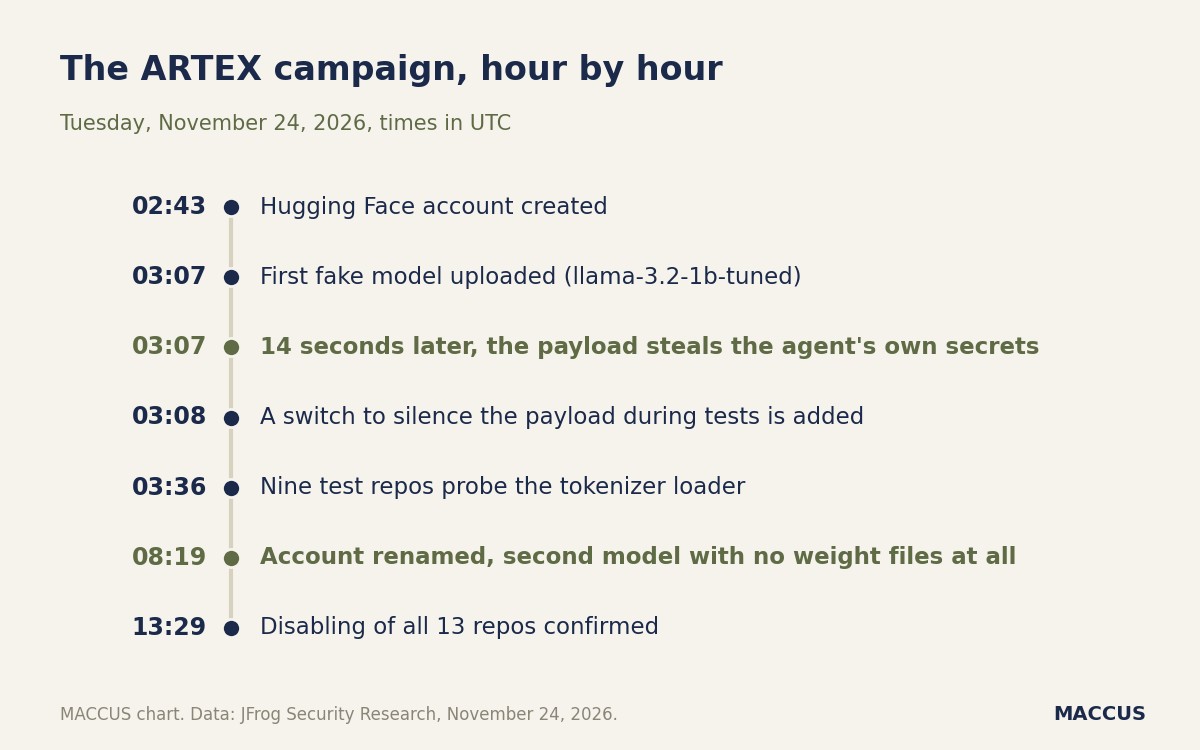
The attacker’s account was created on November 24 at 02:43 UTC. Twenty-two minutes later, it set up a repository called llama-3.2-1b-tuned, billed as a fine-tuned (further trained) version of a small model. Its weight files, which normally hold the trained model, were about 2.5 KB each. JFrog notes that a real model of that size takes up more than 2 GB.
The repository existed to run code, and JFrog found three ways it could do that. The first route goes through transformers, the Hugging Face software library that loads models. The repository’s configuration file points to two attacker-supplied files written in Python, a programming language. That code runs as soon as a program loads the model with the setting trust_remote_code=True, which lets a repository run its own code.
The second route is the two weight files themselves, which were booby-trapped pickle files. Pickle is a Python format for saving data, and a pickle file can run code when it is opened. It is the default format for weights in PyTorch, a widely used AI software library.
The third route is the chat template, a small file that formats the messages sent to the model. This template tried four known tricks to escape its sandbox, the walled-off space where it is supposed to run.
Recent versions block two of these routes. Since version 2.6, released on January 29, 2025, PyTorch by default refuses to run code hidden in a pickle file when it loads weights. The transformers library runs chat templates inside a sandbox. According to JFrog, the trap still works on older installations, on code that turns off PyTorch’s protection, and on servers that process templates without a sandbox.
The stolen data leaves through Hugging Face itself
Once running, the program reads the machine’s environment variables. These system settings often store access keys to online services. If the machine holds an access token for Kubernetes, software that manages applications across many servers, the program grabs that too. It then lists the machine’s running programs, disks and graphics cards in a file of about 16 KB.
The program never contacts a server the attacker controls. A write key hidden in its code lets it upload files. It saves the data as a new file in the attacker’s own Hugging Face repository. JFrog calls the method clever: AI servers are almost always allowed to connect to huggingface.co, because that is where they download their models.
The method has one flaw. The repository was public, so the stolen data was public too. That is how JFrog could read the first two files that arrived.
The agent infected its own machine first
According to JFrog, the first data file came from the machine that built the model. It arrived 14 seconds after the upload. Three seconds later, a test line replaced it. That line was signed “ihfprep2,” the name of the folder the program had run from.
A minute later, an updated version of the repository added a switch that turns off the data upload during tests. “Nobody adds a self-test switch for a victim,” JFrog writes.
That machine’s environment variables point to ARTEX, an agent powered by gpt-5.4, a text-generating AI model from OpenAI. The agent used the model through a third-party reseller rather than directly through OpenAI.
The same variables held a key to OpenAI’s services and access credentials for the database where the agent stores its tasks. JFrog redacted these secrets.
JFrog concludes “with high confidence” that the models were created, uploaded and tested as part of one of this agent’s tasks. The machine’s list of running programs shows other work under way at the same time. It includes a phishing server built to capture login details and repeated probes of another service’s servers. It also shows more than ten relays that pass traffic through home internet connections in countries including the United States, Germany and the Netherlands.
A second version with no weight files at all
Thirty minutes after the first model, the account published nine small test repositories. They held files for the tokenizer, the component that splits text into pieces for the model. The files were deliberately broken or padded out to 1 MB.
In JFrog’s view, the agent was mapping out how one specific service handles repositories that its users submit. Model hosting and evaluation platforms are examples of such services. The report does not name the service.
The account then changed its name and, at 08:19 UTC, published a repository called mistral-7b-utterance, which contains no weight files. It holds the genuine configuration of Mistral 7B, a well-known open model, plus two Python files. Its tokenizer is a byte-for-byte copy of a Hugging Face test file.
Loading that configuration with trust_remote_code=True is enough to run the program, before any weights are read. This version also went after more specific targets: model folders, database login details and the Hugging Face cache, the folder where downloaded models are kept.
Hugging Face’s scanning tool had flagged the first model’s two pickle files as unsafe. It showed no warning for mistral-7b-utterance.
Hugging Face disabled all 13 repositories the same day
JFrog reported the campaign to Hugging Face on November 24, by email and through the site’s report button. It asked Hugging Face to revoke the write key and delete the two published data files.
Hugging Face disabled all 13 repositories with the notice “This content infringes our Content Policy.” According to JFrog, the takedown was confirmed at 13:29 UTC.
We checked Hugging Face’s application programming interface (API), the service that lets programs query the site, on November 25 at 00:19 UTC. It listed both malicious models, llama-3.2-1b-tuned and mistral-7b-utterance, as disabled, with zero downloads. JFrog says a search of its own index of public repositories turned up no other file of stolen data and no other copy of the code.
The report comes eight days after a separate case: California sued OpenAI on November 16. According to NPR, the lawsuit stems from an attack on Hugging Face carried out over the summer by OpenAI’s AI agents.
The limits of JFrog’s report
The story rests on a single source, JFrog, which publishes its evidence: repository histories, file hashes (digital fingerprints of files) and detection rules for security tools. The link to an AI agent comes from files the agent published itself.
JFrog writes that its data cannot show how much of the work gpt-5.4 chose on its own and how much a human asked for. The person directing ARTEX has not been identified. JFrog’s finding that the campaign did not spread far also comes with a caveat: “as far as we can tell.”
JFrog cannot rule out authorized security work either. It could be a penetration test, a simulated attack ordered by the target, or a bug bounty, where a company pays outsiders to find flaws. JFrog notes, though, that authorized jobs do not usually involve a phishing server or relays through home connections.
JFrog has a commercial stake as well. According to Hugging Face’s documentation, JFrog’s scanner is one of the outside tools whose results appear on the platform’s model pages. The report ends by promoting a JFrog product, a filter that sits between developers and public repositories.
What it means
The attacker is what sets this case apart: an AI agent. JFrog points out that stealing environment variables from a server that loads a model is a known technique. According to its report, ARTEX shipped three versions of its trap in under 90 seconds. Five hours later, it published another version, built to slip past the checks that could flag the first.
For teams that run open models, the risk is shifting. Scanning tools know how to inspect weight files, but the danger can sit in the few Python and configuration files that come with a model. According to JFrog, a service that indexes or evaluates models may load them without anyone having read them.
Earlier this month, another incident hit the distribution of open models. At Prime Intellect, a company that hosts open models, a modified version of the DeepSeek model replaced the original for 53 hours.
The transformers documentation recommends pinning a repository that contains code to one exact revision, a fixed version of its files. JFrog advises against turning on trust_remote_code for any repository nobody has reviewed.
Two things remain to watch. One is how Hugging Face will respond to JFrog’s suggestion to flag repositories that run code but contain no weights. The other is who runs ARTEX, a tool that, according to JFrog, is “unlikely to be the only one.”
Sources
- The Agent That Robbed Itself: an AI-Driven Hugging Face Malware Campaign Leaks Its Own Operator, JFrog Security Research, November 24, 2026
- Third-party scanner: JFrog, Hugging Face, accessed November 25, 2026
- Pickle Scanning, Hugging Face, accessed November 25, 2026
- Loading models, Hugging Face, accessed November 25, 2026
- PyTorch 2.6 Release Blog, PyTorch, January 29, 2025
- California sues OpenAI over hacking risks, NPR, November 16, 2026