In October, 57 of every 100 new heavy trucks sold in China were electric. The figure comes from insurance-registration data published on November 16, 2026, by the trade magazine Commercial Vehicle News. A year earlier, in October 2025, the share measured the same way was 29%. In October 2024, it was 18%.
October’s electric sales came to 35,309 heavy trucks, 76% more than in October 2025, while the heavy-truck market as a whole shrank. By our calculation, sales of diesel, natural gas and other non-electric heavy trucks fell 47%, from about 50,000 in October 2025 to about 26,500 this October. Fuel use is changing too: Kpler, an energy data firm, expects China’s diesel demand to fall this year even as freight grows, as electric and natural gas trucks replace diesel ones.
35,309 electric trucks in one month
Two Chinese trade outlets published the October figures on November 16: Commercial Vehicle News (商用汽车新闻) and CV World (第一商用车网), a commercial-vehicle trade website. The magazine posted them on its official Weibo account. Weibo is a Chinese social network.
The count is based on the compulsory insurance every new truck needs before it can be registered. Exports are excluded. In China, a heavy truck is one with a gross vehicle weight of 12 metric tons or more.
Electric sales rose 7% from September, and October was the third-best month on record by volume. By share, it was the best month ever: 57.13%, according to the magazine’s chart.
From January to October, China sold 261,736 electric heavy trucks, 66% more than in the same months of 2025. Two Chinese truckmakers led in October: Sinotruk sold 5,907 electric heavy trucks and FAW Jiefang 5,309. The ten largest makers sold 92.4% of October’s total.
The “electric” trucks in these figures are what China calls “new-energy” trucks. That category also includes hydrogen fuel-cell models, but in practice it is almost all battery-electric. In September, China registered 36 fuel-cell heavy trucks and 32,800 battery-electric ones, according to the clean-energy news site CleanTechnica.
On November 12, the China Association of Automobile Manufacturers, an industry group, also said the electric share passed 50% in October. Its figures count manufacturers’ sales rather than registrations.
The third month above 50%
October is the third month in which electric trucks passed half of sales, and the second in a row after September. The first was December 2025, at 53.89%, according to CV World figures reported by Guandian, a Chinese business news site. The electric-vehicle news site Electrek reported that buyers rushed that month before a trade-in subsidy expired and a purchase tax took effect.
The share then fell to 23% in March 2026. It has risen every month since: 30% in April, 41% in May, 45% in June, 47% in July and slightly more in August, just over 50% in September (50.28%) and 57% in October. For full years, the share was 0.7% in 2021 and 28.9% in 2025.
Diesel and natural gas trucks are losing buyers
The overall market shrank. On November 3, before the final count, CV World estimated that China’s heavy-truck sales, exports excluded, fell more than 11% in October compared with October 2025. It also expected sales of natural gas trucks to drop about 68% from the 21,000 sold in October 2025.
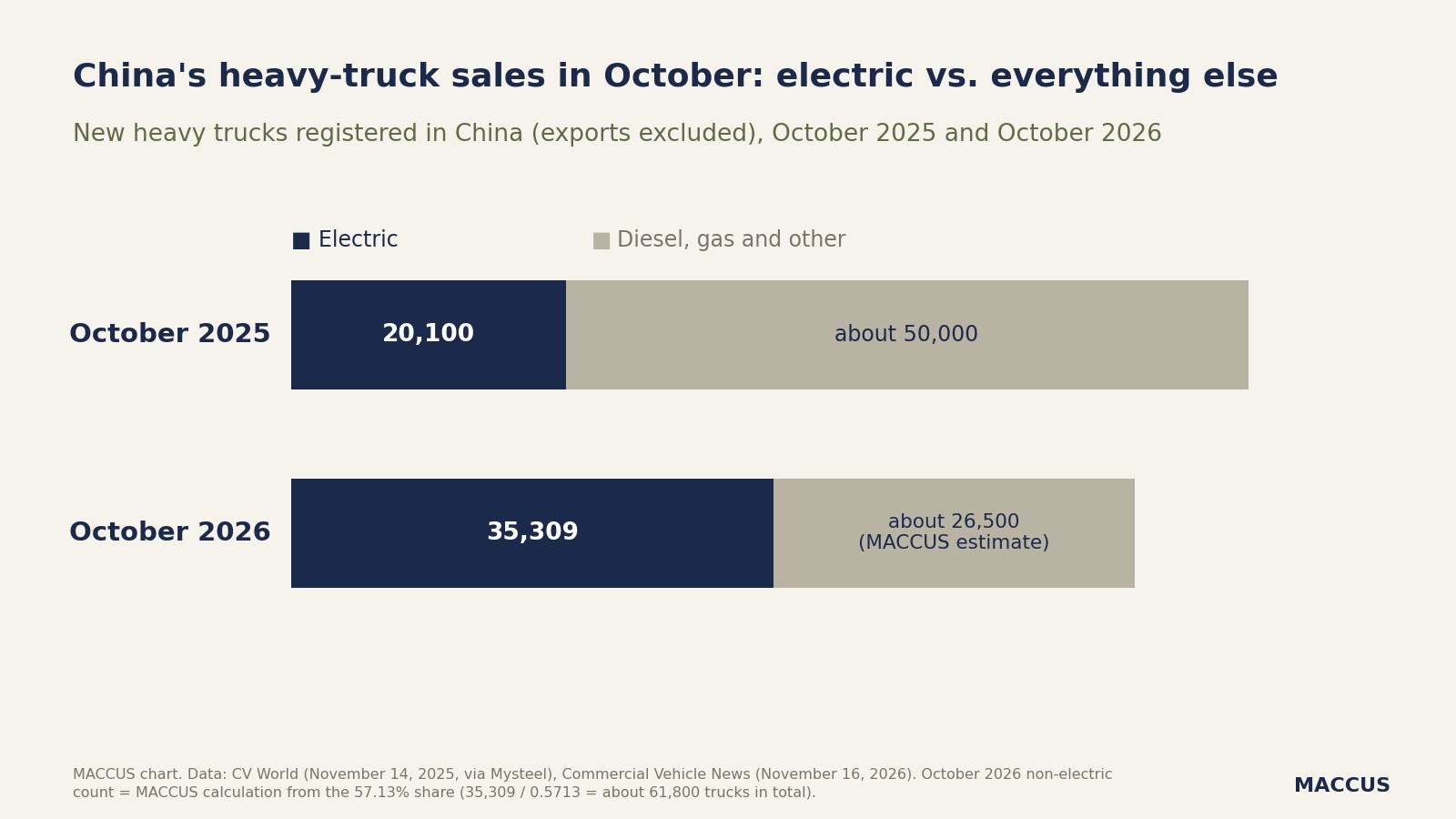
Our calculation from the final figures agrees. In October 2025, China sold 70,100 heavy trucks, 20,100 of them electric, according to CV World. This October, 35,309 electric trucks made up 57.13% of sales, which puts total sales at about 61,800. Sales of non-electric trucks fell from about 50,000 to about 26,500, a drop of 47%.
CV World gave five reasons for the smaller market. Freight demand is weak and freight rates are low. A trade-in program lifted sales last year, so this year is compared with a high base. Some purchases were also brought forward ahead of a new braking-system rule, and the industry is still working through its stocks. Diesel and natural gas prices have been higher since September.
Many owners of diesel and gas trucks are switching to electric, the site wrote. Others, especially on medium and long hauls, are putting off buying a new truck. Higher fuel prices have hit cars too: in September, Chinese buyers bought 49% fewer gasoline-only cars than a year earlier.
Natural gas trucks, long the cheaper alternative to diesel, are losing buyers fastest. According to Kpler, the US-Iran war sent diesel prices sharply higher in March. By May, they were about 35% above their January average.
Gas trucks briefly took 37% of heavy-truck registrations in March, according to Kpler. Then natural gas prices rose too, following oil. Monthly registrations of gas trucks fell from more than 30,000 in March and April to about 6,200 in July.
The cost case and the policy push
The International Council on Clean Transportation (ICCT), a research group, has compared the cost of owning electric and diesel trucks in several Chinese fleets this year. One study looked at an e-commerce fleet in Guangdong, a southern province. There, electric trucks cost 16% less to own over five years than comparable diesel trucks, mainly because electricity costs less than diesel.
A second study looked at tractor-trailers used for express delivery in the Yangtze River Delta, the region around Shanghai. There, the electric trucks’ advantage was 3% over six years without purchase incentives and about 14% with them.
Tractor units, the trucks that pull semi-trailers, are switching fastest. In September, 64.48% of new tractor units registered were electric, according to CleanTechnica. The same site says about one in five new battery-electric heavy trucks registered that month was classified as a battery-swap model. Battery swapping means exchanging an empty battery for a charged one at a station instead of plugging in.
Beijing wants electric trucks to reach 40% of heavy-truck sales by 2030. The target comes from a plan by 11 government agencies, published by the Ministry of Transport on June 15, 2026. The monthly share has been above that 40% mark since May.
The plan also aims for 1.6 million electric heavy trucks on the road by 2030, about 20% of the fleet. It also sets a goal of 30,000 kilometers of what it terms zero-carbon road freight corridors and about 3,000 charging and battery-swap stations.
What the 57% does not show
Most heavy trucks on China’s roads are still not electric. Kpler expects electric trucks to make up about 38% of China’s heavy-truck sales for all of 2026, but only about 8% of the heavy trucks in service by the end of the year.
The share can fall as fast as it rises: it dropped from 54% in December to 23% in March. By our reading of CV World’s explanation, part of October’s share comes from diesel and gas buyers who are waiting rather than switching. When they hold off, the electric share goes up. If fuel prices fall, some of them may return.
The savings also depend on the route and on public money. In the ICCT’s express-delivery study, on routes of 300 to 500 kilometers, electric trucks were only 3% cheaper to own than diesel without purchase incentives.
The environmental gains vary too. In the Guangdong study, electric trucks cut greenhouse gases by about 63% compared with diesel, but particle pollution by only about 31%, because of how the province generates its electricity.
What it means
China’s truck fleet will change more slowly than its sales. If half or more of new heavy trucks stay electric, the share of electric trucks on the road should climb every year as older diesel trucks retire. Meeting the 2030 target of 1.6 million electric heavy trucks would bring them to about 20% of the fleet.
Kpler’s estimates show the effect on oil. In 2026, it expects electric heavy trucks to displace about 230,000 barrels of diesel a day in China, and gas trucks about 450,000. It expects China’s diesel demand to fall by about 230,000 barrels a day this year, even though road freight grew about 3% in the first seven months. In Kpler’s words, “China is moving more freight while consuming less diesel.”
Europe is far behind on trucks, although the EU figures also include medium trucks, so the comparison is rough. In the first nine months of 2026, diesel trucks took 91.7% of new truck registrations in the EU, according to the European vehicle makers’ association ACEA. Plug-in trucks took 5.3%. Europe has moved further on cars and power: in September, electric cars outsold gasoline and diesel cars combined in the EU, and this summer solar was the EU’s biggest source of electricity.
China’s November truck registrations are due in mid-December. On November 3, CV World wrote that electric truck sales in November and December should be at least as high as in October.
Sources
- 新能源重卡银十胜金九,渗透率突破 57%,重汽解放双冠, Commercial Vehicle News (official Weibo, via Sina), November 16, 2026
- 新能源重卡10月销量再破2万,全年剑指20万辆, CV World (via Mysteel), November 14, 2025
- 10月份重卡市场共计销售约9.2万辆 新能源重卡渗透率再度超过50%, Zhitong Finance (CV World data, via Sina Finance), November 3, 2026
- 中汽协:10月新能源重卡渗透率突破50% 2025年销量增182%, Guandian (via Sina Finance), November 12, 2026
- China’s road fuel demand displacement reaches 1.3 Mbd in 2026 as high prices accelerates technology shift, Kpler, updated October 20, 2026
- 新能源重卡规模化应用实施方案发布, Ministry of Transport of China, June 15, 2026
- Electrifying on-road freight: A case study of straight trucks for e-commerce logistics in China, ICCT, November 5, 2026
- China’s Electric Heavy Trucks Are Taking Sales from Diesel and LNG, CleanTechnica, November 17, 2026
Header image: MACCUS chart, electric share of China’s heavy-truck sales in October 2024, 2025 and 2026. Data: CV World (November 14, 2025, via Mysteel), Commercial Vehicle News (November 16, 2026).