

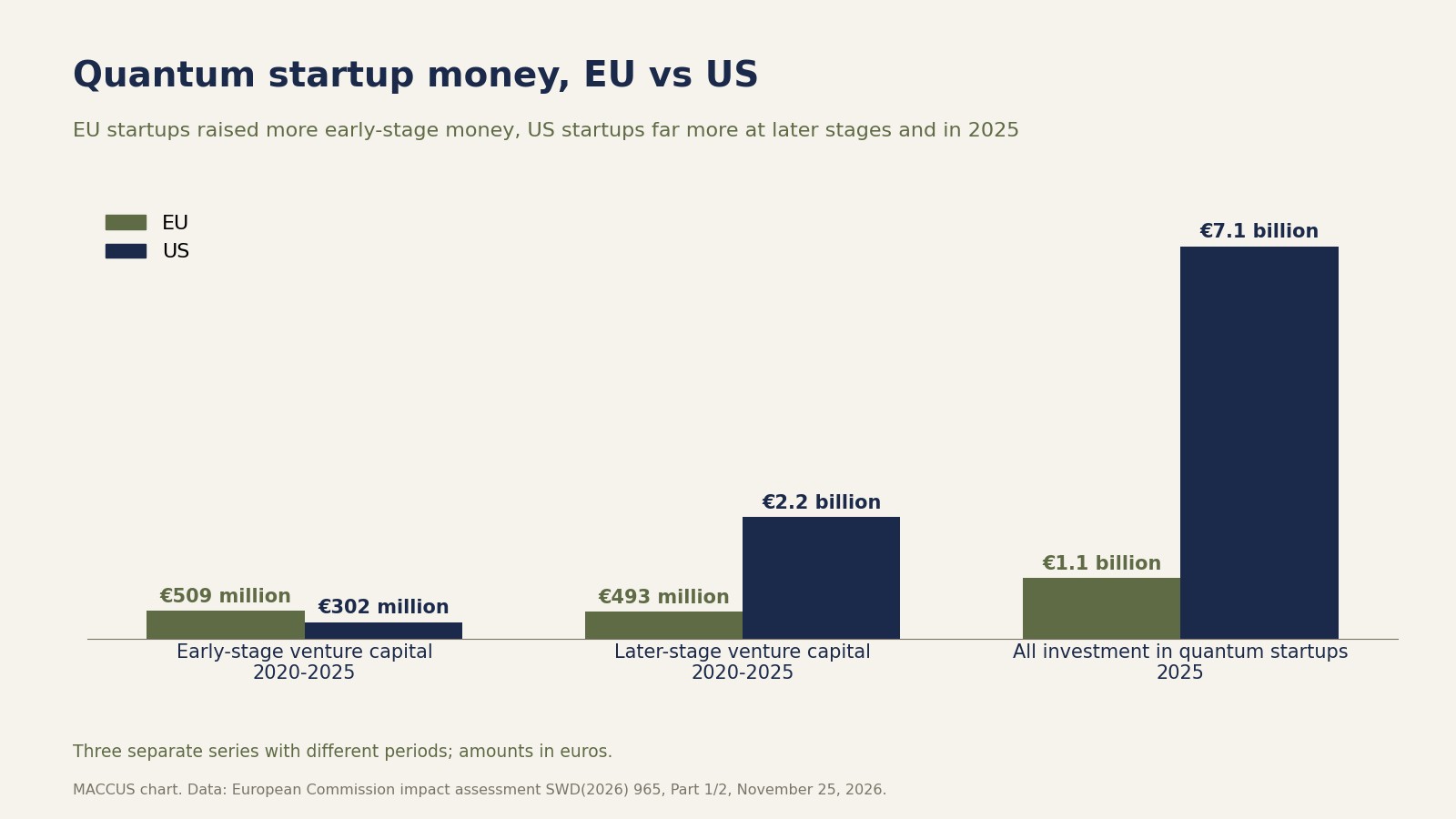
Quantum startups in the United States took in about 7 billion euros of investment in 2025, more than six times the 1.1 billion euros that went to startups in the European Union. The European Commission published those figures on November 25, 2026, when it proposed a Quantum Act, a law meant to help turn Europe’s quantum research into products and services. They appear in the impact assessment, the analysis published with a draft law.
The same document shows that EU startups fall behind as they grow. About a third of the world’s quantum companies are in the EU, and from 2020 to 2025 they raised more money than US firms in early funding rounds. The money runs short when they need large rounds to move from prototypes to industrial production. The Act would restrict public quantum contracts to EU-controlled firms and authorized partner-country suppliers, and give the EU a legal basis for an investment fund with no fixed budget yet.
Where the money runs out
The impact assessment, SWD(2026) 965, says: “Private financing shows a different picture: in 2025, quantum start-ups received around EUR 7 billion in investment in the US compared with EUR 1.1 billion in the EU.” Its table gives 7.10 billion euros for the US and 1.10 billion for the EU. It gives no comparable private figure for China.
EU firms led in early-stage venture capital, the first rounds of investor money for young companies. From 2020 to 2025, EU quantum companies raised about 509 million euros at that stage, against 302 million for US firms. At later stages the order flips: US firms raised about 2.2 billion euros, 4.5 times the 493 million raised by EU firms over the same years. “The observed problem is therefore not a lack of entrepreneurial creation,” the report says, “but the limited progression of firms from start-up and prototype stages to sustained industrial scale within the Union.”
From 2012 to 2024, EU firms took part in only 35 of the 188 mapped funding rounds above 25 million euros. Growth rounds pay for a company’s expansion, and only six EU quantum companies have raised one above 100 million euros, against 28 worldwide.
Citing McKinsey’s Quantum Technology Monitor 2026, the report says the ten largest financing deals involving quantum companies in 2025 totaled 6.6 billion euros. Eight involved US companies, one British and one Canadian. “No EU-headquartered company appeared in the top 10.”
US tech giants add to the gap: the report notes that IBM, Google, Microsoft and Amazon invest in quantum directly. Google’s DeepMind and Quantum AI labs recently used AI agents to find quantum programs up to 290 times cheaper than the best published designs. Corporate investors put about 148 million dollars into EU quantum startups in 2025, against about 1 billion dollars for US ones, McKinsey figures quoted in the report show. Across all sectors, the venture firm Atomico estimates that US investors now supply 52% of the money in Europe’s Series C rounds, a late funding stage.
The risk Brussels names
The report spells out what it fears: a case where “a strategically important European quantum company lacks viable European financing alternatives and risks relocation or acquisition.” It adds: “Foreign investment is not inherently problematic.” It names no company that has left.
Henna Virkkunen, the Commission executive vice-president who presented the proposal, gave reporters a different measure: “quantum start-ups in Europe attracted only 5% of global private funding, compared to 50% in the US.” Presenting the new fund, she added: “No company should be obliged to leave Europe due to a lack of finance.”
European quantum companies delivered “roughly half of all procured machines in the world,” about 150. Every quantum computer installed worldwide includes European cryogenics (deep-cooling equipment) or photonics (light-based components), the report says.
Proposed rules for public contracts
Under Article 20 of the proposal, COM(2026) 965, quantum tenders by public buyers “shall be restricted to quantum technology products and services provided by Union-controlled entities and entities authorised to participate pursuant to Article 31.” The same rule would bind subcontractors, and the Commission could later reserve certain critical components for EU-controlled suppliers. The text now goes to the European Parliament and the Council of member states, which can amend it.
“Union-controlled” is a test of control. A company qualifies if it is set up in a member state and has its registered office or central administration in the EU. It must not be controlled by a non-EU government, company or citizen. A foreign stake that carries no control does not by itself disqualify it, the text says.
Under Article 31, companies from countries whose public-purchasing agreements with the EU cover quantum products would keep the right to bid. Others could be admitted through strategic partnerships that give EU firms the same access. The Commission’s FAQ adds: “This is not a blanket requirement that every component be manufactured in the EU.”
The proposal also covers post-quantum cryptography, encryption designed to protect data against what the Commission calls “future cyber risks linked to quantum computing.” For critical digital purchases, public administrations covered by NIS2, an EU cybersecurity directive, would have to buy only products that support such encryption. The rule would cover tenders launched six months or more after the law takes effect, with a migration-plan exception where no such product exists yet. Older encryption is already being tested with ordinary computers: AI agents at Google DeepMind recently reran an attack that forges 1024-bit RSA signatures.
A fund with no fixed budget
Article 23 says the EU “may establish and implement an equity investment vehicle,” the Sovereign Tech Equity Fund. It would buy stakes in companies in quantum, AI, chips, biotech and other critical technologies. Member states and “other public or private investors” could join the EU as shareholders.
The FAQ says: “no fixed budget is allocated under the proposal.” The goal is to have the fund running by the start of the EU’s next seven-year budget, for 2028 to 2034.
The Financial Times reported on November 25 that the EU plans to mobilize 50 billion euros for the fund, and Reuters and Bloomberg carried the same figure. That number appears neither in the proposal nor in the Commission’s press release.
The Commission’s own papers estimate something else: the European quantum sector as a whole needs 50 to 60 billion euros, mainly in equity. That includes up to 4 billion euros for 20 to 40 startups and 20 to 25 billion for up to 50 scale-ups. Large strategic projects and quantum foundries, plants that make quantum hardware, account for 25 to 30 billion.
The industry group asks for more
The European Quantum Industry Consortium (QuIC), an industry group with more than 240 members, welcomed the plan but wants more. In a statement relayed by The Quantum Insider, it said it will ask lawmakers for 7.7 to 12.3 billion euros of public quantum purchases over five years. It will also seek “a quantum share in the Sovereign Tech Equity Fund.”
The limits of the numbers
The report gives no source for the 2025 investment figures in its table. Its EU figures cover only the 27 member states, without the UK or Switzerland. It warns that public support figures are “not directly comparable” across countries. Counting announced funding up to 2025, public quantum support comes to about 8.6 billion euros in the EU, 5.3 billion in the US and 13.6 billion in China.
EU startups that reach a Series A, usually their first large venture round, take longer on average: 4.53 years, against 3.76 outside the EU. The report says that figure “should be interpreted cautiously.”
What it means for Europe
The EU leads where companies start. From 2020 to 2025, EU firms raised more early-stage venture capital than US firms, 509 million euros against 302 million, and the EU has about a third of the world’s quantum companies. European companies also delivered roughly half of the quantum machines bought worldwide. Reserving public contracts for EU-controlled firms and authorized partner-country suppliers would make governments early customers, which is what QuIC’s 7.7 to 12.3 billion euro purchase request is about.
The money gap remains. US startups took in 7.1 billion euros in 2025, against 1.1 billion for EU ones, and no EU company was among that year’s ten largest quantum deals. The fund meant to help close that gap has no fixed budget, and the Commission aims to have it running by the start of 2028. Its own report expects the market’s clear winners to emerge within the next five to eight years.
Two decisions are still open. Parliament and the Council will settle the procurement rule in Article 20. Some stakeholders consulted by the Commission had warned against “broad sourcing restrictions,” while others wanted stronger funding, procurement or security measures. The budget talks for 2028 to 2034, and what member states and private investors choose to add, will decide how much money the equity fund actually gets.
Sources
- Commission Staff Working Document, Impact Assessment Report accompanying the Proposal for a Regulation on a framework of measures for strengthening the Union’s quantum ecosystem (Quantum Act), SWD(2026) 965 final, Part 1/2, European Commission, November 25, 2026
- Proposal for a Regulation of the European Parliament and of the Council on a framework of measures for strengthening the Union’s quantum ecosystem (Quantum Act), COM(2026) 965 final, European Commission, November 25, 2026
- Executive Summary of the Impact Assessment Report, SWD(2026) 966 final, European Commission, November 25, 2026
- Commission proposes Quantum Act and new Sovereign Tech Equity Fund to strengthen Europe’s industrial capacity and security, European Commission, November 25, 2026
- The Quantum Act explained, European Commission, November 25, 2026
- Remarks by Executive Vice-President Virkkunen on the Quantum Act, European Commission, November 25, 2026
- QuIC Welcomes the European Quantum Act, Pledges to ‘Mobilize Industry’, The Quantum Insider, November 25, 2026