
NVIDIA has released Nemotron-Labs-Image-30B-A3B, a text-to-image model, as an open-weight download. Its repository on Hugging Face, a site for sharing AI models, went up between the evening of November 24 and the morning of November 25, 2026 (UTC). The model card, the page that describes it, shows scores ahead of OpenAI’s GPT Image 2 on several benchmarks.
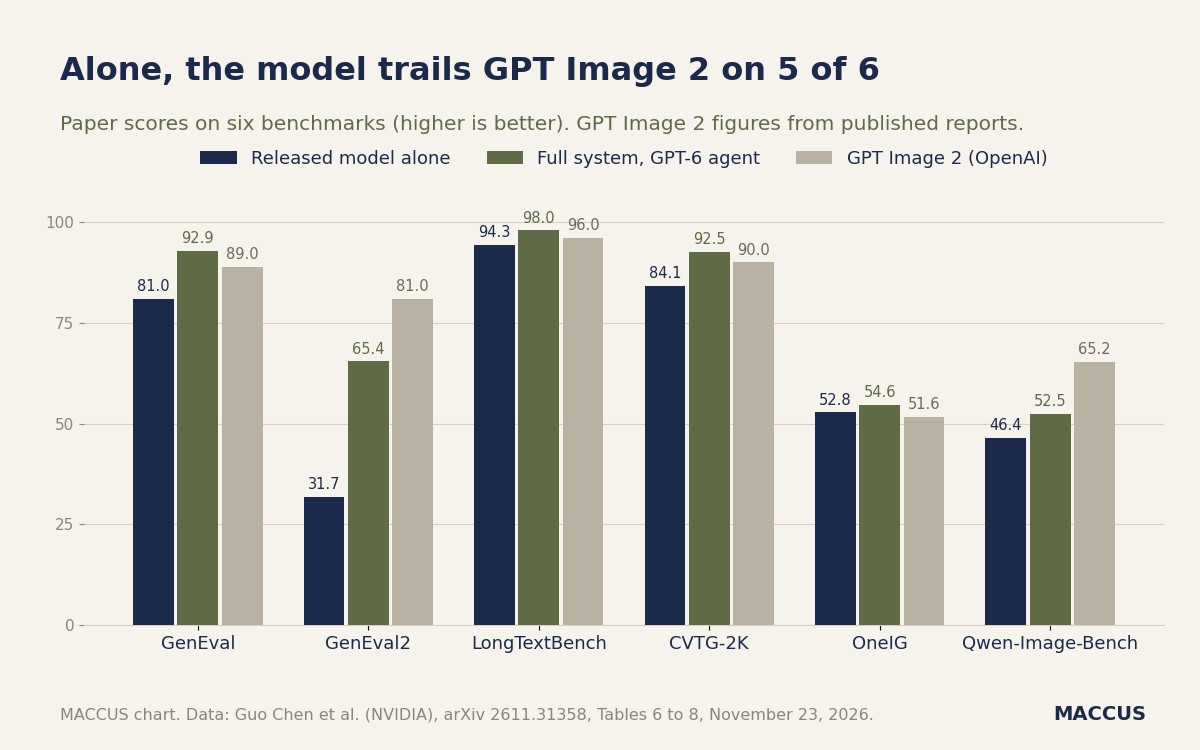
All ten of NVIDIA’s image scores in the card’s results table come from a larger system: OpenAI’s GPT-6 is the agent that steers NVIDIA’s generator through a harness, control software NVIDIA has not released. The card never names GPT-6. Run alone, the downloadable model trails GPT Image 2 on five of the six benchmarks, or standard tests, where NVIDIA’s research paper reports both.
An image generator built on a language model
The model is built on Nemotron 3 Nano, one of NVIDIA’s large language models. The image model uses a mixture-of-experts design: of its 30 billion parameters, the values learned in training, only 3 billion are activated for each token it generates. That is the “30B-A3B” in its name.
The model builds an image the way a language model writes text, one token at a time; its tokens are visual codes. A bundled tokenizer, an encoder and decoder of roughly 642 million parameters, turns those codes into pixels. The card warns that the model is not a Diffusers pipeline, so standard code for Diffusers, Hugging Face’s image library, will not load it.
NVIDIA presents the model as the image-generation part of a larger project, Nemotron-Labs-VisualCreation. The card calls that project “an agentic framework” for images and editable webpages, presentations, charts and scientific figures.
The release consists of the Hugging Face repository, whose release snapshot was committed at 21:55 UTC on November 24, and a paper on arXiv, a research-paper archive. We found no NVIDIA press release or blog post.
Loading the model runs Python code from the repository through the trust_remote_code=True option. NVIDIA advises locking in one reviewed version “for controlled deployments.” According to security researchers at JFrog, Python files that run at load time through that option were one of the attack paths used by ARTEX, an AI agent that planted credential-stealing fake models on Hugging Face.
Three setups behind one column of scores
The card’s results table sets one NVIDIA column, labeled Nemotron-Labs-VisualCreation, against GPT Image 2 and Google’s Nano Banana Pro image generator. A note above the table says the column “reports our best score for each benchmark across the configurations evaluated in the paper.”
The paper, posted on arXiv on November 23 by 12 authors from NVIDIA and four universities, tests three configurations. The first is the released model alone. The other two place the same generator inside NVIDIA’s VisualCreation harness, which handles planning and chooses among candidate images. The agent is either NVIDIA’s own Nemotron models or OpenAI’s GPT-6.
All ten scores in the card’s column come from the GPT-6 configuration, according to our row-by-row comparison with the paper’s Tables 6 to 10.
Run alone, the downloadable model beats GPT Image 2 on one of the six benchmarks where the paper lists both: OneIG (52.77 against 51.60). On GenEval, a test of whether an image follows the prompt, it scores 80.97 against 89.00 for GPT Image 2. On LongTextBench, which measures text rendered inside images, it scores 94.30 against 96.00. The widest gaps are on GenEval2 (31.71 against 81.00) and Qwen-Image-Bench (46.36 against 65.23).
The GPT-6 configuration beats GPT Image 2 on four of those six: GenEval, LongTextBench, CVTG-2K and OneIG. It also wins on BizGenEval, a test of commercial visual design (86.0 against 83.2). It still trails on GenEval2 and Qwen-Image-Bench. The all-NVIDIA configuration beats GPT Image 2 on two of the six: LongTextBench (97.00 against 96.00) and OneIG (54.14 against 51.60).
NVIDIA’s own agents lift the generator’s scores sharply. Its GenEval2 score rises from 31.71 to 52.56. On WISE, a test of knowledge and reasoning, it climbs from 46.30 to 88.60, “a gain of 42.30 points” in the paper’s words. The paper gives no GPT Image 2 score on WISE and no standalone score on BizGenEval.
Can it run on smaller hardware?
NVIDIA documents one data-center setup. The quick-start guide assumes Linux, Python 3.12 and an NVIDIA driver compatible with CUDA 13.0. Its sample script runs on four NVIDIA H100 graphics processors (GPUs) with 80 GB of memory each.
With fewer GPUs, a check stops the script with the message “This example requires four visible GPUs.” The card adds that the generator and the decoder “may be run in separate processes if GPU memory is tight.”
The full repository, paper and animated GIFs included, comes to about 133.2 GB. Hugging Face’s metadata lists 32,634,904,896 parameters across 32 safetensors files, stored in F32, a 32-bit format that takes four bytes per value. The card’s “bfloat16,” a 16-bit format, is the precision used during generation.
Graphics memory is usually what limits running AI models on in-house hardware, and Hugging Face users started shrinking the model within a day. One uploader posted a conversion to NVFP4, a 4-bit format, as a single 24.3 GB file at 07:10 UTC on November 25. GGUF files, the format of the llama.cpp program for running models locally, followed from two other uploaders at 17:19 and 17:54 UTC, ranging from 11.3 GB to 65.3 GB. Two packages for the ComfyUI image-generation tool appeared at 19:11 and 22:05 UTC, with model files from 21.6 to 65.3 GB.
None of these comes from NVIDIA. All carry Hugging Face’s “other” license tag, NVIDIA has not said whether they produce correct images, and they were not tested for this article.
NVIDIA keeps the commercial rights
The card states that the model “is licensed for non-commercial research and evaluation under the NVIDIA License,” with a copy in the repository. Section 3.3 of that license reads: “The Work and any derivative works thereof only may be used or intended for use non-commercially. Notwithstanding the foregoing, NVIDIA Corporation and its affiliates may use the Work and any derivative works commercially.” The license defines non-commercial use as “for research or evaluation purposes only.”
Under section 3.2, any terms placed on a derivative work must keep that limit, so the community conversions stay non-commercial too.
The base model, Nemotron 3 Nano 30B-A3B, comes with different terms. Its card says “This model is ready for commercial use.” It ships under the NVIDIA Nemotron Open Model License, whose page states that “Works are commercially usable.”
NVIDIA’s two Nemotron 3.5 models, released on October 15, 2026, also allow commercial use under the OpenMDW-1.1 license. They are the Bolt 74B-A9B text model and the Super VL model for images and text.
In late October 2026, the French AI company Mistral released the weights of Large 4 under a license that allows commercial use with one exception. Companies that sell access to the model as a service must first sign a commercial license with Mistral.
The card’s wording and the paper’s caveats
The card does say the column is a best-of, and it links to the paper. The word “GPT-6” appears nowhere on the model card, though, as of November 26. The column also carries the framework’s name, without saying which configuration produced it. The paper’s abstract states: “With our best setting, Nemotron-Labs-VisualCreation achieves performance competitive with GPT Image 2 and Nano Banana Pro across most benchmarks with available comparisons.”
A November 25 article by Omar Sohail on the tech news site Wccftech presented the model as an image generator outpacing GPT Image 2. It wrote that on LongTextBench “Nemotron-Labs-Image-30B-A3B scored 97.98 compared to 96.00 for GPT Image 2 and 97.60 for Nano Banana Pro.” In the paper, 97.98 belongs to the GPT-6 configuration; the standalone model scores 94.30. The article also reported GPT Image 2 ahead on GenEval2 and Qwen-Image-Bench, but it does not mention the license, GPT-6 or the GPU requirement.
The paper has caveats of its own. Its GPT Image 2 and Nano Banana Pro numbers are “collected from official reports and leaderboards,” not rerun by NVIDIA. It does not say which GPT-6 version it used, how many calls one image takes, or what that costs. It also notes that “the agent-assisted rows do not specify a total system parameter count,” so the 3 billion active parameters describe the generator alone.
As we read the card and the paper, the setup behind the card’s headline scores cannot be reproduced from the release. GPT-6 is OpenAI’s model, not part of the release. The card lists the VisualCreation harness as “Will be released upon legal clearance,” with no date. As of November 26, we found no independent benchmark of the standalone model.
What it means
Run alone, the model NVIDIA released trails GPT Image 2 on most head-to-head tests, by the paper’s own numbers. The card’s headline scores come from a larger system built on an unreleased harness and OpenAI’s GPT-6.
For people who want an open alternative to GPT Image 2 on their own hardware, the standalone scores are what count. The license also limits the model and all its conversions to research and evaluation.
Much of the system’s strength appears to come from the agent layer: the same generator scores far higher inside the harness than alone. The paper’s own limits apply: no breakdown of what each step adds, competitor figures from published reports and no independent check yet.
Three developments would change this picture: a release of the harness, independent tests of the standalone model and its conversions, and a license change. Nemotron 3 Nano, the base model, is already cleared for commercial use.
Sources
- nvidia/Nemotron-Labs-Image-30B-A3B, NVIDIA on Hugging Face, November 24, 2026
- NVIDIA License (LICENSE), NVIDIA on Hugging Face, November 24, 2026
- Nemotron-Labs-VisualCreation: Pixel as Code for Agentic Visual Creation, Guo Chen et al., arXiv, November 23, 2026
- nvidia/NVIDIA-Nemotron-3-Nano-30B-A3B-BF16, NVIDIA on Hugging Face, August 24, 2026
- NVIDIA Nemotron Open Model License, NVIDIA, December 15, 2025
- NVIDIA Releases Open Weights For Nemotron-Labs-Image-30B-A3B, An Autoregressive Image Generator Outpacing GPT Image 2 With 3B Active Parameters, Wccftech, November 25, 2026