

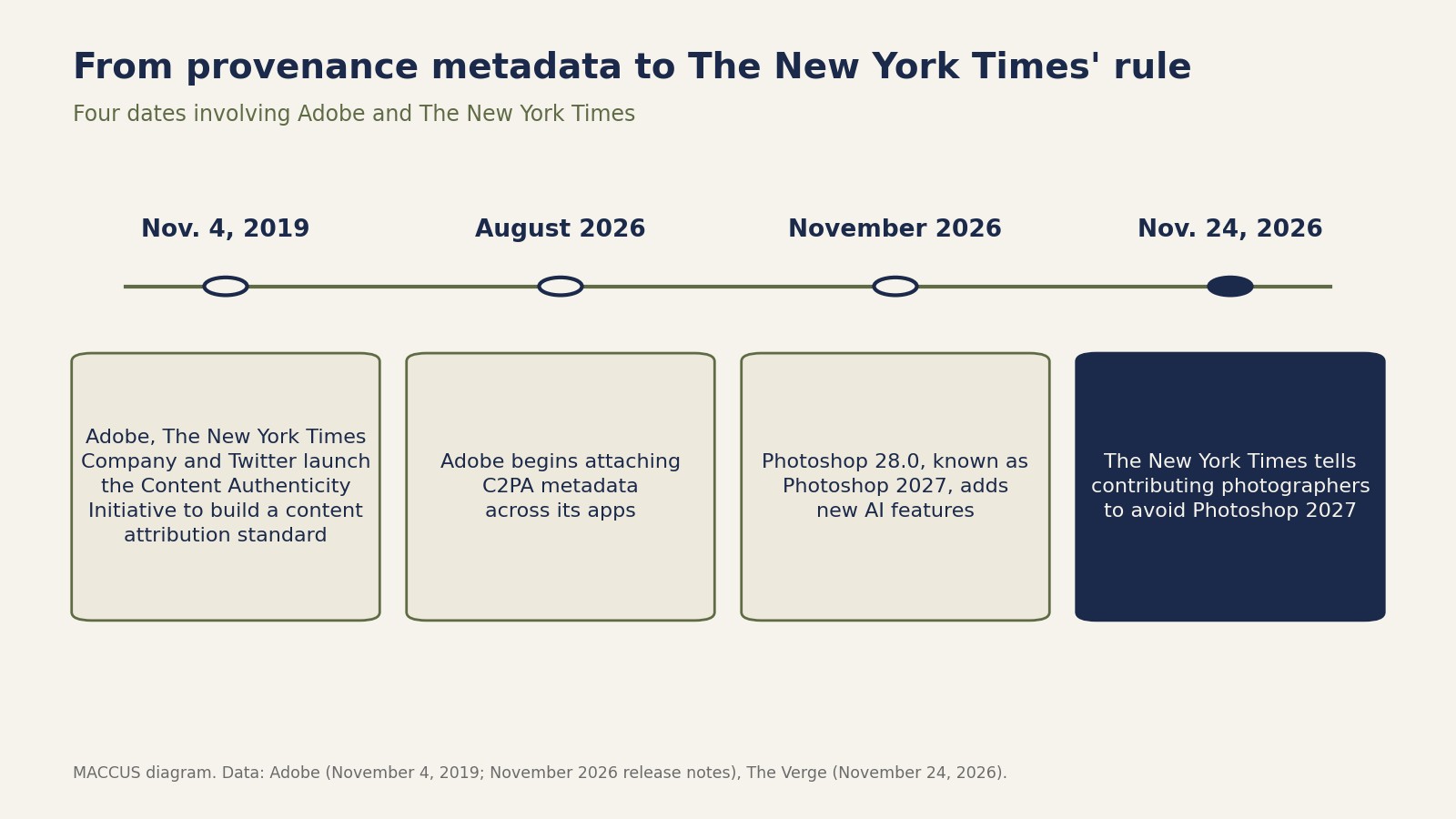
The New York Times is asking photographers on assignment for the paper not to use Photoshop 2027, the latest version of Adobe’s photo editing software. The paper says some artificial intelligence (AI) features in this version can tag a photo’s file as generated by AI. Tech news site The Verge reported the rule on Tuesday, November 24, 2026, based on an email it had seen. The Times confirmed it the same day.
The email says these features use AI “in ways that may not be apparent to users.” Using them “can result in metadata identifying photographs as AI-generated.” Metadata is technical information stored inside an image file that doesn’t show on screen.
According to The Verge, the Times wants to keep this metadata from showing up on its photos by accident. The metadata follows a technical standard called C2PA, which records the provenance of a piece of content: where it comes from and how it was edited. The same standard is used by the AI content checker TikTok opened to everyone on November 20. That tool only detects the provenance marks added by TikTok and four of its sister apps.
A rule for contributing photographers
The email is signed by Meaghan Looram and Josh Haner, whom The Verge describes as two of the Times’ photography leaders. The requirement reads: “At this time, we are requiring that all contributing photographers avoid using Adobe Photoshop 2027 (release 28.0.0 and subsequent updates) when working on assignment for The Times.” The message was also posted on Threads, Meta’s social network.
Times spokesperson Graham James confirmed the requirement in a statement to The Verge. He repeated it to PetaPixel, a site that covers photography: “It has come to our attention that certain functions in Adobe Photoshop 2027 utilize generative AI in ways that may not be apparent to users of the software.” Generative AI means tools that produce new content, such as an image or part of one.
Two questions remain open: who is covered, and for how long. The Verge refers to freelance photographers, while the email addresses “all contributing photographers.” Neither The Verge nor the parts of the email it quotes say whether the paper’s staff photographers are included. The phrase “At this time” sets no end date.
A newsroom that doesn’t retouch its photos
The Times has strict rules on photo editing. As The Verge points out, the paper said in 2025 that it does not “retouch or digitally manipulate” its photos. It may, however, “make minimal adjustments to color to ensure we are accurately reproducing the image.”
PetaPixel summarizes the paper’s ethics standards: people and objects cannot be added to a published photo, or rearranged, blurred, distorted or removed from it. PetaPixel adds that any use of AI must be disclosed to readers.
The Verge calls an AI flag in the metadata “a blunt way of describing what happened in post-production.” Post-production is the editing done after a photo is taken. The site adds that such a flag risks costing the paper its readers’ trust, given that the newsroom keeps editing to a minimum.
The AI features in Photoshop 2027
Photoshop 2027 is version 28.0 of the software. Adobe released it in November 2026, according to the company’s release notes, which list what’s new in each version. The Times’ email identifies it as “release 28.0.0.”
In those notes, Adobe lists several AI features. AI Assisted Editor is a mode for quick adjustments. Prompt to edit changes an entire image based on a written instruction. Adobe’s AI Assistant, available in Photoshop’s beta (test) version, walks users through edits step by step.
Other AI features include Generative restyle, which transforms an image and lets users control how strong the effect is. Generative Recompose fits a photo to new dimensions by repositioning subjects and adapting the background. Firefly Upscaler 2 enlarges images inside the Generative Upscale feature. The same notes describe an upgraded Remove tool, which now also erases shadows, reflections and ripples tied to the removed object.
The Verge notes that it isn’t always clear which Adobe tools rely on AI. The site says even some older options, such as automated selection tools, “may now be considered part of the AI suite.” Selection tools pick out part of an image for editing.
Metadata that can’t be turned off
According to The Verge, Adobe began rolling out C2PA metadata across its apps in August 2026. This metadata indicates whether an image was generated or edited with AI. Adobe’s page of frequently asked questions (FAQ) on generative AI content labeling explains when it is added. When qualifying generative AI tools are used to create or modify content, the metadata is attached to the file automatically.
Users can’t switch the metadata off. “Under the new laws, this metadata cannot be disabled for qualifying content,” Adobe writes. The laws it names are California’s AI Transparency Act and the AI Act, the European Union’s law on artificial intelligence.
According to the FAQ, the metadata may record the app and the AI model used, along with the date and time. It may also show whether the content was fully generated or only modified, and carry a unique content identifier.
The same page says Adobe doesn’t automatically add a visible label to the image. Third-party platforms, such as social networks, search engines and content sites, decide whether and how to display this information. As a result, the same photo can be labeled differently from one site to another.
Article 50 of the AI Act requires providers of AI systems that generate images to mark that content “in a machine-readable format,” meaning readable by software. We covered this part of the law in our piece on the watermark the chatbot Grok applies to its text.
Article 50 also allows exceptions. The marking requirement does not apply when the system performs “an assistive function for standard editing.” It also does not apply when the system does “not substantially alter the input data,” meaning the content fed into it.
The features at issue remain unnamed
Neither the Times nor Adobe’s FAQ names a specific tool. The Times says some features use generative AI in ways users may not notice. Adobe’s FAQ, updated in August 2026, limits this metadata to generative AI tools and says “traditional AI-powered features” are not covered.
It is still unknown which Photoshop 2027 features prompted the Times to act. Adobe had not responded to The Verge or PetaPixel when both sites published their stories on November 24. The Times has not said whether it has found such metadata on photos it has already received.
What it means
According to PetaPixel, the Times still supports the C2PA provenance standard. The paper has worked on content provenance for years. On November 4, 2019, The New York Times Company, which publishes the paper, joined Adobe and Twitter to launch the Content Authenticity Initiative. The project set out to build a common standard for attributing digital content to its source.
The issue is who controls the AI label. The metadata signals that a generative AI tool was used. Each platform then decides what to show. For a paper that bars adding people or objects to a photo or removing them, an AI flag on a news photo is a matter of credibility.
Agencies, independent photographers and brands that buy or publish images edited in Photoshop can be affected too. Once a platform reads C2PA metadata, an edit made with a generative tool can show up as an AI label on a post.
The Times is also pursuing a separate AI-related lawsuit. Since November 2, 2026, it has been suing the company behind the Brave browser, which it accuses of reselling its articles to AI companies.
The Photoshop 2027 rule leaves several questions open. It is unclear which features are involved, how Adobe will respond, whether staff photographers are covered and how long the rule will last. Two more points are worth watching: whether other newsrooms or photo agencies adopt a similar rule, and whether Adobe clarifies what triggers its metadata.
Sources
- The New York Times warns photographers not to update Photoshop over AI features, The Verge, November 24, 2026
- New York Times Prohibits Photographers From Using Photoshop 2027, PetaPixel, November 24, 2026
- Generative AI content labeling FAQ, Adobe, updated August 25, 2026
- Adobe Photoshop on desktop release notes, Adobe, updated November 10, 2026
- Article 50: Transparency obligations for providers and deployers of certain AI systems, European Commission (AI Act Service Desk), accessed November 25, 2026
- Introducing the Content Authenticity Initiative, Adobe, November 4, 2019