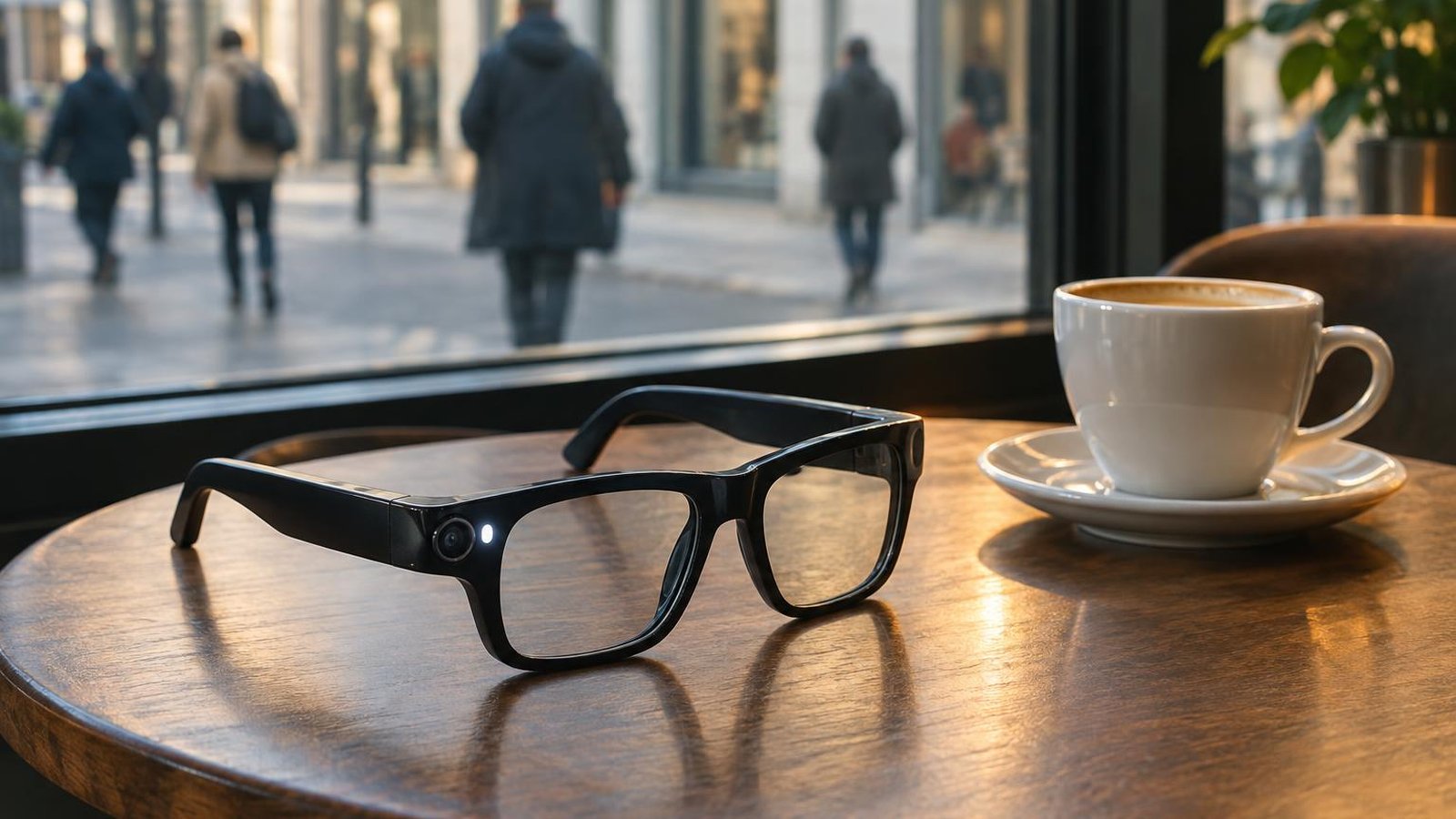

The Federation of German Consumer Organisations (vzbv) has sued the company that makes and sells Ray-Ban Meta camera glasses. It says it has also started proceedings against Meta. In a press release dated November 24, 2026, the group says users “can hardly use the glasses lawfully” (our translation, like all German quotes here).
A wearer who films strangers in public can become legally responsible for their data under the EU’s privacy law, the General Data Protection Regulation (GDPR), and could be fined, the vzbv says. The only sign of a recording that those strangers get is what Ramona Pop, who heads the vzbv, calls “a white blinking light a few millimeters wide.”
Under the GDPR, a person who records others beyond purely personal or family use can become a “controller,” the party responsible for the data. A controller owes the people filmed information about what is collected and why. The glasses offer no practical way to give it, the federation says.
In court, the vzbv wants to stop what it calls missing information for buyers, misleading advertising and a design it says breaches the GDPR. It also wants the GDPR reform now under way to make manufacturers design such products for privacy from the start. The vzbv wants that duty to cover connected doorbell cameras and cars too.
Two suits at different stages
The suit already filed targets Luxottica Group S.p.A., which the vzbv names as the maker and seller of the glasses. The federation lodged it at the Kammergericht, Berlin’s higher regional court. According to the vzbv, Ray-Ban’s online shop does not tell buyers before they pay that using the glasses to collect other people’s personal data can make them data controllers. The design, it says, makes it practically impossible to meet the duties that follow, in particular the duty under Articles 12 and 13 of the GDPR to inform the people recorded.
Heiko Dünkel leads the vzbv’s legal enforcement team. He told the German public TV news service tagesschau that someone who uses the glasses as advertised, on the subway or in a restaurant, risks fines from data protection authorities in the worst case. Luxottica did not answer a formal warning letter before the suit, the vzbv says.
The case against Meta is at an earlier stage. The vzbv says it has started proceedings and decided to sue after Meta did not sign a cease-and-desist declaration, a binding pledge to stop the practices. The German legal news site beck-aktuell describes that suit as announced. The vzbv calls Meta’s advertising misleading because it suggests every feature can be used freely in daily life.
It also says Meta breaches Article 25 of the GDPR, the “privacy by design” rule. The reason, it says, is that the people filmed cannot tell what is collected, for what purpose, or whether their data will be used to train AI systems. Meta processes that data itself, Dünkel told tagesschau, so it has duties of its own that a blinking light “in no way” meets.
The federation has taken Meta to court before, over Facebook’s old “free” slogan. In that case, an adviser to the EU’s top court said on November 19 that a service requiring users to hand over data for commercial use cannot call itself free. Meta also faces privacy regulators elsewhere in Europe: Italy’s data protection authority fined it €805 million on November 14 over the Facebook app’s access to photo galleries on Android phones.
Regulators split over the light
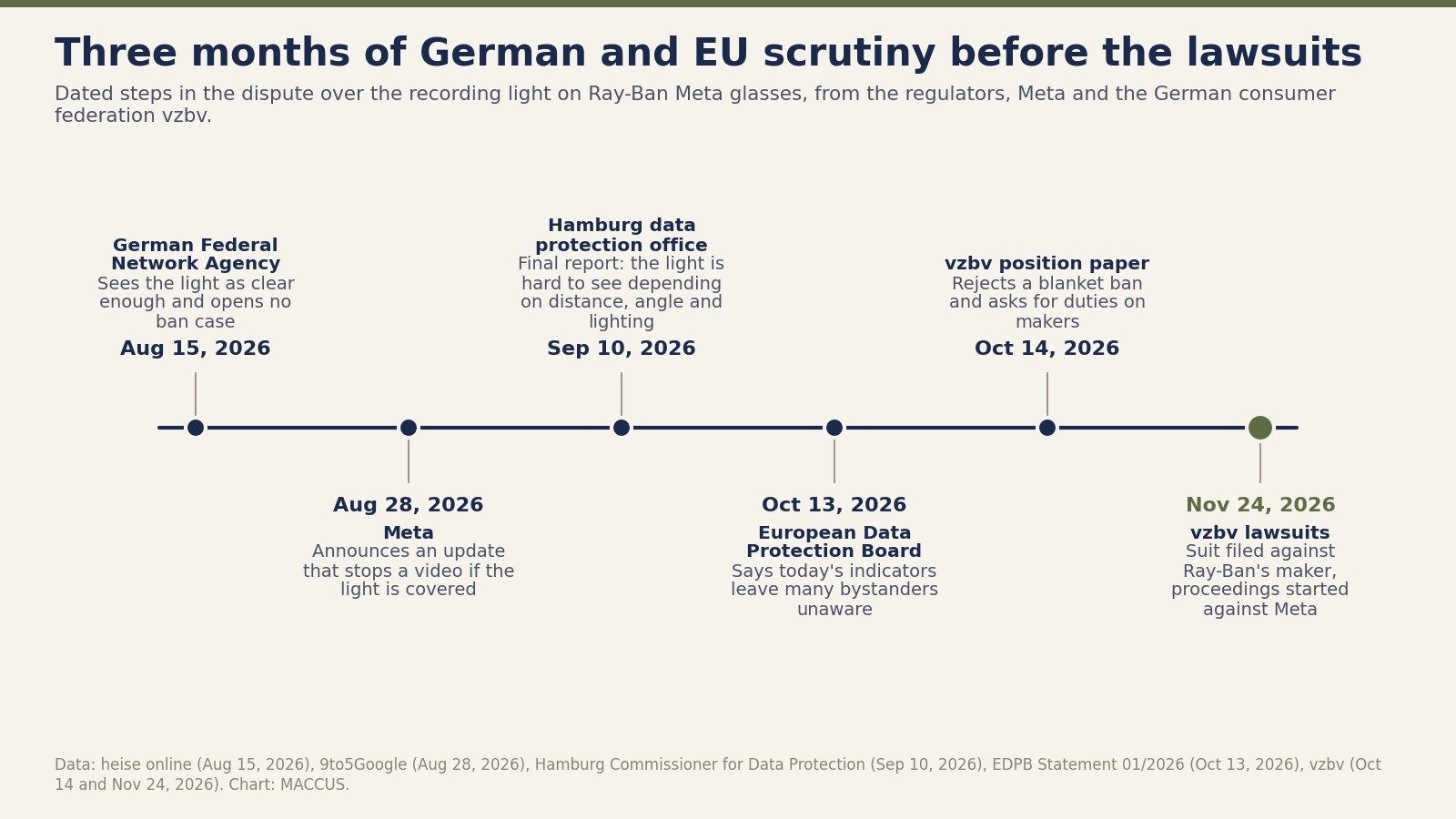
Hamburg’s state data protection commissioner tested a first-generation Ray-Ban Meta Wayfarer and took it apart. In a final report dated September 10, 2026, the office found the light on the frame hard to see in many settings, “especially outdoors and in sunlight.” It concluded that, as a rule, the light could signal a recording only to people standing close by and looking almost straight at the glasses. The light alone does not inform people enough, the report says.
Germany’s Federal Network Agency, the telecom regulator, disagrees. It enforces a German ban on surveillance devices disguised as everyday objects. A spokesperson told the newspaper Frankfurter Allgemeine Zeitung that the Meta and Ray-Ban models checked so far meet that rule thanks to the built-in light. The agency had no formal case open, the spokesperson said, as the German tech news site heise online reported on August 15.
The European Data Protection Board (EDPB), the group of the EU’s national privacy regulators, weighed in on October 13. “The current state of the art with regards to indicators on smart glasses leave many non-users unaware that their data is being processed,” says its statement on smart glasses. An indicator should be visible in many lighting conditions, the board adds, and recording should be impossible while it is covered.
The Hamburg office also found database tables named for face recognition in the Meta AI companion app. They were empty, and the office assumes no face recognition is taking place so far, though it notes the software holds the basic structures to add it. Handheld face matching is being tested elsewhere in Europe: in London, 100 police officers in a six-month trial can now run a face check with their phones.
Meta points to its safeguards
Meta told tagesschau in a written statement that it had not yet received the complaint and could only comment in general terms. It pointed to the light. “It cannot be switched off, and the camera is deactivated if someone covers it or tampers with it, a feature that smartphones and other cameras do not have,” the company wrote. Meta added that it had run ad campaigns across Europe to explain its privacy measures and that the light was designed to be noticed.
Alex Himel, Meta’s vice president for augmented reality, posted about the light on Meta’s Threads app, the tech site 9to5Google reported on August 28. He wrote that the camera already refused to start when the light was blocked. An update starting to roll out would also stop a recording if someone covered the light midway, he wrote.
Hamburg’s tests found that some ways of covering the light, with stickers, paint or caps, hid it without disabling the camera. They also found that a video kept recording when the light was covered after the start, the gap Himel’s update targets. Tagesschau reports that videos of users looking for ways to record without the light keep circulating online.
Limits of the case
No court has ruled, and no hearing date has been made public. No source cites a German wearer who has been fined for using these glasses. The risk of fines is the vzbv’s reading of the law.
The vzbv’s position paper of October 14 says purely personal or family recordings can fall outside the GDPR under its household exemption. One example is footage of relatives or close friends in a private setting. The EDPB agrees but says the exemption is read narrowly. It does not cover a video posted to a public social media account, and in that case the wearer becomes a controller with all of the law’s duties.
The vzbv does not call for a blanket ban. Its paper says a ban limited to Meta’s glasses would leave other makers’ devices untouched. A ban on all camera glasses could block assistive uses for people with visual impairments, the paper adds. It would not stop secret filming either, since anyone set on it can already use a smartphone or a small camera.
What it means
The case asks who is responsible under Europe’s privacy law for a camera worn on the face: the wearer, or the companies that design and sell it. Those who say the makers should carry that duty can point to two regulators. The EDPB says today’s indicators leave many bystanders unaware, and Hamburg’s tests found the light, as a rule, reaches only people standing close and facing the wearer. In the vzbv’s reading, the person who presses record can owe information to everyone in the frame, and the glasses offer no practical way to deliver it. Hamburg’s report says users would have to add signs or tell people themselves. The vzbv itself accepts that family recordings can fall outside the law.
Those who call the suits misplaced can point to Germany’s telecom regulator, which found the light sufficient under the ban on disguised recording devices. They can also cite Meta’s statement that the camera shuts off when the light is covered, unlike ordinary phones. The vzbv concedes that a ban would not stop secret filming because phones already allow it. Meta’s side concedes something too: Himel wrote that some users do try to defeat the light, and the August update was aimed at them.
If the vzbv wins, heise online wrote on November 24, the companies could have to change their advertising, the information given to buyers or their privacy safeguards. Still open are the court’s timetable, whether the suit against Meta will be formally lodged and how Luxottica will respond.
Sources
- Smart Glasses: Verbraucherzentrale verklagt Meta und Ray-Ban, vzbv, November 24, 2026
- Smart Glasses: Datenschutzrisiken und Herstellerverantwortung, vzbv, October 14, 2026
- Abschlussbericht zur technischen und datenschutzrechtlichen Untersuchung der Ray-Ban Meta AI Glasses, Hamburg Commissioner for Data Protection and Freedom of Information, September 10, 2026
- Statement 01/2026 on Smart Glasses, European Data Protection Board, October 13, 2026
- Verbraucherschützer haben die smarte Brille im Blick, tagesschau, November 24, 2026
- Kein Verbot für Meta-Brillen: Behörde sieht LED-Signal als ausreichend, heise online, August 15, 2026
- Meta Ray-Ban update will block the most obvious loophole for disabling the privacy LED, 9to5Google, August 28, 2026
- Datenschutz bei Kamerabrillen: Verbraucherzentrale verklagt Ray-Ban und Meta, beck-aktuell, November 25, 2026