

Some Meta teams that decide which Facebook and Instagram posts come down have lost half or even two thirds of their staff, one employee told the Guardian. The cuts come as Meta hands that work to artificial intelligence, the newspaper reported on November 25, 2026. Several times recently, the same employee said, they went looking for a specific moderation team and found the whole team gone.
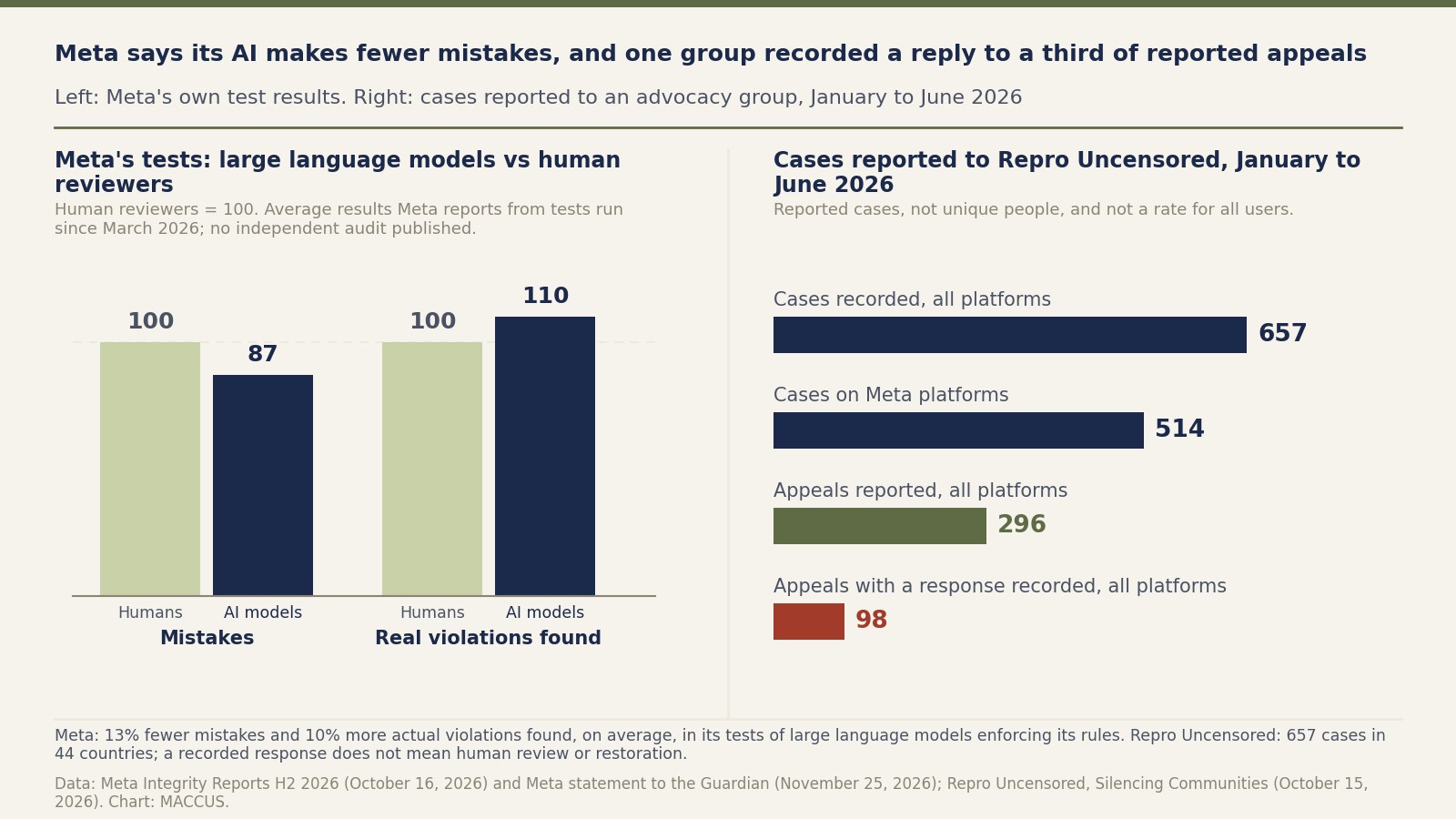
In its own tests, Meta says, its large language models (LLMs) make 13% fewer mistakes than human reviewers and find 10% more actual violations of its rules. LLMs are the technology behind AI chatbots.
Meta employees who spoke to the Guardian anonymously describe a different picture. They say the systems struggle with nuance, especially in languages other than English, and take down posts that should stay up. Getting a wrong takedown reversed is “so much more difficult now,” one of them said.
What the employees told the Guardian
Several Meta employees, speaking anonymously, said the push to AI moderation came with mass layoffs across the company that hit content reviewers hard. One described moderation as now running on “skeleton teams,” some of them down by half or two thirds. “It’s been really a mess,” the same employee said.
Another employee said Meta is removing lower-paid contractors, such as those in Kenya, and the full-time employees who handled the more complex cases. “You are trying to gut all human reviewers, which are kind of essential for making these nuanced decisions and policy decisions,” the employee said. “Of course there are going to be mistakes that are going to happen.” The software works faster than people, the employee added, so those mistakes can happen on a larger scale.
Once a post is down, its owner has far less recourse than before, the Guardian reported. “Even if you know someone at Meta, it’s still very difficult to get through to someone who’s actually going to be able to help you, especially if it’s a highly nuanced case,” one employee said. A Meta spokesperson told the Guardian that people can appeal decisions “if they think we’ve got it wrong.”
The systems mix LLMs with older automated filters, and even staff find them hard to understand. There are “thousands of levers and factors that weigh into how things are ranked,” one employee said, and they change constantly. Employees also said AI moderation played a part in sudden waves of account restrictions, which one of them called “sweeping takedowns.”
Meta’s case for AI moderation
Meta announced the shift on March 19 in a newsroom post on “more advanced AI systems for content enforcement,” meaning action against rule-breaking posts. In early tests, Meta said, the systems found 5,000 scam attempts a day “that no existing review team had caught before.” They caught twice as much adult sexual solicitation as Meta’s review teams, while cutting the rate of mistakes by more than 60%. The systems also work in “languages spoken by 98% of people online,” compared with “around 80 languages” covered before.
“Over the next few years,” the same post said, Meta would roll out the systems across its apps once they “consistently perform better” than its current methods. Meta also said it would “reduce our reliance on third-party vendors for content enforcement.” The systems would take on work such as repetitive reviews of graphic content, while people would keep “a key role” in the riskiest decisions, “such as appeals of account disablement or reports to law enforcement.”
Meta’s integrity report, which tracks how it enforces its rules, was updated October 16. It gave the headline result: “Since March, initial tests have shown that on average LLMs make 13% fewer mistakes than humans when enforcing against violating content while finding 10% more actual violations.”
The rollout has moved fast. By June, LLMs had replaced human reviewers for about half of review requests, Fortune reported, citing the Financial Times. Fortune also cited the Financial Times on Meta’s goal: 90% or more automation for some types of violations by the end of 2026.
Outside Meta, US jobs that AI can largely do on its own had about 820,000 fewer workers in May 2025 than two years earlier. The figure is from the Burning Glass Institute, a job-market research group. Jobs where AI mostly helps workers added 1.4 million, its report found.
Other front-line work was shrinking before the AI wave. US call centers have lost about 235,000 jobs since their 2016 peak, about half of them before ChatGPT arrived. Anthropic, the AI company behind the Claude chatbot, has published how junior hiring fell in its own technical teams.
The moderators and the people they judge
Moderation has long been hard on the people who do it. Former outsourced moderators in Kenya, paid as little as $1.50 an hour to view extremely graphic posts, took legal action against Meta, the Guardian reported in December 2024. They described struggling with post-traumatic stress disorder.
The Electronic Frontier Foundation (EFF), a digital rights group, has long criticized automated moderation. It still names its main benefit: “helping to spare human content moderators who must review content that varies from whimsical to horrific, often for little pay and with devastating mental health consequences.” Meta has used AI against violent extremist content since 2017, the EFF notes. The March plan goes much further: it covers enforcement across Meta’s apps, and Meta says it will rely less on outside vendors.
On October 10, the campaign of Brazil’s president, Luiz Inácio Lula da Silva, went to the Superior Electoral Court, the country’s top election court. It accused Meta of restricting Lula’s posts in favor of his opponent, Flávio Bolsonaro. On October 15, the court ordered Meta to treat both candidates equally or face a daily fine of 500,000 Brazilian reais, about $98,000.
Meta denied treating the candidates unequally and blamed technical errors. Its court filing listed 17 measures, Reuters reported, including a human review within two hours whenever its systems automatically restrict a presidential campaign’s ad account. “Everyone on our platforms is subject to the same set of rules, and any claims of enforcement based on political affiliation or advocacy are baseless,” a Meta spokesperson told the Guardian.
In the United States, Meta suspended the Instagram account of the No Kings protest coalition on October 17, at the height of its day of action. Organizers said it was down for about 90 minutes. Andy Stone, Meta’s vice president of communications, said Meta’s network security systems had flagged an AI tool the coalition used to read profiles and hashtags. He said the company’s “automated protections” had wrongly taken the account offline and apologized for the error.
Repro Uncensored, an advocacy group that monitors online censorship, recorded 657 cases in 44 countries in the first half of 2026. Of those, 514 were on Meta’s platforms. Most of the 657 were bans, deactivations or suspensions. Across all 657 cases, an appeal was reported in 296, and a response was recorded in 98, about one for every three appeals.
What the numbers do not show
Meta’s 13% and 10% figures are averages from its own tests. The integrity report does not say how the tests were run, on which content, or what counts as a mistake. Meta has published no outside audit of them. The figure of about half of review requests comes from the Financial Times, as reported by Fortune.
The employees’ account is anonymous and covers only some teams. No source gives the total number of moderators Meta has cut.
Repro Uncensored warns that its cases “are reported incidents, not unique people.” It adds that they do not measure “the prevalence of restrictions across all platform users,” meaning how common restrictions are in general. It also notes that a recorded reply from a platform “does not establish human review, a useful explanation or restoration.” Appeals with no recorded reply, it says, should not all be read as unanswered.
What it means
Deciding which posts break the rules has been human work at Meta for years, and hard on the people doing it. In Meta’s own tests, the software made 13% fewer mistakes than human reviewers on average, and Meta says the software will take on the repetitive reviews of graphic content. Meta also claims a gain for people who post outside the roughly 80 languages it used to cover, while the employees say the systems still struggle with nuance outside English.
Because the software works faster than people, its errors can hit many accounts at once, one employee said, and the employees say the human route to undo those errors has shrunk. In Brazil, under a court order, Meta offered one fix: a human review within two hours, but only for the presidential campaigns’ ad accounts.
Meta’s next integrity report could show how many appeals get a human review, how fast, and how many decisions get reversed. The 90% automation goal for some types of violations is due by the end of 2026, the Financial Times reported.
Sources
- ‘It’s been really a mess’: Meta insiders concerned over push to AI content moderation, The Guardian, November 25, 2026
- Boosting Your Support and Safety on Meta’s Apps With AI, Meta, March 19, 2026
- Integrity Reports, H2 2026, Meta Transparency Center, October 16, 2026
- Meta says automation wrongly took down No Kings and a Senate candidate’s page. It’s automating more anyway, Fortune, November 3, 2026
- Silencing Communities: Digital Censorship and the Cost to Democracy, Repro Uncensored, October 15, 2026
- Automated Moderation Is Here to Stay, Electronic Frontier Foundation, July 7, 2026