
A website opted out of the AI-written answers in Google Search, and its clicks barely moved. Brodie Clark, a search engine optimization (SEO) consultant, described the case on LinkedIn on November 22, 2026. By his account, the site lost “hundreds of thousands of daily impressions,” and the effect on clicks was “barely even noticeable.” Google counts an impression each time a link to the site appears in one of its AI answers.
Google calls those answers AI Overviews and AI Mode. To leave them, the site used the control Google built for that purpose in Search Console, Google’s free tool for site owners.
The control has been open to every website in the world, including in France, since August 31, 2026. Very few site owners have published what opting out cost them. The main earlier test, run by consultant Cyrus Shepard and reported in late October, found the opposite: clicks went down.
Brodie Clark’s post and its screenshot
Clark is an independent consultant and a co-founder of SERP Lens, according to the trade site PPC Land. His post is only a few lines long. “This site has completely excluded itself from generative AI features (AI Overviews and AI Mode) using the new AI controls in GSC,” he wrote. GSC is short for Google Search Console.
“Hundreds of thousands of daily impressions are gone,” he added. “The result on clicks? Barely even noticeable.” His takeaway was aimed at Google, which “really needs to figure out how to make its AI features more valuable to websites.”
The post’s only image is a screenshot of the “Generative AI features” page in Search Console. The page is labeled “Beta,” meaning the feature is still being tested. A banner on it confirms that the property is excluded from generative AI features on Google Search. In Search Console, a property is a site, or part of a site, that its owner tracks.
The post does not name the site. It gives no sector, no country, no date for the switch and no click or impression totals, PPC Land noted in its November 22 article.
Clark himself did not expect many sites to make this choice. When the control appeared in June, he wrote on his own site that he doubted even 1% of sites would use it, according to PPC Land.
How the opt-out works and where it came from
According to Google’s Search Console help page, the setting sits under Settings, in a section called “Search generative AI.” It covers three features: AI Overviews, AI Mode and the generative AI features in Google Discover. Discover is a feed of articles that Google shows without the user typing a search. Google says the list will change over time.
Site owners get three options, and “Include” is the default. “Exclude” removes links to the site from these answers, and Google stops drawing on the site’s pages to write its AI responses. The third option copies the choice made for a broader “parent” property. That way, a section of a site can simply follow the setting of its main domain.
Google also lists what exclusion does not change. Google says the control “isn’t used as a ranking or inclusion signal affecting other parts of Search,” meaning Google does not use it to rank the site in the regular results. To remove a site from Google Search entirely, an owner still needs a noindex tag. That is a line in a page’s code that asks Google to keep the page out of its results.
The control does not cover AI model training either, the process by which AI models learn from text on the web. Training has its own control, Google-Extended, which Google plans to tie to a robots.txt rule shared by several AI companies. Robots.txt is a file where a site tells crawlers, the bots that scan the web, what they may read.
Excluding a site does not make the AI answers go away. They keep appearing, built from other sites. Google warns that content from those sites “may appear similar” to the excluded site’s own. Exclusion generally takes a few days to apply.
The control grew out of a UK decision. On June 3, 2026, the UK’s competition regulator, the Competition and Markets Authority (CMA), imposed rules on Google meant to protect publishers. Google first tested the control with a subset of UK sites, according to PPC Land. Google then rolled it out “to all websites worldwide” on August 31, according to its help page.
Cyrus Shepard’s October test pointed the other way
On October 30, the news site Search Engine Roundtable reported on a different test, run by consultant Cyrus Shepard. He excluded a site from the AI features for a while, then let it back in. The site’s impressions in the AI answers dropped to zero as soon as it was excluded. They had made up about 8% of the site’s total impressions.
Shepard estimated the click-through rate of those AI impressions, meaning the share that led to a click, at about 0.9%. That is roughly 9 clicks per 1,000 views. His most surprising finding ran against Clark’s case. While the site was excluded, clicks on Google’s regular links, outside the AI answers, fell too.
Shepard attributes this to a “halo effect.” The more places a brand shows up on a results page, the more likely a searcher is to click one of its links. Barry Schwartz, who founded Search Engine Roundtable, called the test a “super limited study” based on a small sample. Like Clark’s report, Shepard’s covers a single site.
Search Console can’t isolate clicks from AI answers
Both cases run into the same measurement limit. Search Console’s generative AI report counts only impressions: how many times links to a site “were shown to a user” in AI Overviews or AI Mode. It reports no clicks.
Clicks from these answers do show up in Search Console’s main performance report, mixed in with clicks from the regular results. No filter separates them, as we explained in our piece on Google’s page about search traffic.
The math has a side effect, PPC Land points out. If hundreds of thousands of impressions disappear while clicks hold steady, the click-through rate shown in Search Console goes up. It rises without a single extra visitor.
Replies to Clark’s post also debate what those impressions were, according to PPC Land. Arash Kamyab, founder of IndexLLM, argues that they came mostly from two sources. One is “fan-out,” the background searches AI Mode runs to put together an answer. The other is scrapers, bots that copy pages.
Daniel Kovacik, a technical SEO specialist at filter maker Mann+Hummel, counters that those background searches do not create impressions. In his view, only real citations of the site in an answer do. Google’s definition refers to a user seeing the link and says nothing about background searches.
What it means
Until now, site owners weighing the opt-out mostly had one small test to go on: Shepard’s, which pointed to a loss of clicks.
Clark’s case points the other way: by his account, the site lost hundreds of thousands of impressions a day, and its clicks barely moved. It is one person’s report, with no precise figures, no site name and no comparison period. It also says nothing about what happened to the site’s Discover traffic or its revenue.
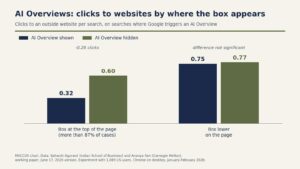
Still, the result fits data published this year. A US experiment by two researchers measured 39.8% fewer clicks to websites when an AI Overview appeared, compared with users who had AI Overviews hidden. If these answers send few visitors to begin with, leaving them may cost some sites few clicks. Nothing shows that Clark’s result holds for a news site, an online store or a local business.
The decision is harder for some sites than for others. Kamyab, of IndexLLM, says opting out is an easy call for publishers. In his view, it is trickier for product brands, which need to be named in the answer even when they don’t get the click.
The control has another limit: it applies to an entire Search Console property at once. Under the CMA’s rules, Google has three more months after December 3, 2026, to offer a page-by-page control.
In France, publishers are already challenging these AI answers. Five French publisher organizations took Google’s AI Overviews and AI Mode to the European Commission on October 29.
The next deadline is in the UK. By December 3, 2026, the CMA requires Google to give publishers figures on its AI answers: impressions, clicks and click-through rate. Those figures will count AI Overviews and AI Mode together.
The opt-out control started with a test on UK sites, then reached every site, including those in France. The open question is whether the click figures will follow the same path and show up in Search Console for sites in France.
Sources
- This has been pretty eye-opening to witness, Brodie Clark, LinkedIn, November 22, 2026
- Search generative AI control, Search Console Help, Google, accessed November 23, 2026
- Generative AI performance report (Search), Search Console Help, Google, accessed November 23, 2026
- Site exits Google AI Overviews and AI Mode, clicks barely move, PPC Land, November 22, 2026
- Google AI Overviews & AI Mode 0.9% Click-Through Rate Says Small Opt Out Study, Search Engine Roundtable, October 30, 2026
- The publisher conduct requirement, Competition and Markets Authority, August 4, 2026