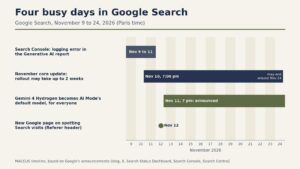
On November 12, 2026, Google published a page that tells site owners how to recognize visits from its search engine. It says nothing about clicks from Google’s AI answers, though the UK competition regulator requires Google to provide figures on those clicks starting December 3, 2026.
Those answers are AI Overviews, the AI-written summaries at the top of Google’s results, and AI Mode, Google’s conversational search. The page covers analytics tools such as Google Analytics, software that counts a site’s visitors. It also covers server logs, the record of every request a server receives.
Google passes only its domain name to sites
When someone clicks a Google result, the browser sends the site a piece of data called the “Referer,” which says where the visit came from. Google applies a rule known as the “origin” policy. It cuts the Referer down to the start of the web address: the protocol and the domain name, such as https://www.google.com/.
The words the user searched for are left out. To see them, Google points site owners to Search Console, its free tool for tracking how a site performs in Google’s results.
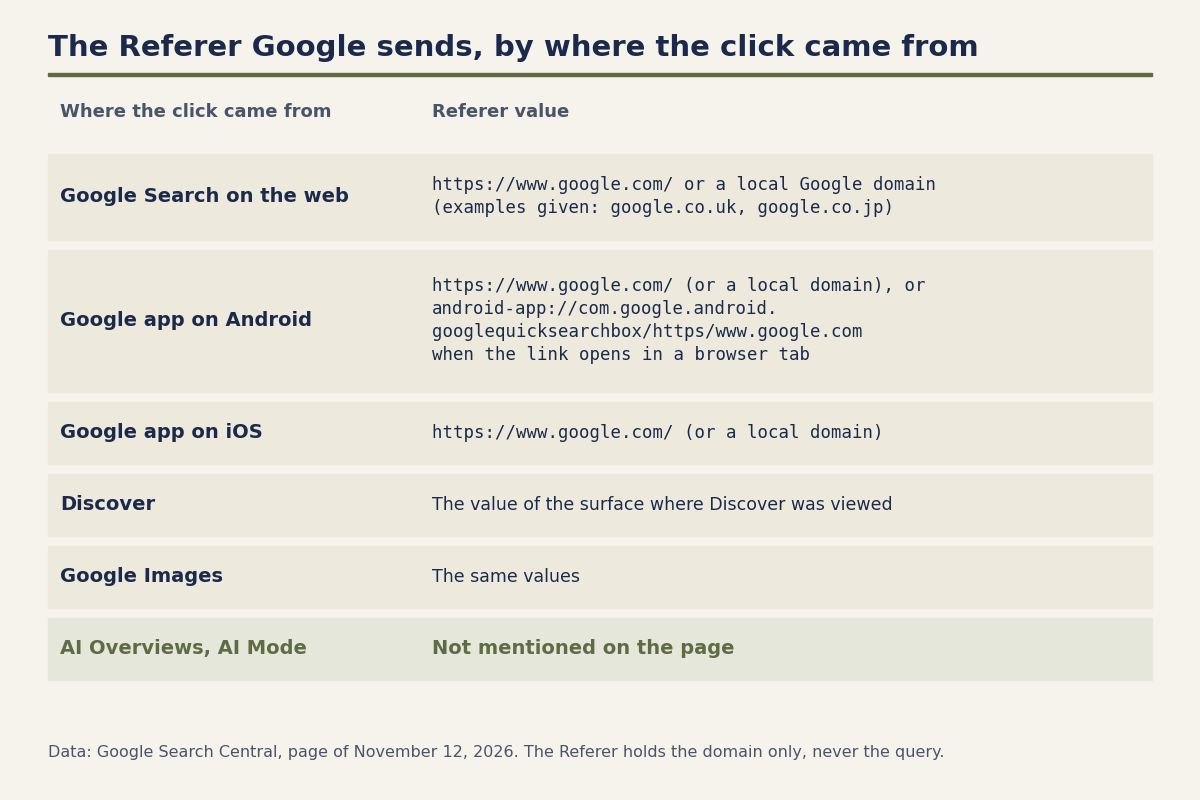
The page lists the values to look for. On the web, the Referer is https://www.google.com/ or a Google domain for a specific country, such as google.co.uk or google.co.jp. The Google app sends the same value on Android and on iOS. The one exception: when the Google app for Android opens a result in a browser tab, the Referer starts with android-app://.
Discover and Google Images send the same values as Search. Discover, the feed of articles Google suggests without a search, passes on the Referer of the app or website where the person reads it. So the Referer alone can’t tell an analytics tool whether a visit came from Search, Discover or Images.
Missing Referers and mislabeled Google visits
Sometimes the Referer never reaches the site. The page lists these cases: private browsing, privacy extensions, opening a result in a new tab in some browsers, and a search from a phone’s search bar that opens in a separate browser.
Google traffic can also land in the wrong category. Most analytics tools file it under “organic search,” meaning unpaid search results. Sometimes it is missing from that category or shows up as “referral,” meaning a link from another site, or as “direct,” meaning no known source. Google then advises checking three settings that can reclassify it: custom channel rules, referral exclusions and filters.
On November 13, a site owner asked on Reddit why Google Analytics was filing most visits to their relaunched sites as direct traffic.
Four reasons analytics tools and Search Console disagree
Google gives four reasons why an analytics tool and Search Console can show different numbers. First, privacy settings and consent choices can block tracking.
Second, redirects, which forward a visitor to another address, can lose information. One written in JavaScript, code that runs in the browser, can replace the Referer with the site’s own address. A misconfigured redirect can also drop gclid, a tag added to the web address to mark clicks on Google’s ads.
Third, the two tools count at different moments. Search Console records a click as soon as the user picks a link. An analytics tool only records a visit once the page has loaded and its tracking code has run. Fourth, Search Console leaves out paid clicks, which an analytics tool may include, depending on its settings.
No word on clicks from AI answers
The November 12 page says nothing about AI Overviews or AI Mode. Both features launched in France on July 22, 2026. On October 15, Google announced it was placing links to sites higher in their answers. It did not say in which countries, or how many clicks those links send.
Search Console counts these clicks but mixes them with all others. According to Search Console Help, a click on an outside link in an AI Overview or in AI Mode counts as a click. Google files them in the Performance report, under the “Web” search type. No filter in that report can separate them, the trade publication Search Engine Journal pointed out on November 2.
Since August 31, 2026, Search Console has given every site worldwide a generative AI performance report. For AI Overviews and AI Mode combined, it shows only impressions, the number of times a link to the site was displayed. It shows no clicks and no click-through rate, the share of impressions that led to a click.
According to the data anomalies page in Search Console Help, a logging error lowered the impressions recorded in that report from November 9 to November 11, 2026.
In its documentation on AI features, Google says clicks from results pages with an AI Overview are “higher quality.” By that, Google means visitors are more likely to spend more time on the site. The November 12 page, however, gives no Referer value specific to AI answers, and no other way to recognize those visits in a site’s own analytics.
UK regulator requires AI click data from December 3
The UK deadline comes from the Competition and Markets Authority (CMA), the country’s competition regulator. On October 10, 2025, the CMA designated Google as having “strategic market status” in general search. That status, created by a 2024 UK law, lets the CMA set conduct requirements, rules on how Google must behave.
On June 3, 2026, the CMA imposed a requirement aimed at publishers. It takes effect six months later, on December 3, 2026. It applies to AI answers shown to people in the UK.
The requirement has two parts. Google must give publishers a way to keep their content out of its AI features, without penalizing them in the rest of its results. Google must also provide clear and detailed metrics on how users engage with that content in its search AI features, such as AI Overviews and AI Mode.
In interpretative notes that explain the requirement, the CMA lists three figures: impressions, clicks to the site and click-through rate. Publishers should also get a way to easily identify those clicks, so they can judge their quality. The data should be broken down by publisher, kept separate from regular search results and offered on a widely accessible platform such as Search Console. Google can take a different approach if it shows the CMA that it complies.
Google has offered an opt-out worldwide since August 31, 2026, through a setting called the “Search generative AI control.” The setting applies to a whole Search Console property, meaning a site or section that a publisher has verified in Search Console. It covers AI Overviews, AI Mode and Discover’s generative AI features as one package. For a page-by-page opt-out, the CMA gives Google three more months, until March 3, 2027.
Publishers wait as Google says it has nothing to announce
On November 2, Gary Illyes, an analyst at Google, replied in the comments under a LinkedIn post, Search Engine Journal reported. “The team is super interested in giving more data, data that makes sense,” he wrote, “but we don’t have anything to announce yet.”
UK publishers are waiting for those click figures before deciding whether to use the opt-out, the media trade publication Digiday reported on November 9. “That is the metric that will determine whether they turn it off or not,” Chris Dicker, CEO of Trusted Reviews owner Candr Media, told Digiday. Publishers hope Google will provide the data worldwide, as it did with the opt-out. Google hasn’t confirmed that it will, Digiday noted.
The PPA, a UK trade body for magazine and specialist media publishers, wants the CMA to make Google offer a separate control for each AI feature. “You’re either opting out of search AI Mode, AI Overviews, basically all these different features, or none of them,” said Eilidh Wilson, the PPA’s head of policy and public affairs.
In France, five publisher organizations filed a complaint with the European Commission against Google’s AI Overviews and AI Mode on October 29, 2026.
OpenAI already shares click counts with some businesses. Since November 10, businesses that claim their profile in ChatGPT, OpenAI’s assistant, can see how many clicks the assistant sends to their site. The feature is in beta, a test version.
What it means
The November 12 page documents a rule Google already follows: its search engine’s Referer contains only the domain name. The page adds an official list of Referer values, the cases where the Referer goes missing and the settings that file Google traffic as direct. It changes no figures in Google Analytics.
Its silence on AI answers matters more. Google says clicks from results pages that show an AI Overview are higher quality. The CMA expects a way to identify clicks from AI answers so publishers can judge their quality. The page, published three weeks before the UK deadline, describes no way to identify those clicks in a site’s own analytics.
Three questions remain open. Google could deliver the figures in Search Console or by some other means. It could limit them to answers shown in the UK, or extend them worldwide, as it did with the opt-out. It is also unclear whether a marker will let sites recognize these visits in Google Analytics.
For now, sites in France and Belgium can base their opt-out decision only on impression counts from AI answers.
Two dates come next. The UK requirement takes effect on December 3, 2026. Google must then submit its first compliance report to the CMA by January 3, 2027, covering June 3 to December 3, 2026, according to Search Engine Journal.
Search Central, Google’s documentation site for site owners, lists its updates in a changelog. It will show whether the November 12 page is updated to cover AI answers.
Sources
- Identify Google Search traffic in your web analytics or server logs, Google Search Central, November 12, 2026
- AI features and your website, Google Search Central, accessed November 16, 2026
- Generative AI performance report (Search), Search Console Help, accessed November 16, 2026
- Search generative AI control, Search Console Help, accessed November 16, 2026
- Google search publisher conduct requirement, Competition and Markets Authority, June 3, 2026
- Publisher CR interpretative notes, Competition and Markets Authority, June 3, 2026
- Google Says No AI Click Reporting News Yet, Ahead Of UK Deadline, Search Engine Journal (Matt G. Southern), November 2, 2026
- As publishers await click data, Google’s AI visibility push complicates the opt-out decision, Digiday (Jessica Davies and Seb Joseph), November 9, 2026
Header image: MACCUS diagram, data from the Competition and Markets Authority and Google, November 2026