
Anthropic disclosed on October 27, 2026, that in July it had bought Mithril Medicine, a drug developer with a single full-time employee, and that Mithril’s two programs for rare childhood muscular dystrophies are now its first in-house drug development programs. Mithril’s founder, Cody Tranbarger, used Claude to organize contracts, logistics and experiments with 11 outside labs, according to Anthropic. In less than 18 months, Mithril took one possible treatment from an idea to promising results in mice.
On October 20, a week before Anthropic’s post, OpenAI announced that it had acquired Orchestra Bio, whose software lets drug developers hand the tracking of studies to AI agents. OpenAI now owns software that tracks drug studies, and Anthropic owns two drug programs that Mithril’s founder coordinated with Claude and contract labs.
One founder, 11 contract labs
Mithril works on two rare muscular dystrophies, LAMA2-related congenital muscular dystrophy (LAMA2-CMD) and alpha-dystroglycanopathy. LAMA2-CMD affects an estimated 4,000 to 5,000 people in the US and Europe, Anthropic writes. Most patients never walk on their own, and no treatment is approved. In both diseases, muscle fibers lose their anchor to the protein sheet around them, and Mithril’s bispecific antibodies grab both to clamp them back together.
Before the acquisition, Tranbarger was Mithril’s only full-time employee; part-time consultants and third-party labs did the rest. The company tested early “tool molecules” in mice engineered to carry a severe form of the disease.
After six weeks, mice on the highest dose had roughly twice the grip strength and muscle force of untreated ones. Between two and six weeks of age, one of eight treated mice died, against four of eight untreated, while all 12 healthy mice lived. “The treated mice remained weaker than healthy mice, so the treatment was not a cure,” the post says. It still calls the result “a large improvement.”
The work handed to Claude
When responsibility for a set of experiments changed hands, Claude worked out where things stood from email threads and 14 months of slide decks, then drafted five handover emails that Tranbarger reviewed and sent to two labs. When antibody screening came back as hundreds of separate files, Claude merged them into one list of candidates and, within a few hours of a single prompt, assessed how easily each could be developed into a drug.
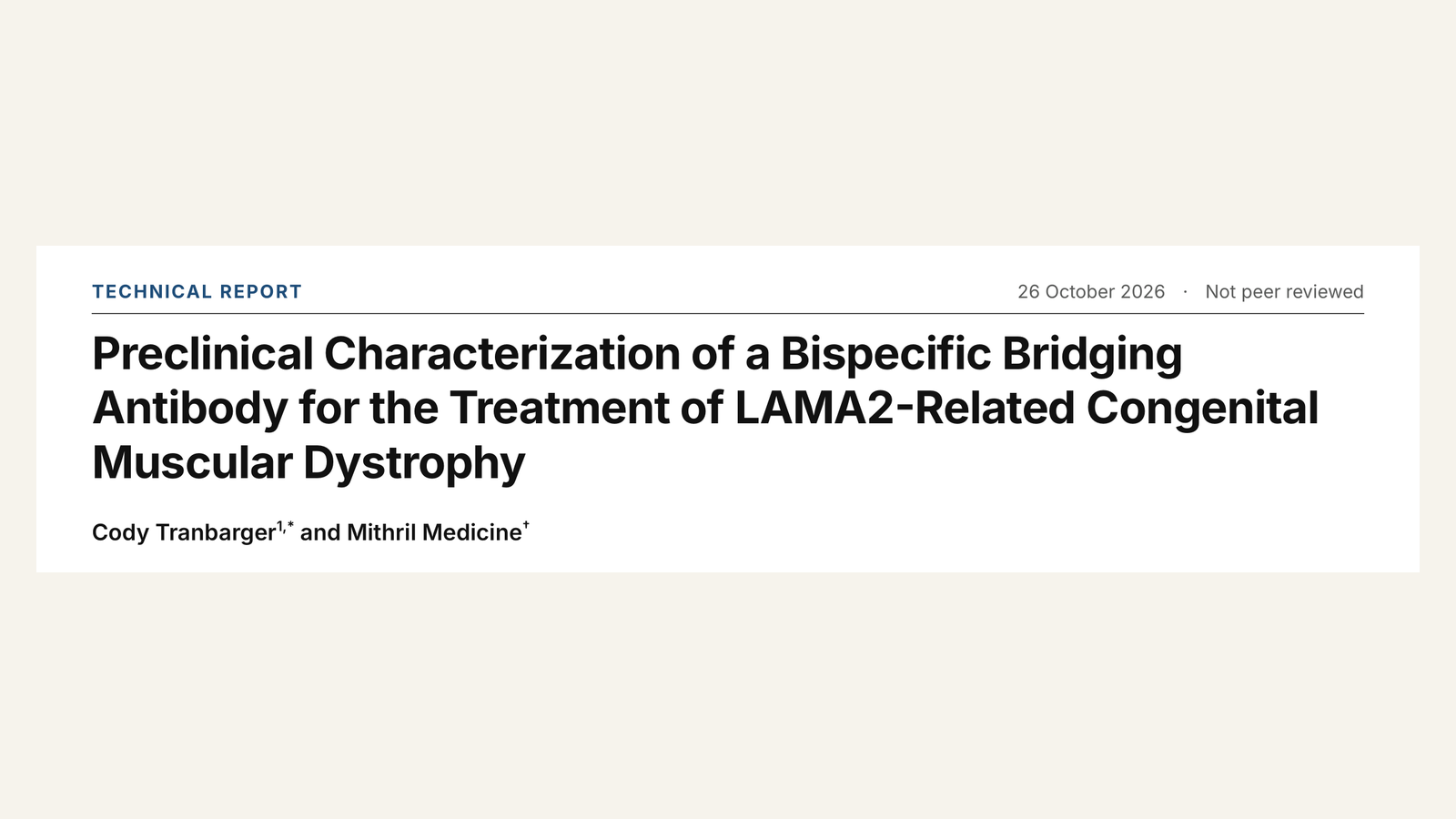
Mithril’s technical report, dated October 26, measures one week of this work. Claude’s first answers took a median of 96 seconds and its full answers 10 minutes, while the contract labs’ first replies took a median of 8.5 hours. When the antibody manufacturer sent a 341-page data package, Claude had a proposed next step for each of the 113 constructs in under eight minutes. Over the week it drafted 17 emails, and the team edited and sent 12 of them; Claude sent none itself.
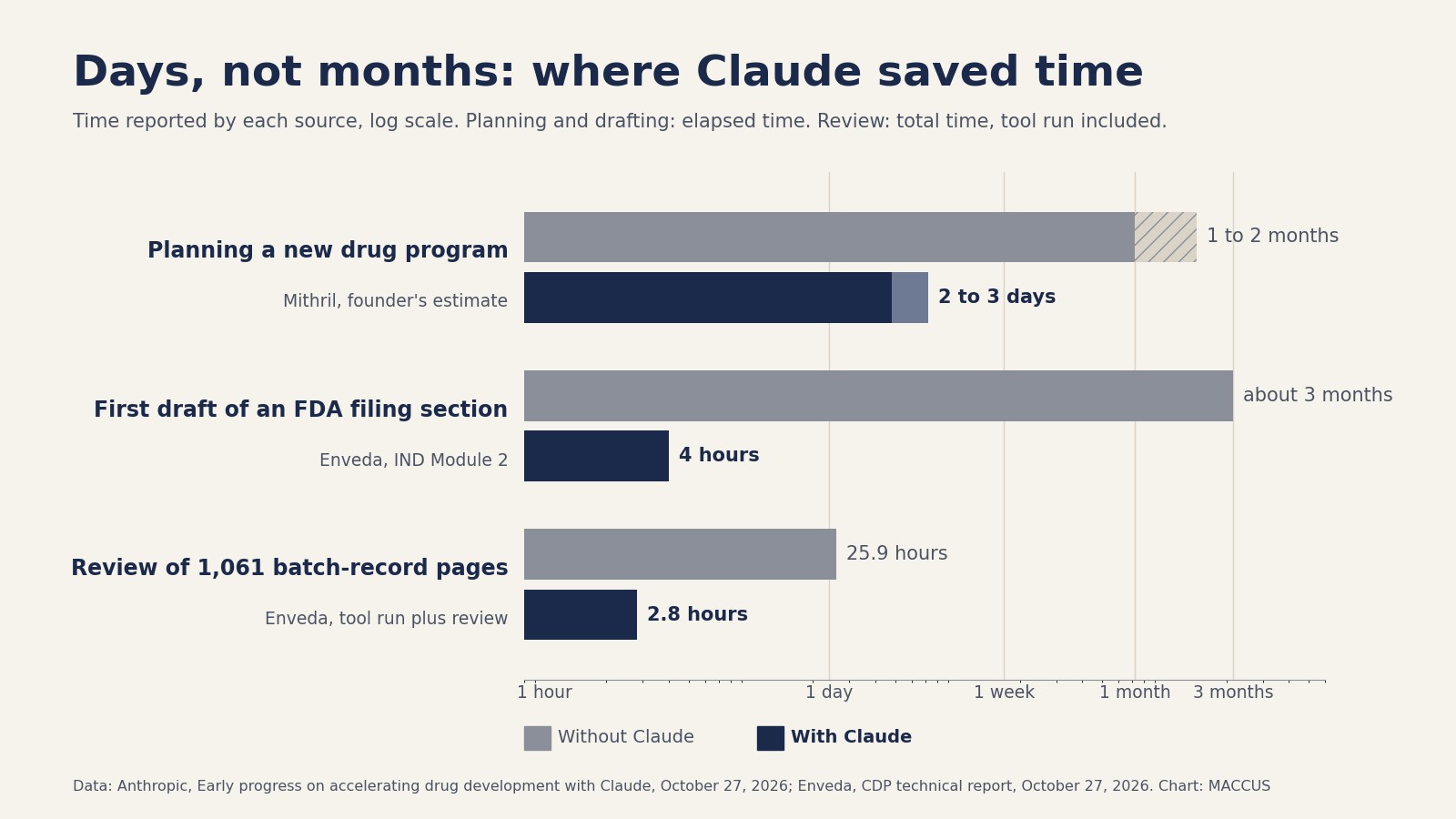
Planning a new program, from first idea to thesis, design plan and experimental strategy, took two to three days. Tranbarger estimates it would have taken him one to two months without Claude, and Anthropic’s chart turns that estimate into “10 to 30x faster.” Anthropic calls the setup Pipeline-in-a-Person: Claude keeps the records and coordinates the labs, and “the human sets the scientific direction and makes the decisions.” In physics, Claude has already rechecked a year of a physicist’s PhD math in 10 hours and found a sign error.
OpenAI’s purchase, announced October 20
OpenAI describes Orchestra Bio as “a platform that helps biopharma teams coordinate the complex process of drug development.” Its team and technology join Rosalind, OpenAI’s models and tools for life sciences research.
On Orchestra’s platform, “scientists and program leaders delegate the monitoring and tracking of studies and campaigns to agents.” In OpenAI’s example, a failed manufacturing batch can delay the start of a clinical trial, and the agents help teams see which activities are affected and compare ways to respond. Developing a new medicine takes “roughly 10 to 15 years on average from target discovery to regulatory approval in the United States,” the post says.
TechCrunch reported that the startup was four years old, that terms were not disclosed, and that it had reportedly raised around $20 million as of 2025 from backers including Andreessen Horowitz, Atria and 8VC. Julie Bort called the deal “a classic example of how the biggest AI labs (namely OpenAI and Anthropic) are building ever more software for the biggest industries, like pharma.” On the care side, one medical AI went from 355 to 703,265 US clinicians a month in 30 months.
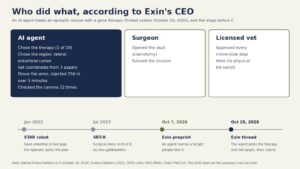
On October 21, OpenAI, PerturbAI and Scripps Research reported that thousands of GPT-Rosalind agents had interpreted existing data from millions of mouse brain cells in 32 minutes, work the team estimated would take people months to a year. It produced hypotheses to test in the lab, such as a possible link between DCTN1, a Perry syndrome gene, and cholesterol. A week later, on October 28, the CEO of the startup Exin Therapeutics said an AI agent had chosen one of 19 gene therapies and injected it into a mouse’s brain, with a vet holding a kill switch.
The numbers from Anthropic’s partners
Anthropic’s post also covers six outside partners. The most detailed numbers come from Enveda, which used a Claude-based tool to review four batch records from a Phase 2 manufacturing campaign, 1,061 pages in total. Across several runs, the tool raised all 11 issues that human reviewers had found, and one timed run flagged seven more that nobody had caught, which Enveda’s report calls “detail-level items.” Checking the records by hand took the reviewers 25.9 hours; running the tool and having them check its comments took 2.8 hours in total.
Enveda also had Claude draft Module 2 of an Investigational New Drug application, the summary part of the file a company must send the FDA before testing a drug in people. The first draft took four hours, against about three months by hand, Enveda says, and neither figure includes a three-week review. At Divergence Labs, Claude produced roughly 35,000 antibody designs for a food allergy drug in about a month, and the company had lab results within weeks, against up to nine months in earlier projects.
The caveats in the papers
Everything above is preclinical; “these are early results in mice, not human trials,” Anthropic writes. The force comparison in Mithril’s report rests on seven treated and four untreated mice at week six. Treated mice reached 1.95 times the peak force of untreated ones, but because each litter received a single treatment, the authors repeated the test on litter averages and got a p-value of 0.057, just above the usual 0.05 cutoff. The diseased mice’s body mass stayed at about half that of healthy mice whatever the treatment, and the second tool molecule showed no detectable benefit.
The report carries the header “Not peer reviewed.” Anthropic owns the program and employs the author, and Claude drafted the manuscript. The section on working with Claude “was compiled by Claude from its own threads and notes and therefore carries a risk of bias,” the authors write. Of six Claude errors they examined, at least three reached a contract lab in emails the team had edited and sent; one, a request for less material per tube than the lab wanted, was fixed before any tube was filled.
The partner results are reported by companies that work with Anthropic. Anthropic gives Enveda and Divergence Claude usage credits and engineering support, and it paid BigHat Biosciences, another partner, for the lab work in its case study.
Mithril aims to name formal drug candidates in 2027 and to start human trials in LAMA2-CMD “as soon as late 2028.” Its own timeline adds that “dates after 2026 are targets, not commitments.”
What it means
The counterexamples to a 1967 fusion conjecture that AI found in September and October came out of computation alone. The drug development speedups that both AI companies are paying for sit in operations: records, handovers, batch reviews, regulatory drafts. Anthropic states the limit itself: “Claude can’t make cells grow or mice age any faster.” In the week Mithril measured, the contract labs’ replies and the team’s decisions set the pace.
Anthropic singles out rare diseases. When a condition affects only a few thousand people, a conventional research team can cost too much to justify, it argues. Its bet is that one scientist with Claude can run several programs at once. For Rosalind, OpenAI cites its work with two large drugmakers, Novo Nordisk and Moderna.
Mithril has built more than 100 new bispecific antibodies and plans to pick a few of the strongest by the end of 2026. Tranbarger is preparing several new programs for rare pediatric diseases with no approved therapy, and Anthropic says it will explain “in the coming months” how it hopes to bring this way of working to other drug hunters.
Sources
- Early progress on accelerating drug development with Claude, Anthropic, October 27, 2026
- Preclinical Characterization of a Bispecific Bridging Antibody for the Treatment of LAMA2-Related Congenital Muscular Dystrophy, Cody Tranbarger and Mithril Medicine, technical report (Anthropic), October 26, 2026
- CDP: a language-model system for quality review of executed pharmaceutical batch records, Enveda, October 27, 2026
- OpenAI acquires Orchestra Bio, OpenAI, October 20, 2026
- OpenAI acquires startup Orchestra Bio to beef up its biotech business, Julie Bort, TechCrunch, October 20, 2026
- Using thousands of AI agents to uncover new leads in biological data, OpenAI, October 21, 2026
Header image: chart by MACCUS, data from Anthropic (October 27, 2026) and Enveda’s CDP technical report (October 27, 2026)