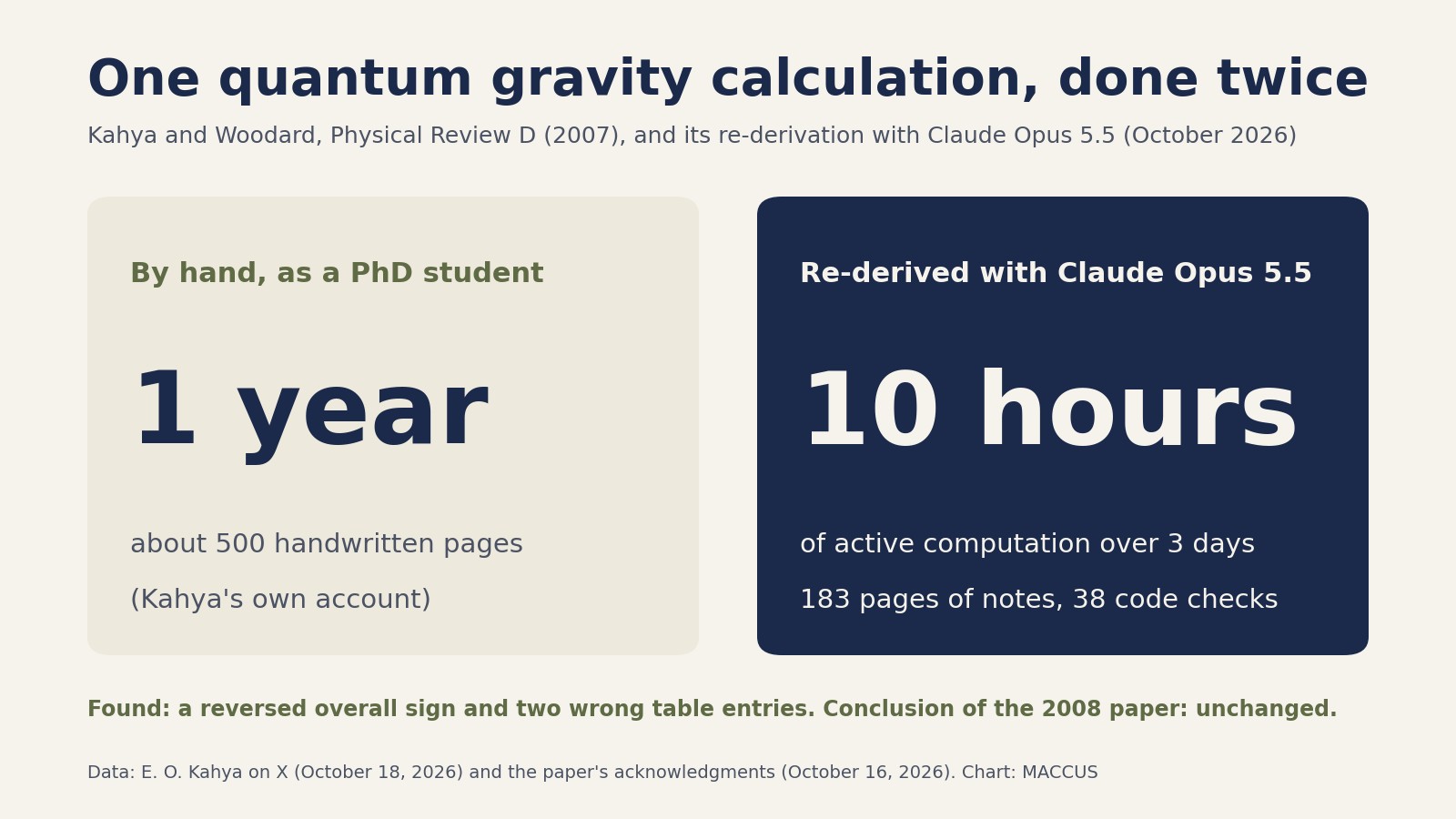

Emre Onur Kahya, now a physicist at Istanbul Technical University, spent a year of his PhD and about 500 handwritten pages on one quantum gravity calculation, by his own count. On October 16, 2026, he published a step-by-step re-derivation of that work, carried out with Claude Opus 5.5 in about 10 hours of computing time spread over three days. It found that the result printed in Physical Review D in 2007 has the wrong overall sign and two wrong entries in its final table, but that the physics conclusion still holds.
A confession on X
Kahya wrote the original calculation with Richard Woodard as a PhD student at the University of Florida. Paper I, posted to arXiv on September 4, 2007, appeared in Physical Review D 76, 124005, and Paper II followed in Physical Review D 77, 084012 in 2008.
On October 18, he summed up the audit in a post in Turkish: “A physicist’s confession: the quantum gravity calculation that took a year of my PhD thesis and about 500 pages by hand, Opus 5.5 did in 10 hours, the paper and the GitHub repo included. It found the errors too. Luckily the result didn’t change. What will ‘labor’ mean in academia from now on?” (our translation). By October 20 the post had more than 540,000 views and 4,000 likes.
The question the calculation answers
During inflation, the burst of expansion at the very start of the universe, space fills with an ever-growing sea of long-wavelength gravitons. The two papers asked whether that sea changes how a massless scalar field, a stand-in for the field that drives inflation, behaves once its waves have stretched beyond the horizon.
Paper I computed the one-loop correction from gravitons, a quantity physicists call the scalar’s self-mass-squared. Paper II fed it into the field’s equation and found, as the 2026 re-derivation confirms, that the field gets no significant correction at late times: nothing in it grows as the universe expands.
Two wrong table entries and a reversed sign
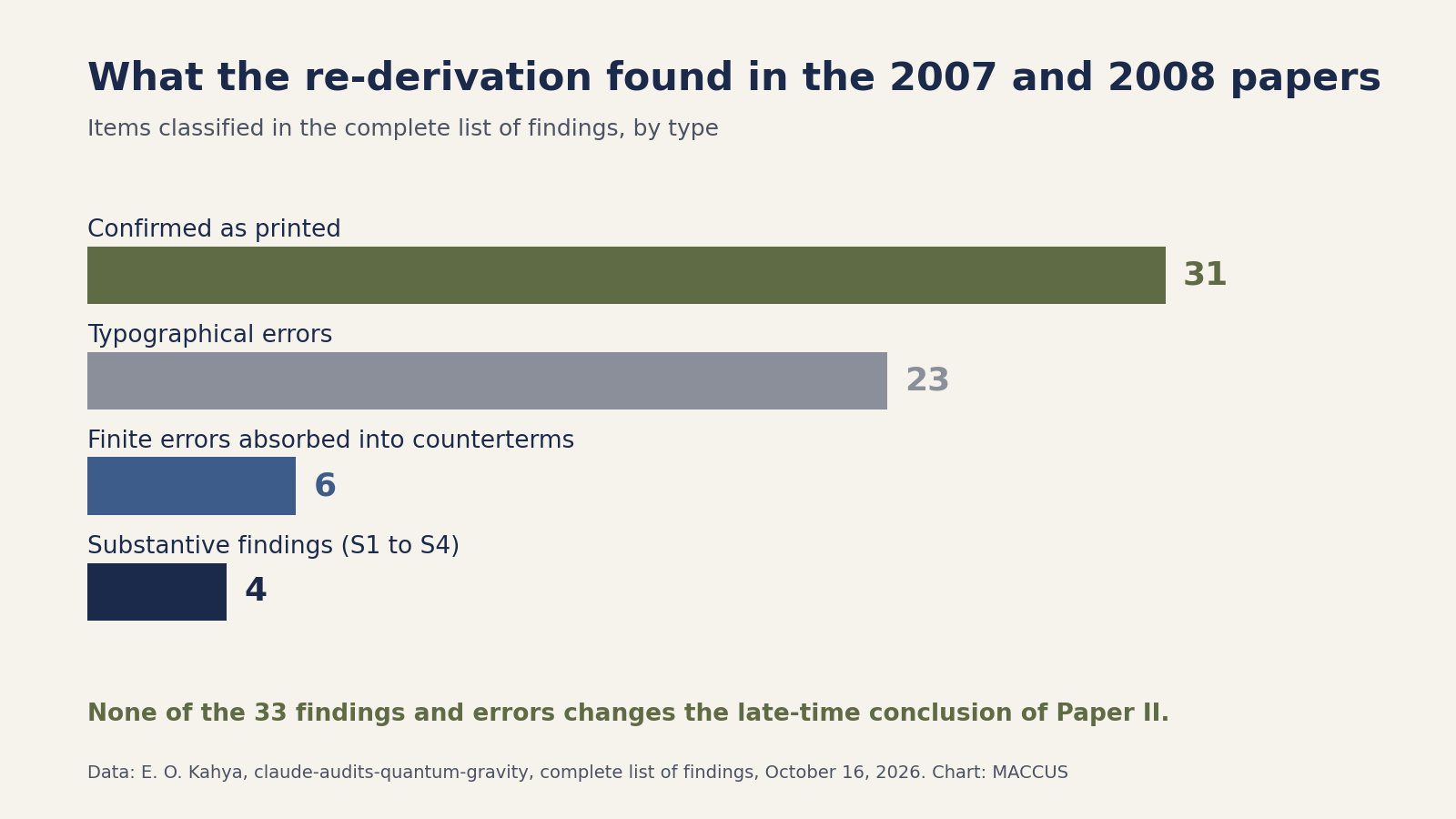
The audit classifies every difference from the printed papers. Four findings are rated substantive.
| Finding | What the audit found | Effect on the conclusion |
|---|---|---|
| S1 | The printed self-mass-squared is the negative of the one Paper I’s own definition gives | Flips only terms that fade at late times |
| S2 | One row of the final Table X lacks a logarithmic term | Adds only terms that fade |
| S3 | A constant in another row should be +18, not -54 | Drops out of the late-time calculation |
| S4 | The argument for a shortcut in Paper II fails term by term | The full calculation gives the same result |
The complete list of findings adds six finite errors absorbed into counterterms, with no physical effect, and 23 typographical errors. It also records 31 items confirmed as printed and Paper II’s Tables 2 to 4 reproduced exactly.
The repository traces the sign to two places, a derivative rule in equation (I.32) and a step from (I.46) to (I.47). The two diagrams involved were both reversed, so their relative sign stayed consistent, and so did a cancellation the paper checks between them.
How the check was built
So that the model could not simply copy the printed answer, each task took as input only the results of earlier tasks and the definitions stated in the papers. “The printed equation to be checked was not used as an input; it was compared only after the derivation was finished,” the README says, and it lists the few exceptions.
Each analytic result was then cross-checked, where possible, by separate SymPy and mpmath code: exact symbolic identities, or numerical tests at random points with 20 to 30 significant digits. The two table corrections came out of a global test, in which Table X matches a direct sum of the separate contributions, to 30 digits, only when S2 and S3 are both applied. All 38 code runs ship with the repository and, according to the README, pass in about 10 minutes on an Apple-silicon Mac.
The size of the job
The two papers were split into 18 tasks in nine stages, following the equations in order. The output fills 183 pages of derivation notes; the 500 pages Kahya mentions are his handwritten originals.
The paper’s acknowledgments credit Claude Opus 5.5 with carrying out “the step-by-step re-derivations and the symbolic and numerical cross-checks reported here,” and with preparing the notes and the repository. The whole job, manuscript included, used about 2.7 million output tokens and about 800 million tokens processed in total, “the large majority of them cached re-reads of the working context.” It took “approximately 10 hours of active computation spread over three days (October 5, 15 and 16, 2026).”
On October 19, Kahya added a practical tip: tell the model explicitly to work sequentially. Otherwise, he wrote, it “will break the whole thing into tens of parts” and hand them to agents working in parallel, where an error can spread. “This will feel so much like training a PhD student,” he added.
The same pattern on benchmarks
On September 11, a Yale-led team re-graded frontier models on physics benchmarks and reported “an expert audit of 250 cases across four benchmark subsets, in which expert review attributes 12 to the model. The other 238 are defects in the questions or the graders.” The authors write that their results suggest the true error rate of frontier models is now “far below the defect rate of available benchmarks.”
On October 9, the authors of TheoPhysEval, a benchmark we covered in our October 17 article on AI and physics, wrote that they first marked GPT-6 Astra wrong on several problems, then found “subtle errors in the original solutions” written by their experts.
In both studies the errors were in the benchmarks themselves; the Kahya error sat in a refereed paper. The case also comes after a Harvard physicist’s 36 manuscripts with Claude in three months and the October 16 Vals Science Index, which grades models on research tasks written by scientists.
A proposal and a worry
On October 19, Kahya tagged Anthropic and OpenAI with a suggestion that they “collaborate with major scientific journals (create one?) where calculations of every paper that is submitted will automatically be checked. So useful for academia.”
Asked on X whether he would rather assign such calculations to doctoral students, he answered that a supervisor would first have to teach them the technical methods, “which many would not do. That might have a damaging effect for academic apprenticeship.” Carlo Iacono, who writes the newsletter Hybrid Horizons, voiced the same worry on October 19: “The ten hours produced a corrected calculation and nobody new.”
What the audit does not show
The repository lists its own limits, along with the points a human expert should still review, starting with the two sources of the sign. The working reports were written in Turkish; the English notes are translations made with Claude and checked against the Turkish in a separate Claude pass. The appendix of Paper I that extracts derivatives was audited, not redone: worked examples were checked by hand and its totals tested numerically. One Turkish working report claimed every row had been reproduced by hand, an overstatement the notes correct.
The global tests are numerical, at two or three random pairs of points, and are not symbolic proofs. The late-time cancellation is exact through order k to the tenth power, with no proof for all orders. A possible extra local term is only partly excluded.
The physics itself was already known, and the audit confirms a 2008 result. The new paper is marked “submitted to arXiv.” It was not listed there on October 20, and no journal has published it. Woodard is thanked in the acknowledgments for the original collaboration, but nothing in the repository says he reviewed the audit.
What it means
The case shows what it now costs to re-derive a long, published calculation. In 2007 the original work took a PhD student a year, by his account, and peer review at Physical Review D missed the reversed overall sign. In October 2026 the re-derivation that caught it took about 10 hours of computation and 2.7 million output tokens, with checks anyone can rerun.
Kahya’s journal idea, for now a suggestion in a post, rests on that cost. If rechecking a calculation costs hours of compute, checking every submitted calculation becomes a question of budget and of who runs the process.
The evidence so far comes from one bounded calculation with a known answer, audited by one of its own authors, who knew the physics, with the work split into ordered tasks. This case does not show whether the method holds when the person running the audit did not write the calculation and does not know where to look.
The next things to watch are the paper’s arXiv listing, whether other physicists rerun the 38 checks and confirm S1 to S3, and whether any journal or lab takes up the automatic-checking proposal.
Sources
- claude-audits-quantum-gravity, E. O. Kahya on GitHub, October 16, 2026
- Auditing a quantum gravity calculation with an AI model: corrected scalar self-mass and unchanged late-time mode functions during inflation, E. O. Kahya, submitted to arXiv, October 16, 2026
- Bir fizikçi itirafı, Emre Onur Kahya on X, October 18, 2026
- Not sure if it would make sense for @AnthropicAI, Emre Onur Kahya on X, October 19, 2026
- Quantum Gravity Corrections to the One Loop Scalar Self-Mass during Inflation, E. O. Kahya and R. P. Woodard, arXiv, September 4, 2007
- How Good Are Frontier Models at Physics? Expert Re-Grading Reveals Broken Evaluations and Near-Saturation of Leading Benchmarks, arXiv, September 11, 2026
- TheoPhysEval: Assessing AI agents at autonomous theoretical physics problem solving, arXiv, October 9, 2026
- When the Work Stops Making the Worker, Carlo Iacono, Hybrid Horizons, October 19, 2026
Header image: chart by MACCUS, data from E. O. Kahya on X (October 18, 2026) and the paper’s acknowledgments (October 16, 2026)