

Austria’s federal procurement agency is seeking bids for a new Microsoft licensing agreement with a ceiling of 1.698 billion euros. That is the most the federal government and other public buyers could order through it over three to four years from February 2027. Per year, the new cap is almost three times the one in the current agreement: about 430 million euros against about 157 million, by our calculation from the official EU tender notice and the last round’s award notice. Bids are due on Monday, November 30, 2026, at 11 a.m. Vienna time, after two extensions.
The notice gives no reason for the higher ceiling, and we found no public explanation from the agency or the government. Trending Topics, a Vienna tech news site, lists possible reasons: higher Microsoft prices, more cloud services and AI features such as Microsoft’s Copilot assistant, more agencies joining, or simply a bigger safety margin. Its report of November 27 is the first press coverage of the tender we found.
Three lots and one winner for each
The tender is run by the Bundesbeschaffung GmbH (BBG), the central purchasing agency of Austria’s federal government. The agreement covers “software licenses, subscriptions, maintenance, cloud products and related services” from Microsoft. The notice names three kinds of buyer: the Republic of Austria at federal level, the BBG itself and “all further contracting authorities” on a customer list attached to the tender documents. That list is not on TED, the EU’s official site for public tenders.
The tender is split into three lots, each with its own ceiling. The first and largest covers Enterprise, the Microsoft licensing model that large organizations use, according to Trending Topics. Its ceiling is 1.576 billion euros over four years, or 93% of the total.
The second lot, for Microsoft’s Select Plus licensing model, is capped at 62 million euros over three years. The third, for cloud subscriptions sold through Microsoft’s Cloud Solution Provider program, is capped at 62 million euros over four years. All three are set to start on February 18, 2027.
Each lot will have exactly one winner. Public buyers will then order from that company directly, with no new round of competition, the notice and Trending Topics both say. This kind of standing contract is called a framework agreement.
According to Trending Topics, Microsoft itself is not bidding. The site says the tender targets resellers, companies that Microsoft has authorized to sell its products under large agreements. Microsoft sets the products and list prices, it says, and the resellers compete mainly on their markup and service.
The notice is dated October 9 and appeared on TED on October 13, with bids due November 12. On November 4, a change notice, the formal way to amend a tender, moved that deadline to November 26. A second one, published on November 26, moved it to November 30. Both give the same one-word reason: “Fristverlängerung,” German for deadline extension.
Smaller ceilings in two earlier rounds
Austria has run this tender before. The framework agreement signed in January 2021 had a ceiling of 340 million euros over three years. The one signed on January 19, 2024, had a ceiling of 470 million euros over three years.
Both went to the same Vienna reseller, ACP IT Solutions. The award notices for the two rounds record three bids for each lot. Price was the only basis for choosing the winner both times, according to the 2024 award notice and the 2020 notice that launched the earlier round.
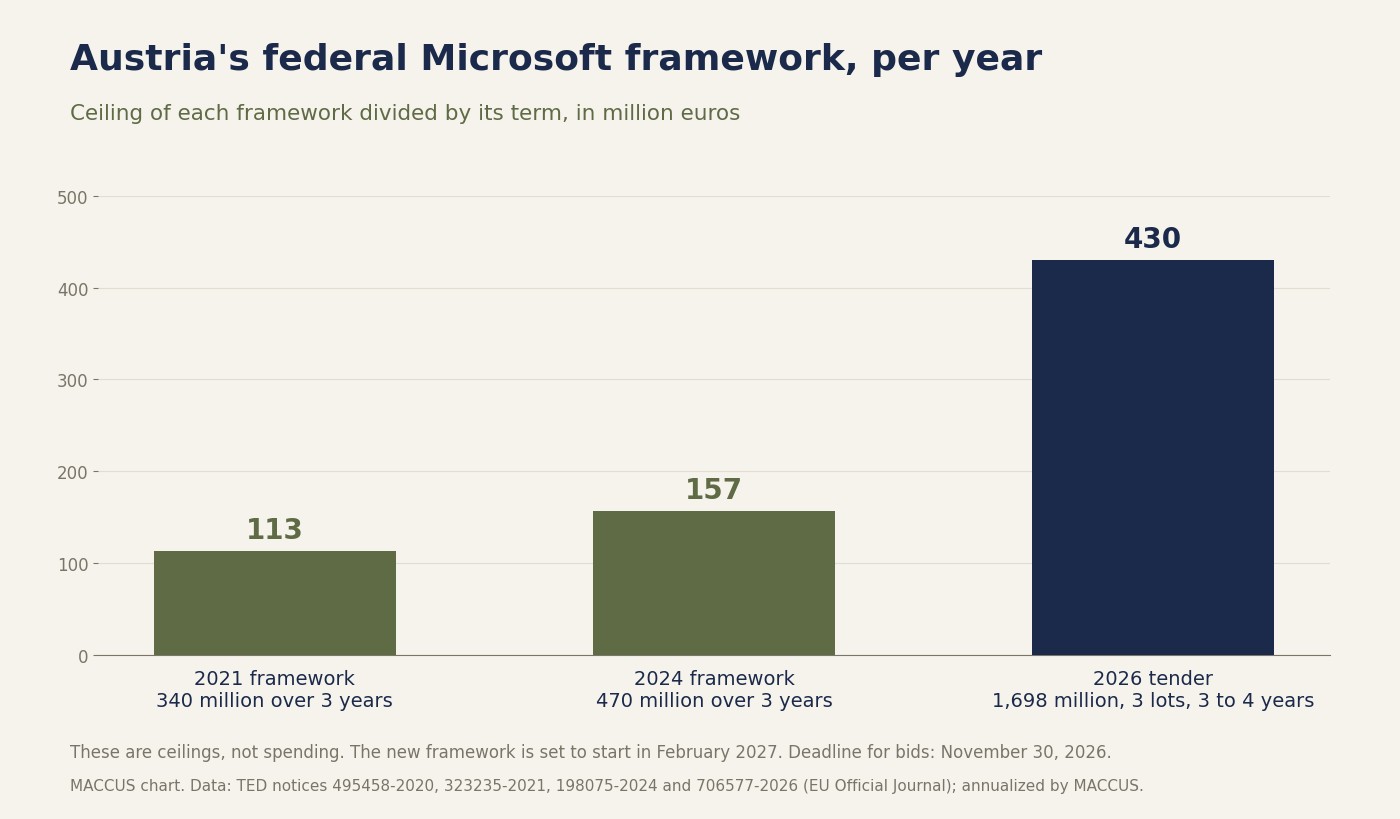
Spread over each term, the yearly ceiling rises from about 113 million euros for the 2021 agreement to about 157 million for the 2024 one, by our arithmetic. The new tender raises it to about 430 million a year. Trending Topics made the same calculation for the 2024 framework and the new tender. The raw totals, 1.698 billion euros against 470 million, differ by a factor of 3.6, but they cover terms of different lengths.
We found no public total of what Austria has actually spent under the current agreement. According to Trending Topics, the IT services arm of Austria’s social insurance system alone placed one order of just over 7 million euros this year. The site also lists federal frameworks with other software makers: up to 410 million euros for Germany’s SAP, 160 million for VMware and 50 million for IBM.
Vienna’s TikTok push and the military’s LibreOffice plan
Four days before the bid deadline, Austria’s government pushed for European control of a major tech platform. On November 26, Alexander Pröll, Austria’s state secretary for digitalization, met Wolfram Weimer, Germany’s minister of state for culture and media, at the Federal Chancellery in Vienna. In a release from the Chancellery, issued through OTS, an Austrian press release service, the two called for European ownership of TikTok’s business in Europe. They also called for European responsibility for “the central technological infrastructure,” from the recommendation algorithm to data access.
“TikTok has long stopped being a toy. It is infrastructure of our democracy,” Pröll said in the release. In German: “TikTok ist längst kein Spielzeug mehr, sondern Infrastruktur unserer Demokratie.” He added that this infrastructure must not stay in the hands of “a geopolitical systemic rival.”
The two officials also said Austria had initiated a declaration on European digital sovereignty that all 27 EU member states support. Pröll plans to seek support for the TikTok initiative from more member states at a meeting of EU telecom ministers in Brussels on December 2.
The release is about TikTok and its Chinese owner, ByteDance. It does not mention Microsoft or the tender, which the BBG runs for the federal government.
Trending Topics, citing the public broadcaster ORF, says Pröll has floated making digital sovereignty a mandatory criterion in public procurement. It adds that the current tender contains no such criterion. We could not check the tender documents, which sit on the BBG’s own portal.
Austria’s armed forces, the Bundesheer, said in September 2025 that they would move 16,000 workstations from Microsoft Office to LibreOffice by the end of that year, the defense publication Janes reported. LibreOffice is a free, open-source office suite.
Michael Hillebrand, of the military’s IT and cyber directorate, told Janes that “the main aim was to maintain the independence of our own IT infrastructure.” Saving money was not the main reason, he said.
Trending Topics also pointed to this month’s Microsoft 365 outage in its report on the tender. The outage cut some users off from Outlook email and the Teams calendar for about 30 hours, by Microsoft’s own count.
Limits of what is known
A ceiling is a limit on orders. Trending Topics notes that such caps “are often not reached.” The yearly comparison is our arithmetic on two ceilings and says nothing about what Austria will pay. Nobody has won the new lots yet, and the bidders are not public.
The reasons for the jump are also unknown. The notice does not say whether AI features such as Copilot are a factor. The customer list that would show how many agencies take part is not on TED.
No primary source we could open confirms that the Bundesheer’s move is finished. Trending Topics recalls Munich’s case to show how hard leaving Microsoft can be for an administration. The city moved its administration to Linux, a free operating system, over several years. It then returned to Microsoft in 2017 after political disputes and complaints about compatibility.
What it means for Europe
The tender has some features that work for taxpayers. It is open to bidders across the EU, three bids came in for each lot in the last two rounds, and price alone decided both awards. Austria can also point to 16,000 military workstations planned for an open-source suite, and to a sovereignty declaration it says all 27 member states back.
By our arithmetic, the new cap allows Microsoft orders of up to about 430 million euros a year, almost three times the last cap. Elsewhere in Europe, an Aalto University study estimates that 56% of Finland’s national online public services run on US clouds, and the head of the French AI company Mistral AI has said that only 20% of European digital services run on European infrastructure, a figure he gave without a published method. Our reading: Vienna’s sovereignty push of November 26 targets a Chinese-owned app, while the tender for its own federal offices covers up to four more years of Microsoft, a choice Dutch Railways also made this month for its cloud, saying data security outweighed sovereignty.
The bids are opened on Monday, November 30, at 11 a.m. The BBG is due to pick one reseller per lot before the planned start on February 18, 2027. The next things to watch are whether the agency or the government explains the higher ceiling, and what Pröll brings to EU telecom ministers on December 2.
Sources
- Microsoft Enterprise & Select (contract notice 706577-2026), TED, Official Journal of the European Union, October 13, 2026
- Microsoft Enterprise & Select (change notice 820948-2026), TED, Official Journal of the European Union, November 26, 2026
- Microsoft Enterprise & Select (contract award notice 198075-2024), TED, Official Journal of the European Union, April 4, 2024
- Microsoft Enterprise & Select (contract notice 495458-2020), TED, Official Journal of the European Union, October 20, 2020
- Microsoft Enterprise & Select (contract award notice 323235-2021), TED, Official Journal of the European Union, June 28, 2021
- Austria Wants to Buy Up to €1.7 Billion in Microsoft Licenses, Trending Topics, November 27, 2026
- „Europa muss die Systemfrage zu TikTok stellen“: Pröll und Weimer treiben Allianz für europäische Lösung weiter voran, Austrian Federal Chancellery (OTS), November 26, 2026
- Austrian Armed Forces replacing Microsoft Office with LibreOffice, Janes, October 31, 2025