

Researchers at Finland’s Aalto University estimate that 56% of the country’s national online public services are hosted on Amazon Web Services, Microsoft Azure or Google Cloud. That is more than half, and the second-highest share in the European Union after Malta, at 78.5%. Their working paper, published on November 24, 2026, ranks 158 countries by the share of national public web services running on servers rented from these three US companies. The paper opens on a Danish warning about a possible US cutoff, and the EU is still negotiating a proposed law on cloud and AI services.
Finland’s neighbors rely far less on US clouds: Sweden is at 12.8% and Estonia, across the Gulf of Finland, at 1.6%. Germany and France are also far lower, at 2.9% and 9.3%. The authors attribute Finland’s high share to wages and size. In a rich country, paying staff to run servers in-house is expensive, and a small home market cannot support a local rival to the US giants.
The study behind the figures
The working paper, released online rather than in a journal, is titled “Technology dependence from scale economies.” Its authors are Vili Lehdonvirta, Jaakko Kilpi and Otto Kässi of Aalto University’s computer science department. Lehdonvirta leads the Digital Economic Security Lab, which presented the results on November 26, 2026, in a post titled “Small, rich, dependent.” The European Union funds the work through a European Research Council grant.
The team collected 23,876 web domains, or website addresses, run by national public bodies in 158 countries. These bodies include ministries, agencies, regulators and national services for tax, health, social benefits, justice and immigration. Regional and local governments, state-owned companies, public broadcasters and universities were left out, and so was the United States. A state-owned company’s choice, such as the Dutch national railway’s planned move of 30 apps to Microsoft’s cloud, does not count in these figures.
Governments rarely say where their websites are hosted, so the team inferred it with a classifier, a program trained to sort examples. For each domain, the program read public internet records: who runs the name servers that direct visitors to the site, and the mail servers that handle its email. It also checked which network carries the site and who issued its security certificate, the digital ID behind a browser’s padlock. From those clues, it estimated whether the site is hosted on one of the three US clouds.
The team trained and tested the classifier on 269 public services whose hosting had been confirmed. Most were confirmed in the UK, Finland and the Philippines through freedom of information requests, a legal route to official records. The best version of the classifier got 83% of them right. In that checked sample, 64% of the Finnish services and 77% of the UK services were hosted on US hyperscalers, the industry’s term for the largest cloud providers.
How Europe compares
Most EU countries sit far below Finland: France, in the middle of the 27-country ranking, is at 9.3%. On the central estimates, five member states are above 25%: Malta, Finland, Ireland (45.8%), Portugal (29.1%) and Italy (25.5%). Eleven are below 5%, among them Germany, Belgium, Austria, Luxembourg and Estonia. The Netherlands, home to a data center industry that used 5% of the country’s electricity in 2025, is at 7.0%.
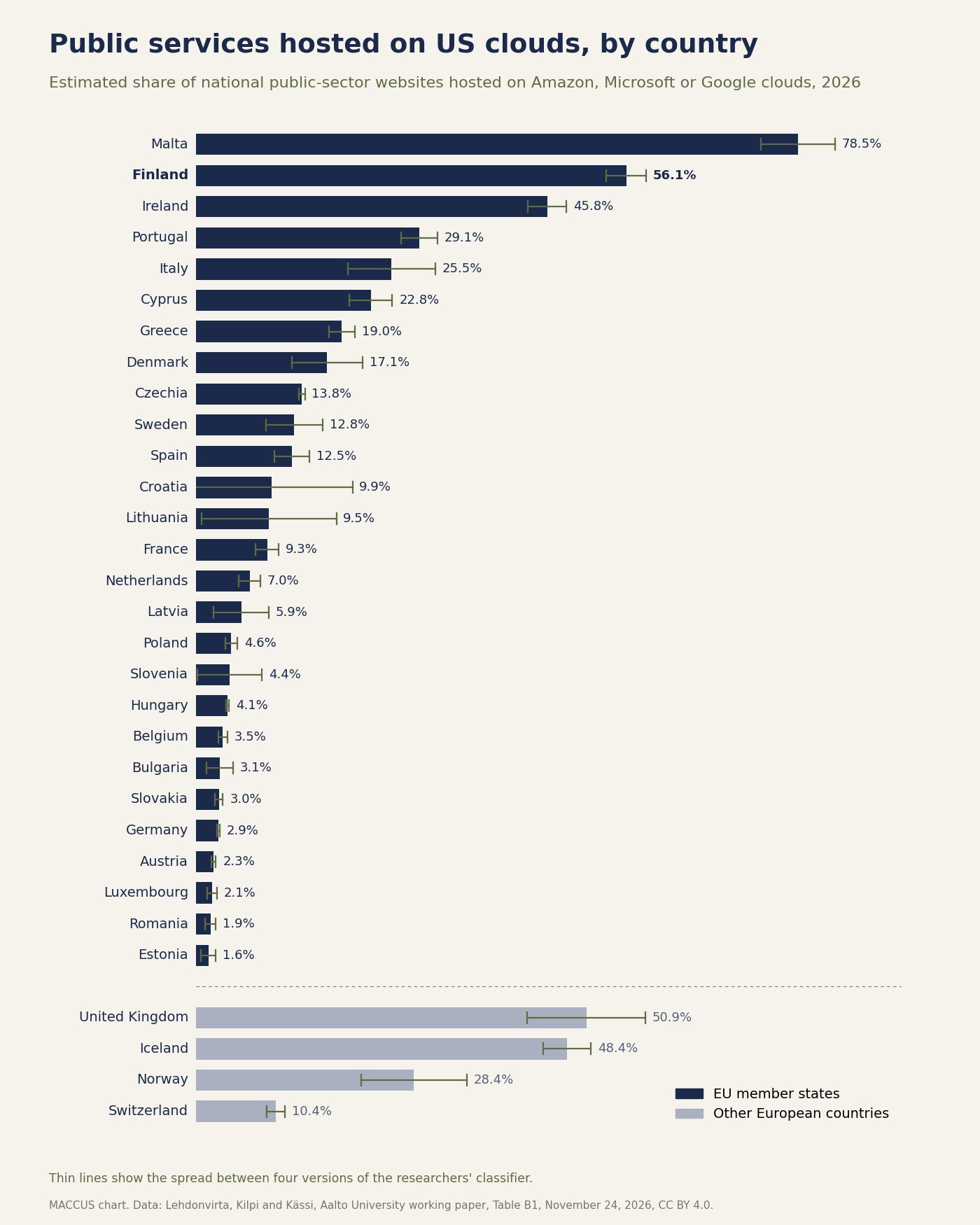
Outside the EU, the UK is at 50.9%. The five Nordic countries span a wide range: Finland 56%, Iceland 48%, Norway 28%, Denmark 17% and Sweden 13%.
Worldwide, the share runs from zero in China and Russia to 81% in Bahrain. The median, or middle, country is at 3.7%. Richer countries rely on US clouds far more than poorer ones: 21% on average in higher-income countries, against 6% in lower-income ones.
Each country’s figure comes with a margin, the spread between four versions of the classifier. The margin is narrow for Finland (2.6 percentage points) and Germany (0.2 points), and wide for Croatia (10.5 points), Lithuania (8.8) and the UK (7.7).
Why small, rich countries depend most
The first of the authors’ two reasons is labor cost. Poorer countries can run government websites on their own servers, a labor-heavy setup, while high-wage countries turn to cloud services to save staff time. The second is scale. Cloud computing rewards size, and “a small home market cannot sustain a domestic provider that competes with AWS, Azure, or Google,” the lab writes.
“Small rich states face both constraints at once,” the lab’s post says. “This explains the cluster at the top: Malta, Singapore, Bahrain, Finland, and Iceland.” The paper suggests that dependence on US clouds becomes easier to shed for countries above roughly 50 million people or 2 trillion dollars of GDP, a threshold it calls indicative.
Some large, rich countries chose cloud-first policies anyway. The UK, at 51%, adopted a “Cloud First” procurement policy in 2013. Japan, at 49%, launched its Government Cloud initiative in 2021. The lab writes that those policies “in practice handed over” public hosting to the US providers.
Others did not. South Korea, at 1%, brought in a certification program for public-sector cloud in 2016 that effectively barred AWS and Azure. Germany and France both have domestic cloud providers.
Luxembourg, with 630,000 people and about 2% of its services on US clouds, is the exception the authors’ model does not predict. The paper links this to a large local hosting industry, built to serve its financial and corporate services sector. It also cites the state’s role as an investor in sovereign data centers since at least 2006. The lab’s post adds that the state has been an anchor customer.
Malta, with 520,000 people, fits the pattern: it is at 78.5%. Neither the paper nor the lab’s post discusses Estonia or why it sits so far below Finland.
The worry about a US cutoff
The paper opens with a 2025 warning from the chair of Denmark’s Cybersecurity Council, made as Washington renewed its claims on Greenland. “If Americans decide to shut down cloud services at 8am, Denmark will be at a standstill by 9am,” the chair said. The lab also points to US sanctions that cut off judges and prosecutors at the International Criminal Court from Microsoft and Amazon services.
Neither source reports any such move against Finland. In Iceland, services that appear to be hosted on US clouds include the central government portal, the police, immigration, social benefits, the electoral commission’s information portal and the emergency number portal. The paper gives no such list for Finland.
Limits of the estimates
The figures are estimates from a working paper. A companion paper setting out the method was published in a peer-reviewed journal, Government Information Quarterly. An AI agent, Anthropic’s Claude Opus 4.6, compiled the lists of domains, following rules the team refined in trial runs with research assistants.
Each service counts the same in the figures, however critical it is. The estimates cover national bodies only, and the authors note that “local government services may well be more cloud-dependent.” The classifier can miss US providers that work through local partners. Web hosting is also one slice of a state’s technology: “Productivity software, email, AI models, and chips are separate dependencies.”
What it means for Europe
The EU measure the researchers point to is the Cloud and AI Development Act, a proposal the European Commission presented on June 3, 2026. It would set a single EU-wide framework to assess the sovereignty of cloud and AI services. It would also add a mechanism for public-sector adoption, while keeping most of the market open to “like-minded partners.” The European Parliament and the Council, where EU governments sit, still have to negotiate it, including how strict its sovereignty assessment will be.
By these estimates, Germany and Luxembourg host more than 97% of their national online services outside the three US clouds, and France more than 90%. The authors suggest small states buy cloud services jointly across countries, but the Commission split its six-year, 180 million euro cloud budget for its agencies among four groups of companies, the paper notes. European providers’ share of the European cloud market fell from 29% in 2017 to 15% in 2025, according to a Synergy Research Group estimate cited in the paper. On November 13, Mistral AI’s chief executive said, without giving a method, that only 20% of European digital services run on European infrastructure.
The researchers write that bigger member states, whose own providers would gain, want tighter exclusions of US providers from critical services. Smaller states that already use US clouds would face “a huge migration cost” and oppose such exclusions, they add. The stakes of the negotiation are larger for Finland, Ireland and Malta than for Germany or France. A rule that pushes public bodies off US clouds would touch more than half of Finland’s national online services by this estimate, against fewer than 3% of Germany’s.
Sources
- Technology dependence from scale economies: A global comparative study of U.S. cloud penetration in the public sector, Vili Lehdonvirta, Jaakko Kilpi and Otto Kässi, Aalto University (working paper, Zenodo), November 24, 2026
- Small, rich, dependent: new data reveals which governments rely on US cloud, Digital Economic Security Lab, November 26, 2026
- Detecting digital dependence: Inferring government use of hyperscale cloud from internet infrastructure data, Government Information Quarterly, December 2026
- Proposal for the Cloud and AI Development Act (CADA), European Commission, June 3, 2026
- Commission proposes tech sovereignty package to strengthen Europe’s digital autonomy and resilience, European Commission, June 3, 2026