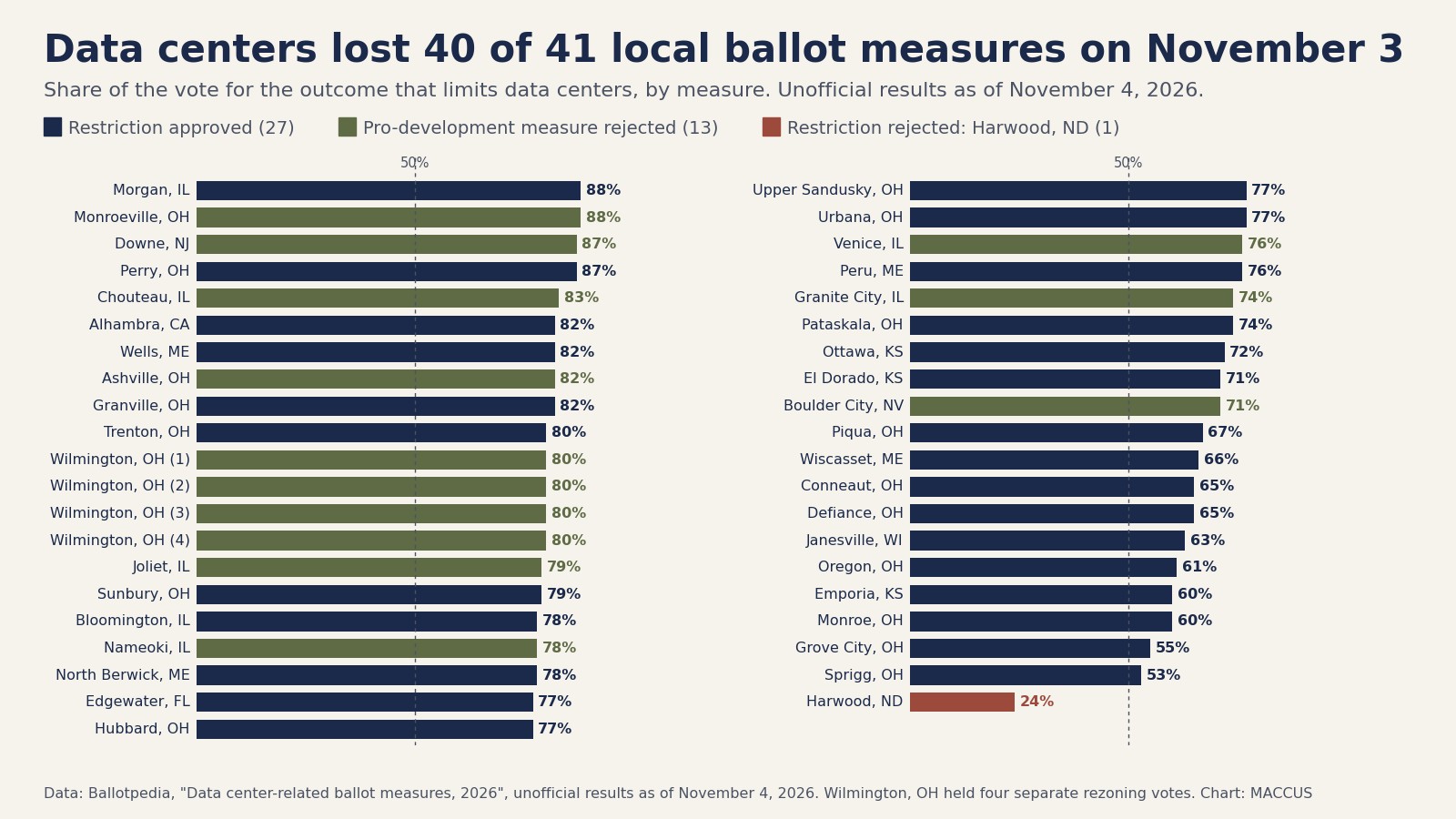

On November 3, voters in 38 American communities decided 41 local measures on data centers, and in 40 of them the majority chose to block or slow new ones nearby. That is the unofficial count as of November 4 from Ballotpedia, an online encyclopedia of American politics. Data centers are the server buildings behind the AI boom, the largest the size of a warehouse, and AI companies plan to build many more.
The 41 measures, spread over 10 states, pointed in two directions. Twenty-eight would have limited data centers through bans, moratoriums (temporary freezes), new approval rules and other limits; voters passed 27. Thirteen would have cleared the way, by changing land-use rules, approving a deal with a developer or voicing non-binding support; all 13 failed. The one exception was Harwood, North Dakota, where voters rejected extra review of large industrial projects, data centers included, by 325 votes to 105.
Voters nationwide told pollsters much the same. In a national exit poll, a survey of voters about their choices, 76% said they would oppose a new data center in their own community and 24% would favor one. NBC News published the poll, with data from the research firm SSRS.
Bans, moratoriums and rezonings, town by town
Ohio held about half the votes, 21 of 41, followed by Illinois with 7, Maine 4 and Kansas 3. California, Florida, Nevada, New Jersey, North Dakota and Wisconsin had one each, according to Ballotpedia’s November 3 preview.
About 73% of all votes cast on the 41 measures went to the side that limits data centers. Ballotpedia’s per-measure results add up to about 249,000 votes, from 248 in Monroe, in Adams County, Ohio, to more than 28,000 in Bloomington, Illinois.
Seventeen of the measures were bans, Ballotpedia counts: five on all data centers and twelve on those above a size limit, such as 25 megawatts of electricity or 25,000 square feet in area. Alhambra, California, banned data centers with 82% of the vote. In Wells, Maine, 82% approved a retroactive 180-day moratorium: it can cancel data center approvals issued within 45 days of its effective date.
Measures that would have helped data centers lost by similar margins. Joliet, Illinois, asked voters in a non-binding advisory vote whether the city should “approve the construction of AI data centers,” and 79% said no. In Wilmington, Ohio, voters rejected four rezonings that would have opened rural residential land to light industry and a data center, each with about 80% of the vote. Ashville, Ohio, voted 82% to 18% against a term sheet, the outline of a deal, for negotiating two data centers with the developer EdgeConneX.
The two closest results were also in Ohio. Sprigg, in Adams County, voted 330 to 297 for zoning, the rules on what may be built where, on land outside any town or village. In Grove City, 55% approved sending large projects to a public vote: those using more than 20 megawatts of peak power or 500,000 gallons of water a day, or covering at least 50 contiguous acres.
What voters told the exit poll
Of the five issues the poll asked about, “artificial intelligence (AI) and data centers” mattered least to the vote for Congress. It was a crucial or major factor for 56% of voters, compared with 90% for government corruption, 89% for the cost of living, 74% for the war in Iran and 73% for immigration enforcement. That 56% splits into 23% “crucial” and 33% “a major factor”; 13% said it was not a factor at all.
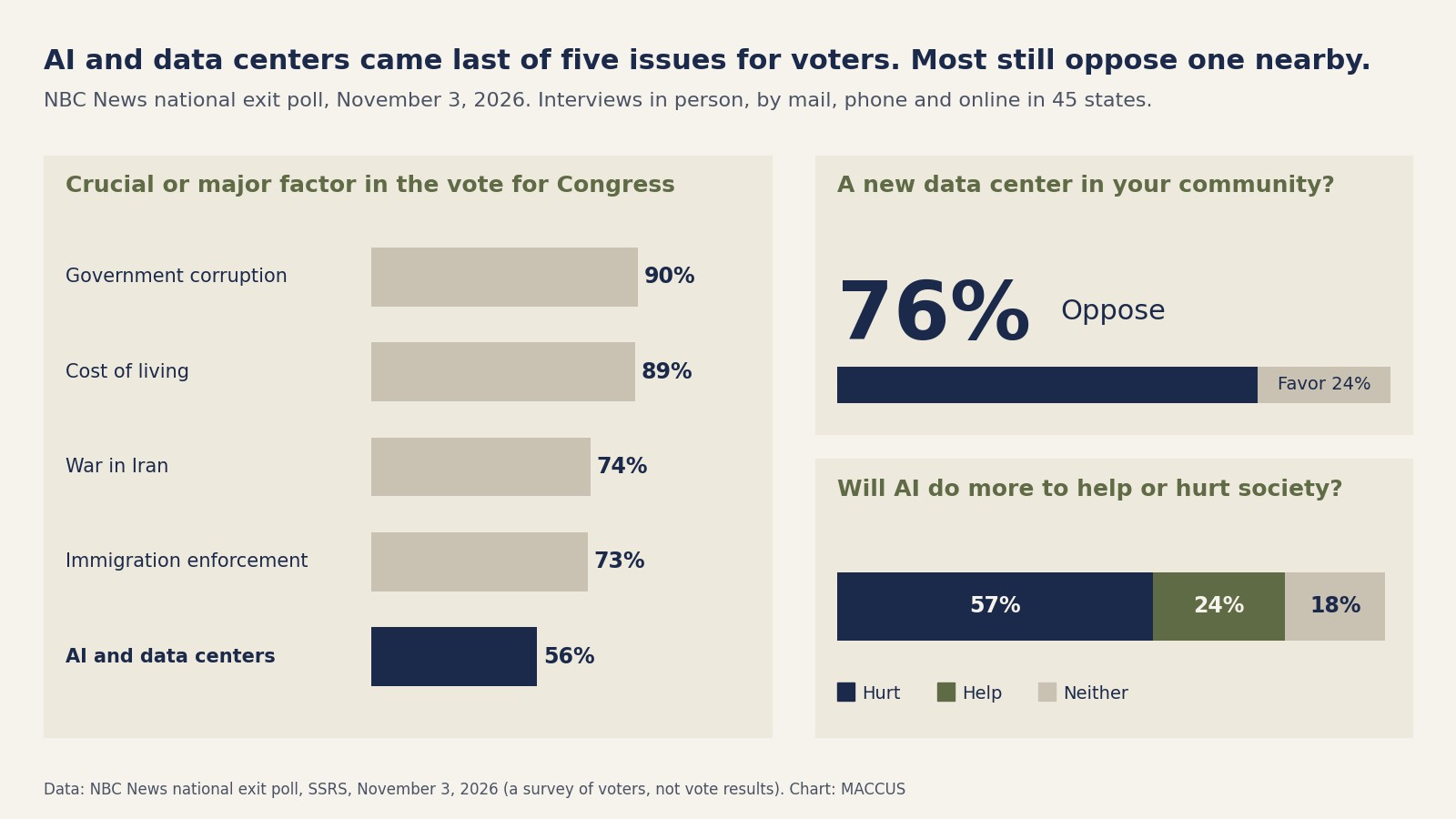
On AI itself, 57% of voters said it will do more to hurt society and 24% more to help; 18% said neither. Asked which party would better handle AI, 43% named neither, 30% the Democrats and 27% the Republicans.
NBC says the poll combined in-person, mail, phone and online interviews in 45 states.
Power bills and the build-out
Microsoft named the local worries ten months before the vote. “Communities value new jobs and property tax revenue, but not if they come with higher power bills or tighter water supplies,” Microsoft vice chair and president Brad Smith wrote on January 13.
The clearest evidence on bills comes from PJM, which runs the power grid for more than 65 million people in the Midwest and mid-Atlantic. It also runs a capacity market, which pays power plants to be available in future years. Prices in that market rose nearly tenfold between mid-2024 and mid-2025, FactCheck.org reported on October 29.
PJM’s independent market monitor called data centers “the primary reason” for the higher prices in June 2025, FactCheck.org reports. In January, it put the extra cost of data centers to electricity customers at $7.3 billion for the current 12-month delivery year and $6.5 billion for the next. Between mid-2025 and mid-2026, capacity price increases added about $16 a month to the average home bill in Ohio and $18 in western Maryland, University of Pennsylvania energy researcher Sanya Carley told FactCheck.org. An estimated 63% of that increase was due to data centers.
AI companies plan very large projects, including in Ohio. OpenAI said in August it had secured 8 gigawatts of computing capacity at the PORTS-Pike Technology Campus there, coming online in phases from 2028, CNBC reports. Anthropic, which has filed to go public, listed about $895 billion of spending commitments, nearly all for computing power and infrastructure, in its amended IPO filing of November 2.
Democrats who campaigned on pausing or regulating new data centers won the governor’s races in Ohio, Georgia and Texas, CNBC and Scientific American report. Ohio’s governor-elect, Amy Acton, backs a “conditional moratorium,” a pause to ensure data centers cover 100% of their utility costs and “exclusively build with union labor.”
AI was already a state issue before the vote: eight states sued OpenAI on October 14 and Texas filed its own suit on October 23, seeking court-approved outside review of new models. Texas also accounts for about a quarter of the US data center capacity in the works, according to an analysis cited by Scientific American.
The limits of these numbers
The results are unofficial until counties certify them, and Ballotpedia’s tally can still change. Nine of the 41 measures were advisory, including all seven in Illinois. The exit poll asked about AI and data centers as a single item, so it cannot tell the two apart.
Outside PJM, the measured effect on bills is smaller. Douglas Arent, of Columbia University’s Center on Global Energy Policy, told FactCheck.org that elsewhere, rising electricity demand and data centers “have not been a principal driver of price increases in electric markets around the country.”
A working paper from MIT’s Center for Energy and Environmental Policy Research looked at individual utilities, the local power companies. It found that a data center’s arrival raised retail electricity rates by 2.7% between 2010 and 2024. FactCheck.org concluded that a price rise is “not a given” when a data center moves in, “but the risk is real.”
Near Harwood, the one exception, a $3 billion data center called Polaris Forge 2 is already under construction, Scientific American reports.
Tech stocks diverged the day after the election. Amazon gained 8%, Google more than 6%, Microsoft 4% and Meta 3% during trading on November 4. CoreWeave, which rents out AI computing power, fell 10%, and the chipmaker Nvidia slipped just over 1%, CNBC reports. Analysts gave several reasons, including divided government in Washington, with Congress and the White House set to be held by different parties.
One analyst saw an advantage for hyperscalers, the largest cloud providers, which have the most experience building AI data centers. “We believe higher regulatory barriers entrench incumbents,” wrote Laura Martin of the investment bank Needham. “Hyperscalers are AI incumbents.”
What it means
For the companies building AI, local consent has joined chips and power as something a project can run short of. So far this year, voters sided with limits in 46 of 47 local measures, Ballotpedia counts. The November 3 measures dealt with local effects (power, water, land and tax deals), mostly in small towns. Paul Golding of the bank Macquarie wrote that well-capitalized operators gain the most if projects slow.
Some conditions for that consent are already on the table. In January, Microsoft pledged to pay its full share of local property taxes and to ask utilities to set its rates high enough that its data centers do not raise anyone else’s power prices. Ohio’s governor-elect wants data centers to cover 100% of their utility costs as a condition, and Grove City voted to send large projects to a public vote.
On December 1, voters in Clarksville, Arkansas, decide whether to uphold two city ordinances authorizing up to $50 billion and $5 billion in industrial development bonds to finance data center equipment and land. On December 15, Mandan, North Dakota, votes on a ban on data centers of 25 megawatts or more. The larger test is Texas, where Gina Hinojosa won the governor’s race after blaming the incumbent for the rapid build-out of data centers there, CNBC reports.
Sources
- Data center-related ballot measures, 2026, Ballotpedia, results as of November 4, 2026
- Voters in ten states will vote on data center-related ballot measures November 3, Ballotpedia News, November 3, 2026
- National Exit Polls: Election 2026 Results, NBC News (SSRS), November 3, 2026
- Data Centers and Electricity Prices: It’s Not as Simple as Voters May Think, FactCheck.org, October 29, 2026
- Voters rebuff data centers in every ballot measure except one during the 2026 midterms, CNBC, November 4, 2026
- Hyperscalers and Apple surge after election results remove investor uncertainty, CNBC, November 4, 2026
- 2026 election results show widespread opposition to AI data centers, Scientific American, November 4, 2026
- Building Community-First AI Infrastructure, Microsoft On the Issues, January 13, 2026
Header image: chart by MACCUS, data from Ballotpedia (unofficial results as of November 4, 2026)