
On an MSI laptop with Nvidia’s RTX Spark chip, an AI language model runs nearly five times slower on Linux than on Windows once the charger is plugged in. Alex Ziskind, a YouTuber who reviews developer hardware, published the measurement in a video on October 31, 2026. Nvidia sells the chip for running large AI models on the laptop itself.
An explanation that spread online blamed encrypted firmware only Windows can read. A bug report filed with Nvidia on November 4 points elsewhere: its Linux driver queries the laptop’s power controller in protocol versions the controller rejects. That night, Nvidia released driver code that adds the missing version. No test yet shows whether it fixes the slowdown.
RTX Spark puts two processors on one chip, sharing up to 128 GB of memory. The main processor, called Grace, is based on Arm designs. The graphics processor, or GPU, uses Nvidia’s Blackwell design and handles most AI work. Nvidia’s product page promises to run models of “up to 120B parameters,” the usual measure of model size, and lists Windows 11 as the only operating system.
Nvidia held RTX Spark launch events on October 16; the product page shows six laptops, from Asus, Dell, HP, Lenovo, Microsoft and MSI. Nvidia also publishes its own open AI models built to fit in a local machine’s memory.
Same model, four setups
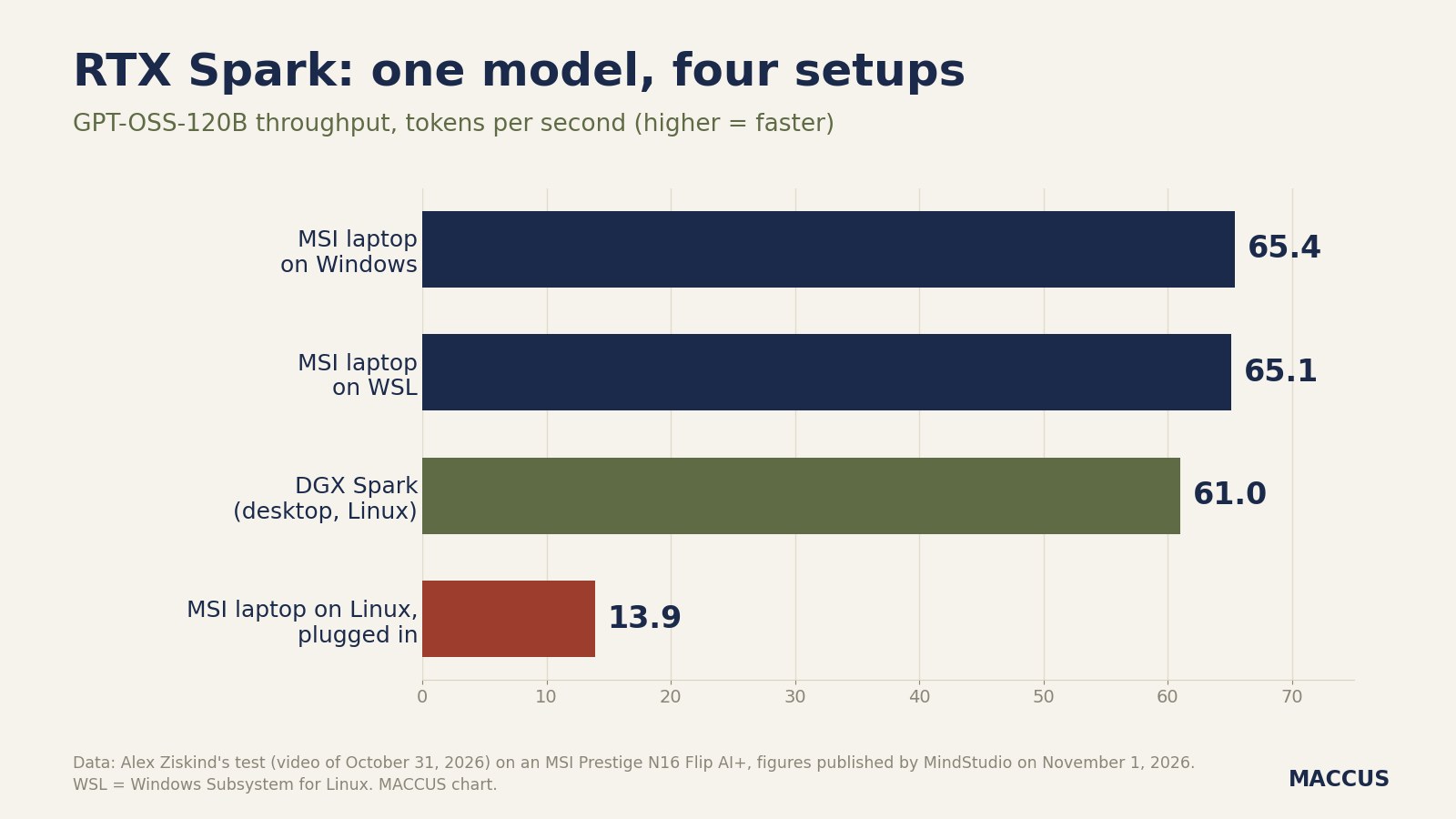
Ziskind’s test used an MSI Prestige N16 Flip AI+ laptop and GPT-OSS-120B, an open model from OpenAI with 120 billion parameters. Speed is measured in tokens per second, where a token is a word or part of a word. On Windows, the laptop produced 65.4 tokens per second. Under WSL, a Windows feature that runs Linux inside Windows, it produced 65.1.
Nvidia’s DGX Spark, a small desktop computer the company sells with Linux, reached 61 tokens per second. With Linux installed directly on the laptop and the charger plugged in, speed fell to 13.9, about a fifth of the Windows result.
On the MSI, the slowdown appears only on wall power, according to detailed figures that MindStudio, an AI software company, published on November 1. On battery, Linux reached 61 to 67 tokens per second in LM Studio, a desktop app for running models locally. The GPU’s clock speed, its working pace, sat around 1,800 MHz.
Plugged in, the clock stayed stuck around 780 MHz, versus about 2,200 MHz on Windows, and speed dropped to 15 tokens per second. MindStudio notes that laptops usually do the opposite and slow down on battery.
In a longer run, Windows finished in about 8 minutes and Linux in 37. Temperatures stayed between 40 and 47°C, which rules out overheating.
MindStudio blames a power controller only Windows uses
MindStudio’s post blames “Nvidia Platform Controllers and Framework,” a component listed in Windows Device Manager. It splits power between the chip’s main processor and its GPU. In a separate Windows measurement, disabling it cut speed from about 83 to just over 30 tokens per second. The GPU clock fell from 2,000 MHz to 786 MHz, close to the Linux figure, and turning the component back on restored both.
The post also says the laptop’s firmware, the low-level software built into the hardware, hands this component a table of power settings. According to MindStudio, that table is encrypted and only the Windows driver can decrypt it. The post does not say how it established this.
MindStudio concludes that only Nvidia can fix this, by adding equivalent power management to its Linux driver. On November 4, the post drew more than 580 votes on Hacker News, a technology news forum, under a title built on the encrypted-firmware claim. The idea then spread to Reddit.
A bug report points to the Linux driver
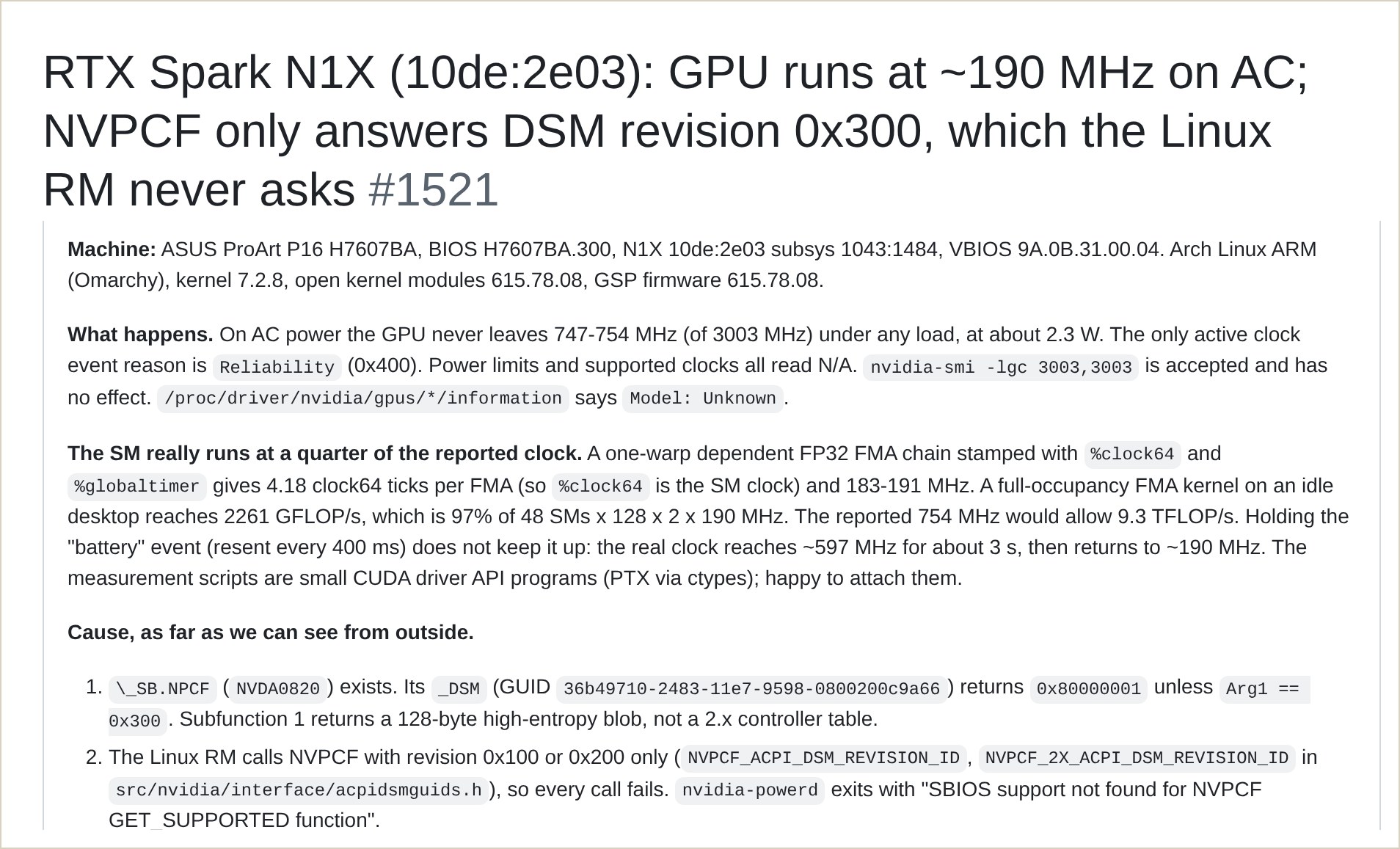
On November 4 at 4:44 p.m. UTC, a user reported the same problem on another laptop, an Asus ProArt P16. The report was filed on GitHub, in the repository where Nvidia publishes the open-source code for its Linux driver’s kernel modules. These are the driver parts that run inside the operating system’s core.
On wall power, the GPU stays between 747 and 754 MHz under any load and draws about 2.3 watts. By the user’s own measurements, the computing cores really run at 183 to 191 MHz, a quarter of the reported value. On this Asus, unplugging the charger changes nothing.
The report traces the cause to the power controller MindStudio blamed, which Nvidia calls NVPCF. The firmware exposes it through ACPI, the standard channel an operating system uses to query hardware. The controller only answers requests made in revision 3.0 of its protocol. Nvidia’s Linux driver only asks in revisions 1.0 and 2.0, so every call fails and Nvidia’s power service shuts down at startup.
Nvidia’s published code supports that reading. Version 615.78.08 of the kernel modules, released on October 7, was installed on both the Asus and a Surface laptop described below. In that version, the file of revision numbers lists only 0x100 and 0x200 for this controller, the code’s notation for revisions 1.0 and 2.0.
The report adds that the chip itself is not imposing the limit. It budgets 52.8 watts for the GPU, while the whole chip draws only 13 watts. The author asks Nvidia whether revision 3.0 is planned for Linux, or whether the driver could at least apply a default power budget.
That evening, a second user replied to the report with a related case on a Microsoft Surface Laptop Ultra. On that laptop too, the controller only answers revision 3.0, but the result is the opposite. The GPU runs at about 2,400 MHz and 50 watts, and the machine sets no power limit at all.
Under a long workload, the chip stays around 80 watts until the laptop’s case passes 57°C, the temperature Windows treats as critical. The laptop shut itself off once. Its owner now holds it back with a small homemade program.
Nvidia ships a new driver version overnight
On November 5 at about 12:20 a.m. UTC, Nvidia published version 620.70.06 of the kernel modules in the same repository. Its revision file now includes 0x300, meaning revision 3.0, and the driver contains code that queries the controller in that revision.
The release lists RTX Spark N1X chips among the supported GPUs, with no restriction by laptop maker. The 615 releases did not list these chips. The release only links to the download page and does not mention bug report #1521. No public test yet shows whether the new version ends the slowdown.
Encrypted firmware or a missing protocol version?
Both explanations could be true, but they place the failure at different points. In the bug report, the failure comes before encryption is even involved: the Linux driver asks the controller in a version it rejects. Asked in revision 3.0, the controller returns a 128-byte block that looks random. The report leaves open whether that block is an encrypted table or a format nobody has decoded yet.
The Hacker News title, which says speed drops to 35% on Linux, does not match the main measurement. That measurement, 13.9 tokens per second versus 65.4, works out to about 21%. The closest figure, around 38%, comes from the Windows test with the component disabled.
The public documents cover only three laptops and a few workloads. The MindStudio post does not give its software versions. It cites two Windows reference speeds, 65.4 and 83 tokens per second, and does not name the model behind the second. As of publication, Nvidia had not replied to the bug report or commented publicly on these tests.
What it means
Nvidia sells RTX Spark as a Windows PC for AI development, creative work and gaming, with CUDA, its platform for programming its GPUs. MindStudio notes that many local AI tools run on Linux first, including at companies that host open models on their own servers. Chief among them is vLLM, a server program for AI models.
On the MSI and the Asus, Linux installed directly slows the GPU on wall power, and the Asus stays slow on battery too. The Surface has the opposite problem: no power limit at all.
In the published tests, Linux running through WSL, on top of Windows, kept full speed. The DGX Spark, sold with Linux and sharing the laptop chip’s GPU design according to MindStudio, reached 61 tokens per second in the same test. For local AI, the choice of hardware also depends on the operating system it will run.
Nvidia already provides Linux code for the chip’s main processor. In an October 14 code change, the maintainers of Omarchy, a ready-to-install version of Linux, write that Nvidia asked them to include its power-profile patch for the processor. Nvidia ships that patch in its own RTX Spark system images.
For the GPU, the only public sign so far is version 620.70.06, which adds revision 3.0 without comment.
Three questions remain open. Does version 620.70.06 restore the GPU’s speed on wall power, and on which laptops? Does the behavior vary with each maker’s firmware, as the three cases suggest? Is the table the controller returns actually encrypted?
The next clues will come from tests of the new driver on the affected laptops and a reply from Nvidia on GitHub. BIOS updates from laptop makers, which change the firmware, are the third signal.
Sources
- NVIDIA Didn’t Want Me to Do This… Linux on RTX Spark, Alex Ziskind on YouTube, October 31, 2026
- Linux on the Nvidia RTX Spark Laptop: What Actually Works, MindStudio, November 1, 2026
- RTX Spark N1X (10de:2e03): GPU runs at ~190 MHz on AC; NVPCF only answers DSM revision 0x300, which the Linux RM never asks, NVIDIA/open-gpu-kernel-modules on GitHub, November 4, 2026
- acpidsmguids.h, modules version 615.78.08, Nvidia on GitHub, October 7, 2026
- acpidsmguids.h, modules version 620.70.06, Nvidia on GitHub, November 5, 2026
- NVIDIA RTX Spark, product page, Nvidia, accessed November 5, 2026
- Use NVIDIA’s RTX Spark driver in omarchy-power-profiles-daemon, Omarchy on GitHub, October 14, 2026
- Nvidia RTX Spark encrypted firmware slows inference speed to 35% on Linux, Hacker News, November 4, 2026
Header image: MACCUS chart, data from Alex Ziskind (October 31, 2026) and MindStudio (November 1, 2026).