

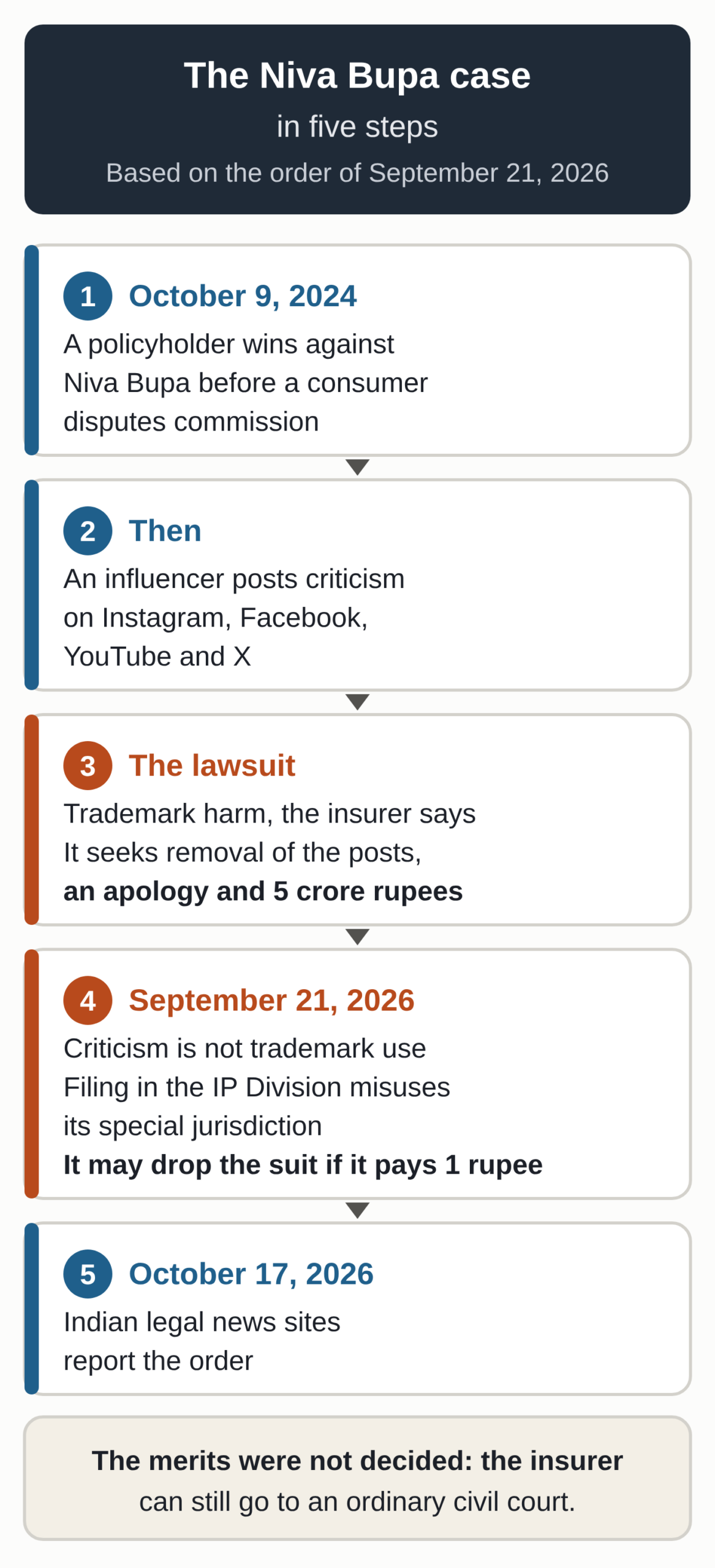
Indian health insurer Niva Bupa sued an influencer in the Delhi High Court’s Intellectual Property Division, arguing that his critical posts infringed its trademark. It wanted the posts taken down, an apology and 5 crore rupees in damages, or 50 million rupees (about 470,000 euros at the European Central Bank rate of October 16, 2026). In an order dated September 21, 2026, Justice A. J. Bhambhani held that naming the insurer in his criticism did not amount to using its trademark “in the course of trade.” He found that filing the suit there was a “misuse of the special jurisdiction” of the court and let the insurer withdraw it on one condition: paying the influencer “notional costs” of one rupee, less than one euro cent.
The order is dated September 21, 2026, but Indian legal news sites didn’t report it until October 17: LiveLaw Biz first, then Verdictum and Bar and Bench later that day. The signed six-page order is available on LiveLaw Biz.
The case shows a common reflex at work: answering public criticism with a cease-and-desist letter or a lawsuit. Here, the lawsuit earned the insurer a written rebuke from the judge and headlines in India’s legal press.
A trademark suit over critical posts
According to the order, it all started with a consumer dispute. A policyholder took Niva Bupa to the District Consumer Disputes Redressal Commission in Charkhi Dadri, in Haryana state, over a medical insurance claim. The commission ruled in his favor on October 9, 2024, and made remarks about medical insurers in general.
The influencer, who posts on Instagram, Facebook, YouTube and X, then published content about the case that Niva Bupa calls offensive. Niva Bupa says the posts also cite an August 19, 2026, order from India’s insurance regulator, IRDAI, barring the company from opening a new place of business for six months over regulatory violations. The lawyer who had represented the insurer is a co-plaintiff and sought similar relief.
When the judge asked what made this an intellectual property case, Niva Bupa’s lawyers pointed to Section 29 of India’s Trade Marks Act, 1999: in their view, the posts harmed the reputation of a registered trademark. Asked directly, they confirmed that the influencer “is not in the insurance business nor is he connected with such business in any manner.” They argued that he was disparaging the insurer’s services “to gain views and traction” on social media.
The judge’s reasoning
The judge built his ruling on that admission. Since the influencer has no connection to insurance, he wrote, using the insurer’s trademark or trade name “merely to refer to” the company does not amount to using the trademark “in the course of trade” under Section 29. The suit therefore did not involve the infringement of any intellectual property right, and the specialized division could not hear it. The judge returned the complaint to the plaintiffs so they could file it in a court with proper jurisdiction.
After the order was dictated, the insurer’s lawyers asked to withdraw the case and keep the option of refiling it as an ordinary civil suit. The judge then wrote: “Since the suit was filed and pressed, this court is of the view that filing of such suit amounts to misuse of the special jurisdiction of this court under the Intellectual Property Division.” He allowed the withdrawal on the condition that the plaintiffs pay the influencer “notional costs” of one rupee.
The merits were not decided
The order does not say whether the posts are accurate or defamatory. It rules out one route, trademark infringement, and leaves Niva Bupa free to sue the influencer over the same posts in an ordinary civil court.
The rupee is the condition for withdrawing the suit: the order imposes no fine and awards no damages. Bar and Bench’s headline read “Delhi High Court imposes costs of ₹1 on Niva Bupa for misusing IP jurisdiction to sue influencer,” and in the order those notional costs come with the permission to withdraw.
The case is also a matter of Indian law, and nothing in the order indicates how a French or Belgian court would rule on a similar one. Brand-name disputes take other forms elsewhere: in Macau, a group registered as the Hyrox Association of Macau ended up saying it has no ties to the fitness brand Hyrox.
When a lawsuit advertises the critic
This pattern has had a name since 2005: the Streisand effect. In 2003, singer Barbra Streisand sued photographer Kenneth Adelman, who was photographing the entire California coastline for a public database, over an aerial photo that showed her Malibu home. The Associated Press headline at the time read “Streisand files $50 million lawsuit over aerial photos.” According to the photo project’s website, a Los Angeles court dismissed her suit on December 31, 2003, then ordered her to pay the defendants $177,107.54 in legal fees and court costs.
The term itself comes from a trademark dispute: on January 5, 2005, Mike Masnick published a Techdirt post titled “Since When Is It Illegal To Just Mention A Trademark Online?” He described how a beach resort, the Marco Beach Ocean Resort, claimed it was illegal for a website devoted to photos of urinals to use its name. He asked how long it would take lawyers to realize “that the simple act of trying to repress something they don’t like online is likely to make it so that something that most people would never, ever see (like a photo of a urinal in some random beach resort) is now seen by many more people?” Then he wrote: “Let’s call it the Streisand Effect.”
The Niva Bupa case fits the pattern. The posts at issue lived on one influencer’s accounts. On October 17, three Indian legal news sites covered the lawsuit and the rupee, two of them with the insurer’s name in the headline.
Defamation in France, abusive lawsuits in Europe
In France, a post that attributes a specific fact to a company and hurts its reputation can amount to defamation. The French government’s defamation page on Service-public.fr, last reviewed on March 30, 2026, defines it as asserting a specific fact that harms someone’s honor or reputation. A fact is specific when it can be disproved. A complaint must be filed within three months of the offense, and the author of public defamation faces a fine of 12,000 euros.
In the EU, Directive (EU) 2024/1069 of April 11, 2024, known as the anti-SLAPP directive, protects people who engage in public participation against “manifestly unfounded claims” and “abusive court proceedings.” It provides for early dismissal of the former and, for the latter, lets courts order the claimant to pay the defendant’s legal fees and impose penalties. It covers only civil and commercial matters with cross-border implications, and member states had until May 7, 2026, to write it into national law.
A possible second lawsuit
If Niva Bupa refiles in an ordinary civil court, that case will turn on what the posts actually say, which the Intellectual Property Division did not rule on. None of the three October 17 reports includes a response from the insurer.