
On October 15, 2026, Google Search Advocate John Mueller wrote on Bluesky that the JPEG XL image format is “currently not supported” in Google Images or Discover previews. His post came nine days after the release of Chrome 155, the first version of Google’s browser to display the format by default, and two days after Firefox 158.
A site can now serve .jxl files that Chrome, Firefox and Safari display but that Google doesn’t currently use in image search or for Discover thumbnails. As of October 25, Google Search’s list of supported formats still stops at AVIF.
John Mueller’s post
The post, published at 9:26 a.m. ET (3:26 p.m. in Paris), was a reply in a thread started by Barry Pollard, a developer advocate on the Chrome team. Mueller wrote that for anyone hoping to get images shown in Google Images and as previews in Discover, “JPEG-XL is currently not supported.” He linked to the section on supported image formats in Google’s image SEO best practices, which lists seven: BMP, GIF, JPEG, PNG, WebP, SVG and AVIF. On October 21, he was back on Bluesky asking sites taken offline to patch the PHP2Shell flaws to return a 503.
The image SEO page hasn’t changed since March 2, 2026, and Google’s page on indexable file types, last updated February 3, 2026, lists the same seven formats. The Search Central documentation changelog doesn’t mention JPEG XL. Its latest entry, from October 23, covers URL structure; the October 16 entry is about the Indexing API quota page.
German magazine Dr. Web picked up the story on October 20, followed by Search Engine Journal on October 21 and Search Engine Roundtable on October 23. Dr. Web’s publisher, Michael Dobler, summed it up: “When it comes to image formats, it isn’t the fastest browser that decides when to switch, it’s the slowest search engine.”
Three of the four major browsers now support the format
JPEG XL is standardized as ISO/IEC 18181. In an October 6 post on the Chrome for Developers blog, Luca Versari, Moritz Firsching and Philip Jägenstedt credit the format with “30-50% better compression than JPEG,” along with lossless compression, HDR support and lossless transcoding of existing JPEG files. Chrome decodes it with jxl-rs, a decoder written in Rust.
Firefox 158’s release notes say JPEG XL “generally has better compression than WebP, JPEG, PNG, and GIF.” The Chrome post is more careful when it comes to AVIF: it recommends “trying both AVIF and JPEG XL” and expects JPEG XL to help most with high-fidelity images, especially photos, and with lossless compression. In technical SEO, image file size is one of the factors that affect page speed.
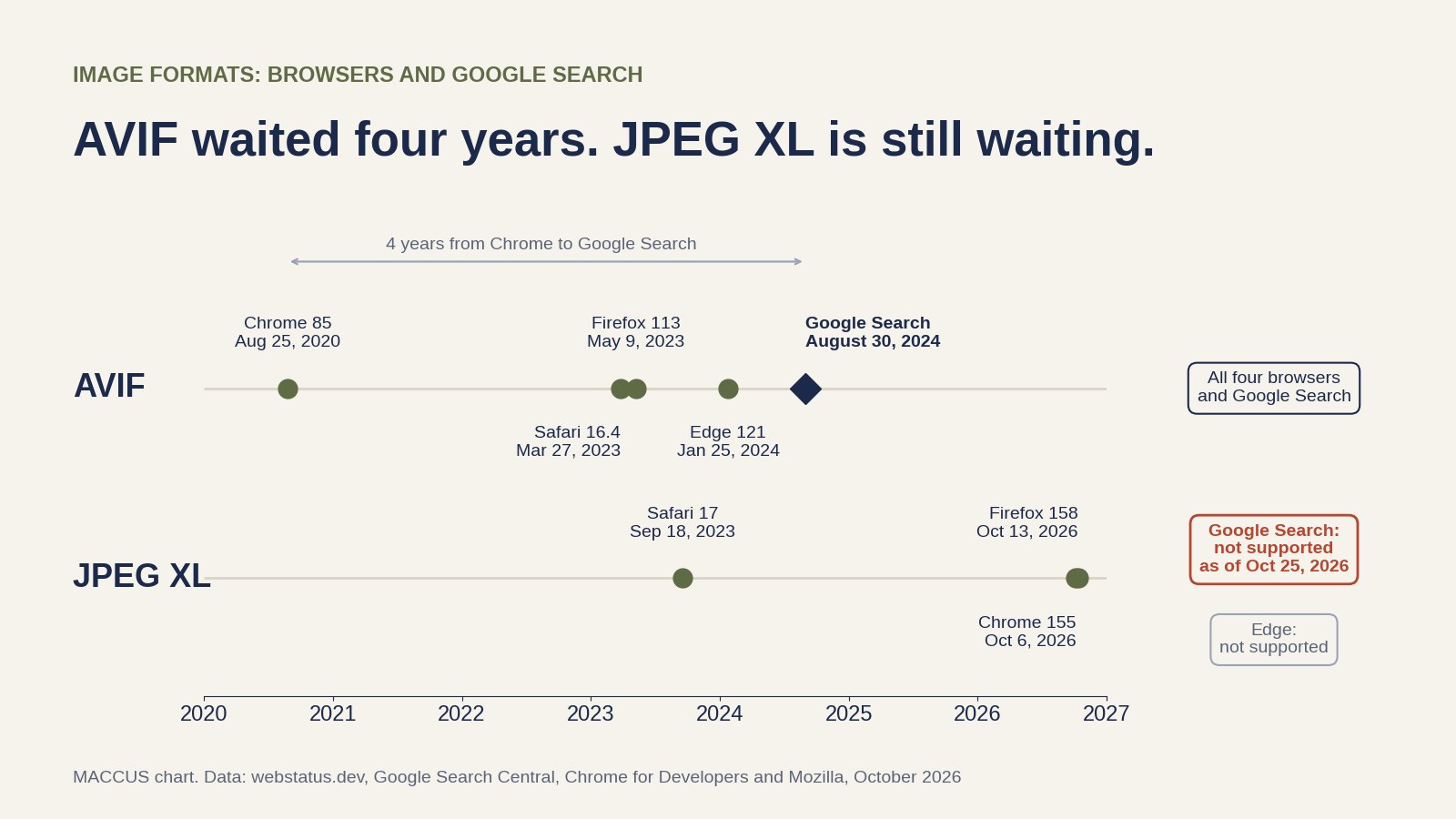
According to webstatus.dev, which tracks feature support across browsers, Chrome has supported the format since version 155 (October 6, 2026) on desktop and Android, Firefox since version 158 (October 13) and Safari since version 17 (September 18, 2023). With Microsoft Edge missing, JPEG XL is still listed as “Limited availability” and doesn’t qualify for the Baseline label, which requires support in all four major browsers.
| Browser or service | AVIF | JPEG XL |
|---|---|---|
| Chrome | yes, since version 85 (August 2020) | yes, since version 155 (October 6, 2026) |
| Firefox | yes, since version 113 (May 2023) | yes, since version 158 (October 13, 2026) |
| Safari | yes, since version 16.4 (March 2023) | yes, since version 17 (September 2023) |
| Microsoft Edge | yes, since version 121 (January 2024) | no |
| Google Search (Images, Discover) | yes, since August 30, 2024 | no |
| Google Merchant Center | no | no |
The picture element as a fallback
In the same thread, Pollard said sites should provide fallbacks anyway, since the format is new to Chrome and Firefox. Mueller replied: “The picture element includes an img element, so that would work for any search engine (or other page parsing setup).” He added that he hadn’t heard of any problems with this kind of progressive enhancement, where the browser picks the newest format it can read.
Google’s documentation agrees: the search engine can find images in the src attribute of an img element “even when it’s a child of other elements, such as the <picture> element,” and it recommends that sites “always specify a fallback URL using the src attribute.” That way, a page can offer a .jxl file in a source element while keeping a JPEG, WebP or AVIF file in the img element. Pollard said putting a JPEG XL file directly in the img element would be “kinda silly.”
Google’s Discover documentation doesn’t name any format. It recommends images at least 1,200 pixels wide, enabled by the max-image-preview:large setting, and suggests specifying the large image with og:image or schema.org markup, since “this can influence which image is chosen as the thumbnail in Discover.” Dr. Web concludes that an og:image tag pointing to a .jxl file costs the page its large thumbnail.
Online stores face one more constraint. Google Merchant Center’s help page on the image_link attribute lists JPEG, WebP, PNG, GIF, BMP and TIFF as supported formats and requires the file extension to match the format. JPEG XL isn’t on the list, and neither is AVIF.
The .jxl files spotted in Google Images
On October 23, SEO consultant Glenn Gabe noticed that a filetype:jxl search turned up .jxl files in Google Images and asked whether the format sometimes works without official support. Pollard checked: none of the images he looked at were actually served as JPEG XL, despite the extension. The example he cited is a PNG.
According to Pollard, image CDNs often convert a file to a supported format without changing its extension. Mueller added that swapping extensions and file types is “pretty common” for images, since the actual format is specified in the file header, though he said he had no data and was speaking from observation. Google’s own documentation recommends that the file extension match the file type.
No timeline for support
Mueller wrote “currently,” but Google hasn’t announced a date or a plan to add JPEG XL to its list. The .jxl files visible in Google Images aren’t evidence that Google indexes the format.
The 30-50% gain Chrome cites is measured against JPEG; the post doesn’t quantify the gap with WebP or AVIF. Pollard also asked whether Google Search would handle a format chosen by the server based on the request headers. Mueller’s reply addressed only the picture element.
On the WordPress side, the Gutenberg issue requesting JPEG XL support, filed on April 1, 2026, is still open. Its author, WordPress contributor Adam Silverstein, deferred it past version 7.1 on June 27, then moved it into the 7.3 iteration on October 20; on October 22, he noted that Edge was the only major browser without support. In the development version (7.2 beta as of October 25), JPEG XL is missing from the list of recognized file types, which includes AVIF and HEIC.
What it means
In October, only the browsers changed: Chrome and Firefox joined Safari, while Google Search, Discover and Merchant Center are sticking with format lists that leave out JPEG XL. A site that switched its images to .jxl with no fallback would see them drop out of Google Images and would lose large Discover thumbnails, two sources of traffic for publishers and online stores.
AVIF’s history gives a sense of the timeline. Chrome supported AVIF starting in August 2020 and Edge, the last major browser to follow, in January 2024; Google Search announced support on August 30, 2024, four years after Chrome and seven months after Edge. In that announcement, Mueller warned against blindly making sweeping changes to a site’s images and told sites to set up server-side redirects when file names change. This time, Edge is still missing.
The least visible case involves sites whose images pass through a CDN or an optimization plugin that picks the format based on the browser. The format Googlebot receives then depends on those tools, a point Mueller didn’t address.
Three developments would signal a change: a JPEG XL entry in the Search Central changelog, support in Microsoft Edge, and JPEG XL’s addition to the file types WordPress recognizes. For product feeds, the benchmark is Merchant Center’s help page, which doesn’t list AVIF yet.
Sources
- Post by John Mueller and replies by Barry Pollard and Glenn Gabe, Bluesky, October 15 and 23, 2026
- Image SEO Best Practices, Google Search Central, accessed October 25, 2026
- Shipping JPEG XL in Chrome, Chrome for Developers, October 6, 2026
- Firefox 158.0 Release Notes, Mozilla, October 13, 2026
- JPEG XL, webstatus.dev, accessed October 25, 2026
- Image link [image_link], Google Merchant Center Help, accessed October 25, 2026
- Supporting AVIF in Google Search, Google Search Central, August 30, 2024
- Add JPEG XL (JXL) support, WordPress/Gutenberg on GitHub, April 1, 2026, updated October 22, 2026
Header image: MACCUS chart. Data: webstatus.dev, Google Search Central, Chrome for Developers and Mozilla, October 2026