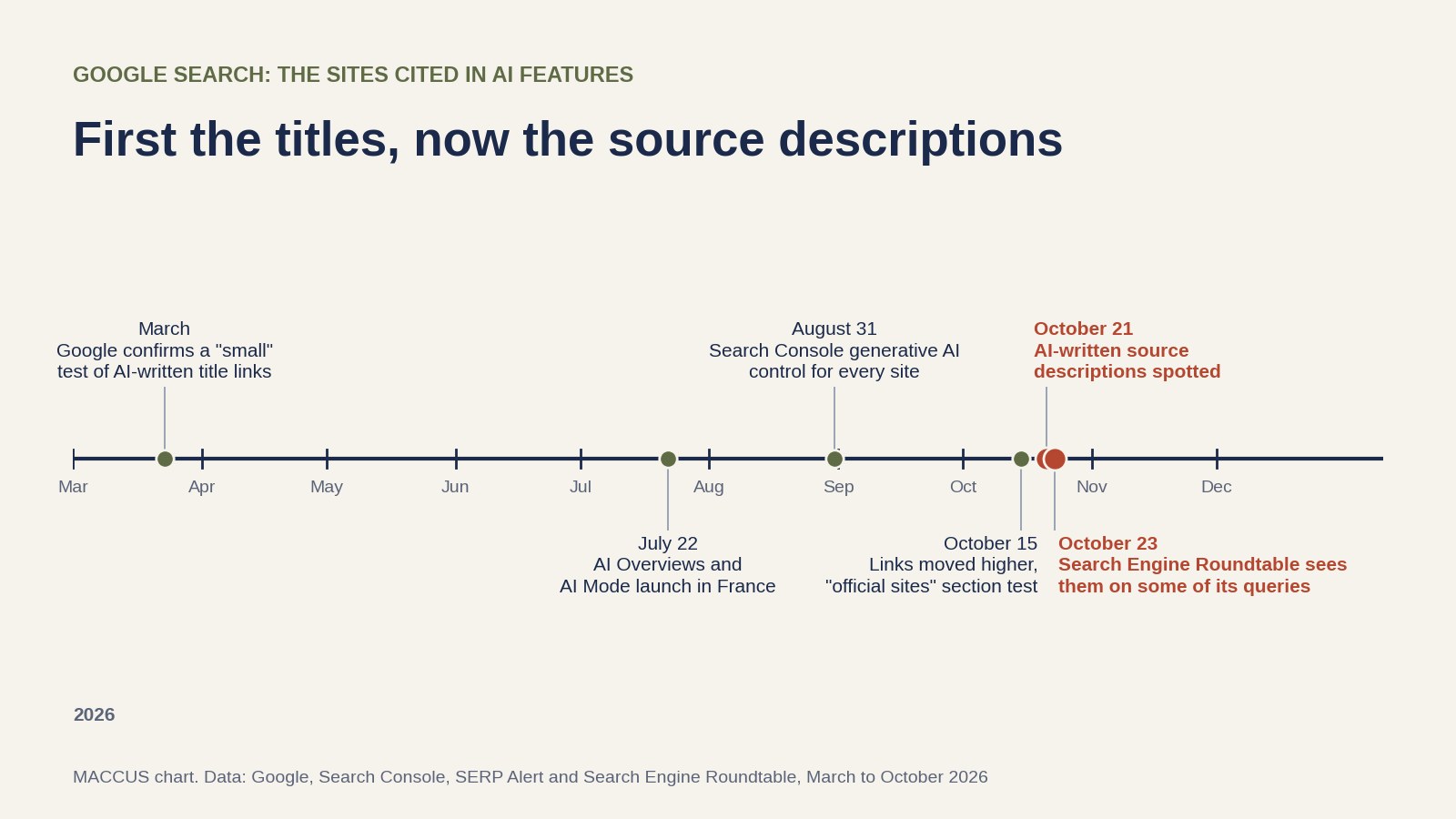

Google is testing source cards in AI Overviews where a summary written by its own models replaces the snippet pulled from the cited page. SEO consultant Brodie Clark flagged it on X on October 21, 2026. Two days later, Barry Schwartz, executive editor of Search Engine Roundtable, found the same summaries in his own tests.
As of October 26, Google had made no public comment on the test, and its help pages, checked the same day, say nothing about model-written descriptions for the sites cited in AI Overviews.
A summary where the snippet used to be
Source cards appear to the right of an AI Overview, or below it. Each one shows the site name, the page title and a few lines of text that, until now, looked like the snippet of a regular search result.
Brodie Clark, a consultant based in Melbourne, posted his screenshot on October 21 from the X account of his newsletter, SERP Alert. For the query “independent seo consultant,” the card for his site reads “Consultant: Brodie Clark (Melbourne, Australia, global reach). Clients: Tripadvisor…” The next card, for another consultant, uses the same pattern: “Services: SEO Audits & Strategy,” then details in parentheses.
The text reads like a fact sheet: a label, then a value. Further down the same screenshot, the regular result for his homepage shows an ordinary snippet written in full sentences. Clark wrote that the card text “doesn’t appear exactly like this on the page” and that it is “being summarised based on the information that Google thinks is most relevant to the query.” The word “reach,” he noted, doesn’t appear anywhere on his homepage.
A limited test, with no word from Google
Schwartz wrote up the finding on October 23. He sees the summaries on only some of his test queries and describes the change as a test or the start of a rollout. His post mentions no response from Google.
Neither of them says which markets are affected. Both published screenshots show the same English query: Clark’s search was localized to a Melbourne suburb, Schwartz’s to Wesley Hills, New York. In the second screenshot, only one of the three visible cards follows the new pattern (“Identity: Jono Alderson, independent technical SEO consultant…”); the other two show an ordinary snippet. As far as we know, no sightings on French-language queries had been published as of October 26, even though AI Overviews have been available in France since July 22, 2026, according to Google France.
On the local SEO subreddit, a user shared the finding on October 25 and asked what it meant for SEO.
Google’s written rules on snippets
Google’s documentation on regular snippets says that “snippets are primarily created from the page content itself.” Google sometimes uses the meta description tag when it describes the page better. The text can change from one search to the next, and Google says it “can’t manually change snippets for individual sites.”
Google’s page on AI features sets one condition. To be eligible as a supporting link in AI Overviews or AI Mode, a page must be indexed and “eligible to be shown in Google Search with a snippet.” For site owners who want to limit what is shown from their pages, Google points to the nosnippet, data-nosnippet, max-snippet and noindex controls.
The robots meta tag specification spells out their scope. The nosnippet rule applies to all forms of search results, AI Overviews and AI Mode included, and “will also prevent the content from being used as a direct input” for both. The max-snippet rule sets a maximum snippet length, and that limit also applies to how much of the content may be used as a direct input, unless the publisher has granted separate permission (through structured data or a license agreement with Google). None of these pages says whether a model-written description honors those settings.
Since August 31, 2026, Search Console has also given every site a Search generative AI control, located in the property settings. The “Exclude” option removes the site’s links and content from AI Overviews, AI Mode and the generative AI features in Discover. The site then gets no traffic or impressions from those features, and Google’s help page warns that content from other sites will still be available there and “may appear similar to yours.”
Rewritten titles came first
Google already rewrites titles. Its documentation on title links describes a process that is “completely automated,” drawing on the title tag, the main visible title, h1 elements, og:title and the text of links pointing to the page. On March 23, 2026, Search Engine Roundtable reported that Google had confirmed to Search Engine Land that it was testing AI-generated title links in regular results, a test Google called “small” and “narrow.”
On October 15, 2026, Google announced more prominent links in AI Mode and AI Overviews. The same post, by Hema Budaraju, vice president of product management, also described a test of a dedicated section for official websites, with context about why each link is useful. Google has not connected that test to the descriptions spotted six days later.
How AI search picks the pages it cites is still poorly documented. A Fudan University study posted on arXiv on October 8 found that eight of the ten AI search engines tested had cited a made-up concept within seven days, after nothing more than ordinary posts on sites those engines often cite.
Unknown scope, no documented way to flag errors
The public evidence comes down to two screenshots, in English and for the same query, one taken in Australia and the other in the United States. Schwartz has not published the list of test queries where he says he sees the summaries. Google has given no numbers, no timeline and no explanation.
It is unclear whether this is an interface experiment on a fraction of searches or the start of a rollout. The markets and languages involved are not known either.
If a description is wrong, the snippet documentation rules out any manual correction by Google, and none of the pages we checked describes a way to report it.
Search Console’s generative AI performance report, available to every site since August 31, counts impressions by page, country and device but says nothing about the text shown next to the link. Clicks from AI Overviews are still counted with the rest of web traffic in the Performance report.
What it means
Until now, a source card carried text close to a regular snippet, which a site could influence through its content and, according to the snippet documentation, through its meta description. In the test seen so far, Google replaces that text with a summary laid out like a fact sheet and, according to Clark, tailored to the query. Both published screenshots show consultants on a local-intent query. Nothing yet shows whether local businesses, online stores or publishers cited in AI Overviews are seeing the same thing.
Google has made no claims about the test. In his screenshot, Clark spotted at least one word that isn’t on his homepage, and no one has reported a factual error. The text shown no longer comes word for word from the site.
The documented controls determine whether a site appears among the sources and how much of its content can be reused. The nosnippet rule and the Search Console exclusion remove the site from the sources; max-snippet and data-nosnippet limit how much Google can take from it. No control lets a site correct a sentence.
The next signals to watch are a statement from Google, updates to the “Control your snippets in search results” and “AI features and your website” pages, and these cards showing up on French-language queries. The open question is whether max-snippet will apply to generated text the way it applies to snippets.
Sources
- Brodie Clark’s post on AI Overviews source cards, SERP Alert on X, October 21, 2026
- Google AI Overview Citation Cards With AI-Generated Summary Snippets, Search Engine Roundtable, October 23, 2026
- Control your snippets in search results, Google Search Central, updated April 20, 2026
- AI features and your website, Google Search Central, updated December 10, 2025
- Robots meta tag, data-nosnippet, and X-Robots-Tag specifications, Google Search Central, updated March 24, 2026
- Search generative AI control, Search Console Help, accessed October 26, 2026
- More ways to connect with the web from Search, Google, The Keyword, October 15, 2026
- Google Using AI to Create Title Links on SERP, Search Engine Roundtable, March 23, 2026
Header image: MACCUS chart. Data: Google, Search Console, SERP Alert and Search Engine Roundtable, March to October 2026