Tencent, the Chinese company that owns the WeChat messaging app, launched an artificial intelligence (AI) search engine for consumers on November 11, 2026. Called Yuanbao Search, it puts its ads in a separate block that users can collapse with one click. Google, by contrast, places ads inside the answers of AI Mode, its AI search, in the US and ten other countries.
The engine is at so.qq.com and went live on the 28th anniversary of Tencent’s founding. Results pages show a summary written by AI, with the sources it drew on. Results also include content published on WeChat. The service is in Chinese, aimed at users in China, and hasn’t launched in Europe.
“We don’t reject advertising, but users shouldn’t have to look for their answers in the ads,” said Li Ruizhang, head of product for the web version of Yuanbao Search. Kuai Technology, a Chinese tech news site, reported his comments. Quotes in this article are our translations.
Google has taken a different path. It places ads inside the answers of AI Mode, the conversational version of its search engine. On October 28, 2026, it expanded those ads to ten more countries, none of them in the European Union. In the US, the ads now also show up in answers to follow-up questions.
A search engine built on Tencent’s Yuanbao assistant
Yuanbao is Tencent’s AI assistant, a chatbot available as an app. The engine’s Chinese name, 元宝搜索, translates as Yuanbao Search. Tencent Cloud, the company’s cloud computing arm, sells businesses a service with the same name, listed as “Tencent Yuanbao Search.”
According to Tencent’s announcement, as reported by Kuai Technology, so.qq.com works in any browser. Users of the latest version of QQ Browser, Tencent’s web browser, can also choose Yuanbao Search as their search engine in the settings.
Tencent says it rebuilt its entire search system on Yuanbao’s language models, the AI programs that understand and write text. The company says these models now handle every step: understanding the query, finding and ranking pages, and writing the answer.
Tencent claims the engine’s index, the store of pages it draws its results from, holds around a hundred billion pages. Beyond the open web, the engine covers WeChat Official Accounts, where brands, media outlets and institutions publish articles. It also covers Channels, which is WeChat’s video service, along with the news site Tencent News and academic papers. Tencent says 157 “authoritative” sources are plugged into the engine and that it ranks institutions and official sources first.
People can search by typing, speaking or taking a photo. For academic papers, Tencent says the engine sums up the conclusions in plain language while keeping references to the original text. It also translates the title and abstract of English-language papers in one click, the company says.
According to TechWeb, another Chinese tech news site, Li said Tencent has no current plans to release a standalone app for the engine. Sogou, Tencent’s other search engine, will keep serving its regular users, and Yuanbao Search won’t fully replace it.
Three test searches, one ad
We opened so.qq.com on the morning of November 12, 2026, Brussels time. The home page is titled “Yuanbao Search, Tencent’s new generation of AI search.” It holds little more than a search box, buttons to search by voice or by image, and a button labeled “AI 模式” (AI mode). At the bottom, a link labeled “企业推广” (business promotion) leads to Tencent’s advertising platform.
We searched for “笔记本电脑 推荐” (laptop recommendations). The results page has tabs for all results, academic papers and popular science, WeChat Official Accounts, videos, images, organizations and mainstream media. It also offers a date filter and a switch between Chinese and English.
The first block on the page, labeled “相关广告” (related ads), held a single ad from Apple for its Mac computers. Right below it, a “收起广告” (collapse ads) button hides the ad. The block’s heading then stays on screen, with a button to bring the ad back.
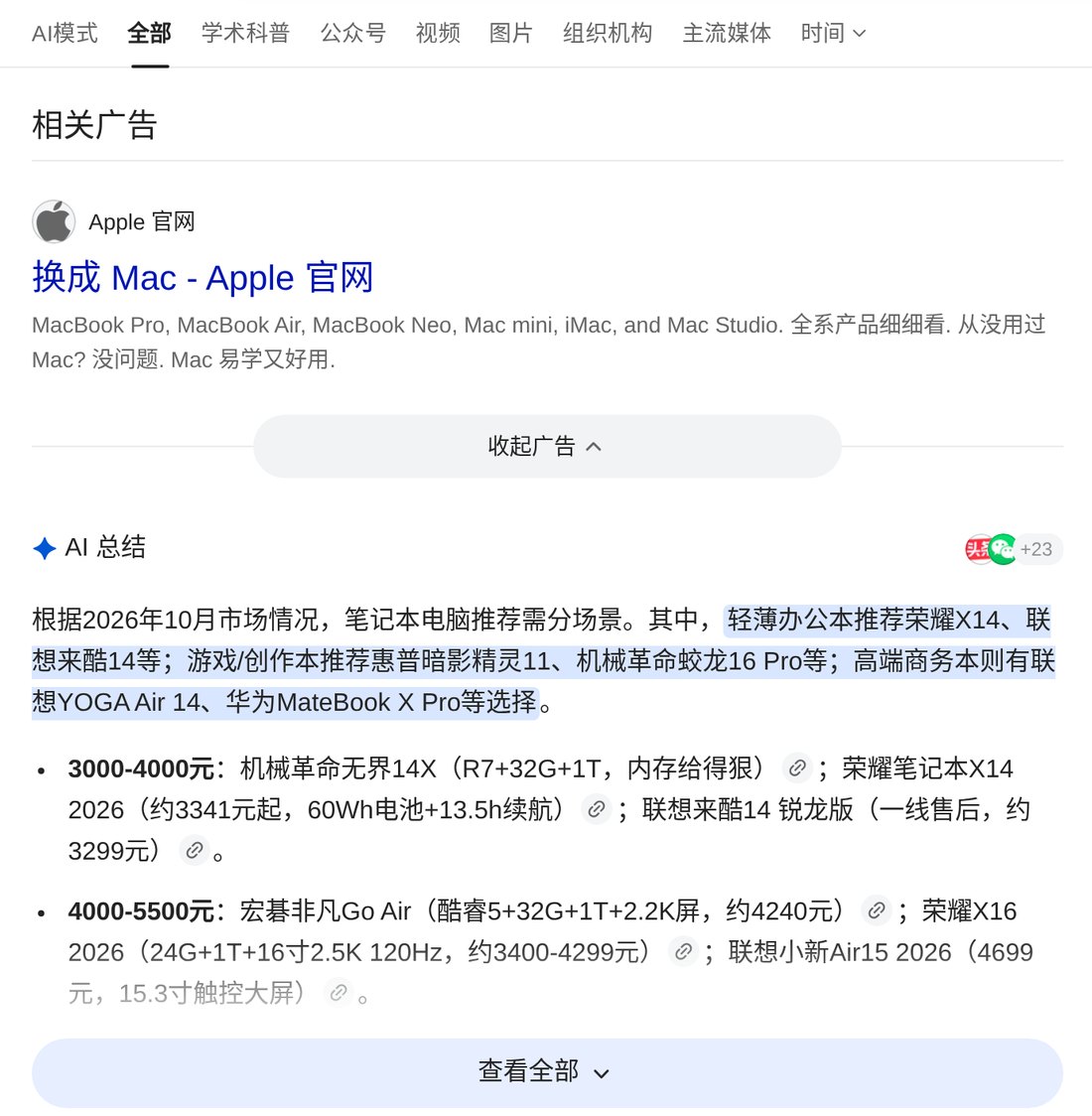
Next came the AI summary, labeled “AI 总结” (AI summary). It sorted laptops into price bands in Chinese yuan and ended by asking about the user’s budget. Its sources appeared as icons, with a “+23” counter beside them. A note said the text was AI-generated and offered “for reference only.”
Suggested questions followed, then three Channels videos, then regular web results. On this search, the ad sat above the AI summary, outside its text.
The same day, two other searches showed no ads at all. One asked which phones to buy, the other what a black hole is. Three searches are a small sample, and whether ads appear can vary with the query and the timing.
Ads kept apart, but part of the plan
Li doesn’t present Yuanbao Search as ad-free. “As a product, we don’t want to avoid commercial relationships entirely, but our core thinking is that the core mission of a search product is to give users results that have value,” he said, according to Kuai Technology. He says Tencent commits to keeping ads from posing as answers. They go in a separate block, labeled “related ads,” that users can collapse.
“With common industry practice blurring the line between ads and content, if this isn’t handled well, the user experience can quietly get worse,” he added. “Our approach is restraint.” According to TechWeb, the engine selects ads and organic (unpaid) results through two separate systems.
Still, Li is counting on advertising. TechWeb reports that he said yes when asked whether an AI that understands users better makes ads more valuable.
On a search engine, he explained, people state what they need directly, like booking a hotel or asking a legal question. The ad system then only has to find the matching advertiser. “As AI understands users better and better, it will certainly help the ad system target more precisely, and the commercial value will keep growing.”
Tencent says it screens content written for search engines
Some users worry that advertorials and copied, reworded articles will surface in the answers, TechWeb reports. According to Li, a first filter runs when the engine collects pages from the web. There, a language model flags advertorials and promotional copy. It also flags content written for search engine optimization (SEO), meaning text produced mainly to rank well in search results.
At the ranking stage, he says, a dedicated model scores the quality of SEO content. Other sources are used to check the results the engine recommends.
According to TechWeb, Tencent also describes a step in which the AI reads each page. It judges whether the page really answers the question before keeping and ranking it. Tencent doesn’t publish the criteria these models use.
Any engine that writes its own answers runs the risk of surfacing unreliable content. In October, a team at Fudan University in Shanghai showed that eight of ten AI search engines cited a made-up concept within seven days.
Already sold to businesses
Tencent sold the search service to businesses before launching the consumer engine. According to the product’s updates page, Tencent Cloud launched Yuanbao’s “web search API” on July 1, 2025. An API lets other software query a service directly. A flagship tier followed on May 29, 2026, and the service was renamed Yuanbao Search on October 9, 2026.
In an October 21, 2026, post on the Tencent Cloud developer community, Tencent announced that the service was open to outside customers. The post offered 2,000 free calls a month. A call is one request sent to the service by a piece of software.
The post also put daily use at “hundreds of millions” of calls. More than 50 Tencent services were using it at the time, including the streaming platform Tencent Video and two AI tools, WorkBuddy and ima.
According to the post, the 157 “authoritative” sources come from 13 sectors, including finance, health, law and travel. Among them, it names the brokerage Shenwan Hongyuan, the travel agency Ctrip and Tencent’s own mapping service, Tencent Maps.
Gaps in what Tencent has disclosed
Tencent’s figures can’t be checked from outside the company. That goes for the size of the index and for the 157 sources, whose full list hasn’t been published. The same goes for two rates Li cited: content coverage and recall both above 94% on long-tail questions, meaning rare, very specific searches. Recall is the share of relevant pages the engine finds.
Tencent also doesn’t explain in detail how it decides that a source is “authoritative,” and it doesn’t say which models write the answers. The company builds its own language models, including Hy4, which came out of preview on November 4.
Pandaily, an English-language site that covers Chinese tech, points to more gaps. Tencent gave no usage figures for the consumer engine and said nothing about a version outside China. It also didn’t say whether ads could one day appear inside the AI’s answers.
Tencent says the engine also improves on its own from user feedback. According to TechWeb, the company describes a three-step loop: spot disappointing results, have an AI agent label them automatically, then retrain the model. Pandaily notes that Tencent hasn’t detailed the safeguards around this mechanism.
What it means
With Yuanbao Search, Tencent makes the AI summary the core of the results page, placed below any ads. It also brings WeChat articles and videos into its web results.
According to TechWeb, Li faults existing search engines on several counts. Some content is walled off inside separate platforms, and part of it can’t be found at all. Ads are mixed in with organic results. Tencent presents the new engine as its answer to these flaws.
For publishers and SEO specialists outside China, nothing changes in the short term, since the engine is in Chinese and aimed at China. But Yuanbao Search does show a second way to sell ads in AI search.
Google places its ads inside AI Mode answers. On October 28, its parent company Alphabet acknowledged that AI Mode earns less and helped slow its search growth. Tencent says it keeps ads out of the answer, in a labeled block that users can collapse, as it did in our test. Li also expects AI to make those ads more valuable.
Tencent hasn’t said whether labeled ads could one day appear inside the AI summaries. The open question is how much room ads will take up as Tencent’s ad sales team sells space on the new engine. The other things to watch are the first usage figures and whether Tencent publicly describes the models that weed out SEO content.
Sources
- 元宝搜索-腾讯旗下新一代AI搜索 (home page and results pages), Tencent, accessed November 12, 2026
- 腾讯28周年重磅推出元宝搜索:广告不伪装成答案!接腾讯入157个权威信源, Kuai Technology, November 11, 2026
- 腾讯元宝搜索上线!负责人称不排斥广告 但用户不应该在广告里找答案, Sina Tech, via Kuai Technology, November 11, 2026
- 用元宝重做网页搜索 腾讯是怎么想的?, TechWeb, republished by Futu, November 12, 2026
- 元宝搜索, 产品动态, Tencent Cloud, accessed November 12, 2026
- 元宝搜索,正式开放, Tencent Cloud Developer Community, October 21, 2026
- Tencent Launches Yuanbao Search, a Standalone AI Search Product at so.qq.com, Pandaily, November 12, 2026
- Ads in AI Mode expand to new markets, Google, October 28, 2026
Header image: MACCUS chart. Data: Tencent Cloud, Yuanbao Search product updates page and October 21, 2026 post; Kuai Technology, November 11, 2026