

On November 23, 2026, the AI company Anthropic posted a 70-page paper on GitHub that claims to settle VP vs VNP. The computer scientist Leslie Valiant posed that problem in 1979, and it has been open ever since. The paper’s only listed author is “Claude, Anthropic,” and its README, the short note posted with it, says the result “was discovered by an internal research Claude model.”
VP vs VNP asks whether the permanent, a polynomial built from a square grid of numbers, and others like it need huge circuits of additions and multiplications to compute. It is the algebraic version of the famous P vs NP problem, which asks whether every problem whose answer is quick to check is also quick to solve. P vs NP itself stays open, and the paper says so in its abstract.
The proof comes with about 73,000 lines of Lean, a programming language in which software checks every step of a proof. The README also says what has not happened yet: the paper and the Lean code “were written by AI models, and no human mathematician has checked the proof.”
A folder on GitHub and no press release
The release is a folder named vp-vnp in anthropics/formal-math, a public GitHub repository where Anthropic publishes machine-checked proofs. The commit that added it is signed by Thomas Steinke and dated 8:04 p.m. UTC on November 23. The pull request that merged it into the repository’s main version was accepted at 9:43 p.m. UTC. The README calls the folder a “research artifact,” one that is not maintained and does not accept contributions.
As of 1:30 a.m. Brussels time on November 24, Anthropic’s newsroom had no post about it. The first link on Hacker News, a tech forum where readers vote stories up, was posted at 10:09 p.m. UTC and passed 180 points and 140 comments within three hours.
The question Valiant asked in 1979
Valiant’s question uses a different model of computing from P vs NP. P vs NP is about Turing machines, the mathematical model of an ordinary computer, and its circuit version is about Boolean circuits, networks of logic gates that work on 0s and 1s.
An arithmetic circuit works on numbers instead, and each gate adds or multiplies. The circuit must build the target polynomial itself, so its result is right for every possible input, including fractions and complex numbers. Mathematicians call a number system in which addition, subtraction, multiplication and division all work a field: the fractions, the real numbers and the complex numbers are all fields.
The question turns on two polynomials. The determinant of a square grid of numbers, a staple of algebra courses, can be computed in a number of steps that grows like a fixed power of the grid’s size, called polynomial growth. The permanent adds up the same products of the grid’s entries, but without the determinant’s minus signs.
In a 1979 paper at STOC, a major computer science conference, Valiant conjectured that no arithmetic circuit of polynomial size can compute the permanent.
Valiant also defined two classes of polynomials. VP holds the families that circuits of polynomial size can compute. VNP holds a wider set that includes the permanent. A proof that no circuit of polynomial size computes the permanent therefore proves that the two classes differ, and that is what the paper claims.
The known link to P vs NP runs one way only. A 2000 result by Peter Bürgisser shows that if VP equaled VNP over a suitable field, P would equal NP in the Boolean-circuit version of the problem. Nobody knows an implication in the other direction. NP-complete problems are the hardest of the problems whose answers are quick to check, and the paper says its results “say nothing about whether NP-complete problems have fast algorithms.” It adds that its bound “does not apply to Boolean circuits.”
What the paper claims
The main theorem sets a floor on the size of any circuit for the permanent. For a grid with m rows and m columns, every arithmetic circuit for the permanent needs more than m^(c (log m)^(1/3)) gates once m is large, for some fixed number c above zero. That holds over the real numbers and over every field except those of characteristic two, the number systems in which 1 + 1 equals 0. For a close relative of the permanent, the Hamiltonian cycle polynomial, it holds over every field.
The bound grows faster than any fixed power of m, because its exponent keeps rising as m grows. That is what separating VP from VNP requires, and, if the proof holds, it goes well past the old record. According to the paper’s review of earlier work, no lower bound larger than about m² log m gates was known for the permanent in general circuits, a level set by Volker Strassen in 1973 and by Baur and Strassen in 1983.
The claim also covers circuits that only approximate the permanent. From that version, the paper derives a statement that Ketan Mulmuley and Milind Sohoni conjectured in 2001 as the target of geometric complexity theory, their program for attacking these questions with algebraic geometry and representation theory: determinants of polynomial size cannot approximate the permanent. The paper says its proof uses neither representation theory nor the orbit closures at the core of that program.
About 73,000 lines checked by a machine
By our count, the folder holds 324 Lean files and 72,932 lines of Lean. The paper says every numbered statement has a Lean counterpart proved from Mathlib, Lean’s shared library of formal mathematics, with no assumptions beyond Lean’s three standard axioms. The one exception is Remark N.6, the consequence for determinants described above, which has no Lean counterpart.
The repository’s automated checks go further than a normal build. A tool called Comparator compares the proved theorems with a separate file that holds only the bare statements. Then nanoda, a second proof checker written independently, checks every proof again.
The machine checks have a known blind spot, and the README names it. A 98-line file called Statement.lean, by our count, defines arithmetic circuits, the permanent, VP and VNP, and states the main theorems. The README warns: “Lean checks the proofs, but no machine checks that this file says what is claimed.” A definition in that file could differ from the standard one and the proofs would still pass. Appendix Q of the paper adds: “Whether the statements say what is meant was judged only by AI readers.”
Other AI math claims this fall
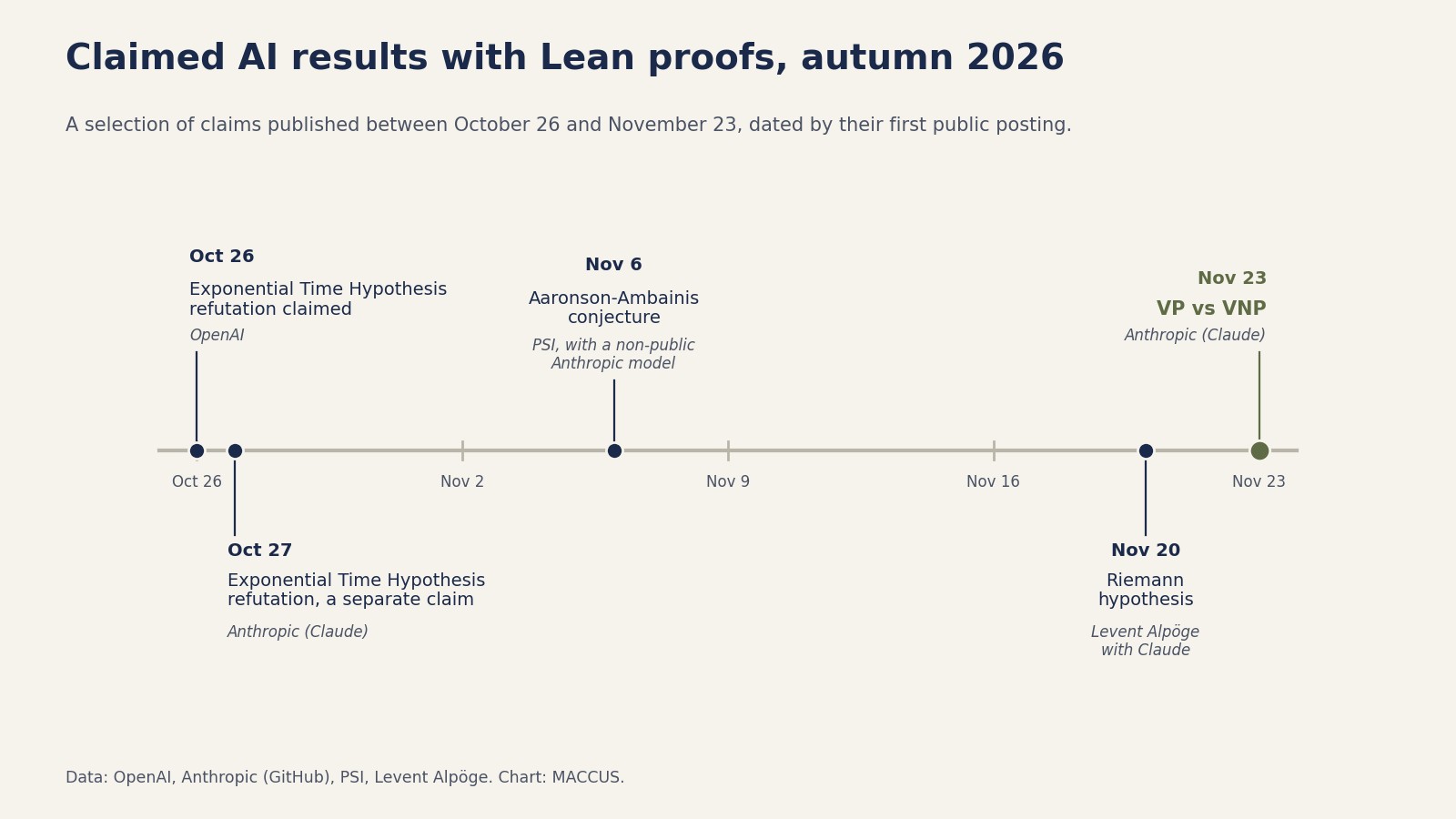
The release lands in a crowded month for AI mathematics. Each of the claims below came with a Lean proof.
Two of them concern the same hypothesis. On October 26, OpenAI said an internal model had refuted the Exponential Time Hypothesis, a 1999 assumption about how hard it is to solve 3-SAT, a classic logic puzzle. On October 27, Anthropic added a separate claimed refutation of the same hypothesis to its formal-math repository, also credited to “an internal research Claude model.”
Two other claims involved Anthropic models. On November 6, the startup PSI said its research system, running a non-public Anthropic model, had proved the Aaronson-Ambainis conjecture about quantum computers. On November 20, Levent Alpöge, a mathematician at Anthropic, wrote that he believed he had found a proof of the Riemann hypothesis, a famous open problem about how prime numbers are spread out, working with Claude.
OpenAI has also worked on the permanent. Anthropic’s paper cites a September 24 OpenAI manuscript, with its own Lean code, that announced a cubic lower bound on how large a determinant must be to approximate the permanent. Remark N.6 of Anthropic’s paper claims a bound on the same question that grows faster than any fixed power.
Hours before the VP vs VNP folder appeared, Bill Gasarch posted a dialogue between himself and Lance Fortnow on Computational Complexity, the blog the two computer scientists run. The post says it is loosely based on an actual dinner conversation.
“We have all these wonderful new theorems assisted or proven by AI, but I just can’t get myself excited to read the proofs,” Fortnow says in it. Asked whether the theorems are correct, he answers: “They are mostly Lean-verified. And if they aren’t, I’m not the one to thoroughly check all the details.”
What has not been shown
No human mathematician has checked the proof, and the paper names no journal or conference, the usual routes to expert review. Until specialists in algebraic complexity theory, the branch of computer science that studies arithmetic circuits, compare Statement.lean with their standard definitions, the Lean check covers the theorems only as that file states them.
The bound is also far below the size of the best known circuits for the permanent. The paper calls its bound quasipolynomial, of order 2 raised to the power (log m)^(4/3), which grows faster than any polynomial and far slower than an exponential. The smallest known circuits for the permanent grow exponentially, with a size of order 2^m. In the paper’s words, “there is still plenty of room to tighten the bounds.”
Anthropic gives no model name, no figure for the computing power used and no account of how long the work took. On the model, the folder says only that “an internal research Claude model” found the result.
What it means
Valiant’s conjecture has been open for 47 years, and Anthropic has now posted a claimed answer from an internal Claude model with a machine-checked proof. It went up with no newsroom announcement, three days after Levent Alpöge’s Riemann claim, in a run of AI-claimed results whose proofs Lance Fortnow, in the dialogue quoted above, says he can’t get excited to read.
The checking work has changed shape. The repository’s automated check passed on November 23, so Lean has gone through every step of the formal proof. The main open question is whether the 98 lines of definitions in Statement.lean say what algebraic complexity theorists mean by circuits, VP and VNP. That is a reading job for a few specialists, on a text far shorter than the 70-page paper, and the README itself flags it as the unchecked link.
The signs to watch are a public reading of Statement.lean by algebraic complexity researchers, outside teams rerunning the Lean build, and a submission to a journal or conference. After that comes the gap between the new floor and the exponential size of the best known circuits, a question the paper leaves open.
Sources
- VP ≠ VNP over every field (README), Anthropic, GitHub, November 23, 2026
- VP ≠ VNP over every field, Claude (Anthropic), November 23, 2026
- vp-vnp: VP != VNP, paper and Lean proof (pull request #51), Anthropic, GitHub, November 23, 2026
- A 2^o(n) Time Algorithm for 3-SAT, Anthropic, GitHub, October 27, 2026
- Working with academic communities to build scientific understanding, OpenAI, October 26, 2026
- A proof of the Aaronson-Ambainis conjecture, PSI, November 6, 2026
- remark, Levent Alpöge, November 20, 2026
- Why read proofs anymore?, Computational Complexity (Lance Fortnow and Bill Gasarch), November 23, 2026