

Anthropic, the company behind the Claude AI models, launched Claude Ship on November 23, 2026. The service lets Claude review code changes, fix them and, when a team’s rules allow it, approve them on its own. Claude Ship bundles three AI agents, programs that carry out tasks by themselves. It is in beta on Claude’s Team and Enterprise business plans, for projects hosted on GitHub, the code-hosting platform.
The approval step is what’s new. “Most teams want a person to approve every change,” Anthropic writes in its announcement. The Claude Ship documentation, however, spells out that with some settings, a change written by a bot can be merged without any human looking at it. Merging means adding the change to the project’s main code.
The three agents in Claude Ship
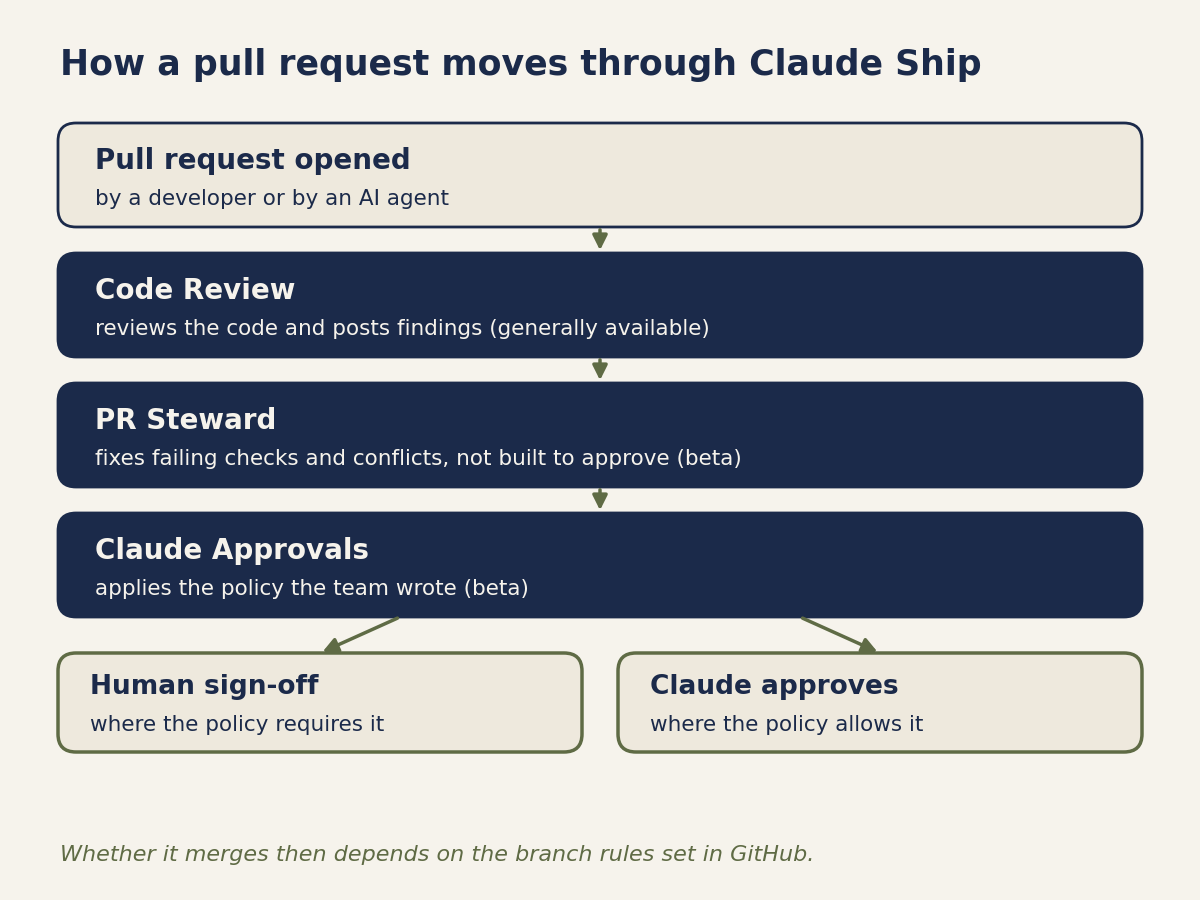
On GitHub, developers propose their changes as a pull request, or PR. Colleagues review it before the new code goes into the shared codebase. Claude Ship works at that stage, in each repository where an organization turns it on. A repository is where a project’s code is stored.
An admin turns on two of the agents there, Code Review and PR Steward. The third, Claude Approvals, starts as soon as an approval policy file sits on the repository’s default branch, the main version of the code.
The first agent, Code Review, already existed. The tech news site ZDNET reports it launched in March, and it reached general release on October 15, 2026.
Code Review has several agents read each pull request at once, along with the code around it. Other agents then check each flagged problem. Only the confirmed ones are posted as comments. Teams pick a review level for each repository: quick, standard or deep.
The second agent, PR Steward, is in beta and steps in when a pull request is stuck. It deals with failing automated checks, merge conflicts (two changes that clash over the same code) and comments from human or automated reviewers. After each round of fixes, it posts a comment explaining what it changed and how to undo it. A developer stops it with the comment @claude stop.
Anthropic says PR Steward is designed to leave approving and merging to the team. Approval is the job of the third agent, Claude Approvals, also in beta. The team writes its policy in a file in the repository named .claude/approvals.yml. The file sets how many people must sign off on each type of change, and when Claude may approve.
On GitHub, a file called CODEOWNERS names the people responsible for each part of the code. Anthropic says Claude Approvals works like “a smarter CODEOWNERS file.”
A /ship command for individual developers
Individual developers can also use the service from Claude Code, Anthropic’s coding tool. Once their change is ready, they type the /ship command. Claude uploads, or pushes, the change to GitHub, opens the pull request, reviews it, then works through the comments and failing tests. In this mode, the documentation tells developers to merge the change themselves.
According to ZDNET, individual subscribers on the Pro, Max and Ultra plans can use /ship. The command runs in the developer’s own session and counts against their Claude Code usage, the documentation says. It requires Claude Code version 2.1.330 or later, plus GitHub’s command-line tool.
The documentation flags a risk. While Claude watches the pull request from the developer’s computer, other people can get programs to run on that computer using the developer’s credentials. That covers anyone who can push code to the developer’s branch or merge code into the branch the change is aimed at. Anthropic advises letting Claude watch only when the developer trusts all of them.
Billed by usage, on top of the subscription
Claude Ship is billed by usage, based on the number of tokens processed. A token is a piece of a word, the unit that AI language models like Claude work in. The charges come on top of the subscription. They are drawn from the organization’s usage credits, separate from the usage included in its plan.
The Code Review documentation says there is no flat price per review. The cost depends on the size of each change, the complexity of the code around it, the review level chosen and how often reviews run. By default, a review runs again on every new push of code, so the cost is multiplied by the number of pushes. Anthropic recommends trying it first on a few repositories, with a monthly cap, to measure the average cost before a wider rollout.
Admins can set a spending cap for Code Review and PR Steward. PR Steward has no cap of its own until an admin sets one. Claude Approvals has no base charge, but the checks it triggers are billed. This applies even in observe mode, where the tool posts its decision without approving anything.
Eligible Enterprise customers can claim at least $10,000 in Claude Ship credits, about €9,140 at the European Central Bank’s rate for November 23, 2026. They must claim them by January 15, 2027, and use them within 30 days of claiming.
The service is closed to organizations that use Zero Data Retention, an option under which Anthropic does not store prompts or responses after answering. The same goes for those on the HIPAA configuration (HIPAA is a US framework for health data) and those that manage their own encryption keys.
Anthropic’s own numbers, and merges with no human review
Anthropic supports the launch with figures from its own teams. In an October 15 post on a company blog, the Claude Code team wrote that Claude writes about 90% of that tool’s code. The team added that daily changes to the company’s main repository had grown from about 2,500 in May to more than 30,000 in September.
Between June and September, according to Anthropic, the number of pull requests merged into Claude Code’s codebase more than doubled. Over the same period, the share of changes that had to be reverted, or undone, fell by more than 40%. The company notes that Claude’s review is only one step in a broader process, so these figures do not measure the effect of Claude Ship alone. The team’s goal is for most Claude Code pull requests to merge with at most one person involved, who can be the author, and with no rise in reverts or incidents.
The Claude Approvals documentation has a section on merges without human review. If the policy asks for a single approval, the author alone can fill that seat. If it asks for none, a change written by a bot can be merged without anyone having looked at it.
A rule can also let Claude approve a change without triggering any review at all. GitHub’s auto-merge feature adds a change to the code as soon as its conditions are met. With auto-merge on and a policy that requires no human sign-off, a change can go into the code without anyone stepping in.
Anthropic also writes that Claude Ship uses AI and may miss bugs, security vulnerabilities or other issues. The company recommends starting Claude Approvals in observe mode, then letting its decisions take effect only once they match those of the team’s reviewers.
Early reactions are cautious. ZDNET’s David Gewirtz said the idea of releasing code as fast as it is written “raises the hair on the back of my neck.” He would not be surprised if these tools proved as effective as Claude Code, which he finds impressive so far. He worries, though, about what it means for younger developers.
The French news site Numerama noted that it will all depend on which changes each company considers “routine.”
What it means
Claude Ship moves a line that Anthropic itself had drawn. When it launched Code Review in March, the company wrote that approving a pull request was still a human call and that the tool only posted findings. With Claude Approvals, approval becomes a setting in a file, and Claude can apply it on its own. One vendor can now cover every step: writing the code with Claude Code, then reviewing, fixing and approving it.
On paper, teams stay in control. Claude approves nothing without a policy file, and observe mode lets teams compare its decisions with their reviewers’. The same documentation shows, though, that an overly loose rule, combined with GitHub’s auto-merge, lets through code nobody has read.
Anthropic’s figures on merges and reverts come from its own team, measured on its own code under rules it set. There is no independent measure yet of how many mistakes Claude Approvals lets through.
The launch is aimed first at organizations on the Team and Enterprise plans. Individual subscribers get only /ship. With it, they merge the change themselves, unless GitHub’s auto-merge is turned on.
Claude Ship follows a trend that already shows up in the numbers. In September, AI agents started more than 40% of GitHub’s pull requests. In November, Amazon’s team said it had neither written nor reviewed the code of its AWS emulator, built by AI agents, a free program that imitates Amazon’s cloud services on a developer’s computer. Claude Code’s cost already drives some decisions, as with the digital bank Revolut, which sidelined it for a self-hosted model.
One open question is how GitHub, which Microsoft owns, and other coding tools will respond. PR Steward and Claude Approvals also have no date for leaving beta. The first public cases of a change approved by Claude and later reverted will show how well these rules hold up outside Anthropic’s own teams.
Sources
- Introducing Claude Ship, Anthropic, November 23, 2026
- Claude Ship (documentation), Anthropic, accessed November 24, 2026
- Claude Approvals (documentation), Anthropic, accessed November 24, 2026
- Get a pull request ready with /ship and /steward (documentation), Anthropic, accessed November 24, 2026
- Code Review costs and usage (documentation), Anthropic, accessed November 24, 2026
- How the Claude Code team does code review, Anthropic, October 15, 2026
- Claude can ship code for you now – how to try it (if you dare), ZDNET, November 23, 2026
- Anthropic lance Claude Ship, un outil qui veut valider votre code à la place de vos collègues, Numerama, November 23, 2026