

Anthropic released Claude Haiku 5.5, the cheapest model in its lineup, on October 7, 2026. Through the API, it costs 90% less than Haiku 4.5 for requests of up to 100,000 tokens: €0.09 per million tokens sent to the model, versus €0.89. The same day, Anthropic announced a monthly API credit for Max and Team subscribers. If you already hand repetitive work to Claude through the API (sorting email, reading invoices, writing summaries), moving it to Haiku 5.5 can cut the cost sharply, and on Max or Team your subscription can now cover part of it.
A token is a fragment of a word. It is the unit the API uses to count and bill the text a model reads and writes.
What Anthropic announced on October 7
In its announcement, Anthropic positions Haiku 5.5 for high-volume work where cost matters (summaries, request classification, database queries) and, because of its speed, for live customer support. The company calls Haiku 5.5 its fastest model to date. It is also the first Haiku with an effort setting, which lets you favor cost or answer quality. Its context window, the amount of text it can handle at once, grows to one million tokens, up from 200,000 on Haiku 4.5.
The model is available in Claude.ai (web, iOS and Android) on every plan, Free included. It also runs in Claude Code, through Anthropic’s API, and on Amazon Web Services, Google Cloud and Microsoft Foundry. For developers, its model ID is claude-haiku-5-5.
Anthropic’s own benchmarks show a wide gap between Haiku 5.5 and Haiku 4.5. On OSWorld, which measures how well an agent can use a computer to finish a multi-step task, Haiku 5.5 scores 72.4% at maximum effort (53.3% at the default setting), compared with 15.7% for its predecessor. VentureBeat points out that these results come from Anthropic and have not been independently verified.
The new prices, converted to euros
Anthropic lists its prices in US dollars per million tokens. The table converts them at the European Central Bank reference rate of October 9, 2026 (€1 = $1.1206), excluding VAT.
| Price per million tokens | Haiku 4.5 | Haiku 5.5, requests up to 100,000 tokens | Haiku 5.5, larger requests | Sonnet 5.5 |
|---|---|---|---|---|
| Text sent to the model | €0.89 | €0.09 | €0.45 | €1.78 |
| Text the model writes | €4.46 | €0.45 | €2.23 | €8.92 |
| Cache reads | €0.09 | €0.009 | €0.045 | €0.09 |
Prices drop 90% for requests up to 100,000 tokens and 50% above that. According to Anthropic, 90% of the requests sent to Haiku 4.5 fell under that threshold.
The new model splits text differently, though: the same text produces about 30% more tokens. With that factored in, Anthropic puts the average savings at around 75%. The Batch API, meant for jobs that can wait, halves these prices again.
Prompt caching cuts the cost of instructions that repeat from one request to the next, such as an automation’s standing instructions. Anthropic also halved the price of cache reads on Sonnet 5.5, from €0.18 to €0.09 per million tokens. The company says this makes Sonnet 5.5 about 20% cheaper on most agentic work.
OpenAI’s price list shows the same entry-level prices for GPT-6 Luna as for Haiku 5.5. If you are weighing the two ecosystems, our guide to OpenAI’s GPT models explains which one to use in ChatGPT and in the API. Further up the price scale, Meta launched Muse Wonder on October 12, at 40 times Haiku 5.5’s API price on requests of up to 100,000 tokens.
What changes depending on how you use Claude
In the Claude app
Haiku 5.5 shows up in the model picker, Free plan included. For rewording text, sorting a list or pulling details out of a document, Haiku is often enough. The model you choose is also one of the factors that decide how quickly you reach your plan’s usage limits.
In pay-as-you-go automations
If an automation calls Claude through the API (via n8n, Make, Zapier or a script), moving its small tasks to Haiku 5.5 brings the bill down sharply. Take an automation that sorts 1,000 emails a month, at about 1,500 tokens in and 200 tokens out per email on Haiku 4.5. That costs about €2.20 a month. On Haiku 5.5, with 30% more tokens from the new tokenizer, it comes to about €0.30.
That figure leaves out the model’s thinking. On Haiku 5.5, adaptive thinking is on by default: the model decides when to think before it answers, and that thinking adds to the tokens it writes. At these prices, whether a task is worth automating comes down mostly to the time it takes to set up and monitor.
With a Max or Team subscription
Since October 7, Max and Team plans include a monthly credit to spend on Anthropic’s API platform, so you can run your own tools and agents. The amounts are set in dollars and come to about €89 a month for Max 5x and €178 for Max 20x. On Team, each Standard seat adds about €18 and each Premium seat about €89, with the total pooled and capped at about €446 a month. The Pro plan is not eligible.
At Haiku 5.5 prices, an €89 credit pays for sorting about 300,000 emails from the example above, not counting the model’s thinking. Anthropic’s Help Center says the credit does not roll over from one month to the next and does not change your usage limits in Claude. It does not cover interactive Claude Code, extra usage beyond your plan’s limits, or Claude through Amazon, Google Cloud or Microsoft.
What you can do this week
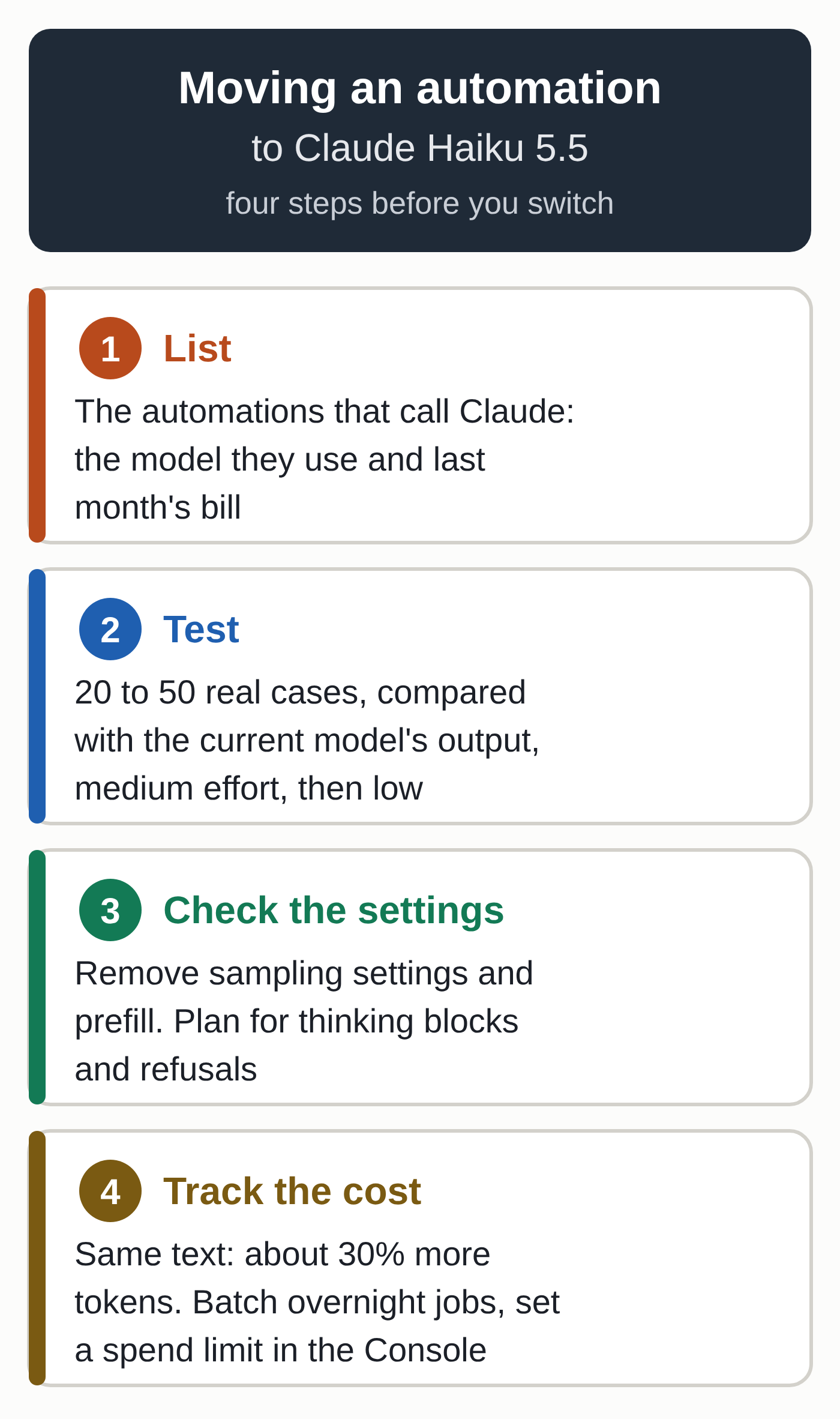
- List every automation that calls Claude, along with the model it uses and last month’s bill. Simple tasks running on Sonnet or Opus are the first candidates for Haiku 5.5.
- Test Haiku 5.5 on 20 to 50 real examples before you switch, and compare the results with your current model’s output. Start at the default effort setting (medium), then try low effort on sorting tasks.
- Check the settings your tool sends. On Haiku 5.5, remove the sampling parameters (
temperature,top_p,top_k), which can trigger an error, and response prefill, which will trigger one. Your tool should also expect responses that start with a thinking block. Without these changes, an automation built for Haiku 4.5 can fail. - On Max or Team, claim the credit: in Claude.ai, open Settings, then Billing (Organization settings for Team), go to the API credits section and select “Link organization.” Choose your Console organization carefully, because you cannot change it yourself later. The credit becomes available once you have been on the plan for seven days.
- If several people use the same organization, set per-workspace spend limits in the Console. Rework your budget to account for the 30% extra tokens, and run overnight jobs (invoices, reports) through the Batch API.
The limits to keep in mind
VentureBeat notes that Haiku 5.5’s score of about 39% on Terminal-Bench, which tests command-line work, comes at maximum effort and drops to about 20% at the default setting. Anthropic itself considers Sonnet 5.5 and Opus 5.5 better suited to complex agentic coding tasks, and positions Haiku 5.5 for more narrowly scoped work, such as summaries or subagent tasks.
VentureBeat adds that token prices alone cannot tell you what a task will cost: the number of tokens used, retries and accuracy also go into the calculation.
Haiku 5.5’s safety classifiers can decline a request, and Anthropic’s documentation states that no automatic server-side fallback is available. An automation therefore needs a plan for refusals, for example sending the request back to you to handle by hand.
Two sets of terms apply: Anthropic’s Supplemental Credit Terms for the API credit, and its Commercial Terms for API use. Read them before you subscribe to Max or Team for the credit.
What to watch in the coming weeks
Haiku 4.5 is still active. Anthropic’s model deprecations page says it will not be retired before October 15, 2026, and no retirement notice was listed there on October 10. Anthropic commits to at least 60 days’ notice before it retires a publicly released model. Test Haiku 5.5 now rather than waiting for that notice.
The API credit is rolling out to accounts over a few days. If it is not in your settings yet, Anthropic says the rollout may not have reached you. Also check that your no-code tool already lists claude-haiku-5-5 among its models.
If you would rather hand off your administrative work without building anything yourself, take a look at our AI assistant.