

A manual action is a penalty decided by a human reviewer at Google when pages on a site don’t comply with Google’s spam policies. All or part of the site then drops in the search results, or disappears from them. It shows up in the Manual actions report in Search Console.
As of October 10, 2026, Google’s help page lists 16 types of manual actions. For each one, this guide gives the label, the cause and the expected fix, then a reconsideration request template to copy. The rule is the same for all of them: fix every affected page, document the fixes, and only then request a review.
Manual action or algorithmic drop, the check to run first
A traffic drop isn’t necessarily a manual action. Google’s automated systems, including during spam updates, also demote sites, and those drops don’t appear in the Manual actions report, which only lists issues detected manually. A drop can also come from pages that fell out of the index: our guide to Search Console indexing statuses explains each reason.
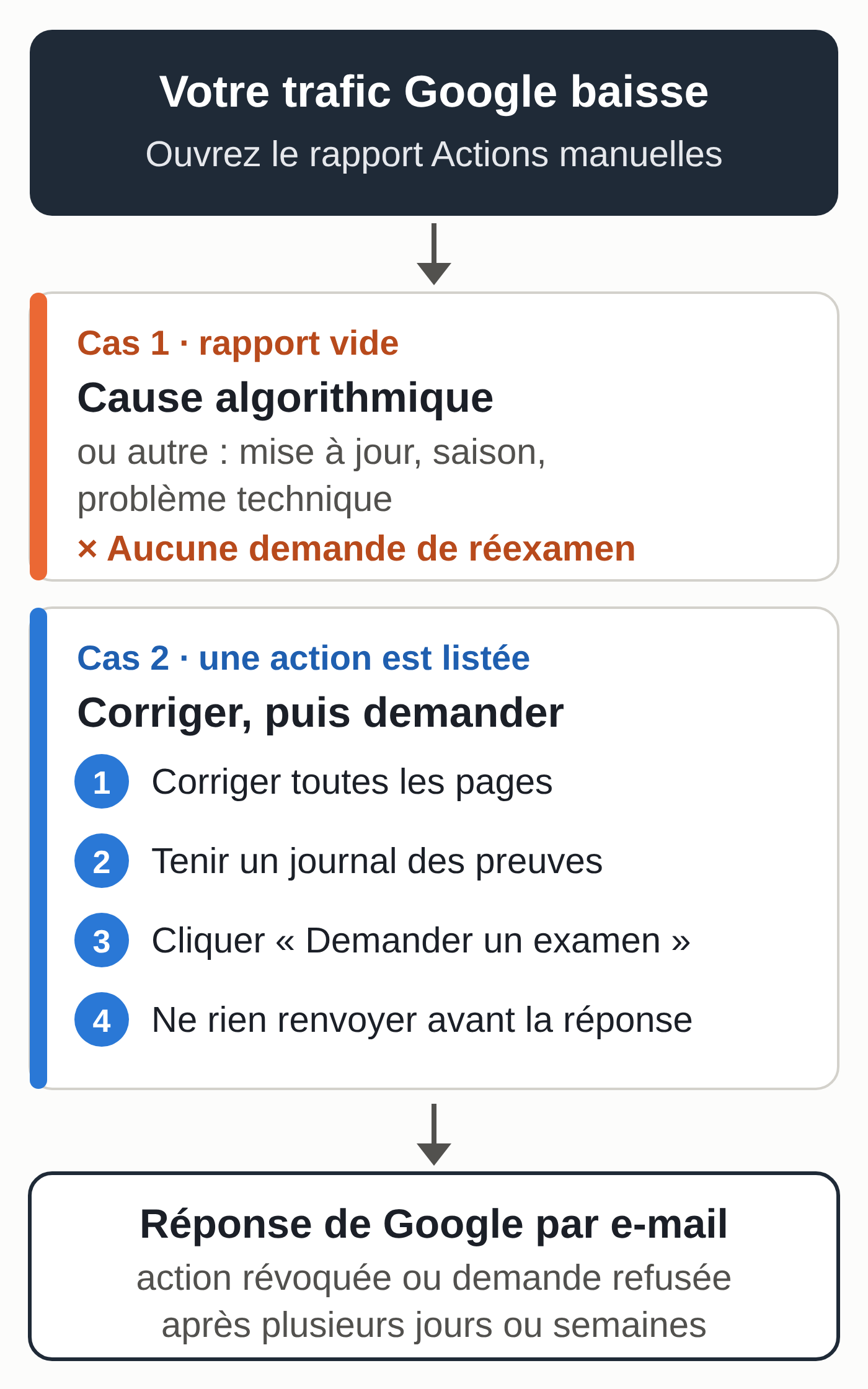
Open the Manual actions report for your site’s property. At the top, Google shows the number of active actions. If there are none, a green check mark and a message confirm it. A manual action is also flagged in the Search Console message center, and usually by email.
If the report is empty, there’s nothing to request: a reconsideration request only applies after a manual action or a security issue flagged by Google. An algorithmic drop is fixed on the site, and the effect shows up over time. Google says its automated systems may need several months of observation before they find that a site complies with its policies again. Our article on the September 2026 Google spam update explains how to date a drop and compare it with the good weeks.
The neighboring report, “Security issues”, deals with something else: hacking, phishing, malware. Those pages may show up with a warning in the results. A manual action usually demotes or removes pages, with no visible sign for the searcher.
The scope of the action, the affected pages and the history
Expand the description of the action. Google lists URL patterns there. For example, https://example.com/real-estate/* refers to all or some of the pages in that directory, and the note “Affects all pages” targets the whole site. Not every page that matches a pattern is necessarily affected.
Each action shows a type, a short description and a “Learn more” link to Google’s help center. If several actions are listed, you have to fix all of them before requesting a review. The report also keeps the history of past actions.
Two special cases. If you just bought the site, Google has a provision for that. Fix what violated the policies before you arrived, then state in the request that you acquired the site recently and that it now complies with the policies.
If the action follows a spam report, Google’s page on reporting spam, in its April 2026 version, says a report can lead to a manual action. To comply with regulations, Google then forwards the text of the report to the site owner, so they understand the context of the action.
Google’s 16 manual actions as of October 10, 2026
The table lists each type in the order of Google’s help page. The right-hand column sums up the fix Google describes for that type. The details of each fix and the matching letter template are further down.
| Label (Google’s help page) | Cause | Expected fix |
|---|---|---|
| Back button hijacking | A script prevents visitors from returning to the previous page with the Back button. | Disable or remove the code responsible, including in a library or an ad script. |
| Site abused with third-party spam | A large part of the site is overrun with spam left by visitors or third parties: forums, guestbooks, file uploads, internal search. | Delete the spam, filter unwanted terms, close the security holes. Only the pages concerned are affected. |
| User-generated spam | Spam posts or profiles published by visitors, often on a forum, a guestbook or in profiles. | Delete this content and put measures in place against this spam. |
| Spammy free host | A significant share of the sites on a free hosting service contain spam. | Delete the spam accounts and alert the host’s technical team. |
| Structured data issue | Markup that goes against the guidelines: hidden content marked up, irrelevant or misleading markup. | Bring the markup into compliance, or remove it. |
| Unnatural links to your site | Inbound links that were bought or come from link schemes. | Get these links removed or switched to nofollow, then disavow the ones that remain. |
| Unnatural links from your site | Paid outbound links or excessive link exchanges on your site. | Remove these links or stop them from passing PageRank (rel=”nofollow” or a more specific attribute). |
| Thin content with little or no added value | Affiliate pages with no added value, content copied from other sites, doorway pages. | Delete or improve these pages so they give the reader real value. |
| Cloaking and/or sneaky redirects | Google and the searcher don’t see the same page, or the searcher is redirected elsewhere. | Remove the code responsible: server, JavaScript, .htaccess file, plugin. |
| Major spam problems | Aggressive spam techniques: scaled content, cloaking, repeated or blatant violations. | Bring the whole site back into compliance with the spam policies. |
| Cloaked images | The images shown to Google differ from those on the site, or are obscured. | Serve exactly the same images to Google and to visitors. |
| Hidden text and/or keyword stuffing | Text invisible to the searcher, or keywords repeated without context. | Delete this text or make it visible, and clean up title tags and alt text. |
| AMP content mismatch | The AMP page and its canonical page don’t have the same content. | Align the two versions and check the canonical. In the meantime, Google shows the canonical page. |
| Sneaky mobile redirects | Mobile visitors are redirected to other content, often by an ad script or after a hack. | Check for a hack, remove third-party scripts one at a time, test on mobile. |
| News and Discover policy violations | A violation of the Google News or Discover content policies, in 16 subtypes (transparency, misleading content, impersonation, etc.). | Fix or remove the content, and prove a change in editorial practices. |
| Site reputation abuse | Third-party content published mainly to take advantage of the host site’s reputation. | Delete it, set it to noindex, move it to a new domain or turn it into first-party content. No effect on results shown in the EEA. |
Checked on October 10, 2026, on Google’s “Manual actions report” help page, in French and in English.
Method: the labels are those of Google’s help page, which the “Learn more” link of each action points to. We haven’t seen these labels in the interface of a penalized site, and Search Console may word them slightly differently. The list rarely changes, but it changed twice in 2026. We reread Google’s page with every announced spam update, and the date above changes with each review.
Two changes from 2026 and an old label
On October 8, 2026, Barry Schwartz of Search Engine Roundtable relayed comments from consultants Marie Haynes and Daniel Foley Carter, who say they’ve been seeing more manual actions in recent weeks. Google hasn’t confirmed any increase. We summarized these reports in our article on fake authors and unreviewed AI content.
Two changes in Google’s documentation in 2026 matter for Belgian and French sites. A third point concerns an old label.
Back button hijacking, penalized since June 15, 2026
Google announced on April 13, 2026 that back button hijacking had become an explicit violation, in the malicious practices category. Penalties have applied since June 15, 2026, as manual actions or automatic demotions.
Google notes that this behavior sometimes comes from a library included in the site or from an advertising platform. It asks site owners to check their implementation and remove any code responsible, including a vendor’s.
Site reputation abuse, penalized outside the EEA only
On August 28, 2026, after discussions with the European Commission, Google announced a change for manual actions related to site reputation abuse. Since August 30, 2026, an action of this type no longer has any effect on the results shown to users in the European Economic Area (EEA). The affected part of the site may, over time, be ranked separately from the rest of the domain.
Outside the EEA, the action applies as before. A penalized page therefore stays affected in the results shown in Switzerland, Canada or Morocco, countries where many French-speaking readers live. For results shown in the EEA, Google says it is lifting previously issued actions of this type.
For EEA sites that dispute the measure, Google says it has set up a new reconsideration process, with a commitment to respond within a short time frame (Google has published no figure), and to explain the reasons for the measure in more detail. After a reconsideration request, eligible sites can turn to mediation.
The “pure spam” of older guides
The phrase “Pure spam” is still in circulation: Marie Haynes uses it in the comments relayed by Search Engine Roundtable on October 8, 2026, and the section anchor on Google’s page is still #pure-spam. The help page shows “Major spam problems” (already in January 2025, according to the page’s archives), and its description explicitly cites scaled content abuse.
The common method before any request
Google’s general steps apply to every type. Follow them in order.
- Expand each action and write down its label, its description and the URL patterns listed.
- Draw up the full list of affected pages. The Performance report, your sitemap and a
site:your-domainsearch followed by words unrelated to your topic (“casino”, “streaming”, “viagra”) help you track down spam left by third parties. - Fix every page. Google warns that a partial fix won’t bring part of the site back into the results.
- Check that Google can read the pages you keep: no required login, no paywall, no robots.txt block and no noindex tag on those pages. The Search Console URL Inspection tool checks this page by page.
- Keep a log of the fixes in a spreadsheet: the URL, the issue found, the action taken, the date and the proof (link, screenshot, email sent). You’ll write the request from this log.
- When everything is fixed, click “Request review” in the Manual actions report.
For unnatural links to your site, the disavow file has its own rules: a .txt text file, encoded in UTF-8 or 7-bit ASCII, with one URL or domain per line (prefix domain: for a whole domain), 100,000 lines and 2 MB at most. The tool doesn’t work with Search Console domain properties, and a new file replaces the old one. Google asks you to try to get the links removed first: a blanket disavow without that effort can get the request rejected. Our guide to link equity explains why these links weighed on rankings.
The reconsideration request, its three elements and its timeline
Google expects three things from a reconsideration request: a precise explanation of the quality issue, a description of the steps taken, and the documented results. A request that acknowledges the problem, puts a number on what was removed and explains how a repeat is prevented covers these three points.
Most reconsideration reviews take several days or even several weeks, according to Google, and longer for link-related requests. A first email confirms receipt, a second announces the decision. Don’t send a new request before you get an answer to the previous one.
Several causes of failure stand out in Google’s documentation: a partial fix, fixed pages that Google can’t read, disavowing every link without trying to get them removed. For site reputation abuse, moving third-party content to a subdomain or a subdirectory can be seen as an attempt to get around the policy.
Reconsideration request templates, one per type of action
Each template follows the three points Google asks for. Replace everything in square brackets, delete the sentences that don’t apply, and write nothing you can’t prove. The notes in parentheses inside the brackets, such as (date) or (number), also need replacing. The link to your fix log must be readable without logging in.
A well-written letter only has value if the site is really fixed, because the reviewer judges the state of the pages.
Back button hijacking
For a site where a script (your own, a recommendation widget’s or an ad network’s) manipulated the browser history.
Hello,

On [date], the property [https://www.example.com/] received a "Back button hijacking" manual action targeting [the affected pages or URL patterns].

The issue: [name of the script or service, for example recommendation widget X or ad network Y's tag] added entries to the browser history. A visitor who clicked Back landed on [a recommendations page / an ad] instead of returning to the previous page.

The fixes: we removed [the script / the import / the setting] on [date] across all pages. We checked [number] sample pages, on desktop and on mobile: the Back button now returns to the previous page.

To prevent a repeat: every new third-party script is now tested on this point before going live, and we asked [vendor] to confirm in writing that its code doesn't modify the history.

The details of the pages and tests are in this read-only spreadsheet: [link].

Thank you for your review.
[First Last], [title], [company]
Site abused with third-party spam
For a site whose open areas (forum, guestbook, file uploads, internal search) were overrun with spam.
Hello,

On [date], the property [https://www.example.com/] received a "Site abused with third-party spam" manual action for the pages [URL patterns].

The issue: third parties published spam in [our forum / our internal search pages / our upload tool], unrelated to our [business] activity.

The fixes:
- [number] spam pages and [number] spam accounts deleted between [date] and [date];
- internal search results pages are now set to noindex;
- a list of banned terms blocks the publication of content related to casinos, streaming, medication and adult content;
- [the security hole / the form] used by the spammers was [fixed / removed] on [date].

A site:[domain] search on these terms no longer returns any spam page as of [date].

To prevent a repeat: [pre-moderation / captcha / approval of new accounts], and a weekly check of new pages.

List of deleted URLs: [link].

Thank you for your review.
[First Last], [title], [company]
User-generated spam
For a forum, comments or profiles where visitors published promotional posts or off-topic links.
Hello,

On [date], the property [https://www.example.com/] received a "User-generated spam" manual action.

The issue: automatically created accounts were publishing promotional posts and off-topic links in [the comments / the forum / public profiles], with commercial usernames.

The fixes: we deleted [number] posts and [number] profiles. Links left by visitors now carry the rel="ugc" attribute. Inactive profiles are no longer indexed.

To prevent a repeat: [email verification of accounts / moderation of the first post / captcha] since [date], and a named person reviews new content every [day / week].

List of deleted content: [link].

Thank you for your review.
[First Last], [title], [company]
Spammy free host
For a free hosting service where a significant share of the hosted sites contain spam.
Hello,

On [date], our service [name], hosted at [https://www.example.net/], received a "Spammy free host" manual action.

The issue: many free accounts were being used to publish spam sites.

The fixes: we closed [number] spam accounts out of [number] active accounts. Our technical team was informed of the action on [date]. Sign-ups now require [email address verification / a check of the first content published].

To prevent a repeat: an automated check flags new sites that publish terms related to casinos, medication or adult content, and a named team handles reports within [time frame].

List of closed accounts and the checking procedure: [link].

Thank you for your review.
[First Last], [title], [company]
Structured data issue
For markup that describes content missing from the page: fake reviews, a recipe or a job posting that isn’t one, hidden content marked up.
Hello,

On [date], the property [https://www.example.com/] received a "Structured data issue" manual action, specified as "[issue title if the report shows it, for example: Review written by the site or the person providing the service]".

The issue: our [type of markup, for example Review or JobPosting] markup described [reviews written by our team / expired job postings / content not visible on the page].

The fixes: we [removed / corrected] this markup on [number] pages on [date]. Every remaining tag describes content visible on the page. We checked [number] sample pages with the URL Inspection tool.

To prevent a repeat: the [name] template no longer generates this markup automatically, and every new tag is reviewed by [role] before going live.

List of pages with the markup before and after: [link].

Thank you for your review.
[First Last], [title], [company]
Unnatural links to your site
For inbound links that were bought, exchanged or created by a former vendor.
Hello,

On [date], the property [https://www.example.com/] received an "Unnatural links to your site" manual action.

The issue: between [year] and [year], [we / a former SEO vendor] obtained paid or exchanged links on [number] domains, including sponsored articles without a rel="sponsored" or nofollow attribute and low-quality directories.

The fixes:
- we exported the links from Search Console and analyzed [number] domains;
- we wrote to the owners of [number] domains between [date] and [date];
- [number] links were removed or switched to nofollow;
- [number] domains didn't respond or refused: they are in the disavow file uploaded on [date], with the domain: prefix;
- links earned naturally were not disavowed.

To prevent a repeat: we no longer buy links, and every paid partnership carries the rel="sponsored" attribute.

Spreadsheet of the domains, emails sent and replies: [link].

Thank you for your review.
[First Last], [title], [company]
Unnatural links from your site
For outbound links that were sold, exchanged in bulk or placed in sponsored content without an attribute.
Hello,

On [date], the property [https://www.example.com/] received an "Unnatural links from your site" manual action.

The issue: we published [number] sponsored articles and [link exchanges / sold links] whose links passed PageRank.

The fixes: on [number] pages, we [removed these links / added the rel="sponsored" attribute] on [date]. Examples of fixed pages: [URL 1], [URL 2], [URL 3].

To prevent a repeat: all paid content is now labeled as such for readers, and its links carry rel="sponsored". We have stopped link exchanges.

Full list of the pages and links changed: [link].

Thank you for your review.
[First Last], [title], [company]
Thin content with little or no added value
For affiliate pages with no added value, content copied from elsewhere, or doorway pages created for keyword variants.
Hello,

On [date], the property [https://www.example.com/] received a "Thin content with little or no added value" manual action for [URL patterns].

The issue: [number] pages [copied our partners' product listings / contained only affiliate links / each targeted a city without any content of their own].

The fixes:
- [number] pages deleted (404 or 410 response);
- [number] pages merged and redirected to a more complete page;
- [number] pages rewritten with [product tests carried out by our team / original photos / prices and terms checked on (date)].

Examples of content removed: [URL]. Examples of content added: [URL].

To prevent a repeat: no page is published without [a specific criterion, for example a test or first-hand information], and [role] reviews every page before publication.

Page-by-page inventory: [link].

Thank you for your review.
[First Last], [title], [company]
Cloaking and/or sneaky redirects
For a site that shows Google a different page from the one the searcher sees, or that redirects depending on where the visitor comes from.
Hello,

On [date], the property [https://www.example.com/] received a "Cloaking and/or sneaky redirects" manual action.

The issue: [a rule in the .htaccess file / a JavaScript script / plugin X] redirected visitors coming from Google Search to [destination], while Googlebot saw the original page. [This rule was added during a hack on (date) / by a former vendor.]

The fixes: the rule was deleted on [date]. For [number] pages, we compared the version fetched by the URL Inspection tool with the page a visitor sees: they are identical. No redirect depends on the referrer or the IP address anymore.

To prevent a repeat: [passwords changed / unused plugins deleted / file change monitoring].

List of pages checked: [link].

Thank you for your review.
[First Last], [title], [company]
Major spam problems
For a site penalized in whole or in part for aggressive spam techniques: content produced at scale, cloaking or repeated violations. The request must describe the overhaul of every affected page.
Hello,

On [date], the property [https://www.example.com/] received a "Major spam problems" manual action targeting [all pages / the URL patterns].

The issue: between [date] and [date], we published [number] pages produced [automatically / from feeds or pages on other sites], with no added value for the reader. [If you just bought the site: we acquired this domain on (date); these pages date from the previous owner.]

The fixes:
- [number] pages deleted out of [number], or [percentage]% of the site;
- the remaining [number] pages were reviewed and expanded by [name or role];
- the system that produced these pages was shut down on [date].

Examples of content removed: [URL]. Examples of content kept and improved: [URL].

To prevent a repeat: every new page is written or reviewed by a person identified on the site, and we publish at [a realistic pace].

Full inventory: [link].

Thank you for your review.
[First Last], [title], [company]
Cloaked images
For images served differently to Google and to visitors, or hidden by another element.
Hello,

On [date], the property [https://www.example.com/] received a "Cloaked images" manual action.

The issue: [our server / our image protection plugin] served Google images different from the ones displayed on our pages [or: images covered by a text banner].

The fixes: since [date], Google and visitors receive exactly the same image files. [If you don't want the full-size image to appear in the results: we now use the inline linking opt-out Google describes, with an empty response to requests coming from a Google domain.]

Pages checked: [number], list here: [link].

Thank you for your review.
[First Last], [title], [company]
Hidden text and/or keyword stuffing
For invisible text (same color as the background, hidden with CSS) or lists of repeated keywords.
Hello,

On [date], the property [https://www.example.com/] received a "Hidden text and/or keyword stuffing" manual action.

The issue: [number] pages contained [a block of text hidden with CSS / lists of cities or keywords at the bottom of the page / title tags and alt text stuffed with repeated keywords].

The fixes: we deleted these blocks on [date] and rewrote [number] title tags and [number] alt texts. We checked each page by selecting all the text on the page and with the URL Inspection tool.

To prevent a repeat: [the template that generated these blocks was changed / plugin X was uninstalled].

List of fixed pages: [link].

Thank you for your review.
[First Last], [title], [company]
AMP content mismatch
For AMP pages whose content differs from their canonical page.
Hello,

On [date], the property [https://www.example.com/] received an "AMP content mismatch" manual action.

The issue: our AMP pages [only displayed a summary / pointed to the wrong canonical page / had resources blocked by robots.txt].

The fixes: since [date], each AMP page points to the right canonical page and offers the same content, with the same options for the reader. [Or: we deleted our AMP pages and redirected their URLs to the canonical pages.] We checked [number] page pairs with the URL Inspection tool.

List of page pairs checked: [link].

Thank you for your review.
[First Last], [title], [company]
Sneaky mobile redirects
For smartphone visitors redirected to another site, often by an ad script or code added during a hack.
Hello,

On [date], the property [https://www.example.com/] received a "Sneaky mobile redirects" manual action.

The issue: on mobile only, [ad network X's script / code added during a hack on (date)] redirected some visitors to [type of destination]. We hadn't detected it, because our tests were run on desktop.

The fixes: we checked the "Security issues" report (no issue reported as of [date]), then removed third-party scripts one at a time while testing on a smartphone. The script responsible was deleted on [date]. We then visited [number] pages from Google results, on a smartphone: no redirect.

To prevent a repeat: every ad script is tested on mobile before going live, and an alert monitors mobile visit duration in our analytics.

List of pages tested and scripts removed: [link].

Thank you for your review.
[First Last], [title], [company]
News and Discover policy violations
For a publisher penalized under one of the 16 subtypes (transparency, misleading content, impersonation, medical content, etc.). Here, Google asks for proof of a change in editorial practices.
Hello,

On [date], the property [https://www.example.com/] received a "News and Discover policy violations" manual action, subtype "[title if the report shows it, for example: Transparency]".

The issue: [for Transparency: our articles had neither a date nor an identified author, and the site presented neither the publisher nor a contact address] [for another subtype: describe the content in question precisely].

The fixes:
- [number] pieces of content [fixed / removed] on [date];
- every article now carries a publication date and an update date, and the name of its author, with an author page;
- an "About us" page presents the publisher, [the company], its address and a named contact person.

Our editorial practices have changed: editorial policy published on [date] ([link]), editorial board made up of [names and roles], review of every article before publication since [date].

Thank you for your review.
[First Last], [title], [company]
Site reputation abuse
For a site that hosts partner content (promo codes, comparisons, affiliate articles) published mainly to take advantage of its rankings. The action only affects results shown outside the EEA.
Hello,

On [date], the property [https://www.example.com/] received a "Site reputation abuse" manual action for [URL pattern, for example https://www.example.com/promo-codes/*].

The issue: this section was produced by [partner], without any editorial control on our part, and it wasn't integrated with the rest of the site.

The fixes, as of [date]:
- [number] pages [deleted / set to noindex, without a robots.txt block so the tag can be read];
- [or: the content was moved to the new domain (domain), without redirects from our URLs; links to this domain carry the nofollow attribute];
- [or: the (number) pages kept were rewritten by our editorial team, signed and integrated into our sections].

We did not move this content to a subdomain or a subdirectory of our site.

To prevent a repeat: all partner content is now [reviewed, signed and published by our editorial team / excluded from the index].

List of URLs and the treatment applied: [link].

Thank you for your review.
[First Last], [title], [company]
After Google’s answer, revocation or rejection
If Google considers that the site no longer violates its policies, the manual action is revoked and you’re notified in Search Console. Traffic doesn’t necessarily return to its previous level. Writing about its link spam updates, Google says that the ranking benefit from spam links is lost and can’t be recovered. It’s prudent to apply the same reasoning after an action for unnatural links.
A rejection means Google considers that the site still violates its policies. Reread the reply message, redo the inventory from the start, then send a complete request again. On October 8, 2026, Barry Schwartz of Search Engine Roundtable cited a thread on Google’s help forum where a site owner says they were turned down three times despite cleaning up more than 6,000 URLs, and is looking for what’s left to fix. Google asks that every affected page be fixed, however much has already been cleaned up.
Be wary of offers that guarantee a “penalty recovery” within a few days. Google alone decides, and its reconsideration timeline runs to days or weeks. It’s one of the warning signs described in our article on how to recognize a bad SEO agency.
The checklist to run before every spam update
Google announces its spam updates on its Search Status Dashboard. These checks reduce the risk of a manual action as well as an algorithmic drop.
- Open the Manual actions report once a month, and check who receives Search Console messages. If only a former vendor still has access to the property, those messages never reach you. For Bing, the equivalent console is Bing Webmaster Tools.
- Moderate the areas open to the public (comments, forum, profiles, internal search), block a list of unwanted terms and add rel=”ugc” to links left by visitors.
- Mark paid or sponsored outbound links with rel=”sponsored” or rel=”nofollow”.
- Monitor the Links report in Search Console, and turn down any offer of links bought in bulk.
- After adding any third-party script (ads, recommendation widget, pop-up), test the Back button and navigation on a smartphone.
- Check that every piece of structured data describes content visible on the page: reviews, recipes, job postings, events.
- Review pages produced in bulk or machine-translated. A page that gives the reader nothing is taken out of the index (our guide to indexing explains how) or deleted. Pages created for every variant of a question in order to appear in Google’s AI Overviews fall into the same category.
- For partner content published on your domain, there are two options: your team integrates, signs and reviews it, or it is excluded from the index.
- Before buying an expired domain, check its history: Google’s policies prohibit buying and reusing an expired domain with the main purpose of manipulating rankings.
A site translated into several languages
Among the examples of scaled content abuse, Google’s policy cites pages mass-produced from other content, including through automated translation, when they offer little value to readers. A translated site must therefore give something to the reader of each language. Our guide to multilingual site SEO details quality control language by language.
If your site exists in several languages and you’d like an outside view of its translated versions, our multilingual SEO service starts with a first review of the indexing and the pages in each language, before the quote.