

A 30-year-old woman from Bonita Springs, Florida, was arrested at home on September 30, 2026, after two messages she allegedly typed into Claude, Anthropic’s AI assistant, according to investigative records cited by Gulf Coast News and Straight Arrow News. Investigators say Anthropic’s automated monitoring flagged the messages and a team of human reviewers at the company then judged them serious enough to alert law enforcement. She has pleaded not guilty and is presumed innocent.
According to Gizmodo, Lee County Sheriff Carmine Marceno told WINK News that she explained to investigators she uses Claude like a “diary.” For any business whose staff type into a chatbot every day, the case raises two practical questions: who can read those conversations, and when does the AI company call the police? Anthropic’s new usage policy takes effect on November 12, 2026, and turning off training on your data doesn’t change any of what follows.
Two messages, a human review, an arrest
The arrest report, as quoted by Gulf Coast News on October 1, attributes a first message to her on September 26 at about 5:10 a.m.: “I’m going to shoot up the sheriff’s right the [expletive] now.” The second, sent September 27 at about 1:07 a.m., calls it a “last chance” and reads: “I got a new [expletive] gun today.” Lee County sheriff’s deputies took her into custody without incident.
According to court records reviewed by Straight Arrow News, Anthropic’s team passed the report to the FBI, which notified the sheriff’s office. The outlet reports that she admitted writing the messages but denied any intent to act on them or owning a gun, and that no weapon was seized. She also told the detective she had used Perplexity, a different service, though the document attributes the messages to Anthropic’s AI. Her attorney declined to say which service she used.
Sheriff Marceno issued a public warning, quoted by Gulf Coast News: “Users need to understand that you are never truly anonymous.” No comment from Anthropic on the case was on record as of October 5, according to Tom’s Hardware, and the company did not immediately respond to requests for comment from Gizmodo or Straight Arrow News.
Straight Arrow News counts at least three cases in the U.S. since August in which messages typed into an Anthropic chatbot ended up in police hands. In San Antonio, Texas, a 22-year-old man was arrested on August 29 on a terroristic threat charge, local station KSAT reports. His arrest warrant accuses him of sending Anthropic’s AI “multiple queries” threatening to kill children at an elementary school, which investigators date to August 11.
A case legal scholars call shaky
Court records checked by Tom’s Hardware list the offense booked at her September 30 arrest under Florida Statute 836.10, in its section on written or electronic threats of a mass shooting or an act of terrorism. The law targets anyone who sends, posts or transmits a writing containing a threat “in any manner in which it may be viewed by another person.” It is a second-degree felony, punishable by up to 15 years in prison and a fine of up to $10,000.
Eugene Volokh, a free-speech scholar at the Hoover Institution, doubts the case will hold up. On his blog, The Volokh Conspiracy, he notes that Florida appeals courts have so far required proof that the writer meant to threaten or knew the message would be seen as a threat. In his view, most people typing into a chatbot assume they are talking only to the machine. John Coleman, legislative counsel at the Foundation for Individual Rights and Expression, voiced the same doubt to Straight Arrow News.
Her attorney plans to argue that a message typed into a chatbot cannot be a written threat under Florida law, Straight Arrow News reports. As of October 8, the outlet adds, prosecutors had not yet formally charged her. Her arraignment is set for November 2.
Anthropic, OpenAI and Google policies as of October 15
Anthropic’s privacy policy, in effect since September 10, 2026, says the company may share personal data with authorities when it believes in good faith that doing so is reasonably necessary to, among other things, “prevent serious harm to any person or to property.” Its consumer terms go further. In the European version, governed by Irish law and in effect since October 8, 2025, Anthropic reserves the right, “at our sole discretion,” to report information from or about you to law enforcement, including your messages and Claude’s replies.
Anthropic’s help page on government requests, dated March 16, 2026, sets a different bar for those requests: Anthropic responds only to valid legal process (a subpoena or a warrant), except in an emergency that may result in imminent physical harm or death.
At OpenAI, an August 26, 2025, blog post describes how ChatGPT handles this: conversations where a user appears to be planning to harm others go to a small review team that can ban the account. If that team finds an imminent threat of serious physical harm to others, OpenAI may refer the case to law enforcement.
Google’s Gemini Apps privacy hub, updated October 13, 2026, says nothing about reporting users to the police. It notes that human reviewers read some conversations and asks you not to enter confidential information. With activity saving turned off, Google still uses your chats to “help protect Google, our users, and the public,” and conversations that reviewers have read are kept for up to three years, even after you delete your activity.
From automated filter to police report
The first filter is automated: the arrest report, as quoted by Straight Arrow News, describes measures that “monitor for key phrases and potentially threatening content.” In the Florida case, as in the process OpenAI describes, a person then reviews the flagged message, and alerting the authorities is the last step, decided by a human.
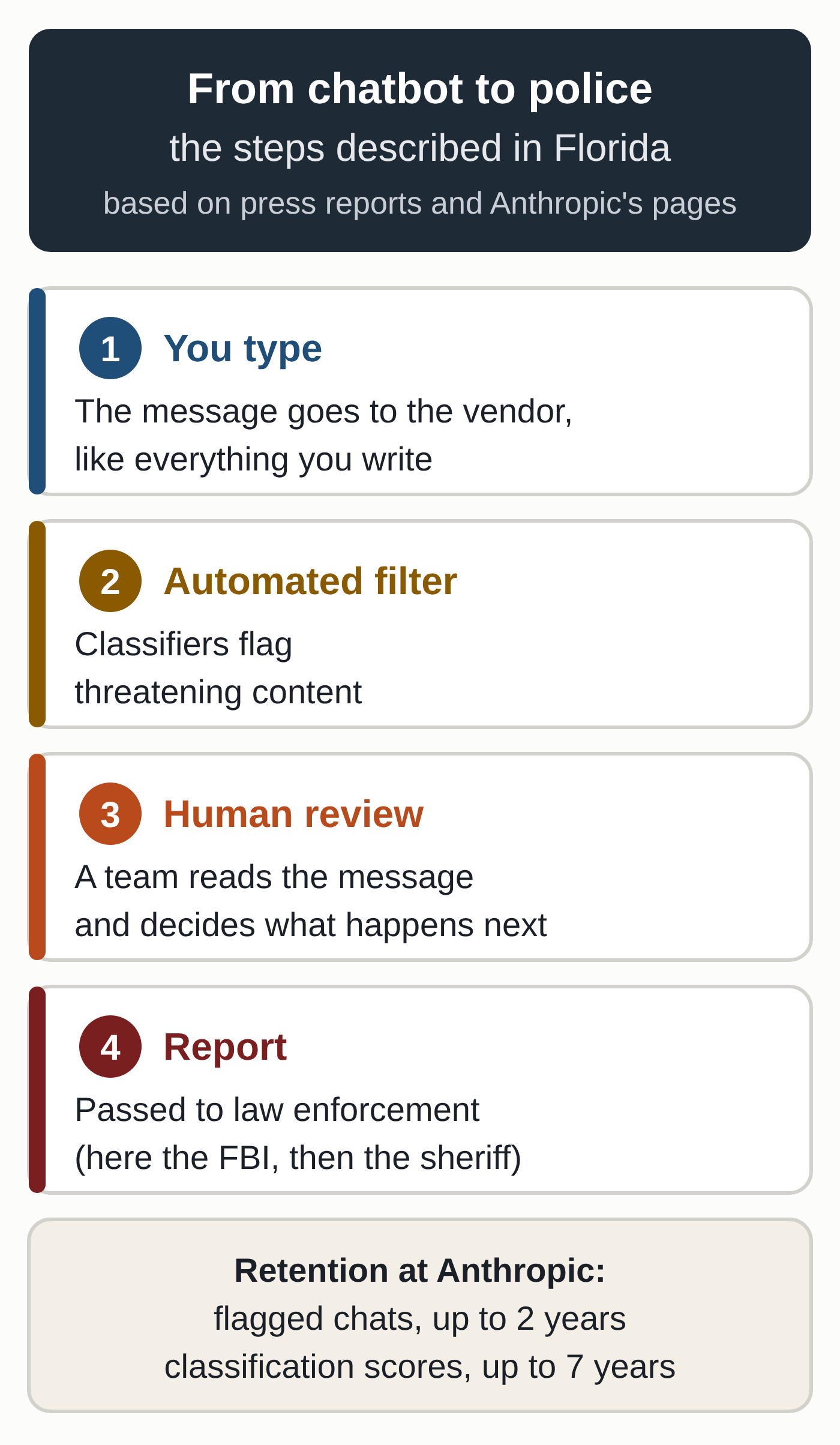
Anthropic’s retention rules follow the same split. A conversation you delete disappears from your history immediately and from Anthropic’s servers within 30 days. A conversation its automated systems flag as violating the usage policy is kept for up to two years, and its classification scores for up to seven years, on consumer and business plans alike.
API inputs and outputs are deleted within 30 days by default, with exceptions such as usage policy enforcement. Zero data retention agreements, which some API and Claude Code Enterprise customers can get with Anthropic’s approval, limit message storage to legal requirements and fighting misuse or harm. Anthropic still keeps its safety classifier results. In Europe, the data controller is Anthropic Ireland, and none of the documents we reviewed provides a separate reporting process for European users.
Four rules for your team
- Treat the chatbot like a letter someone else might open: people at the AI company sometimes read flagged messages. Angry outbursts and threats, even joking ones, have no place there.
- Require business accounts. A personal account, free or paid (Free, Pro, Max), falls under the consumer terms; a Claude business plan is governed by a contract. Those plans are still bound by Anthropic’s usage policy and its automated filters, and a flagged conversation on them is kept for up to two years.
- Strip names, case numbers and medical or disciplinary details from client and HR files before pasting them. If you’re a lawyer, doctor or accountant, your confidentiality obligations also cover anything you paste into a chatbot.
- Write the rules into your AI use policy: approved tools, off-limits data, human review of output. Spell out that the AI company may read some conversations and hand them to the authorities in the cases its terms set out.
How many reports, and at what threshold
According to Straight Arrow News, there are no public numbers on how many reports AI companies make on their own initiative, and the Lee County Sheriff’s Office says it does not keep a count of tips from Anthropic. Tom’s Hardware notes that Anthropic’s report on government requests for the second half of 2025 lists zero emergency requests from law enforcement, but that report does not cover referrals the company makes on its own.
The threshold is murky too: the privacy policy says “serious harm,” the terms say “sole discretion,” and nothing indicates which one applied in the Florida case. Two other things are still open: which platform was actually involved, and the core legal issue, which her attorney plans to raise. Her arraignment is set for November 2.
If you want to hand off your admin work to an AI assistant and choose which tools it can access, our AI assistant is configured for each person and connected to the tools you already use.