Six researchers at Fudan University in Shanghai posted a study to arXiv on October 8, 2026, measuring how easily a post on a platform open to anyone finds its way into AI search engines’ answers. They invented a concept, the “Cactus Gravity Protocol,” and described it in articles placed on sites these engines cite often. Within seven days, eight of the 10 platforms they tested had cited it, including ChatGPT, Perplexity, Grok and Google’s AI.
The study also describes buying a GEO package (generative engine optimization, the practice of optimizing for AI engines) for $14, about €12 at the October 20 exchange rate. Thirteen posts went live in 28 minutes, and an hour later the Chinese assistant Doubao cited one of them. The paper carries the header of NDSS 2027, a computer security symposium scheduled for Seoul in March 2027. Search Engine Journal covered it on October 19, and the German magazine Dr. Web followed on October 20.
Ten engines and 17,211 citations under the microscope
In March 2026, the team put the same set of questions to 10 platforms: four aimed at the English-language web (ChatGPT, Perplexity, Grok and what the study calls “Google AI”) and six aimed at the Chinese-language web, including Doubao, DeepSeek, Kimi and Qwen. It logged 17,211 citations spread across 6,356 domains.
Citations cluster on a small number of sites. Depending on the platform, the 20 most-cited domains account for between 20.5% and 70.8% of the total. Reddit comes first on Google AI and Grok, YouTube on Perplexity, and Wikipedia on ChatGPT. Among each engine’s 10 most-cited domains, between six and 10 accept posts from ordinary users (8.2 on average).
In April 2026, the team tried to create accounts and publish on 22 platforms tied to heavily cited domains. Fifteen had low or medium barriers to signing up and posting. Medium, GitHub, LinkedIn and Facebook were among the easiest to get into.
The made-up concept test
For each engine, the researchers picked the most-cited platform that a new account could still post to, which gave them nine platforms, including Medium, YouTube, Zhihu and Sohu. They published 27 articles there on three topics: the made-up concept, an opinion question (will AI replace junior developers within five years?) and a fictional ergonomic keyboard. The articles were drafted with ChatGPT, edited by hand and built on a template: short paragraphs, subheadings, a Q&A section and statistics.
Each article carried markers (invented names and figures, such as a fictional institute or a 94.7% reduction) so the team could tell when an answer drew on its posts. Before publishing, the authors checked that no engine knew anything about the concept or the keyboard, and that no answer contained the markers.
Once the first citation appeared, Grok linked to the researchers’ posts in 30 of 32 answers, Google AI in 15 of 33, Perplexity in 13 of 35 and ChatGPT in 7 of 20. The markers also made it into the text of the answers: 53% of the time on Grok, 66% on Doubao, 10% on ChatGPT and 6% on Google AI. They never showed up on Perplexity.
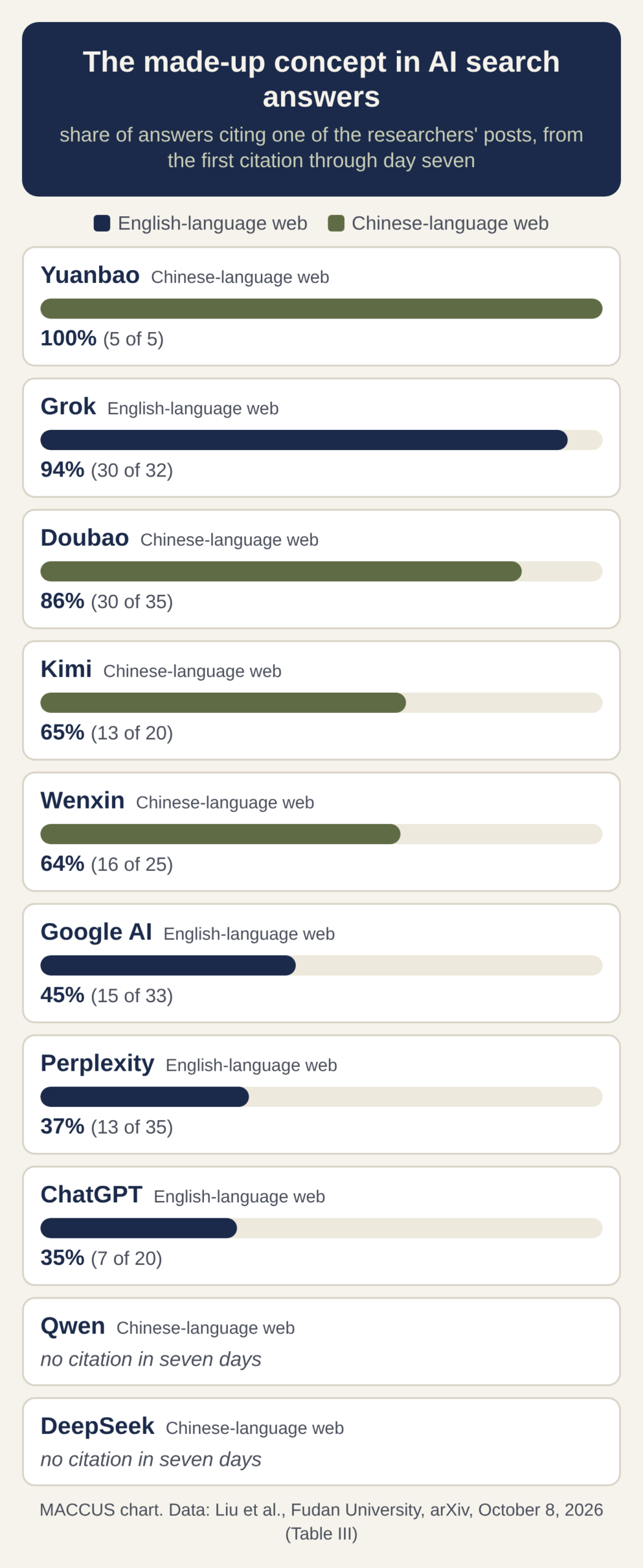
On the opinion question, already heavily debated online, the articles were cited in only 18.8% of the answers that followed the first citation. The keyboard articles reached 36.4% on the same measure, but the keyboard’s invented specs turned up in just 4.7% of those answers.
Across the three topics and seven days, 176 of 1,004 answers cited one of the articles. A replication on 10 more invented topics produced at least one citation or marker for nine of them.
In these tests, placement mattered more than volume
Another test compared five pairs of articles about little-known places, matched for structure and length. In each pair, one went up on a platform the engines cite heavily and the other on a platform they rarely cite or had no history with. The first signal always came from the heavily cited platform. On the rarely cited side, the best case became visible only after 20 posts, and a self-hosted WordPress site got no citations in a week despite 40 articles.
Volume also played a part, though less clearly. Six invented topics, published on Sohu in batches of 1 to 20 articles, produced between 24 and 128 citations across all engines. ChatGPT cited none of them. Because each volume level used a different topic, the authors treat the result only as an association between article count and citations.
Deleting the articles reduced citations without removing all of them. The researchers took their posts down after 11 days of measurement, and Doubao kept citing the made-up concept for the next four days.
A $14 GEO package
Between January 2025 and March 2026, the team surveyed 13 GEO providers or similar services, five in the English-language market and eight in the Chinese market. The English-language providers list entry prices from $29 to $2,500 a month (about €26 to €2,230). They emphasize tracking AI answers and producing content, a market covered in our comparison of AI visibility tools. Coordinated posting across several platforms shows up only among Chinese providers.
The researchers then contacted a provider through its public channels and bought visibility for a made-up imaging technique full of invented acronyms. It offered a self-service plan for $70, a managed plan for $140 a year (about €62 and €125) and per-platform posting. The team took the cheapest option, $14 per platform on the Chinese-language web.
Payment went through at 6:16 p.m. local time. By 6:44 p.m., 13 posts were live on Sohu, Toutiao, Yidianzixun, Zhihu and CSDN, from accounts with a history of unrelated commercial posts. At 7:44 p.m., Doubao, ByteDance’s assistant, cited the Sohu article and repeated the invented markers in its answer. The authors present it as a single case that establishes no success rate.
The authors’ own caveats
The measurements date from March and April 2026, and the authors warn that rates and rankings may have shifted since then with engine updates. No real brand was tested, and most topics were invented or had little competition. Contested commercial topics could require different volumes, account histories or engagement patterns.
The study doesn’t say how many posts on a rarely cited platform equal one post on a heavily cited one, or which Google product “Google AI” refers to. Its tests came before Google clarified on May 15, 2026, that its spam policies apply to generative AI responses in Google Search, and before the spam update that started on September 24, 2026.
The researchers say they notified all 10 platforms. Doubao, Qwen, Kimi, ChatGPT, Perplexity and Google AI acknowledged receipt. The countermeasures they suggest (diversifying cited domains, weighing where pages come from, flagging unusually fast citations of new pages) have not been evaluated, by their own admission.
What it means
The study measures a control gap between two systems: publishing platforms decide what can go online, AI search engines decide what gets cited, and no one oversees the whole chain. On a topic with no competition, a handful of well-placed articles was enough to get into answers within a week, although the authors don’t claim they can reliably manipulate any answer they like.
For brands and publishers that want to appear in these answers, the most telling result is the gap between platforms. In the test on little-known places, 40 articles on a self-hosted WordPress site produced nothing in a week, while a single page on a heavily cited platform was enough. Visibility depended on sites whose rules are set neither by the content’s author nor by the AI engine. In the one case tested, in China, that placement cost $14.
Google had set out its position before the study was published, though after the tests ran. Its spam policies cover attempts “to manipulate generative AI responses in Google Search,” and its guide to generative AI features says that seeking inauthentic “mentions” across the web “isn’t as helpful as it might seem.” The engines are changing too. On October 15, Google announced an update that shows links higher up in AI Mode and AI Overviews answers, and Dr. Web notes that ChatGPT has cited Reddit far less often since August.
On Reddit, threads from SEO practitioners over the past few days keep returning to two questions: how to get recommended by ChatGPT, and which GEO agency to pick. In a forum devoted to local SEO, one participant points to best-provider roundups in which the company publishing the roundup ranks itself first.
Three things are worth watching: any public response from OpenAI, Google or Perplexity beyond acknowledging receipt; attempts to repeat these measurements with real brands and contested commercial queries; and the study’s presentation at NDSS in Seoul in March 2027.
Sources
- From Public Posts to AI-Search Citations: Measuring the Fragility of AI Search, Qi Liu, Geng Hong, Xinyang Zhang, Pei Chen, Yutong Li and Min Yang (Fudan University), arXiv, October 8, 2026
- Spam Policies for Google Web Search, Google Search Central, updated August 28, 2026
- Google’s Guide to Optimizing for Generative AI Features on Google Search, Google Search Central, updated July 10, 2026
- Latest Google Search Documentation Updates, Google Search Central, entry of May 15, 2026
- More ways to connect with the web from Search, Hema Budaraju, Google, October 15, 2026
- AI Search Tools Cited A Made-Up Concept Within A Week, Paper Finds, Matt G. Southern, Search Engine Journal, October 19, 2026
- Studie: Acht von zehn KI-Suchmaschinen zitierten binnen einer Woche einen erfundenen Begriff, Markus Seyfferth, Dr. Web, October 20, 2026
Header image: MACCUS chart, data from the study by Liu et al., Fudan University, arXiv, October 8, 2026