

Google completed its September spam update, the fourth of 2026, on 8 October. The rollout took almost two weeks, and consultant Glenn Gabe reported sharp drops across several sectors and countries.
What Google announced, and when
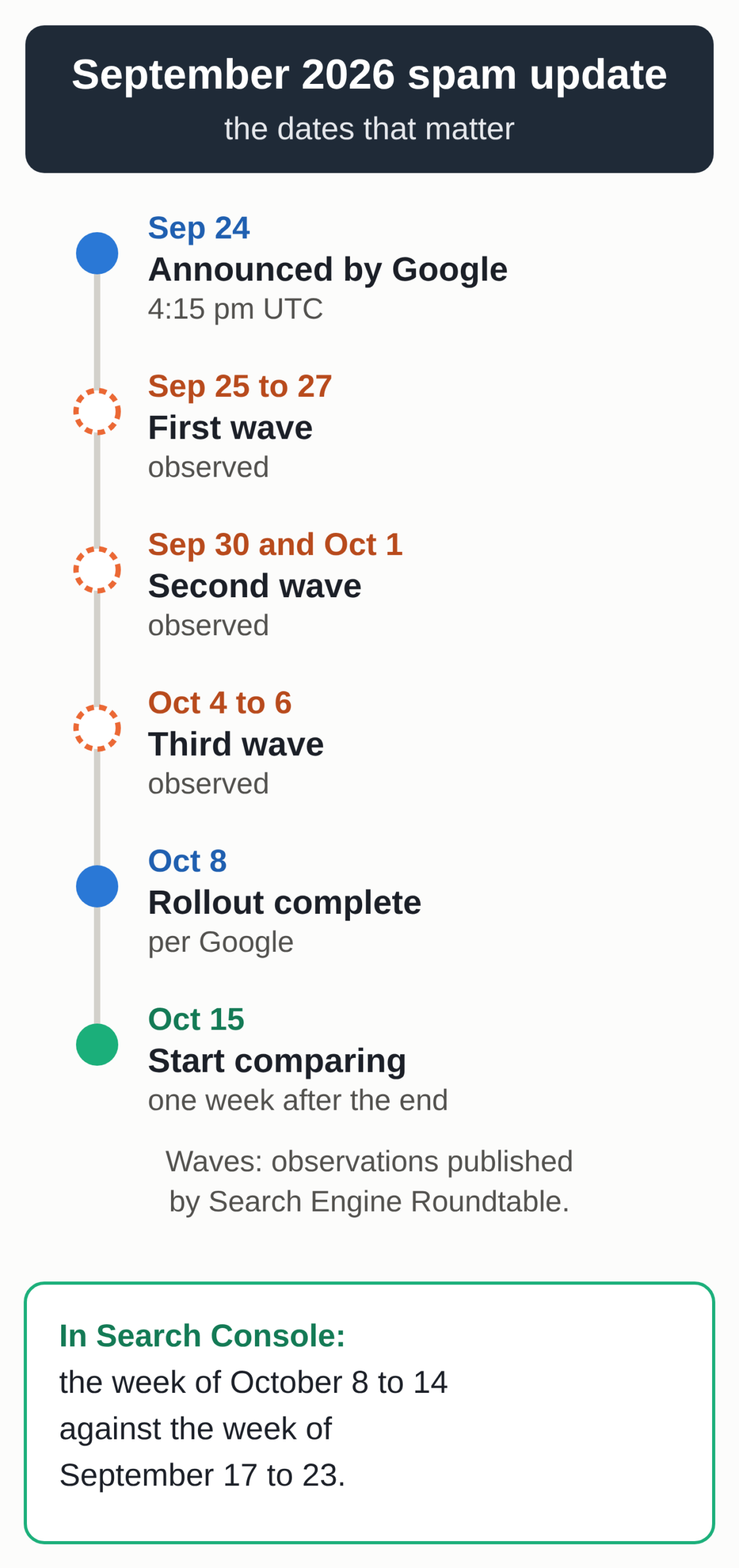
The Google Search Status Dashboard posted the announcement on 24 September 2026 at 16:15 UTC (18:15 in Brussels and Paris). The update “applies globally and to all languages”, and the rollout “may take up to two weeks to complete”.
On 8 October 2026, Google added that the rollout was complete. The dashboard puts the end at 08:00 UTC (10:00 in Brussels) and lists a duration of 13 days and 16 hours.
That is long. The three earlier spam updates of 2026 took 19 hours and 30 minutes in March, 2 days and 1 hour in June, and 2 days and 16 hours in August. Barry Schwartz of Search Engine Roundtable checked with Google’s John Mueller that the two-week estimate was not a typo. Mueller confirmed: “Yes, it’s likely to take longer than some of the previous ones.”
Google did not say which policy or practice this update targeted, as Matt G. Southern pointed out in Search Engine Journal on launch day.
What a spam update targets
Google explains that its automated spam detection systems run all the time. It uses the name “spam update” for a notable improvement to those systems, for example to SpamBrain, its AI-based spam prevention system.
What those systems look for is set out in Google’s spam policies. Six of them matter most for a small business:
| Practice (Google’s name) | What it looks like on a small site |
|---|---|
| Scaled content abuse | Hundreds of pages produced in bulk (a tool, AI, or other sites’ content translated or reworded) that give the reader almost nothing |
| Expired domain abuse | An old domain bought for its history, then filled with unrelated content |
| Site reputation policy | Third-party pages hosted on your site mainly to borrow your rankings |
| Hacked content | Pages or links added without your knowledge after a security breach |
| Cloaking | Different content for Google and for visitors |
| Link spam | Links bought for rankings, swapped in bulk or placed in low-quality directories |
Among its examples of content made at scale, Google lists generative AI used to create many pages without adding value, and content scraped from other sites and transformed automatically, including by translation, to churn out pages of little value to users. Its guidance on generative AI content, updated on 1 October 2026, points back to that same policy.
One detail matters in Belgium and France. On 28 August 2026, Google changed how it enforces the site reputation policy in the European Economic Area (EEA). Since 30 August, a manual action under that policy no longer affects results shown to users in the EEA; the section concerned may instead be ranked separately from the rest of the domain.
Spam update, core update and helpful content
A spam update is not a core update. Google describes core updates as broad changes that do not target specific sites or pages.
Nor is it a rerun of the “Helpful Content Update”. According to Google’s guide to its ranking systems, that system became part of the core ranking systems in March 2024.
How to tell whether your site was hit
- Open Search Console and go to Security & Manual Actions. A manual action is reported in the Manual Actions report. A spam update works through automated systems, so an empty report does not prove you were spared. Since early October, consultants have reported more manual actions: see our article on fake authors and unreviewed AI content.
- In the Performance report, set the Date filter to Last 16 months. A drop that comes back every autumn is seasonal.
- Compare the right dates. For core updates, Google recommends waiting at least a full week after the rollout ends, then comparing with a week before it started. We apply the same rule to this spam update: from 15 October, compare 8 to 14 October with 17 to 23 September.
- Look at the shape of the curve. A clear step across the whole site on a specific day of the rollout is a signal. A single page that loses a rich result or its place in Discover usually has a different cause.
- Sort the Pages table by Clicks Difference. If the losses cluster on a group of pages built from the same template, start there.
- Check web search, the News search type and the Discover report separately: they do not always move together.
Google’s guide to debugging traffic drops also stresses seasonality. A mild autumn, for example, can delay seasonal searches with no update involved.
What to do if you were hit
Google points you back to its policies. Fixing the violations may help, if its automated systems learn “over a period of months” that the site now complies.
Three special cases:
- Link spam: Google says any ranking benefit those links gave you is lost and cannot be regained. Our advice: replace it with links you earn.
- Manual action: fix every affected page, then submit a reconsideration request from the report.
- Pages produced at scale: Google asks you to exclude them from Search if they do nothing for the reader; our guide to indexing explains how. On a translated site, check quality one language at a time.
Be wary of anyone promising a quick way out of a penalty, one of the signs of a bad SEO agency.
What other publishers saw
These are observations from publishers and consultants. Only the Google pages cited above describe Google’s policies.
Barry Schwartz of Search Engine Roundtable followed the volatility trackers through the rollout. He describes three waves: 25 to 27 September, 30 September and 1 October, then 4 to 6 October.
On 28 September, consultant Glenn Gabe wrote on X that he was seeing big drops across a number of sites, in several sectors and countries. He pointed to several cases of what he calls “Mt. AI”: sites that climbed fast on AI-generated content, then fell. The same day, consultant Lily Ray saw early signs that the update was hitting sites built on heavily templated pages, probably made with AI at scale, such as one page per phone number.
On 30 September, posters on the WebmasterWorld forum, quoted by Search Engine Roundtable, said their Discover and Google News traffic had vanished. On 1 October, Glenn Gabe reported emails from site owners who saw a sharp drop on 30 September itself. He also noted that Reddit’s AI-translated pages were climbing again in Italy, Germany, Brazil and France.
Seven dated accounts from Reddit:
- Late on 29 September, the person behind an independent events listing in Spain described losing about 95% of their Google traffic overnight, starting on 27 September. The site publishes one page per event, on a shared template, with data taken from official sources. Replies split two ways: aggregation with no added value, or ordinary volatility on a very new site.
- On 7 October, the publisher of a comparison site launched a month earlier, with thousands of local pages on one template, watched impressions all but disappear. They were unsure whether a launch boost had ended or scaled content was the problem.
- In late September, on r/bigseo, a publisher hit in June said traffic was up about 15% after removing old guest posts and fixing thin pages, though still below pre-June levels. Another said 19 domains in their sector fell around 24 September, with the top three positions holding up better than positions 10 and lower.
- On 29 September, on r/SEO, a participant who runs test sites reminded others that the August update (18 to 21 August) could explain a drop blamed on September.
- In early October, an online shop fell to a handful of impressions a day. Replies advised waiting a week after the rollout ended before drawing conclusions.
- On 4 October, several site owners noticed the Performance report stopped at 29 September across multiple properties. Some read it as a traffic collapse. It was a reporting delay: the missing days appeared later. On October 11, the report fell behind again, by up to 67 hours according to Search Engine Roundtable: see our article on the Search Console delay.
- On 7 October, on r/TechSEO, a site hit in August saw clicks recover while impressions stayed low. Most replies read it as lost impressions on poorly matched queries.
In these accounts, several of the sites hit had many pages built from one template, or were very new. And some alarms had other causes: delayed data, seasonality, an earlier update.
On our own sites
We checked Search Console for our sites: our main site, marcwiner.com (a French recipe site translated into 23 languages), charcuteriemaison.fr and homeinspiration.be; maccus.fr still gets too few clicks to read. None of them dropped at launch, in the first two waves or at the start of the third (complete data up to 5 October). On our main site, the trend during the rollout looks like the same weeks of 2025.
If you were not hit: a 30-minute check
- Open the Manual Actions and Security Issues reports in Search Console.
- Search
site:yourdomain.comon Google and look for pages you did not create. - List the pages you build from a template (cities, products, listings) and ask what each one offers that the next one does not.
- Check that sponsored and affiliate links carry
rel="sponsored"orrel="nofollow". Our complete backlink guide covers the details. - Find any third-party content published on your domain and check that it fits the rest of the site.
- Note the dates of this rollout (24 September to 8 October 2026) for your next comparisons.
If you would like a second opinion on your data, we offer a free SEO audit of your site, done by a person.