

An AI visibility tool, also called a GEO tool, asks ChatGPT, Gemini, Perplexity or Google’s AI Mode the same questions every day. It then counts how many answers cite your brand, which ones cite your competitors and which pages are used as sources.
This comparison covers seven paid tools (Qwairy, Meteoria, Peec AI, Otterly.AI, SE Ranking, Ahrefs Brand Radar and Profound) and six free or open-source options. Prices are in euros, as displayed on October 10, 2026 on the official pages for a visitor located in France.
To find out whether this matters for you, start with the free reports in Google Search Console and Bing Webmaster Tools and a manual tracking sheet of twenty prompts. Subscriptions start at €29 a month (Otterly.AI Lite) and cost between €75 and €85 for the tools built for a marketing team (Meteoria, Qwairy, Peec AI).
The metrics these tools provide
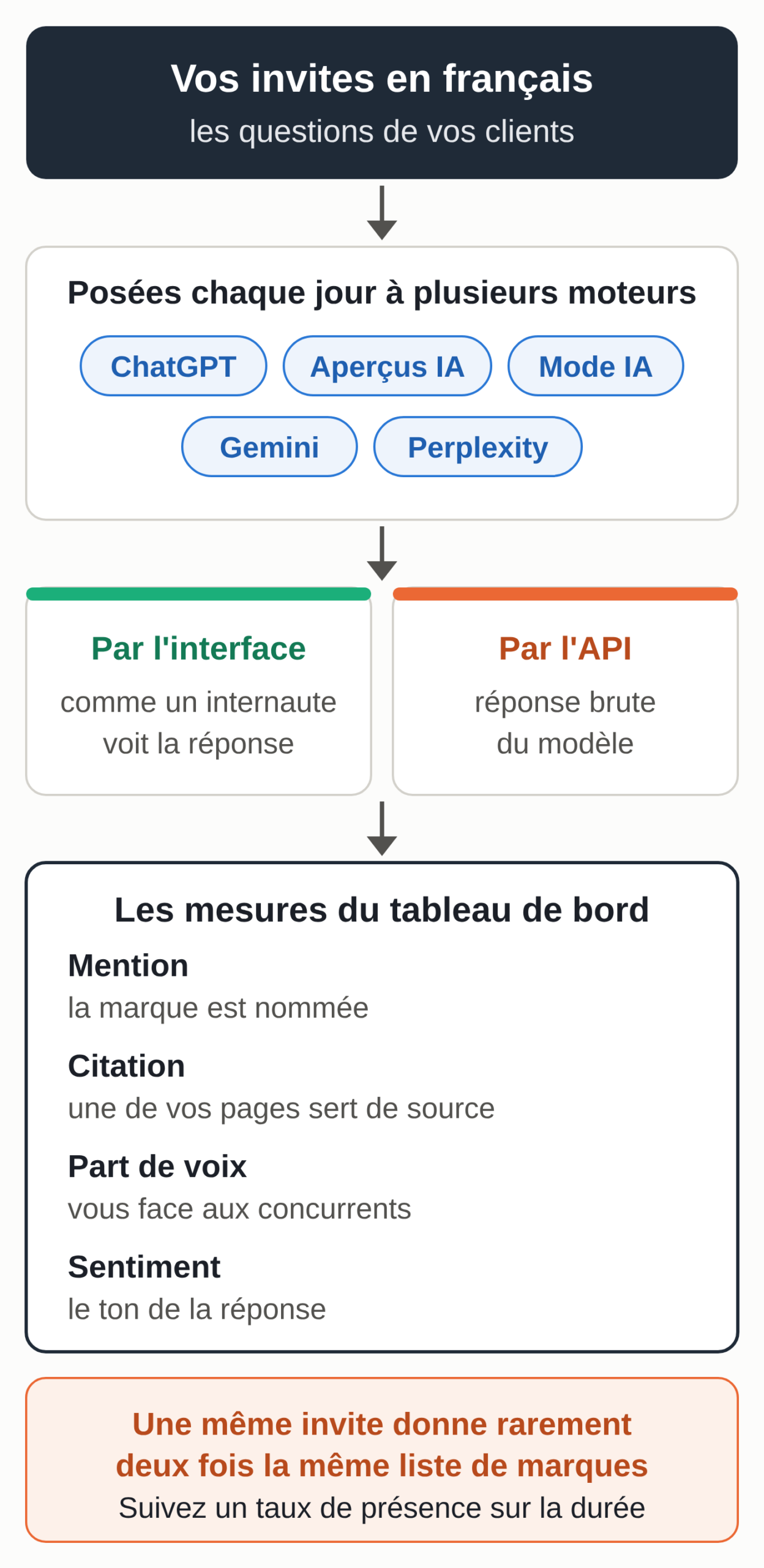
The principle is the same everywhere. You enter a list of prompts, meaning the questions your customers would ask an assistant: “which POS software for a bakery in Lille?” The tool sends them at regular intervals, usually once a day, to the engines you picked, then analyzes the answers.
A mention means the answer names your brand. A citation means the answer relies on a page from your site, with a link, even if your brand isn’t named. Peec AI explains the difference in its FAQ: a mention tells you whether the AI recommends you, a citation tells you whether it trusts your content.
Share of voice compares your presence rate with that of the competitors you have declared, on the same prompts. Most tools add a sentiment score (the tone of the answer about you) and the list of the most cited domains. That list helps you spot the sites where an article, a review or a listing would raise your chances of being picked up. If an answer confuses you with another company, our guide to entity SEO explains how to clear up the ambiguity.
Two collection methods coexist. The first reads the assistant’s public interface, the way a user would: SE Ranking describes “interface-based” tracking, and Qwairy states for each engine whether it goes through the interface, the API or both. The second queries the model through its API. An API answer doesn’t necessarily include the web search or the app’s layout, which can produce differences between two tools on the same prompt.
Limits to know before you pay
Assistants’ answers change from one run to the next. In January 2026, Rand Fishkin (SparkToro) and Patrick O’Donnell (Gumshoe.ai) published a study run with 600 volunteers: 12 brand recommendation prompts, submitted 2,961 times to ChatGPT, Claude and Google’s AI answers in November and December 2025.
For ChatGPT and Google, the probability of getting the same list of brands twice was less than 1 in 100. Getting the same list in the same order was closer to 1 in 1,000. Rand Fishkin draws a simple rule from this: a presence rate calculated over dozens of prompts run several times is a reasonable metric, a “position in AI” is not. Gumshoe.ai, where Patrick O’Donnell works, sells an AI visibility tracking tool itself: keep that in mind when you read the figures.
None of these tools sees users’ real conversations. They work on the prompts you give them or on modeled prompts. Ahrefs says each prompt in its index is modeled on real searches from its keyword database, and Peec AI rates the demand for each prompt from 1 to 5. These figures help you choose prompts; they remain estimates.
Language matters too. According to a study published by Peec AI in February 2026 covering more than 10 million prompts, ChatGPT adds searches in English in nearly 78% of conversations held in another language. French isn’t broken out, but the advice holds for a French-speaking brand: track prompts written in French, set to France or Belgium, and check which version of your pages gets cited.
If your site exists in several languages, treat each language as a separate project, with its own prompts. Our guide to multilingual website SEO details the URL structure by language.
How we checked this comparison
Each row of the two tables was recorded on October 10, 2026 from the primary source: the vendor’s pricing page, official documentation, the project’s GitHub repository, or an official announcement from Google or Microsoft. No account was created and no trial was started.
So this comparison checks what each tool offers and charges. It doesn’t measure how accurate each tool’s data is: that check requires a trial on your own prompts, and the protocol for running one is further down.
Prices are those displayed for a visitor located in France. Qwairy and Otterly.AI show them excluding VAT; the other vendors don’t say on their pricing pages. The only price published in dollars, for the hosted version of Elmo, is converted at the European Central Bank reference rate of October 9, 2026 (€1 = $1.1206) and rounded to the nearest euro. The tables are reviewed every quarter; the date of the last check appears above each one.
Semrush also sells an AI visibility toolkit. Its pricing page could not be accessed on the day of the check: since it couldn’t be verified at the source, it isn’t in the table.
Paid tools compared
Checked on October 10, 2026 on each vendor’s pricing pages and documentation. Prices displayed for a visitor located in France; Qwairy and Otterly.AI show them excluding VAT, the other vendors don’t specify.
| Tool | Listed entry price | Prompts at that price | Engines tracked | Countries and language | Trial | Export and API |
|---|---|---|---|---|---|---|
| Qwairy | €79/month, €65/month billed annually (Starter) | Up to 100, with 1,300 credits a month | ChatGPT, AI Overviews, AI Mode, Gemini, Claude, Perplexity, Copilot, Grok, Meta AI, Mistral and 8 others | More than 240 countries, more than 45 languages advertised | Free start, no credit card | CSV and PDF; API from Growth (€199/month) |
| Meteoria | €75/month (Starter) | 25 a day | 3 of your choice among ChatGPT, Perplexity, AI Overviews, AI Mode, Gemini, Grok, Copilot | Unlimited countries | One-week free trial | CSV and JSON, Google Analytics; Looker Studio on Advanced (€420/month) |
| Peec AI | €85/month (Starter, billed monthly); 15% off billed annually | 50 a day | 3 models of your choice; up to 13 on Enterprise | 1 country on Starter, 3 from Pro (€205/month); unlimited languages | Free trial offered, length not stated | CSV export on all plans; API from Pro (€205/month); Looker Studio on Advanced (€425/month) |
| Otterly.AI | €29/month (Lite), €25/month billed annually | 15 a day | ChatGPT, AI Overviews, Perplexity, Copilot; AI Mode, Gemini and Claude as add-ons | More than 50 countries | 7 days, no credit card | Reports and export; Looker Studio and API from Standard (€189/month) |
| SE Ranking | €109/month, €87.20 billed annually (Core); AI Search add-on €79/month, €63.20 billed annually | 100 a day (Core); 200 with the add-on | ChatGPT, AI Overviews, AI Mode, Gemini, Perplexity | 42 countries including France and Belgium, prompt language set per project (SE Visible) | 14 days, no credit card, 20 prompts a day | API and MCP included (credits depend on the plan) |
| Ahrefs Brand Radar | From €47/month (custom prompts); €179/month (AI index) | Depends on checks: 1 check per prompt, engine, location and update (8 for Claude) | AI Overviews, AI Mode, ChatGPT, Perplexity, Gemini, Copilot; Claude available | Location set per prompt; language chosen when creating prompts | No trial; 5 prompts included in Ahrefs Lite, more on higher plans; sold on its own with a free Ahrefs account | Not verified on the page |
| Profound | Free trial; Enterprise plan on quote | 50 fixed prompts during the trial | Trial: ChatGPT, Gemini, AI Overviews; Enterprise: up to 9 engines | Trial: 1 language, 1 region | 7 days | Trial: none; Enterprise: CSV, JSON, API |
Method: each row comes from the vendor’s official page, read on the day of the check without creating an account; figures announced by the vendor (countries, languages) are reported as stated. The table is reviewed every quarter.
Each tool’s strengths and limits
Qwairy
Qwairy shows the widest coverage in the table: 18 engines and model families listed on its pricing page, from ChatGPT to Mistral by way of Claude, Copilot, Grok, Meta AI and Naver, more than 240 countries and more than 45 languages. The vendor describes itself as designed in France, with data hosted in the European Union.
Usage is counted in credits: 1,300 a month on the Starter plan, for up to 100 prompts. The pricing page offers a calculator to estimate your usage before you choose. The API only comes with the Growth plan, at €199 a month.
Meteoria
Meteoria gives you unlimited countries, seats and projects from the Starter plan, which matters for a brand active in France and Belgium. You pick three engines out of seven (ChatGPT, Perplexity, AI Overviews, AI Mode, Gemini, Grok and Copilot).
The Starter plan at €75 a month tracks 25 prompts a day, the Pro plan (€175) tracks 100. The FAQ lists CSV and JSON exports and a Google Analytics integration. Looker Studio, the risk report and AI crawler log analysis come with the Advanced plan (€420); the API and MCP are reserved for the custom-quote offer for companies and agencies.
Peec AI
Peec AI charges €85 a month for 50 prompts tracked daily on three models of your choice, with unlimited users. Its pricing page gives the volume formula: number of prompts multiplied by the number of active models and by the frequency.
The Starter plan tracks a single country. Tracking three countries and the API start with the Pro plan (€205 a month), the Looker Studio connector with the Advanced plan (€425 a month). CSV export is included from Starter. Peec AI also lists a library of answers that contain a sponsored placement, useful since ads arrived in ChatGPT.
Otterly.AI
Otterly.AI has the lowest entry price: €29 a month for 15 prompts on four included engines (ChatGPT, AI Overviews, Perplexity and Copilot). AI Mode, Gemini and Claude are paid add-ons, from €9 to €29 a month on the Lite plan.
Tracking is daily on every plan and team size is unlimited. The Looker Studio connector and API access come with the Standard plan (€189 a month). A 7-day trial with no credit card is available.
SE Ranking
SE Ranking builds AI answer tracking into its SEO tool: the Core plan (€109 a month, €87.20 billed annually) includes 100 prompts tracked daily. The AI Search add-on adds 200 prompts and access to SE Visible, the vendor’s dedicated platform, for €79 a month (€63.20 billed annually).
The SE Visible FAQ lists 42 countries, including France and Belgium, and one prompt language per project. It’s the logical choice if you already track your Google rankings in SE Ranking. A free checker, limited to five checks a day, is on the AI tracking page.
Ahrefs Brand Radar
Brand Radar works in two ways. Ahrefs’ AI index (€179 a month) queries a database of more than 470 million modeled prompts: it suits brands that already show up in answers. Custom prompts (from €47 a month) track the questions you define, including for a brand nobody searches for yet.
Usage is counted in “checks”: one check per prompt, per engine, per location and per update. Brand Radar is sold on its own, with a free Ahrefs account, and access to all engines with custom prompts is listed at €654 a month.
Profound
Profound targets large accounts: the Enterprise plan is on quote and tracks up to nine engines, including DeepSeek and Exa. The free trial lasts 7 days with 50 fixed prompts, chosen based on your industry and not editable, on ChatGPT, Gemini and AI Overviews.
The trial includes no export and no API, with a single language and a single region: it is mostly a way to try the interface. For a French-speaking small business, the other tools in the table allow a more useful test.
Free and open-source options
Checked on October 10, 2026 against official announcements from Google and Microsoft, OpenAI’s documentation and the projects’ GitHub repositories; dollar price converted at the ECB rate of October 9, 2026 (€1 = $1.1206).
| Option | Cost | Surfaces covered | Data provided | Limits |
|---|---|---|---|---|
| Google Search Console, generative AI performance reports | Free | AI Overviews, AI Mode, Discover | Impressions by page, country, device and date | Your pages only; no queries or clicks in the announced list |
| Bing Webmaster Tools, AI Performance (public preview) | Free | Copilot, Bing AI summaries, some partners | Citations, cited pages per day, a sample of the AI’s search queries, activity by page; since June 16, 2026, in preview: intents, topics, citation share per query, period comparison | No position or role of the page in the answer; no competitor named |
| Your analytics tool (Google Analytics 4 or other) | Free | Visits sent by assistants | Sessions from ChatGPT (parameter utm_source=chatgpt.com) and other assistants | Clicks only; nothing on answers with no click |
| Elmo (open source, MIT license) | Free if self-hosted; hosted version from $29, about €26/month (ChatGPT only, 50 prompts) | ChatGPT, AI Mode, AI Overviews, Gemini, Perplexity, Copilot, Claude, Grok, Mistral and others | Mentions, citations, share of voice | Docker Compose install; collection through scraping or APIs at your own cost |
| Gego (open source, GPL-3.0 license) | Free, excluding API costs | OpenAI, Anthropic, Google, Perplexity, Ollama, via API | Mentions, citations, keywords | API answers; PostgreSQL, MongoDB and etcd to run |
| Manual tracking sheet (template below) | Free | The engines you query yourself | Presence rate on your prompts | A few dozen prompts a month at most |
The two official reports are free: start with them. On June 3, 2026, Google announced generative AI performance reports in Search Console, then opened them to all sites on August 31, 2026. The announced report gives your pages’ impressions in AI Overviews and AI Mode, by page, country, device and date; the list includes no queries and no clicks.
Since February 10, 2026, Bing Webmaster Tools has offered an AI Performance report in public preview. It counts your site’s citations in Copilot, in Bing’s AI summaries and at some partners, with a sample of the queries the AI used to find your pages. Since June 16, 2026, Microsoft has added, in preview, a breakdown of those queries by intent and topic, your site’s citation share for each query and a comparison between two periods.
Your analytics tool then shows the resulting visits. In Google Analytics 4, our guide to AI traffic gives a regex that groups them into a channel. According to OpenAI’s FAQ for publishers, ChatGPT adds the utm_source=chatgpt.com parameter to the links it sends to websites. To appear in ChatGPT search, your site must let the OAI-SearchBot crawler through, says OpenAI’s page about its crawlers. Check this in your robots.txt file with our guide to AI crawlers and robots.txt. The llms.txt file, sometimes presented as a way to win citations, does not replace that setting.
The two open-source projects require a technical profile. Elmo installs with Docker Compose and stays free, but collecting answers goes through scraping services or model APIs, and you pay for those. Gego queries models only through their APIs and runs three components (PostgreSQL, MongoDB and etcd): it measures the model’s raw answer, which can differ from the one shown in the app.
Manual tracking, no subscription
A sheet kept by hand is enough for a first diagnosis. It’s limited to a few dozen prompts, and it answers the starting question: does your brand show up when a customer asks their question?
- Write twenty prompts in French, based on the templates below: eight discovery, six comparison, six about your brand.
- Choose three engines, for example ChatGPT, Google’s AI Overviews and Perplexity.
- Ask each prompt in a session with no history and no memory turned on, always the same one, once a week on the same day.
- Record each answer in the sheet, one row per prompt and per engine.
- After a month, calculate your presence rate per engine: the number of answers that name you divided by the number of answers.
Here is the sheet header, to paste into a spreadsheet (semicolon separator):
date;engine;prompt;prompt_type;country;brand_cited;page_cited;competitors_cited;sources_cited;note
2026-10-12;ChatGPT;which POS software for a bakery in Lille?;discovery;FR;no;;BrandA, BrandB;site-avis.fr, forum-boulangers.fr;answer as a list of 5
And some prompt templates, to adapt by replacing the brackets:
Discovery
- Which [type of product] should I choose for [specific need] in [country]?
- Who are the best [service providers] in [city] for [need]?
- How do I [solve a problem] when I'm [customer profile]?
- Which [tool] would you recommend to a small [industry] business?

Comparison
- [Your brand] or [competitor] for [use]: which one should I choose?
- What are the alternatives to [competitor] for [customer profile]?
- [Competitor A], [competitor B] or [your brand]: how do their prices differ?

Brand
- What do you think of [your brand]?
- Is [your brand] reliable for [use]?
- What are the reviews of [your brand] in [city or country]?
Testing two tools during their free trial
A free trial shows you the interface. To find out whether a tool is worth its price, make it work on your market, under the same conditions as its competitor. The protocol below is the one we recommend; it takes a week.
AI visibility tool test protocol (7 days)

1. Same prompts: the 20 prompts from your manual sheet, in French.
2. Same brands: yours and two direct competitors, spelled the same way everywhere.
3. Same settings: country France or Belgium, French language, same engines
   (at least ChatGPT, AI Overviews and Perplexity).
4. Same period: two tools started on the same day, for 7 days.
5. Manual check: each day, ask 5 of the prompts yourself and note whether the
   brand is cited; compare with what each tool shows for that day.
6. Final readout, for each tool:
   - your brand's presence rate per engine;
   - agreement rate with your manual checks;
   - most frequently cited sources;
   - whether raw answers can be exported (CSV or API);
   - price per 1,000 answers analyzed.
7. Decision: the tool closest to your manual checks, at the lowest price per
   answer, for the number of prompts you need.
Comparing plans by number of answers analyzed
Vendors don’t all count the same way: prompts, credits, checks. The figure that lets you compare is the number of answers analyzed per month, which you get by multiplying prompts by engines and by the number of runs.
With the published figures and one run a day over 30 days, Peec AI’s Starter plan gives 50 prompts × 3 models × 30 days, or 4,500 answers for €85, about €19 per 1,000 answers. Meteoria’s Starter plan gives 25 × 3 × 30, or 2,250 answers for €75, about €33 per 1,000. Otterly.AI’s Lite plan gives 15 × 4 × 30, or 1,800 answers for €29, about €16 per 1,000.
This price per answer lets you compare plans that count differently: 50 prompts at one vendor and 100 at another don’t cover the same number of engines or runs. The quality of the analysis is judged during the trial, with the protocol above.
Which tool for which profile?
For a freelancer or a very small business, Search Console, Bing Webmaster Tools and the manual sheet are enough for the first few months. If the sheet shows that your competitors are cited and you aren’t, an entry-level subscription (Otterly.AI Lite, Meteoria or Qwairy Starter) lets you track the effect of your fixes. Also look at which pages are cited as sources: when they are Reddit threads, our guide to Reddit for brands explains how to take part without losing your account.
For a small business with one person in charge of marketing, Qwairy, Meteoria and Peec AI cover the essentials for €75 to €85 a month: prompts in French, source analysis, data export. Test two of them with the protocol above and keep the one that agrees best with your manual checks.
For an agency, the number of client workspaces and shareable reports matter more than the entry price. Qwairy (5 workspaces on Growth, 20 on Business), SE Ranking with its AI Search add-on and Peec AI with its agency plan are the natural candidates. A technical team can also self-host Elmo and pay only for collection.
If you already pay for Ahrefs or SE Ranking, start with their AI module before adding yet another tool. Your keywords, competitors and reports are already there.
Your site in several languages
Tracking measures your visibility. To get cited, you then need up-to-date pages that crawlers can read, in every language you sell in. If your site needs to exist in several languages, with its performance tracked language by language, see our multilingual SEO service.