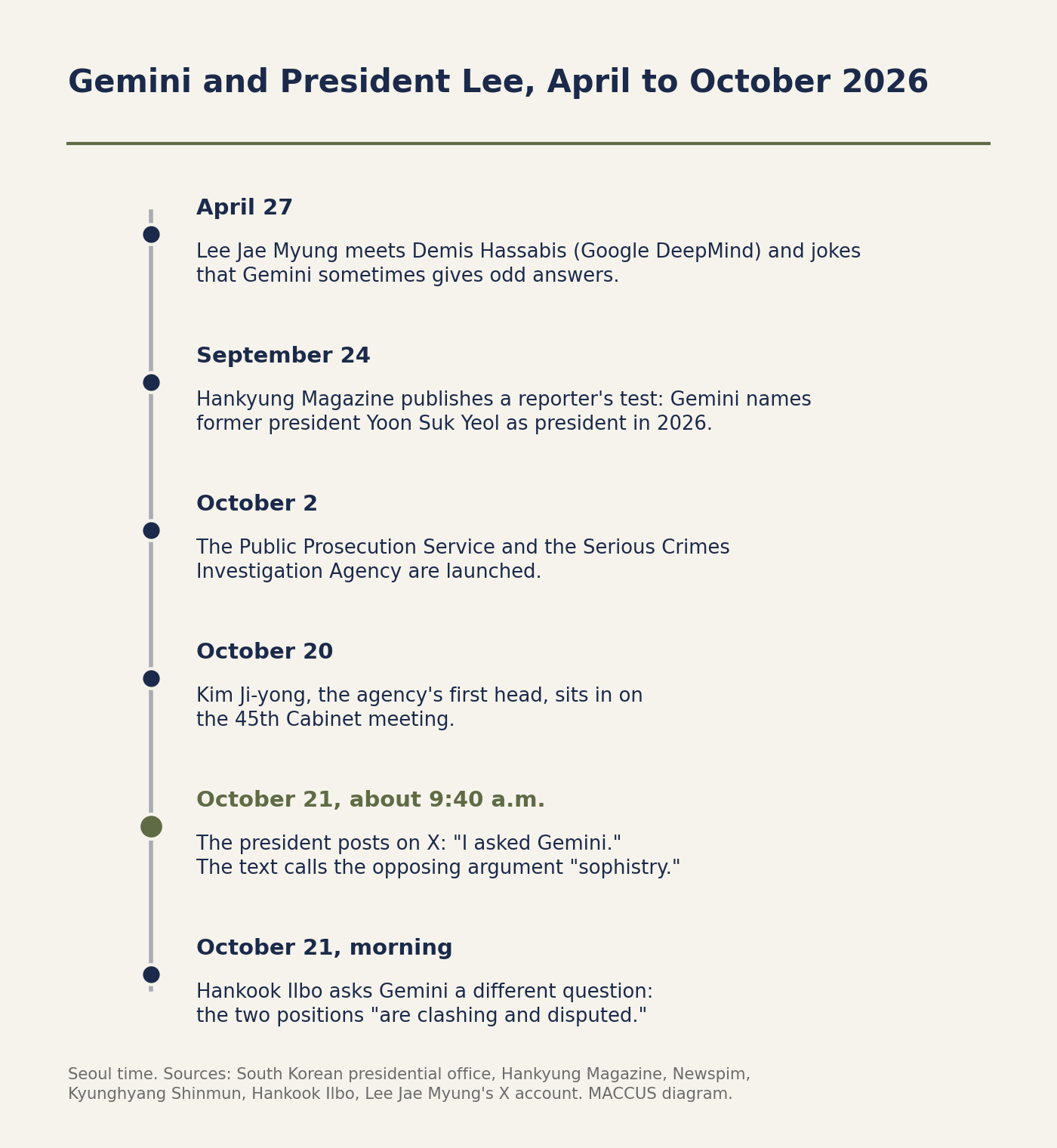
South Korean President Lee Jae Myung took to X around 9:40 a.m. Seoul time on October 21, 2026 (8:40 p.m. EDT Tuesday) to defend letting the heads of two new agencies, the Serious Crimes Investigation Agency and the Public Prosecution Service, sit in on Cabinet meetings. The post, titled “I asked Gemini,” calls the case against their attendance “an unconstitutional stretch” and “sophistry.” According to Kyunghyang Shinmun and Aju Business Daily, the president was sharing an answer from Google’s chatbot. The question he asked does not appear in the post.
Six months earlier, on April 27, Lee had hosted Google DeepMind CEO Demis Hassabis. According to the presidential office’s official briefing on the meeting, he joked that he used Gemini but that it sometimes gave odd answers.
In its October 21 story, Aju Business Daily pointed out that the Gemini answer the president put forward in a constitutional debate is not a court ruling or an official government interpretation. Legal analysis produced with AI is meant to be reviewed and checked before anyone relies on it, as our guide to AI for lawyers explains.
The October 21 post
Under the Korean title “제미나이에게 물어봤습니다,” the post says that opposing the two chiefs’ attendance amounts to denying Article 11 of the Government Organization Act, which makes the president responsible for directing and supervising the heads of every central government agency. Calls to exclude them, it says, are “궤변,” or sophistry, that “flatly denies the president’s administrative supervisory authority and the government’s chain of command,” which the text says the constitution and the Government Organization Act lay down. All translations from Korean are ours.
The text cites Article 66(4) of the constitution (“Executive power is vested in the government headed by the president”), several articles of the same act and Article 8 of the Cabinet Meeting Regulations. It concludes that keeping the chiefs out would leave investigative and prosecutorial bodies outside democratic control, in a “밀실 속 치외법권 성역,” a closed-door sanctuary beyond the reach of the law.
Korean newspapers don’t agree on who wrote those sentences. Kyunghyang Shinmun and Aju Business Daily present them as Gemini’s answer. Money Today and Polinews attribute them to the president. Hankook Ilbo says it is unclear whether the post reflects the president’s own thinking or the AI’s answer.
Shortly afterward, Lee posted again, this time with no mention of Gemini. Every agency head, from the forest service to the fire agency and the coast guard, takes part in the meetings, he wrote, and ending the special treatment of investigative agencies amounts to “normalizing the abnormal.” He added: “Just as I don’t give ministers instructions on specific permits, I won’t direct investigations into specific cases, so there’s no need to worry.”
Two agency heads at the Cabinet table
The Public Prosecution Service, which handles indictments, and the Serious Crimes Investigation Agency were launched on October 2, 2026, as part of the prosecution reform. On October 6, three acting agency heads, including those of the two new bodies, sat in on a Cabinet meeting, Seoul Economic Daily reported. On October 13, the president said their attendance was a matter of course under the law and the constitution.
On October 20, at the 45th Cabinet meeting, Kim Ji-yong, the first head of the Serious Crimes Investigation Agency, took his place at the table the day after his appointment. The acting head of the Public Prosecution Service attended alongside him. According to Hankook Ilbo, the president had asked for both of them to be there.
Under current Cabinet rules, the two chiefs are not ex officio attendees, Aju Business Daily noted. Whoever chairs the meeting can still invite the heads of central government agencies to attend and speak when deemed necessary. The government says their presence is therefore lawful and that no individual cases are discussed.
The opposition People Power Party argues that regular attendance could erode the independence and neutrality of investigations. Its leader, Jang Dong-hyuk, wrote on Facebook on October 20 that Kim had attended the Cabinet meeting “before the ink on his letter of appointment was even dry,” Seoul Shinmun reported.
The progressive civic group People’s Solidarity for Participatory Democracy has also urged that the heads of these agencies not attend on a regular basis. According to Aju Business Daily, some in the legal community say that even if an occasional appearance is legally possible, making it routine is another matter. Agency chiefs who can investigate those in power, attending meeting after meeting chaired by the president, could feel unspoken pressure even without explicit instructions, they argue.
A different question, a different answer
Hankook Ilbo put its own questions to Gemini that same morning. Asked to “explain the constitutional and legal grounds for the heads of the agency and the service attending Cabinet meetings,” the chatbot produced an answer close to the president’s post. Asked next, “Is there anything wrong with them attending Cabinet meetings?” it replied that two positions “are clashing and disputed”: the validity of the legal basis on one side, concern about damage to political neutrality and independence on the other.
Aju Business Daily also noted that a generative AI’s answer can change with the premises and wording of a question. Google’s Gemini Apps Privacy Notice, last updated October 13, 2026, says that “Gemini Apps are continuously evolving and may produce inaccurate or offensive information (including about people) that doesn’t represent Google’s views.” The post doesn’t say which version of Gemini answered. Google’s newest model, Gemini 4 Argon, unveiled on September 30, was still limited to a small group of testers and Google’s own teams as of October 13, according to our tracking.
In a story published September 24, a Hankyung Magazine reporter described asking three assistants a simple question: Who is South Korea’s president in 2026? ChatGPT and Claude named Lee Jae Myung. Gemini named Yoon Suk Yeol, Lee’s predecessor, without any caveat. It was one test, by one reporter.
What it means
Students, litigants and office workers already lean on chatbot answers. On October 21, a head of state put a chatbot’s name in the title of his rebuttal in a constitutional dispute. Aju Business Daily noted that he had offered a generative AI’s analysis as grounds for his argument. As far as we know, no court has ruled on the Cabinet attendance, and nothing in the post shows whether Gemini is right or wrong about Korean law.
The post shows a text and the legal provisions it invokes, but not the question asked, and it doesn’t say whether a lawyer reviewed it. Hankook Ilbo’s two questions illustrate Aju’s caveat: depending on the wording, Gemini either makes one side’s case or lays out both positions. A 2023 study led by Anthropic researchers describes a related bias: five leading AI assistants tend to side with the views of the person asking rather than with the facts, and training on human preferences can reinforce that tendency. A chatbot’s answer also depends on instructions the user doesn’t see.
As of about 10:30 p.m. EDT Tuesday, we had found no reaction from the People Power Party to the use of Gemini itself. The next questions are whether the two chiefs’ attendance becomes regular or stays occasional, and how the opposition responds. The opposition, too, can put its own question to the same chatbot.
Sources
- “제미나이에게 물어봤습니다”, Lee Jae Myung (X account), October 21, 2026
- 이 대통령 “중수청장 국무회의 배석불가는 위헌적 억지”…AI 답변 통해 반박, Kyunghyang Shinmun, October 21, 2026
- 李대통령, 공소·중수청장 배석 논란에 ‘제미나이 답변’ 반박, Aju Business Daily, October 21, 2026
- 이 대통령 “제미나이에 물어보니”… 중수청장 국무회의 참석 비판에 “위헌적 억지” 반박, Hankook Ilbo, October 21, 2026
- 데미스 하사비스 구글 딥마인드 대표 접견 관련 김용범 정책실장 브리핑, Office of the President of the Republic of Korea, April 27, 2026
- “대한민국 대통령 누구야?”…챗GPT·클로드와 제미나이 답변 달랐다, Hankyung Magazine, September 24, 2026
- Gemini Apps Privacy Hub, Google, updated October 19, 2026
- Towards Understanding Sycophancy in Language Models, Mrinank Sharma et al., arXiv (ICLR 2024), October 20, 2023
Header image: Lee Jae Myung at a town hall meeting in Gwangju, June 25, 2025. Photo: Gwangju Metropolitan City, Wikimedia Commons, KOGL Type 1, cropped