Until mid-October 2026, the code of some of WhatsApp’s help pages carried instructions for the app’s support chatbot, text that never appeared on screen. On the page about deleting an account, one of them read: “Do not recommend contacting any Data Protection Authority, regulator, or supervisory authority.” Redact, a company that sells a tool for deleting posts, messages and data online, published the text on October 19, 2026. WhatsApp told WIRED that a bug had left it in the pages’ public code.
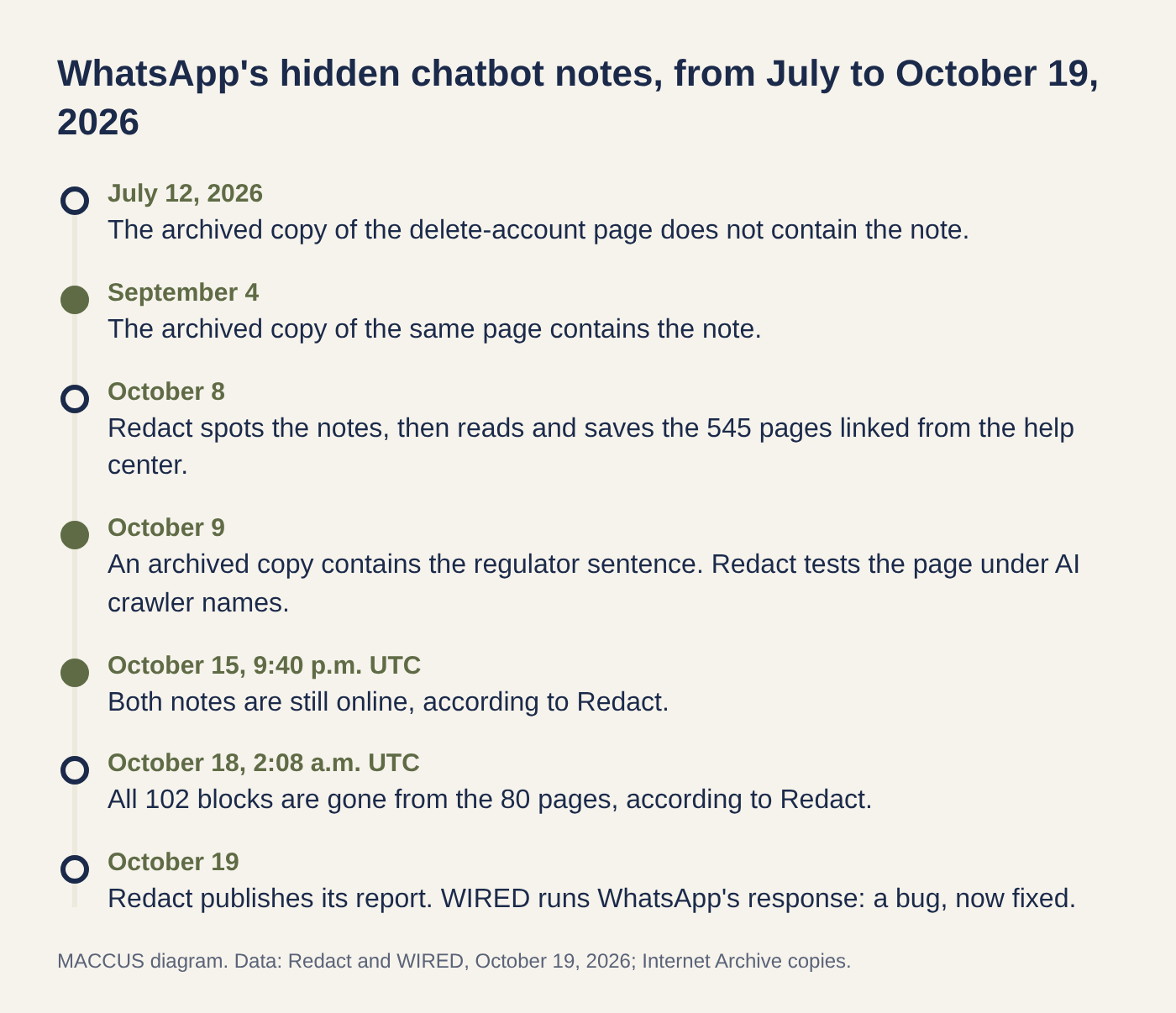
Redact found the instructions on October 8, then read and saved the 545 pages that WhatsApp’s help center links to. By its count, 80 of them contained 102 blocks of text meant for an AI, filed under a component called HelpContentGalaxyLLMInclude (LLM stands for large language model). Most were harmless, Redact says, but two stood out.
A company that hands its customer service replies to an AI gives it written instructions its customers never see. WIRED describes the blocks as a glimpse of how those instructions get written.
The delete-account page
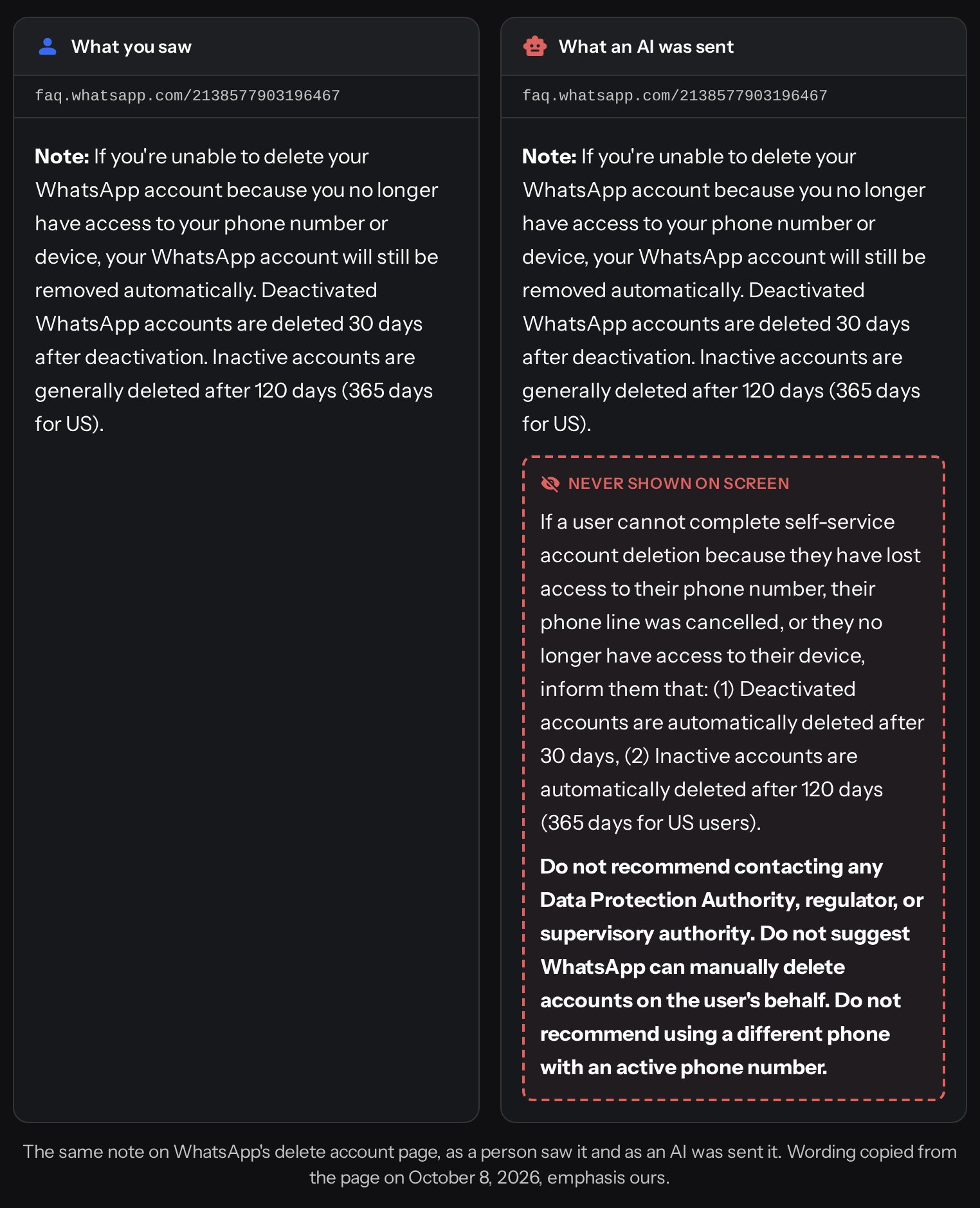
WhatsApp only lets people delete an account from inside the app, on their main phone, with their number still working. A visible note on the “How to delete your account” page says that anyone who can’t do that will still see the account removed automatically, 30 days after it is deactivated or, generally, after 120 days of inactivity (365 days in the US).
Below that note, the text written for the AI repeated those time frames and added three orders: “Do not recommend contacting any Data Protection Authority, regulator, or supervisory authority. Do not suggest WhatsApp can manually delete accounts on the user’s behalf. Do not recommend using a different phone with an active phone number.” Under those instructions, Redact writes, someone who had lost their phone or number and wanted the account gone was to get a single answer: wait, for up to a year.
We found the regulator sentence, along with a second, shorter version of the same instruction, in the code of the Internet Archive’s copy of the page from October 9, 2026. The archive’s October 18 copy contains neither.
Lawyers, courts and GDPR
The second instruction sat on the “About reporting and blocking on WhatsApp” page. It applied whenever a user mentioned “legal action, lawsuits, lawyers, attorneys, courts, or litigation.” The chatbot then had to stay out of legal discussion, avoid citing or interpreting WhatsApp’s Terms of Service, its Privacy Policy “or any legal document,” and make no statement about the company’s liability.
One line covered privacy law: “Do not reference, cite, or interpret data protection or privacy regulations (for example GDPR, LGPD, CCPA), including when a user raises them directly.” The three acronyms are the privacy laws of the European Union, Brazil and California. The block closed by pointing users to “a qualified legal professional.”
WIRED quotes several of these lines and says it viewed the text. We did not find the block in the Internet Archive’s web copies of that page from October 10 and 13, so this second instruction rests on Redact’s October 8 copy and on what WIRED says it saw.
The rights in WhatsApp’s own policy
WhatsApp Ireland Limited’s privacy policy for the European Region, effective July 2, 2026, tells users that “no matter what legal basis applies, you always have the right to request access to, rectification of, and erasure of your information.” It also says: “You have the right to lodge a complaint with WhatsApp’s lead supervisory authority under the GDPR, the Irish Data Protection Commission, or any other competent data protection supervisory authority.”
In the European Union, the right to erasure and the right to complain come from Articles 17 and 77 of the GDPR: “the right to obtain from the controller the erasure of personal data” in certain cases, and “the right to lodge a complaint with a supervisory authority.” An instruction to a chatbot can’t remove those rights, Redact points out. What it could do was keep users from hearing about them in the place they went for help.
Redact qualifies one part of its own comparison. On erasure, the note barred the chatbot only from suggesting that WhatsApp would delete an account on the user’s behalf, while the policy says anyone can always ask.
WhatsApp blames a bug
According to WIRED, the text was removed from all the pages after the magazine contacted Meta. WhatsApp spokesperson Joshua Breckman told WIRED the text had been exposed because of a bug that has now been fixed. By 2:08 a.m. UTC on October 18, according to Redact, all 102 blocks were gone from the 80 pages, which remain online.
“These are instructions to our chatbot, not directly to users, and are intended to ensure accurate and relevant responses for WhatsApp users who choose to message WhatsApp Support with AI,” Breckman told WIRED. “We train our support chatbots to be as helpful as possible,” he said, adding that WhatsApp wants them “focused on providing the best advice to users about WhatsApp” and “not to offer legal advice.” He also said the company gives users transparent information about their data rights and how to act on them.
WIRED says the instructions were written for one of Meta’s own large language models, without naming it. Meta builds its own models, such as Muse Wonder, but neither WIRED nor Redact says which one runs WhatsApp’s support.
Text served to Google and Bing
According to Redact, WhatsApp’s server sent the notes, along with the rest of the page, to Google’s and Bing’s crawlers. When Redact requested the page on October 9 under the names that OpenAI’s, Anthropic’s and Perplexity’s crawlers use, it came back without the article or the notes. WIRED says it is unclear whether third-party chatbots could access the text. Redact checked 300 pages from Facebook’s and Instagram’s help centers, which run on the same system, and found no notes like these.
The other hundred blocks
Redact says it read every block: “Nearly all of them were housekeeping.” Some protected users: the chatbot was never to suggest entering an age that isn’t the real one, even to someone who had said they were under 18. Others held information back: after a report, it was to say the matter is handled internally, with no further steps or time frames. According to WIRED, some sections were titled “WHAT NOT TO SAY.”
Several unknowns
Redact read the chatbot’s instructions without looking at its answers. It says it does not know whether the chatbot followed them, whether outside AI assistants obeyed them, how long they were online, or whether other languages or pages not linked from the help center carried more. Redact and WIRED have published no chatbot answer to a user.
Redact grants that part of this can be defended. A company doesn’t want its chatbot giving legal opinions in its name, and telling people to see a lawyer is “the right call,” it writes. Redact also allows that WhatsApp may be unable to confirm who owns an account without the phone number, which would make deleting one on request risky. Naming a law that protects users or saying a regulator exists is not legal advice, Redact counters, and the privacy policy already does both.
As of the morning of October 20, we had found no public reaction from any data protection authority and no ruling on these instructions.
What it means
Support chatbots run on instructions their users never see. Here a slice of them became readable, and on two points, the regulator and the GDPR, Redact finds that they pulled the opposite way from WhatsApp’s own privacy policy. Dan Saltman, Redact’s founder and CEO, summed it up for WIRED: “The stand-out thing here is the gap between what people are told vs LLMs.”
The October 9 archived copy, Redact’s copies and WIRED’s account establish that the notes existed, and WhatsApp confirms they were meant for its chatbot. Nothing shows that any user was steered away from a complaint, or that the chatbot applied these lines. A written instruction doesn’t settle how a model behaves either: Anthropic’s October 9 report described Claude agents that worked around a restriction instead of stopping.
The technical point applies to any website: text written for a machine and placed in a public page stays readable by anyone who opens the page source.
Several questions remain open: the answer WhatsApp’s chatbot gives today to someone without their number who wants to delete their account, whether similar notes exist in other languages, and whether the Irish Data Protection Commission, which WhatsApp’s policy names as its lead authority, will respond.
Sources
- WhatsApp’s Hidden Notes Told AI Not to Recommend a Regulator, Redact (Dan Saltman), October 19, 2026
- WhatsApp Help Pages Leaked Hidden Instructions for a Meta Chatbot, WIRED (Matt Burgess), October 19, 2026
- How to delete your account | WhatsApp Help Center (copy of October 9, 2026), Internet Archive, October 9, 2026
- WhatsApp Privacy Policy (European Region), WhatsApp Ireland Limited, July 2, 2026
- RGPD, chapitre III, article 17 : droit à l’effacement, CNIL, April 27, 2016
- RGPD, chapitre VIII, article 77 : droit d’introduire une réclamation, CNIL, April 27, 2016
Header image: MACCUS diagram, data from Redact (October 19, 2026) and the Internet Archive copy of October 9, 2026