
Spotify has taken more than 50 million tracks it calls “slop and spam” out of its listeners’ recommendations this year, the company said on October 20. The tracks remain on the service, according to Variety, but a listener now has to seek them out to hear them.
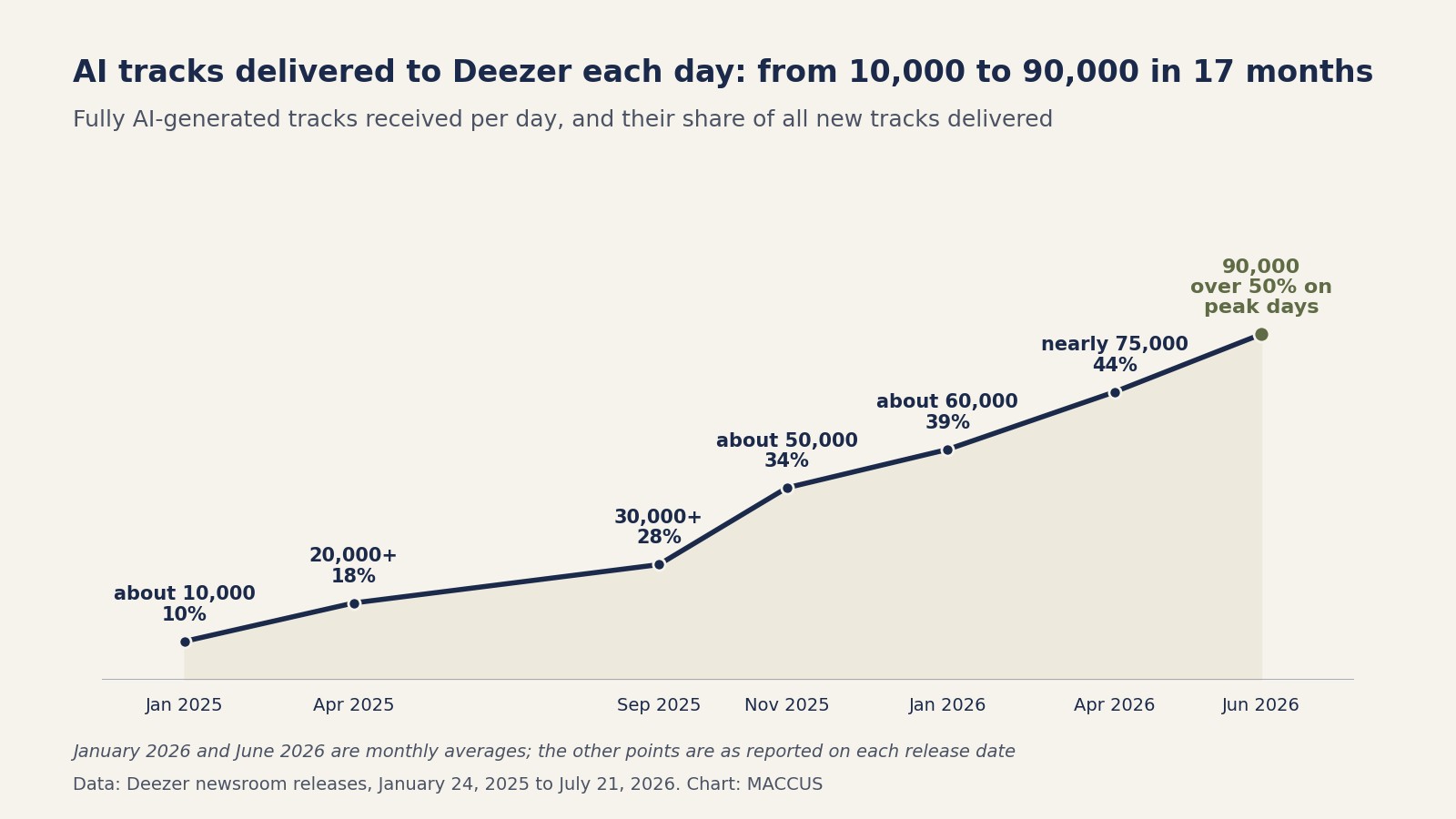
Deezer, the Paris-based streaming service, has published its count of AI uploads since January 2025. It says it now receives nearly 90,000 fully AI-generated tracks a day, up from about 10,000 when it started counting, and that on peak days in June they made up more than half of all new music delivered to it.
Within eight days, three services set out how they now handle that flow. On October 13, Deezer announced a switch that hides AI-generated music from search. YouTube Music started labeling songs “created primarily using generative AI” the next day, and on October 20 Spotify reported on changes it made over the past six months. None of the three announcements takes AI music off the service.
Fifty million tracks out of Spotify’s recommendations
Spotify’s post, titled “One Year In: Putting Human Artistry First on Spotify,” describes the method. Earlier this year the company looked at the tracks listeners were “skipping, ignoring, or telling us they didn’t want to hear” and found they were “consistently ones identified as slop or spam.” Over the past six months it made “numerous updates” to its recommendation system, and its editors do not program content identified as slop or spam. Spotify says it has since seen “a marked decrease in listener concerns.”
Slop is the common term for generic, mass-produced AI content, the kind LinkedIn now screens with its own AI slop detector. Spotify does not say how many of its 50 million tracks were made with AI. To flag them, it combines listener engagement and feedback, upload patterns, metadata and “multiple third-party AI detection tools.”
The 50 million come on top of the more than 75 million “spammy tracks” Spotify says it has removed from the platform altogether for serious or repeated violations. That is the figure Spotify gave in September 2025 for the previous 12 months.
The post also lists other tools. Thousands of artist profiles now carry an AI Persona label and are kept out of editorial and algorithmic recommendations by default, unless a listener follows one. Spotify says it is the only major service labeling artist identities believed to be AI-generated.
More than 300,000 artists, who account for more than 99% of what listeners search for, are verified, and more than 70% of them are independent. Under Spotify’s 1,000-stream royalty threshold, in place since 2024, tracks with a high probability of being AI-generated are 10 times more likely to fall short, the company says.
From 10,000 to 90,000 AI tracks a day
Deezer’s own releases trace the curve. In January 2025, when it launched its detection tool, it counted about 10,000 fully AI-generated tracks delivered each day, roughly 10% of the total. The count passed 20,000 (18%) in April 2025 and 30,000 (28%) in September. It reached about 50,000 (34%) in November and averaged about 60,000 (39%) in January 2026.
By April it was close to 75,000 a day, about 44% of deliveries and more than 2 million tracks a month. In June the monthly average reached 90,000 a day, nine times the January 2025 count, and on peak days AI tracks passed half of all new music uploaded.
Deezer says its detector recognizes the most prolific generators, such as Suno and Udio. In Fortune’s description, Suno can produce “remarkably convincing songs in seconds” from a simple text prompt. The company raised $400 million at a $5.4 billion valuation in June, and Fortune reported, citing fundraising materials obtained by Billboard, that its users were generating more than 7 million songs a day at the time.
Deezer’s switch and YouTube’s labels
Deezer already keeps detected AI tracks out of its algorithmic and editorial recommendations: more than 42 million of them between January 2025 and August 2026, it says, with more than 14 million albums tagged since June 2025. The switch announced on October 13 goes one step further. Once a listener turns it on, AI-generated tracks, albums and the related artists drop out of search results, and turning it off brings them back. Deezer plans to roll it out worldwide before the end of 2026.
“We’ve seen a clear user demand for the ability to filter out AI-generated music,” said Alexis Lanternier, Deezer’s chief executive. In a Deezer and Ipsos survey from November 2025, 45% of music streaming users said they would like to filter out fully AI-generated music. The switch covers music made entirely with generative AI; Deezer says tracks with limited AI-assisted elements are treated differently.
YouTube Music chose labels. Since October 14, it has been rolling out a label on the player page for songs “created primarily using generative AI,” for example when a generative model created “the composition and vocals.” The labels are coming to the main YouTube app as well. YouTube says it works with music partners and uses its own detection tools, and that “our listeners have told us they want transparency.”
Two other services went further. According to TechCrunch, Bandcamp has banned AI tracks, and Tidal cut off monetization for AI uploads.
Half the uploads on peak days, 1 to 3% of the listening
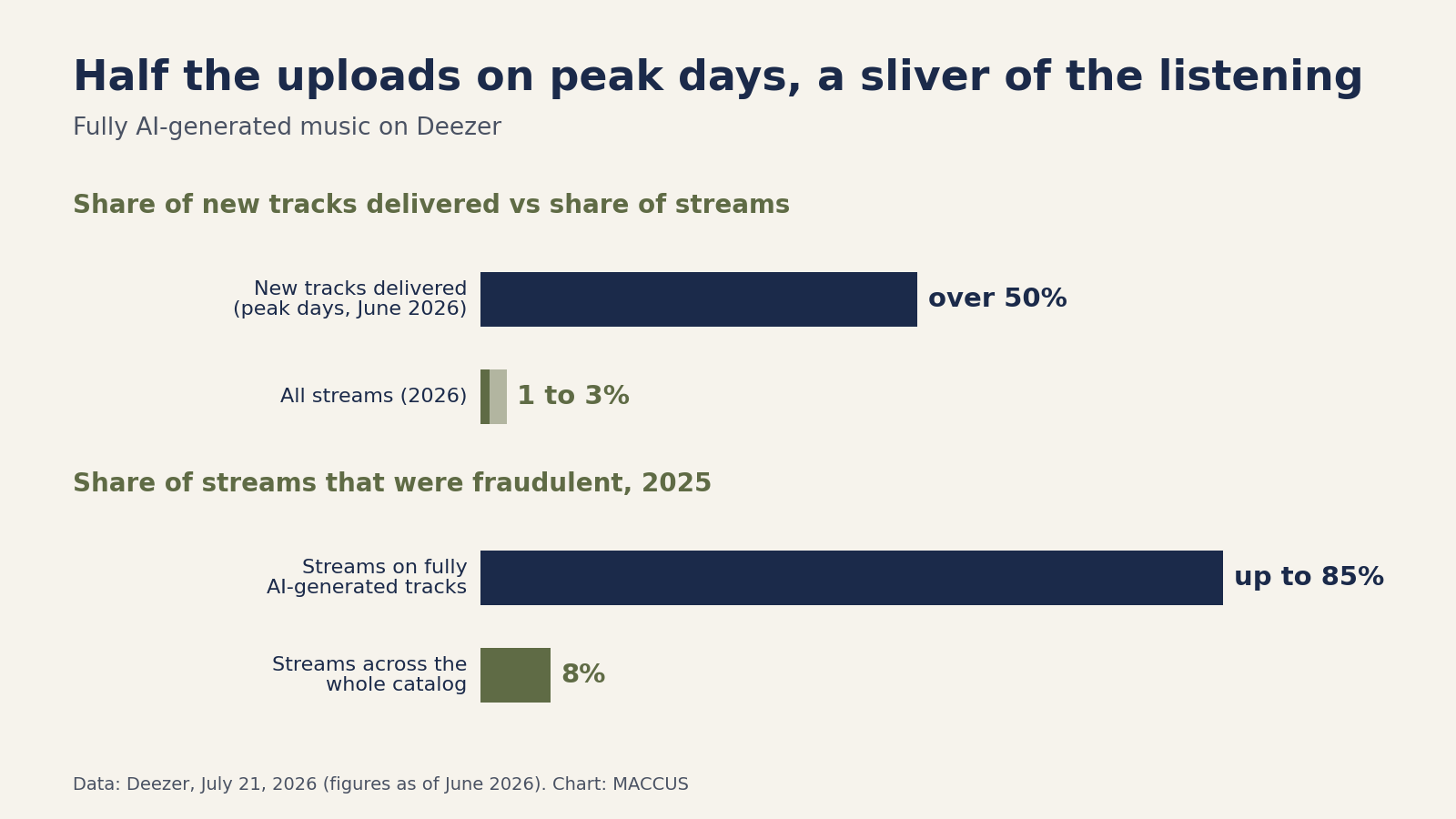
On Deezer, those uploads get few plays. Fully AI-generated music accounts for 1 to 3% of streams there, and Deezer found that up to 85% of the streams those tracks drew in 2025 were fraudulent, against 8% across its whole catalog. It strips the fraudulent streams from royalty payments, and in July it said it would also take down AI tracks used for streaming fraud and those not streamed for six months or more.
In the Deezer and Ipsos poll of 9,000 people in eight countries, 97% could not tell fully AI-generated music from human-made music in a blind test of two AI songs and one human song. In the same survey, 80% said such music should be clearly labeled, 52% said it should stay out of the main charts, and 66% of streaming users said they would listen to it at least once out of curiosity.
The cost to musicians is a projection for now. A study by CISAC, the international confederation of authors’ societies, and PMP Strategy estimates that AI-generated music could put 24% of music creators’ revenues at risk in 2028, an annual loss of €4 billion.
The platform figures in this story come from the companies themselves, and none of the releases cites an independent audit. Spotify does not separate AI from spam inside its 50 million, and the 99.8% accuracy Deezer claims for its detector, with fewer than one false flag per 10,000 human tracks, is Deezer’s own figure. Spotify writes that AI detection “has limitations, and it will only get harder as generative AI evolves.” Digital Music News noted that deciding what was “created primarily” with AI “could prove challenging” as adoption grows.
What it means
Making a finished song now takes a text prompt and a few seconds, and Deezer’s count shows the effect on supply, with nine times as many AI tracks a day as 17 months earlier. Code is going the same way: one AI tool signed more than ten million public GitHub commits in September, almost all in projects hardly anyone watches.
Spotify drew the line in its recommendations, Deezer with a switch and YouTube with a label. All three still carry AI music. In a blind test, 97% of Deezer’s panel could not pick out the AI songs; who will decide what gets played, the listener, the rights holder or the recommendation system, is still open. Questions about AI authorship have reached restaurant guides too, after a Dallas magazine said AI wrote most or all of Michelin’s new Dallas reviews, which Michelin denies.
Two dates are set. Deezer’s switch is due worldwide before the end of 2026, and Spotify says its Artist Profile Protection tool, which lets artists review releases filed under their name, opens to all artists by the end of the year. YouTube’s labels are heading to the main YouTube app, and its announcement does not say whether a label will change how a song is recommended or paid.
Sources
- One Year In: Putting Human Artistry First on Spotify, Spotify, October 20, 2026
- Spotify Has Removed 50 Million AI Slop Tracks From Recommendations This Year, Variety, October 20, 2026
- Deezer will let you fully exclude AI-generated music from your streaming experience, Deezer, October 13, 2026
- YouTube Music adds new labels for AI music, YouTube Official Blog, October 14, 2026
- Deezer: AI music has surpassed 50% of new music uploads for the first time, Deezer, July 21, 2026
- Deezer deploys cutting-edge AI detection tool for music streaming, Deezer, January 24, 2025
- Deezer and Ipsos study: AI fools 97% of listeners, Deezer, November 12, 2025
Header image: chart by MACCUS, data from Deezer newsroom releases (January 24, 2025 to July 21, 2026)